
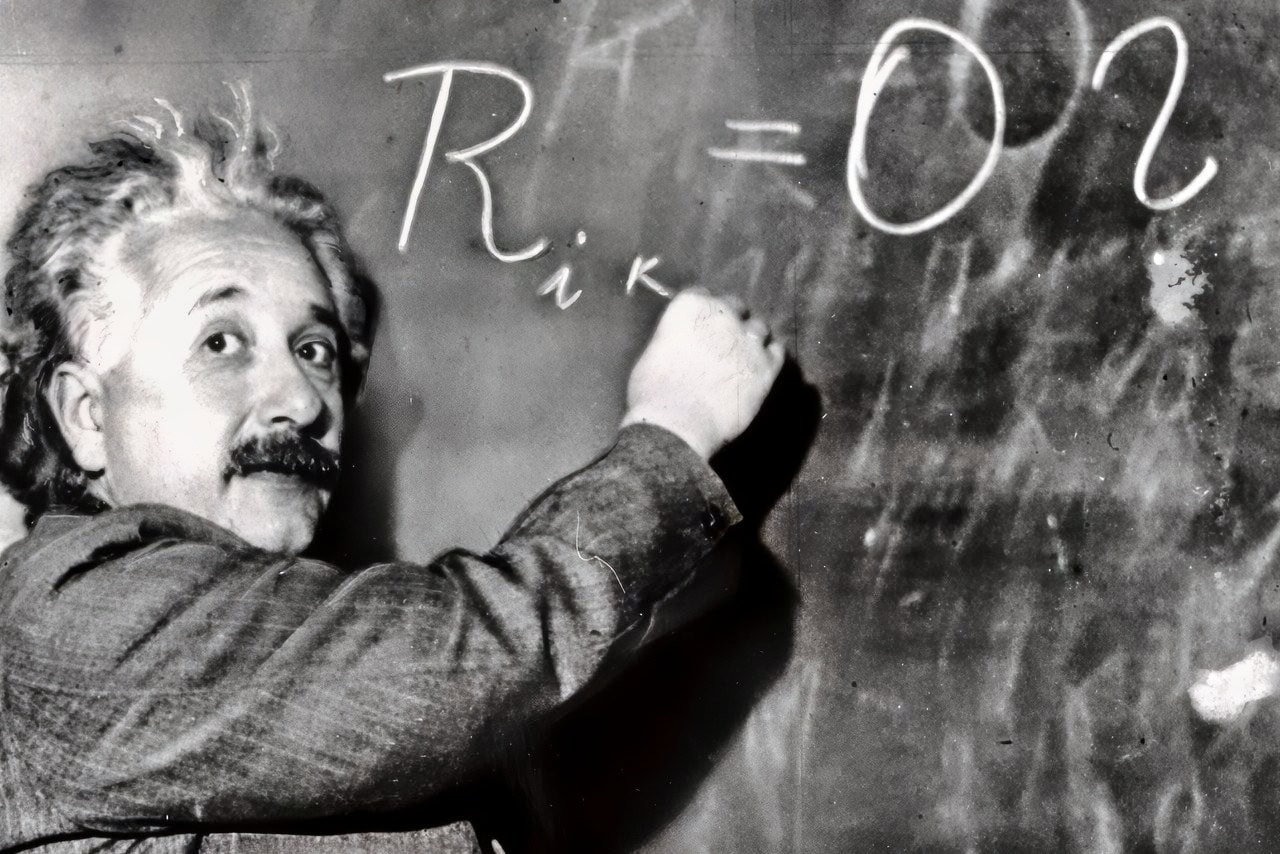
Albert Einstein Changed Physics and Spent His Final Years Warning About Nuclear War: “I know not with what weapons World War III will be fought, but World War IV will be fought with sticks and stones.” The line is among the most famous quotes associated with Albert Einstein. The exact wording is less secure than the attribution suggests. A 1949 interview in Liberal Judaism recorded him answering, “I don’t know. But I can tell you what they’ll use in the fourth—rocks!” Similar versions had circulated earlier, making the familiar sentence a polished variant of an idea he expressed.
The warning still fits Einstein’s public life. He first changed humanity’s understanding of light, motion, gravity, space, and time. He later confronted what scientific knowledge meant once governments learned to release energy from the atom.
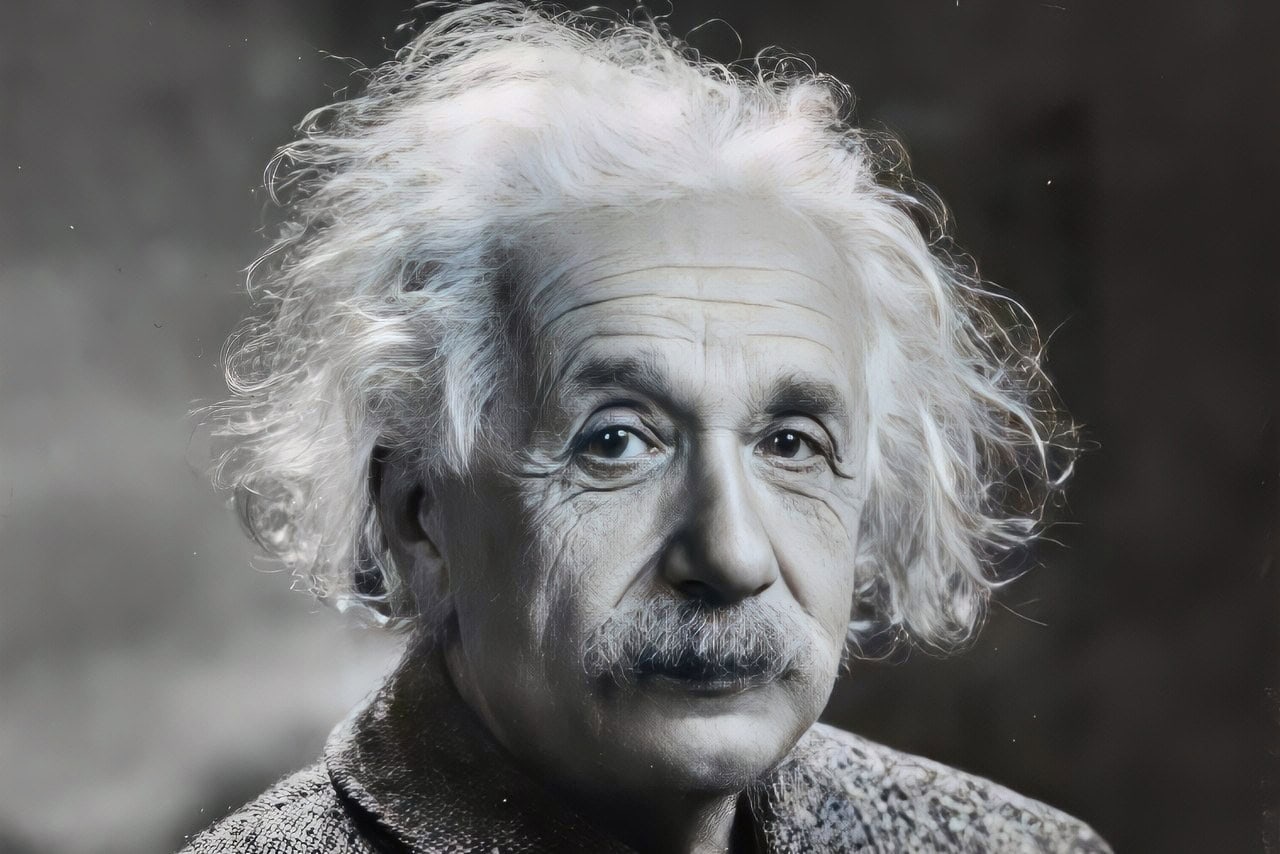
Albert Einstein. Image Credit: Creative Commons.
Albert Einstein was born in Ulm, Germany, on March 14, 1879, and grew up in Munich in a middle-class Jewish family. He disliked rigid schooling but became absorbed by mathematics and geometry. At 15, he left his German school and joined his family in Italy before completing his education in Switzerland.
Einstein entered the Swiss Federal Polytechnic in Zurich in 1896 and graduated in 1900. Academic posts did not follow. After two years of temporary work, he became an examiner at the Swiss Patent Office in Bern. He married former classmate Mileva Marić in 1903, and they later had two sons.
Beyond the Quote: A Patent Examiner Rewrote Physics in 1905
Einstein’s patent-office years produced one of the greatest bursts of work in scientific history. In 1905, he published four papers on the nature of light, evidence for atoms, special relativity, and the relationship between mass and energy. The Institute for Advanced Study’s account explains how those papers established the concept of light quanta, clarified Brownian motion, recast the understanding of motion and electromagnetism, and led to E=mc².
The work opened the academic career previously denied to him. Einstein received his first full-time physics post in 1909, taught in Zurich and Prague, then returned to Zurich before moving to Berlin in 1914.
General Relativity Made Einstein a Global Celebrity
Einstein completed the general theory of relativity in 1915 after years of false starts. The theory described gravity as the curvature of spacetime. British observations during a 1919 solar eclipse supported his prediction that gravity bends light, turning the 40-year-old physicist into an international celebrity.
The Nobel Committee awarded him the 1921 Physics Prize, though the citation emphasized the photoelectric effect rather than relativity. His fame gave him a political platform. Einstein opposed German militarism during World War I, supported pacifist causes, and defended the Weimar Republic while anti-Semitic opponents attacked him and his work.
His private life was less orderly. Einstein separated from Marić after moving to Berlin, divorced her in 1919, and later that year married his cousin, Elsa Löwenthal.
Nazi Germany Broke His Absolute Pacifism
Hitler’s rise forced Einstein to reconsider the limits of pacifism. He was abroad when the Nazis took power in 1933 and refused to return. He joined the Institute for Advanced Study in Princeton, became a U.S. citizen in 1940, and helped refugees threatened by fascism.
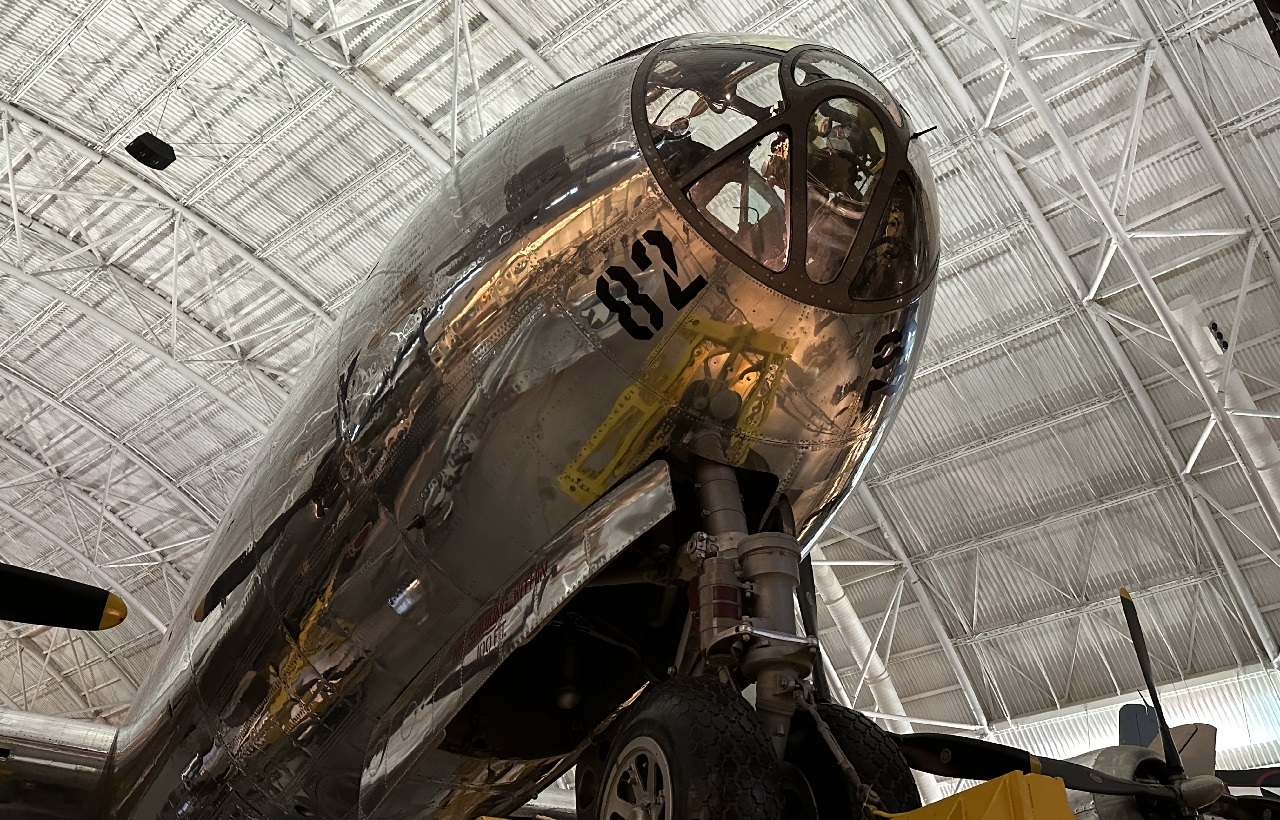
Enola Gay B-29. Image was taken on October 1, 2022. Image Credit: 19FortyFive.com
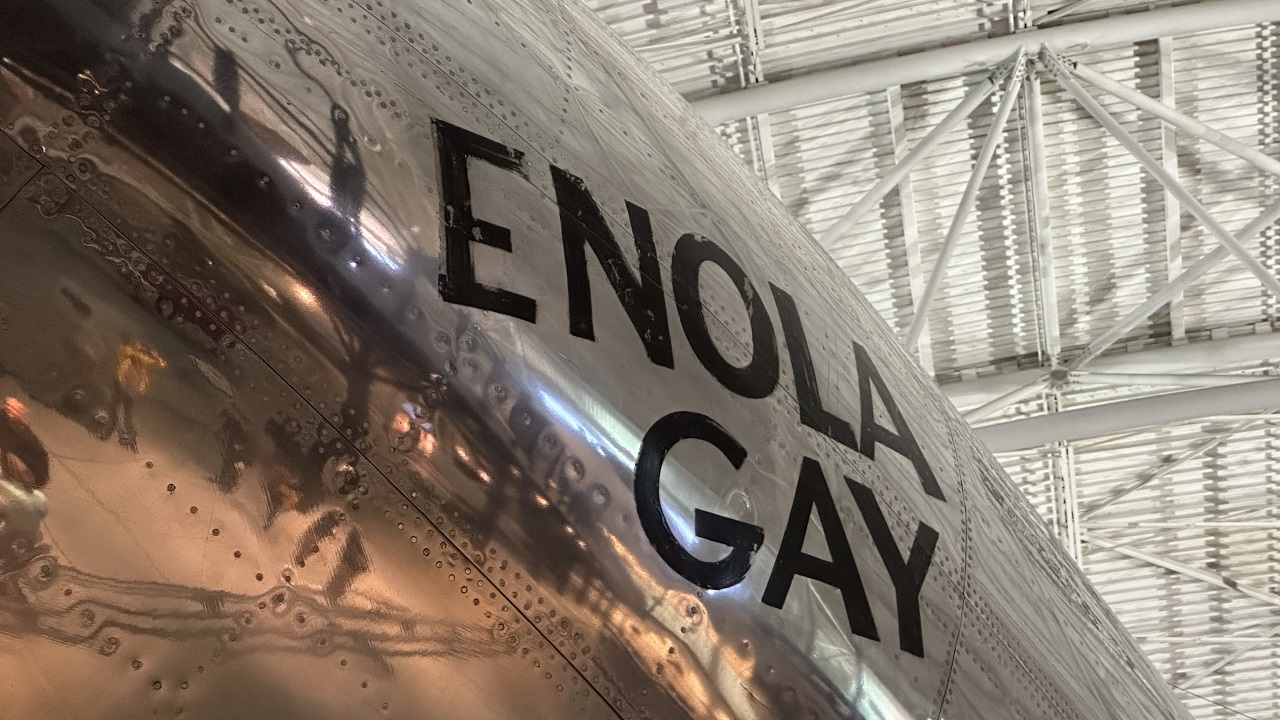
Enola Gay B-29. Image was taken on October 1, 2022. Image Credit: 19FortyFive.com

Enola Gay B-29. Image was taken on October 1, 2022. Image Credit: 19FortyFive.com
In 1939, physicist Leó Szilárd helped prepare a warning for President Franklin D. Roosevelt about nuclear fission and the danger of a German bomb. Einstein signed the August 2 letter to Roosevelt. The president created an advisory committee on uranium, and the federal effort later expanded into the Manhattan Project.
Einstein did not work on the bomb. His equation explained mass-energy equivalence; it was not a weapon design. The Manhattan Project required vast industrial plants, weapons engineering, and a secret scientific network. Its products reached the Pacific aboard USS Indianapolis and were delivered in combat by B-29 bombers over Hiroshima and Nagasaki.
The Atomic Bomb Changed Einstein’s Public Mission
After the war, Einstein said he would not have supported the Roosevelt letter had he known Germany would fail to build an atomic weapon. His regret did not erase the decision; it redirected his public work.
Einstein and Szilárd formed the Emergency Committee of Atomic Scientists in 1946. The National Archives describes its mission as public education, international control of atomic energy, and peaceful uses of nuclear science. Einstein served as chairman and argued that national armament offered no dependable defense against atomic war.
The “World War IV” warning was part of this period. It compressed his fear that scientific civilization might erase the institutions, cities and knowledge supporting modern life. His appeals grew sharper as the hydrogen bomb and U.S.-Soviet arms race expanded, concerns still present in debates over renewed nuclear testing.
Einstein’s Final Signature Was an Appeal Against Nuclear War
Einstein continued searching for a unified field theory at Princeton while much of physics moved in other directions. He declined an offer to become Israel’s president in 1952 and remained active on nuclear disarmament, world government, and civil liberties. His argument that preparing for war worked against abolishing it defined his final decade.
On April 11, 1955, Einstein told Bertrand Russell he was “gladly willing” to sign a proposed statement on nuclear danger. He died seven days later. Russell released the Russell-Einstein Manifesto in London on July 9 with Einstein’s name among its 11 signatories.
About the Author: Harry J. Kazianis
Harry J. Kazianis (@Grecianformula) was the former Senior Director of National Security Affairs at the Center for the National Interest (CFTNI), a foreign policy think tank founded by Richard Nixon based in Washington, DC. Harry has over a decade of experience in think tanks and national security publishing. His ideas have been published in the NY Times, The Washington Post, The Wall Street Journal, CNN, and many other outlets worldwide. He has held positions at CSIS, the Heritage Foundation, the University of Nottingham, and several other institutions related to national security research and studies. He is the former Executive Editor of the National Interest and the Diplomat. He holds a Master’s degree focusing on international affairs from Harvard University.

