
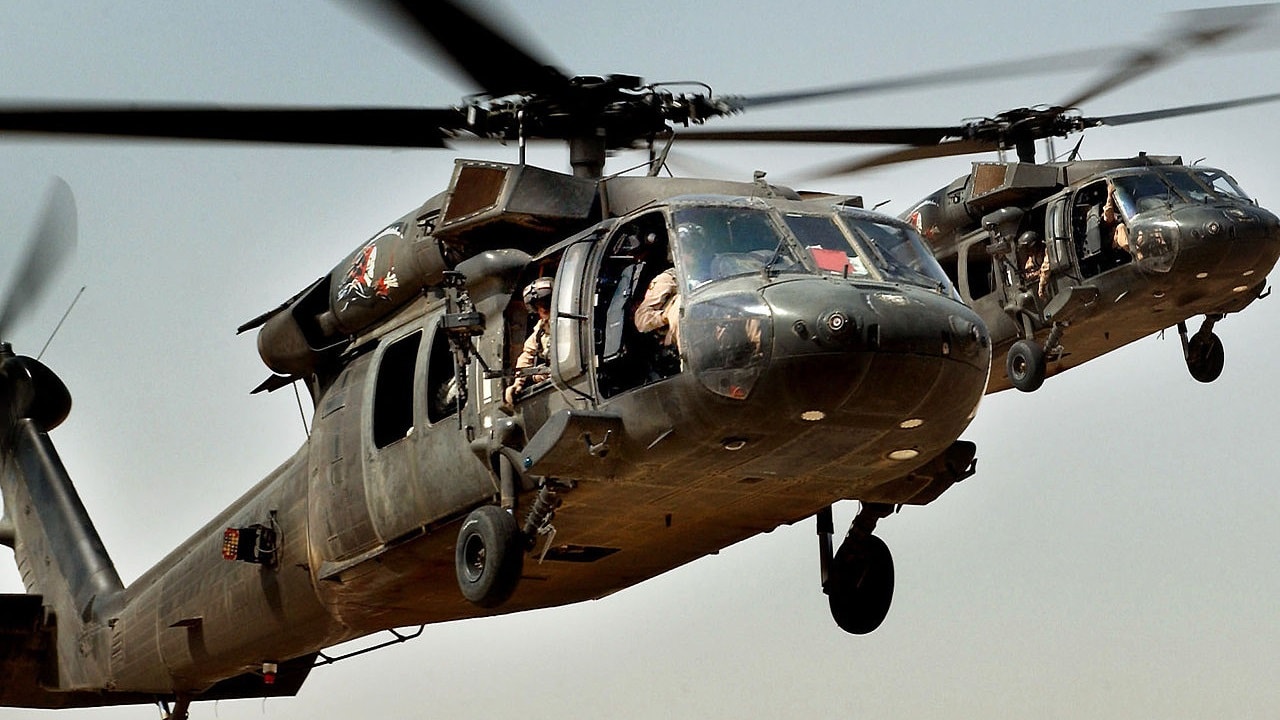
The Sikorsky UH-60 Black Hawk medium-lift utility helicopter—now falling under the purview of Lockheed Martin—has been faithfully serving the United States Army since 1979, as exemplified by the “Black Hawk Down” mission in Mogadishu, Somalia, in 1993.
For good measure, in its HH-60 Pave Hawk variant, it has enabled the U.S. Air Force Special Operations Command’s (AFSOC’s) elite Pararescue Jumpers (“PJs”) to carry out their daring combat search-and-rescue (CSAR) missions.
Now the Black Hawk can add one more bullet point to its already impressive resume: combat drone work.
Bottom Line Up Front (BLUF)
According to recent reporting, during Project Convergence Capstone 6 (PCC6)—a three-day flight demonstration over the Mojave Desert—the U.S. Army showed that an H-60M Black Hawk helicopter can launch and control multiple air-launched effects (ALEs), thus marking a major step toward giving Army choppers greater reach in contested environments while allowing them to remain at comparatively safer stand-off attack distances.
PCC6 served as a follow-up to June 2026 flight tests at Fort A.P. Hill, Virginia.
Mind you, the climatic conditions in the Fort Hill area are characterized by a warm and temperate atmosphere, with a significant amount of rainfall throughout the year, even during the driest month. This is a sharp contrast to the extremely arid and infamously high heat of the Mojave Desert—remember, Death Valley is part of the Mojave—so the successful execution of the Capstone 6 demo proved that the Black Hawk & ALEs tandem can work well even in the most adverse conditions.
This ambitious testing program was developed through collaboration between the Utility Helicopters Project Office (UHPO) and the U.S. Army Combat Capabilities Development Command (DEVCOM) Aviation and Missile Center (AvMC), with additional assistance from Army technical programs and industry partners for integration and flight testing.
DEVCOM describes itself as “the Army’s organic science, technology and engineering organization dedicated to developing combat capabilities.”
PCC6 conferred the added benefit of fast-tracking the Long-Range Precision Munition (LRPM), which is the Army’s lethal version of the Launched Effects program. Managed by the Capability Program Executive Offensive Fires (CPE OF), the LRPM is built for autonomous operation, controlling several units at once, and the power to mass fires on a target simultaneously.
Last but not least, in addition to the ability to deploy ALE combat drone payloads, the modified H-60M utilized in PCC6 featured advanced networking capabilities to share information between air and ground forces, thus streamlining battlespace management and providing a highly reliable node for over-the-horizon communications between aviation and ground assets.
It lends much credence to the manufacturer’s claims that “From a more durable gearbox and stronger rotor blades to a future digital cockpit, today’s HAWK is better than ever.
And tomorrow’s HAWK will accelerate that innovation, with more powerful engines, an integrated digital architecture, and safety systems to help pilots in tough conditions.”
Digging Deeper: Experts and Spokespersons Weigh In
–Dr. Stephanie Reitmeier, Director for DEVCOM AvMC Maneuver Air Directorate and Maneuver Air System Center: “It’s truly remarkable when dedicated Americans from government and industry collaborate to deliver results.
Moving with speed and embracing experimentation as a unified team is driving transformational change across Army capabilities.”
–Brig. Gen. Kevin Chaney, Deputy Portfolio Acquisition Executive for Maneuver Air: “Successfully launching Air-Launched Effects from a Black Hawk is more than a milestone; it is a leap forward.
By extending their reach and increasing lethality, we are changing the battlefield geometry and delivering a decisive advantage to our Soldiers.”
Bigger Picture
This drone work is just the latest example of the versatility and flexibility that has kept the Black Hawk viable for so long. Its mission capabilities include:
CSAR
-External lift
-Combat assault
-Firefighting
This versatility also explains why the Sikorskly/Lockheed Martin whirlybird has been adopted by the military and/or police forces of an estimated 37 foreign nations, including Morocco, the United Arab Emirates (UAE), and Lithuania.
Going back to the Black Hawk’s U.S. Army service, it’s going to be around for at least a few more years before it’s finally retired; the Bell V-280 Valor has been anointed as the UH-60’s successor, but the Bell bird’s limited user tests aren’t planned until 2027 and 2028, and it isn’t expected to deploy until Fiscal Year 2031 (FY31).
About the Author: Christian D. Orr
Christian D. Orr is a Senior Defense Editor. He is a former Air Force Security Forces officer, Federal law enforcement officer, and private military contractor (with assignments worked in Iraq, the United Arab Emirates, Kosovo, Japan, Germany, and the Pentagon). Chris holds a B.A. in International Relations from the University of Southern California (USC) and an M.A. in Intelligence Studies (with a concentration in Terrorism Studies) from American Military University (AMU). He is also the author of the book “Five Decades of a Fabulous Firearm: Celebrating the 50th Anniversary of the Beretta 92 Pistol Series,” the second edition of which was recently published.