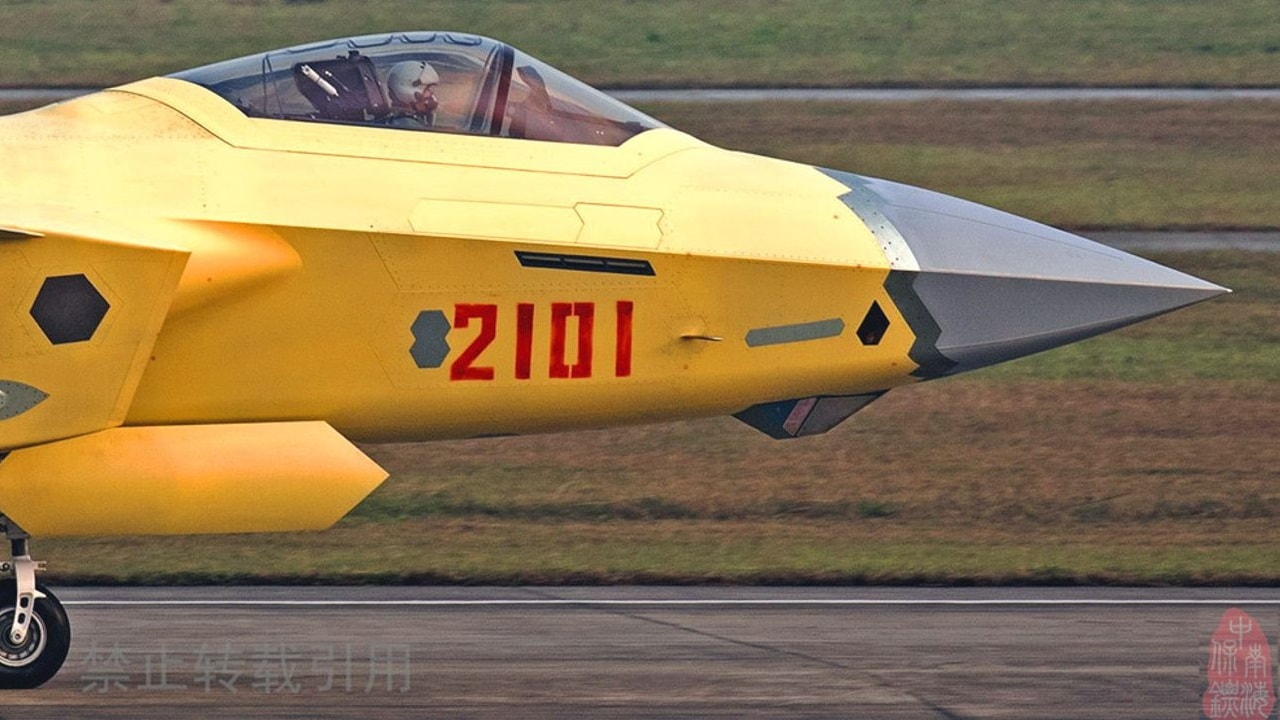
China continues its rapid military modernization and expansion with great aplomb, while the United States struggles to maintain its current force.
That force, while advanced, is not as numerous as it needs to be.
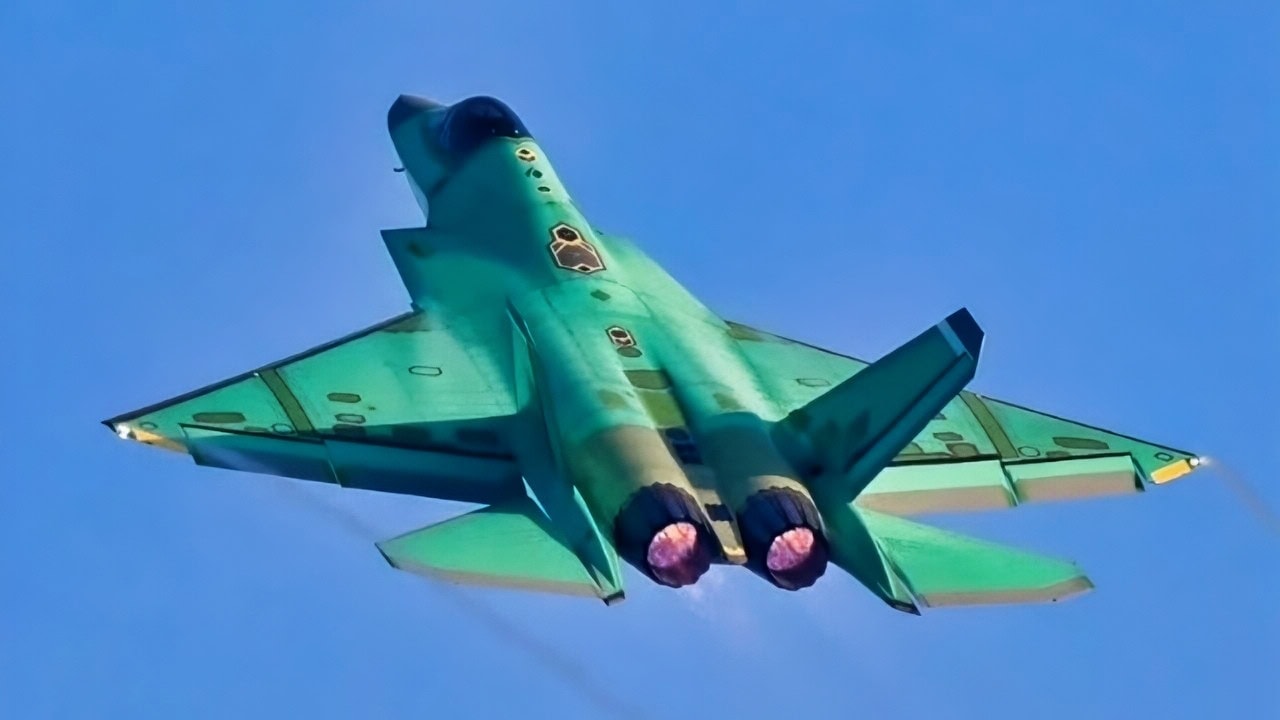
J-35A Stealth Fighter. Image Credit: Social Media Screenshot.
What’s more, the Chinese are not only moving to have much greater numbers of their warplanes and weapons, but the Chinese are also increasing the quality of those greater numbers of advanced systems.
The Comparisons
That is apparent in the development of the Chengdu J-20 “Mighty Dragon” fifth-generation air superiority stealth warplane and the Shenyang J-35 series of fifth-generation multirole stealth warplanes.
These two planes, the former of which is a rival to America’s vaunted F-22 Raptor fifth-generation air superiority stealth plane and the latter of which is a counter to America’s F-35 Lightning II fifth-generation multirole stealth warplane, are benefiting from China’s advanced manufacturing capacity as well as its increasingly sophisticated weapons.
China’s two fifth-generation stealth plane models combine sufficient stealth capability with increasingly long-range armaments designed to target both US warplanes and critical support aircraft from beyond visual range (BVR).
China’s PL-15
Take, for example, the Chinese PL-15 air-to-air long-range missile. This system possesses active radar guidance and actually outranges most Western tactical missiles.
Thus, Chinese fifth-generation warplanes employing this system can strike before entering dogfighting range.
The Americans employ the ubiquitous AIM-120 AMRAAM, which is a time-tested, albeit lethal, weapon. However, most older variants of this system are outranged by the aforementioned Chinese PL-15.
America is developing the AIM-120D to close the gap between its air-to-air missiles and the Chinese PL-15.
The Pakistani Air Force (PAF) held up well against Western warplanes used by the Indian Air Force (IAF) in their war last year because they employed Chinese-made weapons, like the PL-15.
Indeed, the PL-15 did so well that Indian intelligence operatives fought hard to locate a model of the PL-15 that was fired from a PAF jet but never exploded.
Indian military engineers spent the last two years studying and reverse-engineering the PL-15 because it had proven so lethal during the four-day war on the subcontinent last year.
One can only hope that the Indians learned its secrets and shared them with the Americans because otherwise the Chinese will continue enjoying significant advantages with the PL-15 over many older American systems — including missiles that arm the F-22 and F-35.
Chinese Systems vs. American Capabilities
Like America’s F-22 and F-35, the Chinese J-20 and J-35s employ internal weapons bays to maximize low observability–stealth–on enemy radar systems.
At the same time, however, China’s fifth-generation warplanes have bulkier airframes tailored for higher-payload, long-range interception.
Whether it decreases the stealth of the Chinese planes is a matter of debate among experts.
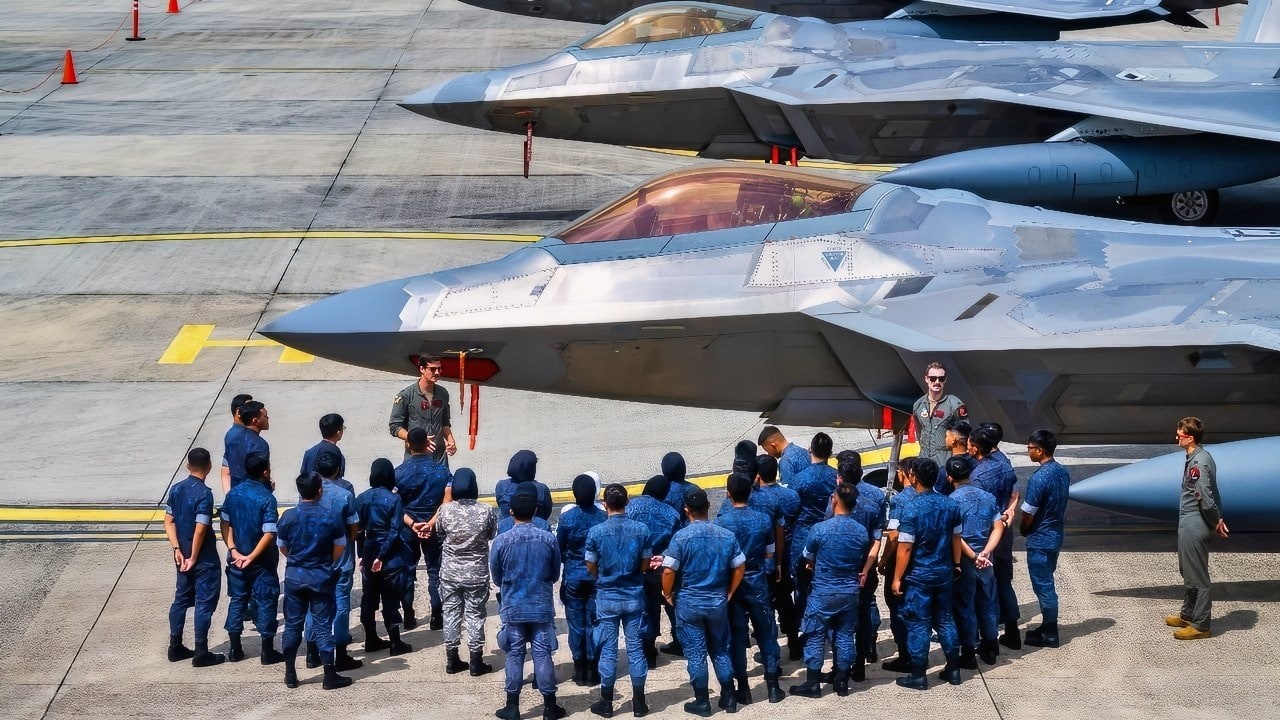
U.S. Air Force F-22 Raptor pilots assigned to 27th Expeditionary Fighter Squadron, Joint Base Langley-Eustis, Virginia, conduct a capabilities brief at Rimba Air Force Base, Brunei Darussalam, on Aug. 7, 2024. This year marks the 40th anniversary since the United States established diplomatic relations with Brunei Darussalam. (U.S. Air Force photo by Senior Airman Mitchell Corley)
One of the most interesting missions for Chinese fifth-generation warplanes, such as the J-20 Mighty Dragon, would be to bypass US frontline warplanes and instead hunt high-value American systems, such as airborne radar platforms (like AWACS) or aerial refueling tankers.
By knocking out these critical support planes, coupled with China’s other advanced anti-access/area-denial (A2/AD) systems (since the Chinese would undoubtedly be fighting any US warplane that comes closer to their territory and defense network), Chinese warplanes could further degrade America’s military reach in war.
And those increasingly long-range missiles could prevent adequate self-defense measures from being undertaken by US planes.
On top of it all is China’s virtually unmatched advanced manufacturing capacity.
The Chinese can churn out advanced J-20s, J-35s, and all the PL-15s needed to overmatch whatever the Americans are employing.
Of course, the Americans fall back on the technological superiority of their fifth-generation warplanes.
Although there are so few F-22s (the Obama administration prematurely shuttered their production line) and the F-35s have an abysmal combat readiness rating, meaning that alleged technological prowess could be overcome by greater numbers of China’s fifth-generation planes.
Other Chinese Missiles
The J-20 and J-35 also employ the PL-10 short-range, infrared-guided missile.
The J-20 also has lateral bays that swing the PL10 outward, allowing Chinese pilots to lock onto targets before firing while closing the doors to maintain stealth.
Then there are the giant, ultra-long-range interceptor PL-17 and PL-21 missiles that can outrange anything in the sky, essentially.
At a range of more than 180 miles, these two missiles are the stuff of nightmares for any pilot tasked with defending themselves or other targets. Those larger missiles are designed specifically for US AWACS aircraft.
The American Side
On the other side of the equation, alongside the AIM-120D AMRAAM, is the AIM-9X Sidewinder, the premier US short-range heat-seeking missile, paired with a helmet-mounted tracking system on the F-35.
Then there’s the classified AIM-260 JATM, a long-range missile being rushed through development to counter the PL-15.
For air-to-ground strike, most experts consider the US F-35 the master of the category.
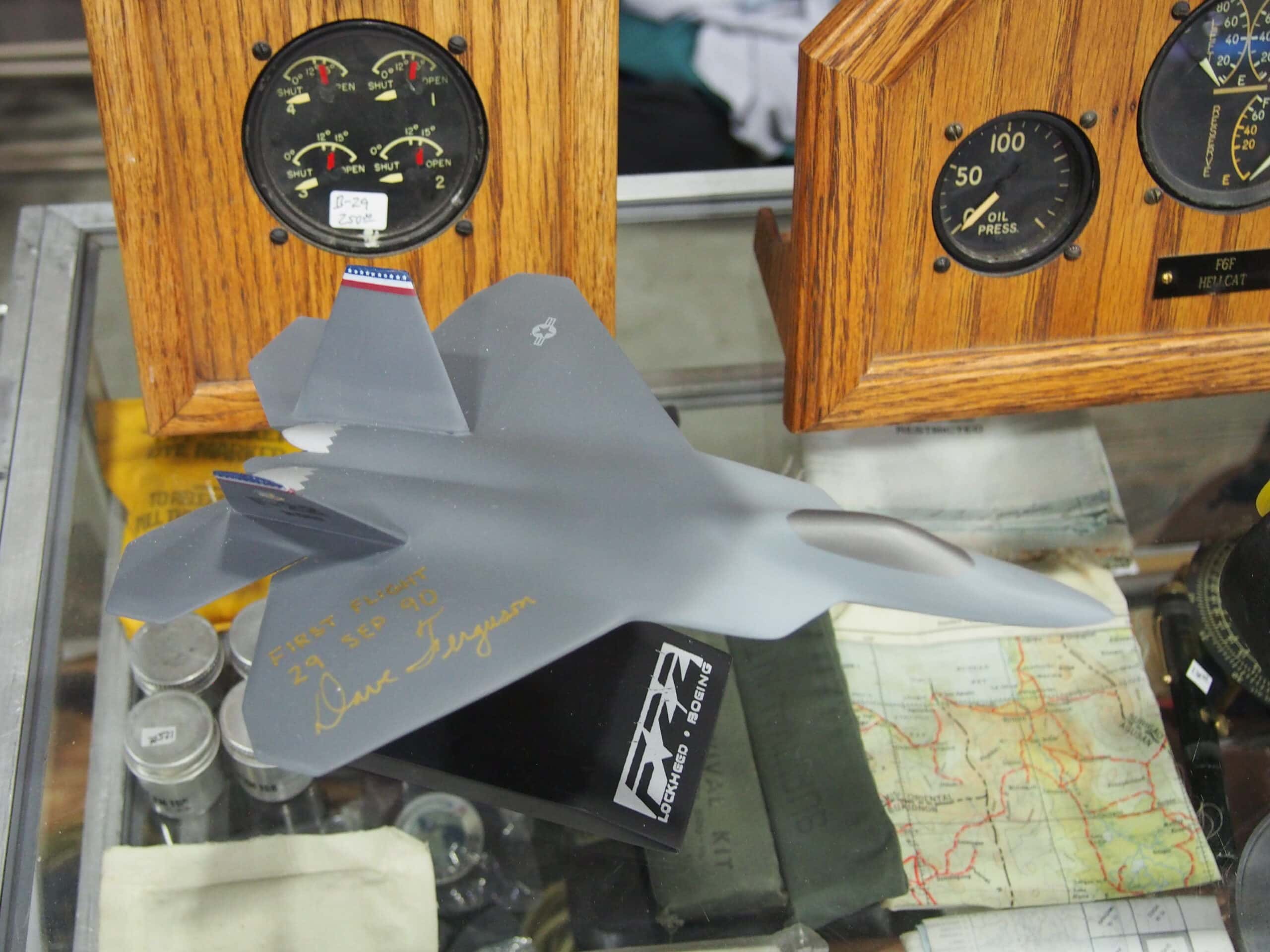
F-22 Model. Image Credit: 19FortyFive.com
This bird can carry the GBU-53/B StormBreaker (SDB II), which is a smart, mini glide bomb with a tri-mode seeker that tracks and hits moving targets up to 40 miles away. An F-35 carries up to eight of these systems when tasked.
The F-35 also integrates the Joint-Directed Attack Munition (JDAM)/GBU series, which comprises GPS- and laser-guided deep-penetration bombs. If needed, the F-35 can deliver a B61-12 tactical nuclear bomb.
Can China Compete?
China’s J-35 carries TL-20 small-diameter bombs, which are China’s answer to the SDB II. J-35s carry up to 12 of these systems.
Then there’s the LD-8A Anti-Radiation Missile that hunts and destroys enemy ground-based air defense radars. The J-35 becomes problematic for the United States when China equips these birds with the YJ-15.
This air-launched supersonic anti-ship cruise missile can execute high-speed terminal sea-skimming maneuvers and is tailored to penetrate the Aegis defenses that protect American aircraft carriers (the ultimate prize for China in any war with the United States).
The YJ-83 subsonic anti-ship cruise missiles can be carried on the external wing pylons of the J-35 (when stealth isn’t needed).
Meanwhile, the F-22 is less suited to these ground-attack-type missions (which is why the US has the F-35). But it is good at dogfighting.
Because of that key mission, the F-22 possesses an internal 20mm M61A2 Vulcan rotary cannon with 480 rounds.
The F-35A, the Air Force version of the plane, possesses a 25mm GAU-22/A four-barrel cannon carrying 181 rounds.
The Carrier versions of the F-35 have an optional external gun pod that can be installed if mission designers believe it is necessary.
Chinese Assumptions Might Not Work Out
China’s planes have no internal gun at all.
Clearly, designers of the J-20 and J-35 assume they can overcome their US rivals with BVR attacks and overwhelming missile barrages.
However, it remains to be seen if these planes can counter the purported superiority of US warplanes. Still, the data provided above should highlight how much riskier it is to go to war with China’s fleet of warplanes today than it would have been even a decade ago.
The US military must not underestimate the Chinese air and naval forces.
About the Author: Brandon J. Weichert
Brandon J. Weichert is the Senior National Security Editor at 19FortyFive.com. He also manages The Weichert Brief on Substack. Weichert also hosts “National Security Talk” on Rumble. He is the author of four bestselling national security books, the most recent of which is A Disaster of Our Own Making: How the West Lost Ukraine (Encounter Books). Follow him via Twitter/X @WeTheBrandon.