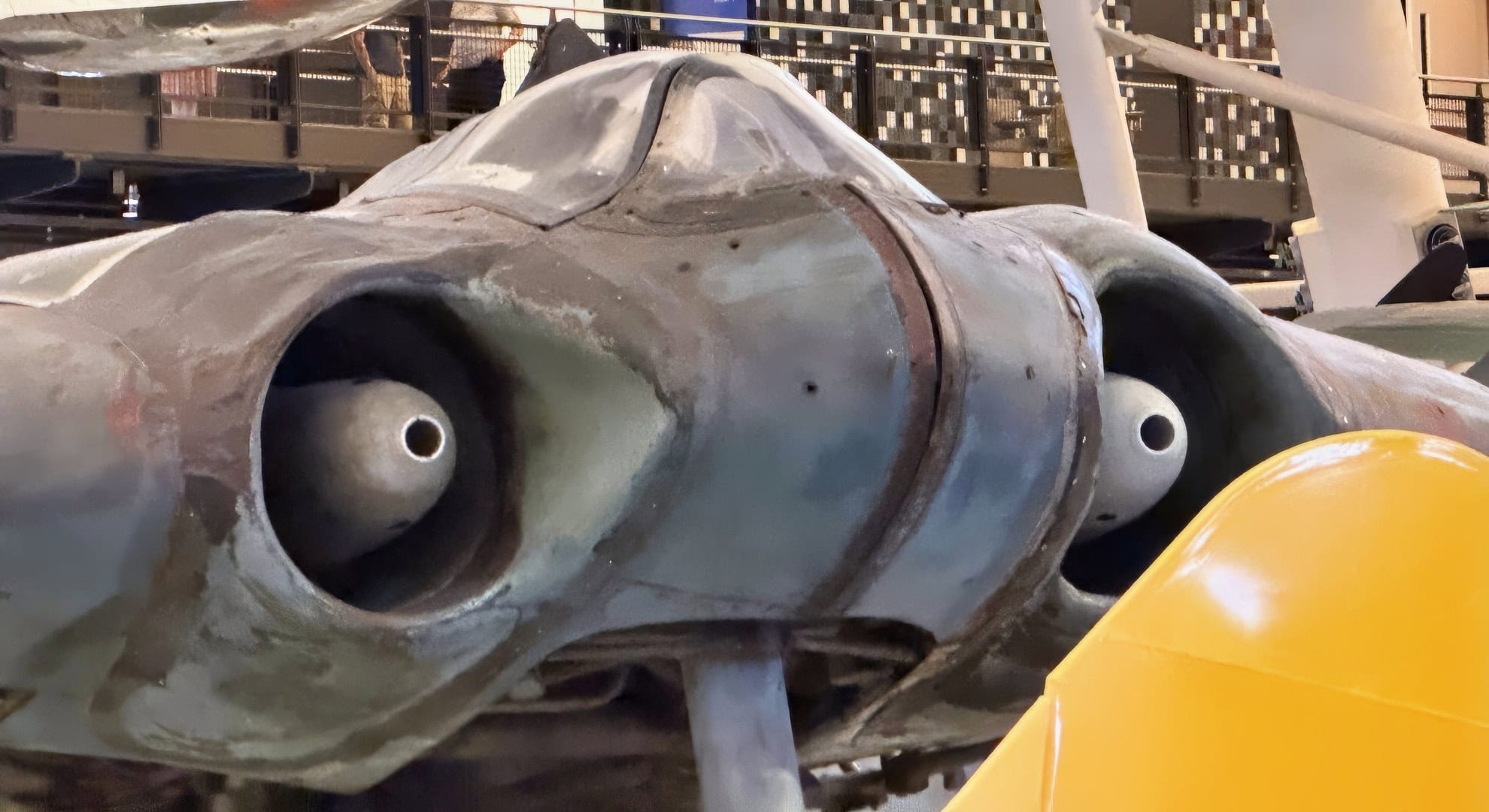
Known as Horten Ho 229, Nazi Germany produced the world’s first flying-wing jet aircraft. Indeed, when many today see the triangular airframe of the gray-hulled Nazi flying wing, they cannot help but see that shape as something familiar. That’s because modern stealth planes, which did not enter service until the 1980s and 1990s, share the same otherworldly design.
Those making such claims, however, lack proof.
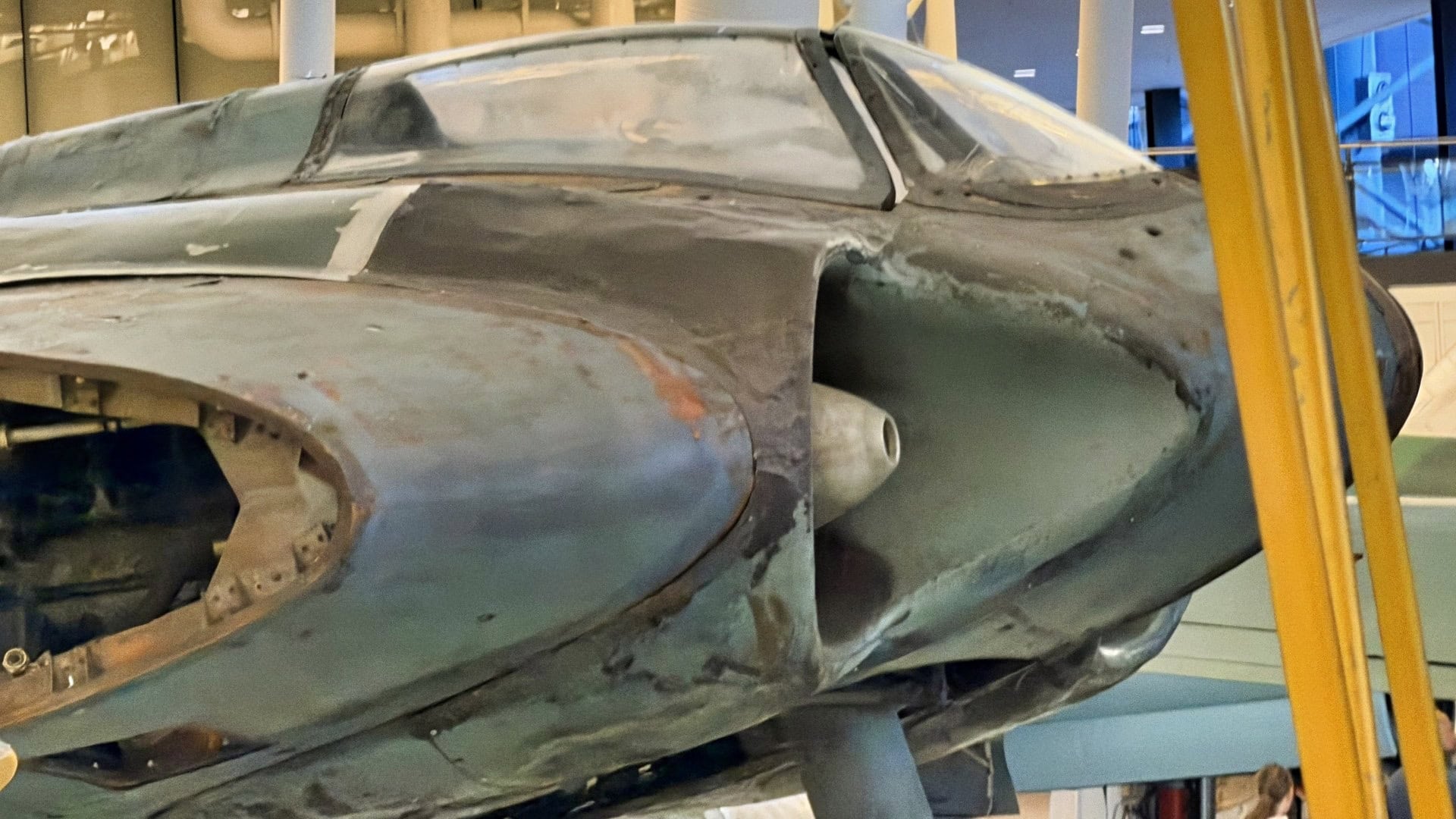
Horten Ho 229 19FortyFive Image from Smithsonian Visit
Some even call this the first stealth bomber. At least from my perspective, Germany’s Ho 229 was not a stealth plane, but it was decades ahead of its time. The Ho 229 was a revolutionary aircraft nonetheless.
Designed by German brothers Reimar Horten and Walter Horten as a radical flying-wing jet aircraft, the project aimed to satisfy Luftwaffe chief Hermann Göring’s famous “Three by 1,000” requirement.
Göring wanted Luftwaffe warplanes to carry 1,000 kilograms of bombs, fly 1,000 kilometers, and reach 1,000 kilometers per hour.
No conventional aircraft of the day could simultaneously achieve all three mission sets.
The Horten brothers, however, believed that eliminating the fuselage and the tail would drastically reduce drag.
What resulted from those decisions was a plane that looked remarkably similar to modern stealth birds.
Lucky for us, we visited the plane at the Smithsonian and have some amazing photos to show our readers.
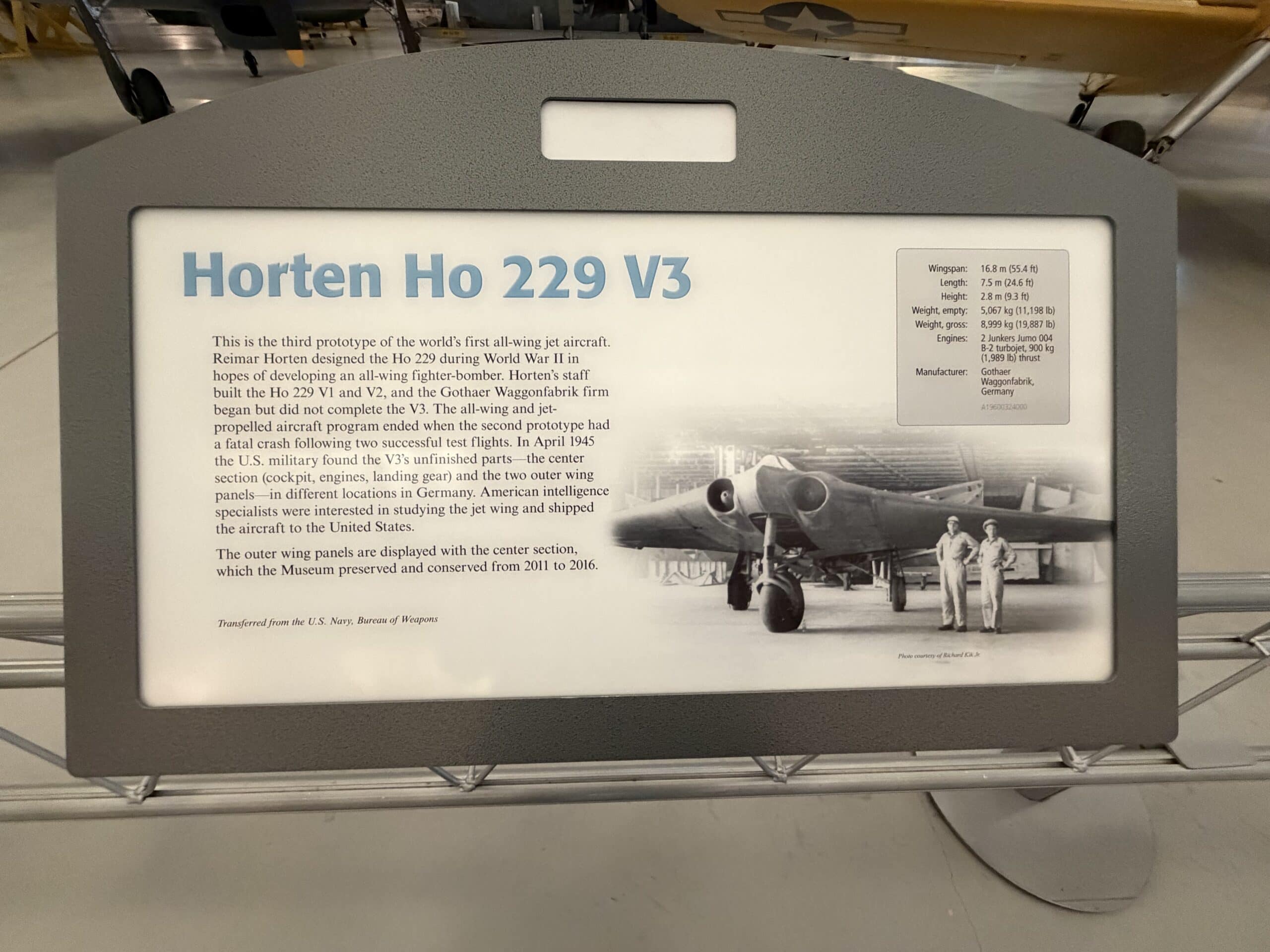
Horten Ho 229 19FortyFive Image from Smithsonian Visit
Decades Ahead
By making the Ho 229 a flying wing design, the Horten Brothers achieved their goal of massively reduced drag.
In fact, the Ho 229 achieved a higher lift-to-drag ratio. Further, the Ho 229 enjoyed greater speed than conventional birds.
It had a longer range, too. And its unique configuration ensured the plane possessed less structural weight.
In fact, these are the same aerodynamic principles that undergird the iconic US Air Force B-2 Spirit long-range, nuclear-capable stealth bomber.
Jet Propulsion
Another fascinating development was the inclusion of two Junkers Jumo 004 turbojets. These were the same engines that powered the Messerschmitt Me 262 (the world’s first jet fighter).
That combination of jet engines, a flying wing, and a relatively small frontal area made the Ho 229 one of the most advanced planes ever to fly the unfriendly skies of World War II.
Indeed, the Allies would not have anything like it for years after this plane first flew in 1945.
Was It Stealth?
Later in his life, Reimar Horten insisted that he wanted to mix charcoal into the glue between the plywood layers of the Ho 229.
According to Reimar Horten, “charcoal would absorb radar waves.” No documentation exists proving that claim.
While we cannot officially give the Horten Brothers credit for having first created rudimentary stealth planes, it’s imperative to understand that much of the advanced Nazi science was captured by the Americans at the end of the war and secretly repurposed for use by the US military in what became the Cold War.
Part of that repurposing under “Operation Paperclip” involved many cover-ups and much obfuscation by US intelligence to keep inquisitive reporters from figuring out what they, and many former Nazi scientists, were really up to.
It is entirely possible, however improbable, that the Horten Brothers were planning to build the first stealth plane.
That evidence might not exist anymore, either because of whatever Operation Paperclip did or simply because the Horten Brothers, being true geniuses, concluded that was what they wanted to do without ever committing those desires to paper.
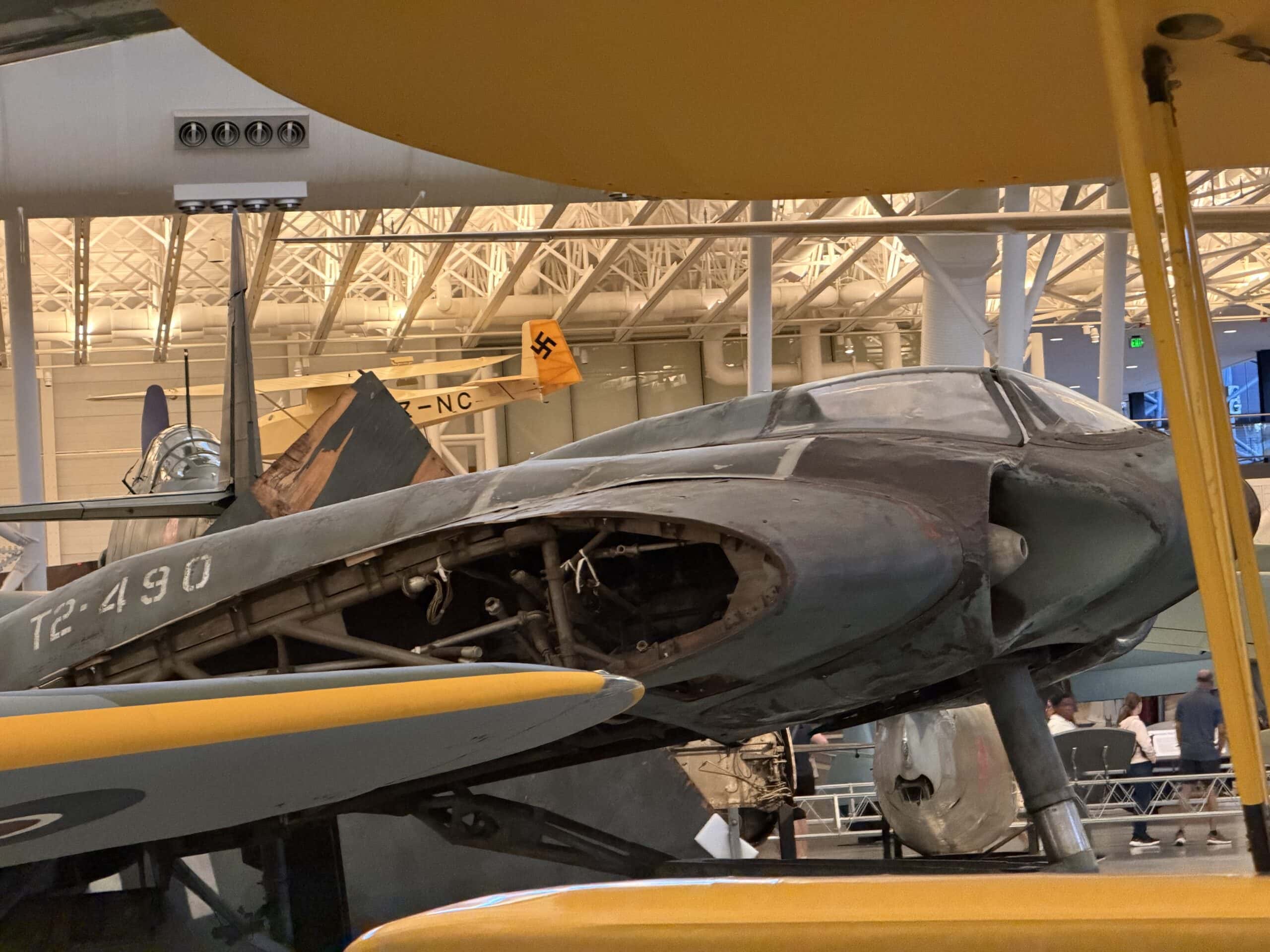
Horten Ho 229 19FortyFive Image from Smithsonian Visit
In fact, the Smithsonian did a deep-dive analysis on the surviving Ho 229 V3.
Researchers from the Smithsonian looked for evidence of charcoal, carbon black, and radar-absorbing material in the Ho 229 V3.
They found no clear evidence that radar-absorbing charcoal was included in the Ho 229 V3. Or that any carbon-like particles were identifiable. What’s more, there was no measurable charcoal layer inside the plywood.
Thus, the researchers at the Smithsonian concluded that the aircraft did not provide convincing evidence that the Horten Brothers built an intentional stealth airplane.
Those reading the study, however, can tell that the researchers carefully parsed their language, meaning that they were not totally convinced that stealth was not part of the ultimate design.
Northrop Grumman Was Interested
In 2008, engineers from the US defense contractor, Northrop Grumman, created a full-size radar model of the plane.
They then tested that model against radar frequencies similar to those used during the war. Their research found that the flying-wing shape naturally reduced radar reflections compared with more conventional aircraft of the day.
Beyond that, Northrop’s scientists determined that any carbon material present was a poor radar absorber and the aircraft would still have been detectable.
So, again, it was not equivalent to modern stealth.
Yet, one cannot dismiss the idea that the Horten Brothers were anticipating the arrival of stealth in some way with their design. Had the war not ended, perhaps they would have begun work on rudimentary stealth designs.
Complications
Nevertheless, the Ho 229 had serious problems–so much so that the plane only flew a handful of times. There were significant engine reliability concerns, too.
Its unique shape and the fact that nothing like it had ever existed–especially in a wartime environment–made it a difficult plane for pilots to control. Plus, a fatal crash during its prototype phase destroyed the only functional model.
Berlin decided against putting the plane into full production.
US forces captured the V3 Ho 229 before the Germans could complete it in April 1945.
How Much Influence Did It Have on the B-2?
Interestingly, the myth that the Ho 229 influenced the design of the B-2 Spirit is just that.
Indeed, Northrop had been experimenting with flying wings since the 1930s. Northrop created the YB-35 and YB-49, which predated the B-2 program by decades.
Meanwhile, modern stealth design grew largely out of radar-scattering theory developed by Soviet physicist Pyotr Ufimtsev.
Additional advances in computer modeling during the 1970s, rather than any direct inheritance from the Ho 229’s design, furthered the American innovation of the stealth plane.
About the Author: Brandon J. Weichert
Brandon J. Weichert is the Senior National Security Editor at 19FortyFive.com. He also manages The Weichert Brief on Substack. Weichert also hosts “National Security Talk” on Rumble. He is the author of four bestselling national security books, the most recent of which is A Disaster of Our Own Making: How the West Lost Ukraine (Encounter Books). Follow him via Twitter/X @WeTheBrandon.