
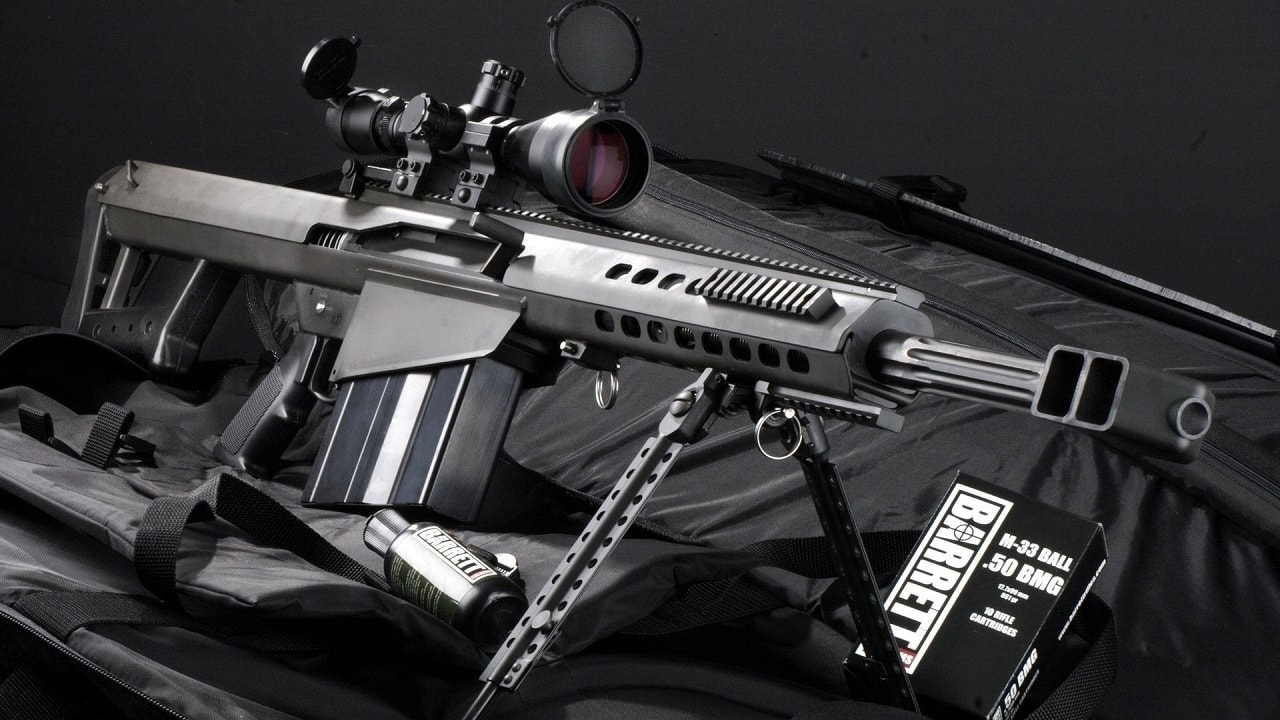
Wind at 1,600 meters isn’t a straight line. It curls over ridgelines, pools in draws, and dies in patches that no anemometer downrange can warn you about.
This is the world the modern sniper rifle was built to conquer: not only raw power, but also the taming of variables across a massive distance.
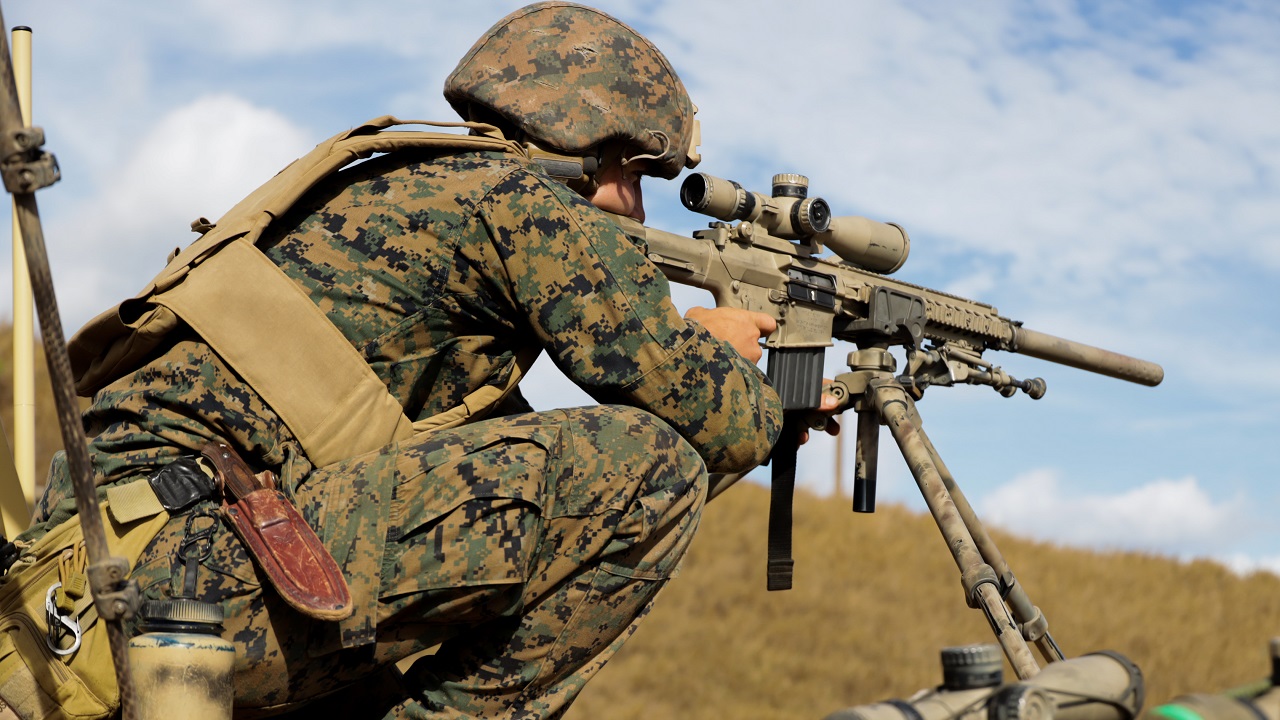
MARINE CORPS BASE HAWAII, Hawaii (July 6, 2022) U.S. Marine Corps Pfc. Darrel Ebaugh, a scout sniper with Weapons Company, Battalion Land Team, 3d Battalion, 4th Marine Regiment, Marine Air-Ground Task Force 7 (MAGFT-7), sights in on a target during a live-fire sniper range in support of Rim of the Pacific (RIMPAC) 2022, on Marine Corps Base Hawaii, July 6, 2022. Twenty-six nations, 38 ships, four submarines, more than 170 aircraft and 25,000 personnel are participating in RIMPAC from June 29 to Aug. 4 in and around the Hawaiian Islands and Southern California. The world’s largest international maritime exercise, RIMPAC provides a unique training opportunity while fostering and sustaining cooperative relationship among participants critical to ensuring the safety of sea lanes and security on the world’s oceans. RIMPAC 2022 is the 28th exercise in the series that began in 1971. (U.S. Marine Corps photo by Lance Cpl. Brayden Daniel)
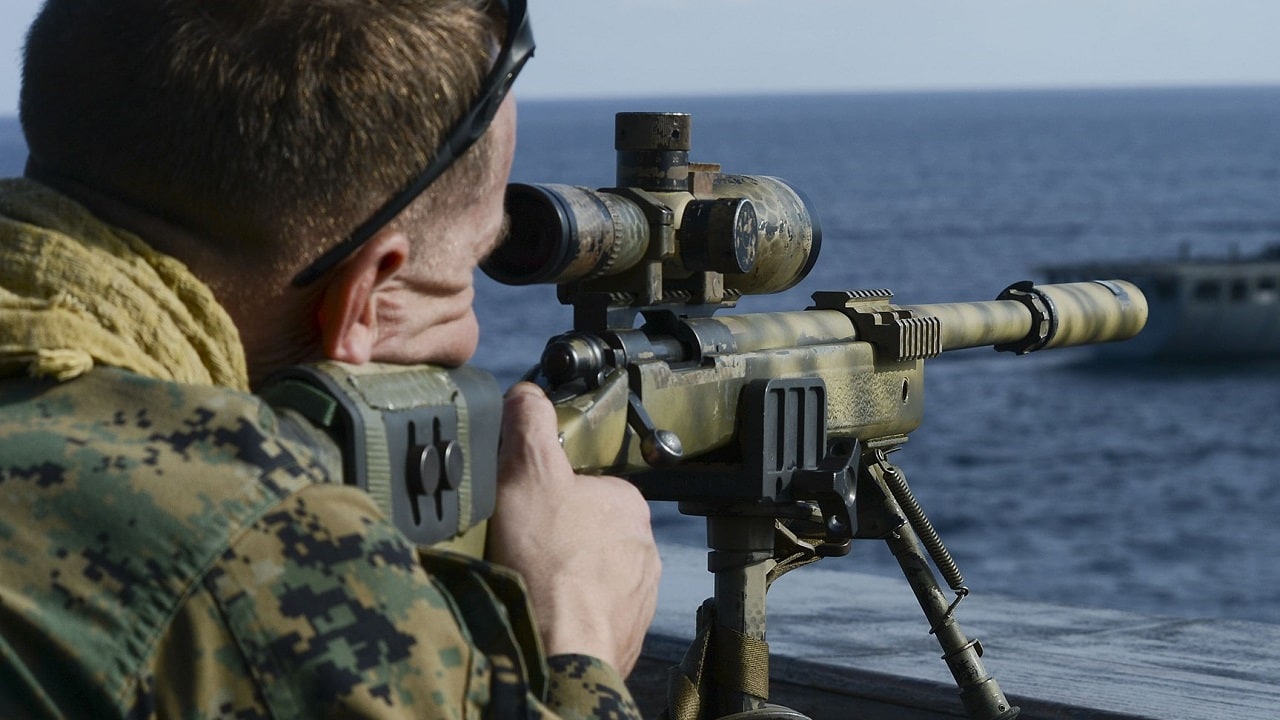
M40 Sniper Rifle. Image Credit: Creative Commons.
And in that quiet, mathematical war between a shooter and the atmosphere, a handful of rifles have earned reputations as some of the finest instruments ever built for the job.
No single, universally agreed “best” sniper rifle exists; militaries, competitive shooters, and long-range hunters all optimize for different things: modularity, caliber flexibility, weight, or raw first-round-hit probability at extreme distance. Making a list such as this is guaranteed to make nine shooters angry for every one that agrees.
But a short list of sniper systems consistently rises to the top of every serious conversation.
The Contender: Accuracy International AXMC
In a stone-walled valley somewhere in a NATO training area, a designated marksman settles behind an Accuracy International AXMC, its skeletal chassis folded open, bipod legs splayed into the scree.
The AI Arctic Warfare lineage, born in Britain in the late 1980s, has spent three decades quietly becoming the gold standard against which every other bolt-action sniper rifle is measured.
The AXMC’s genius isn’t any single feature, but its adaptability. A shooter can swap barrels between .308 Winchester, .300 Norma Magnum, and .338 Lapua Magnum without sending the rifle back to an armorer — just a barrel change and a bolt-head swap, done in the field in minutes.
That modularity, married to AI’s legendary chassis rigidity and repeatable bedding, is why the AXMC (and its predecessor, the AW/AWM family) has been adopted by more special operations units and national police forces worldwide than perhaps any other precision rifle.
AI’s AXMC is renowned for its accuracy, reliability, ruggedness, and unrelenting quality.
It is not flashy. It is simply, unglamorously correct in every dimension that matters. The rifles are crafted for extreme reliability in demanding environments. Accuracy International rifles use high-end materials and strict ISO 9001 standards.
The American Challenger: Barrett MRAD With The Big-Boy .50 Caliber
If the AXMC is the elder statesman, the Barrett MRAD (Multi-Role Adaptive Design) is the rifle that grew up trying to out-engineer it.
Barrett, the company that made its name with the enormous .50 caliber M82 anti-materiel rifle, brought that same obsession with modularity to a bolt gun designed explicitly to compete with the British system.
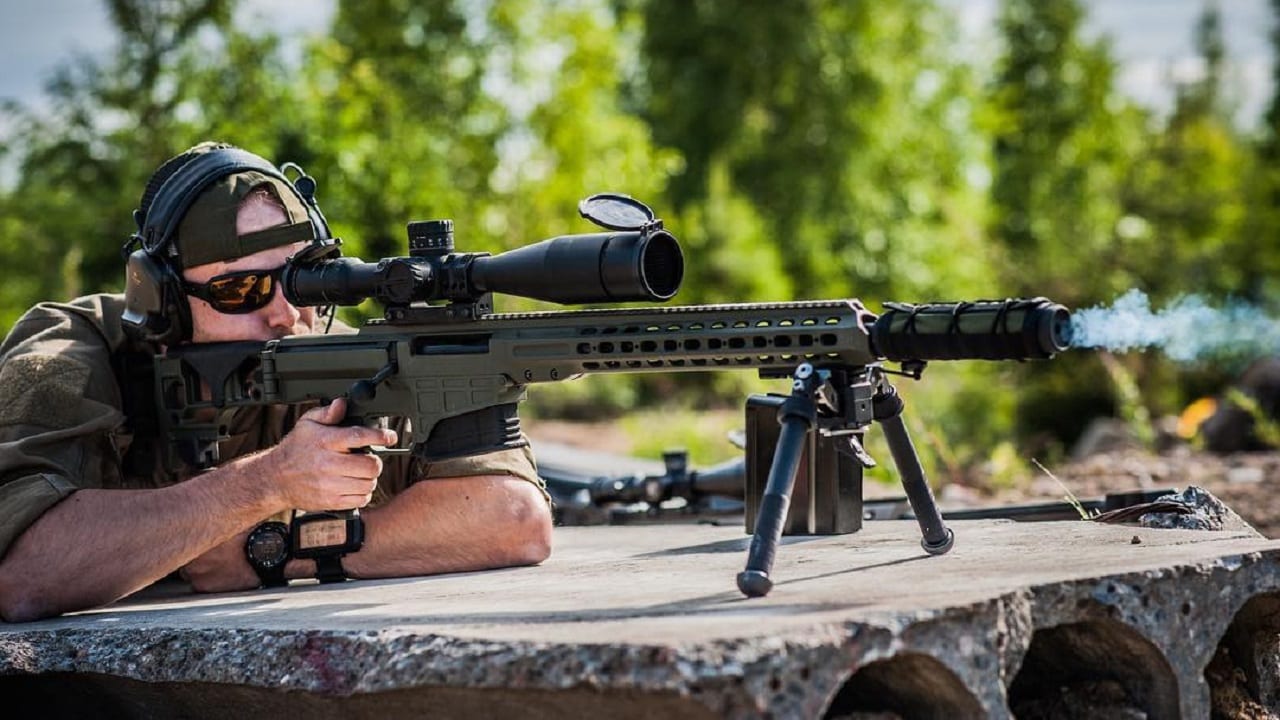
Barrett MRAD. Image Credit: Creative Commons.
The MRAD’s calling card is its user-serviceable barrel-change system, requiring no gunsmith and no special tools, allowing an operator to switch between .338 Lapua Magnum, .300 Winchester Magnum, and .308 Winchester in the field.
It won the U.S. Special Operations Command’s Precision Sniper Rifle competition, beating out several rivals including AI’s own submission, and has since been adopted widely across American and allied special operations units.
Shooters who have used both often describe the MRAD as slightly more ergonomic in cold-weather gloves, with a folding stock geometry that some find faster to deploy from a vehicle or a tight urban position.
SOCOM awarded a $49.9 million contract to Barrett to adopt the MRAD, chambered in 7.62×51 mm NATO, .300 Norma Magnum, and .338 Norma Magnum with the help of a conversion kit, under the command’s Advanced Sniper Rifle (ASR) program.
The American Hunter’s Choice: McMillan TAC-338
Where AI and Barrett chase military contracts, McMillan Firearms Manufacturing has built its reputation the old-fashioned way, one hand-laid fiberglass and carbon-fiber stock at a time.
The TAC-338 gained widespread fame as the rifle used by U.S. Navy SEAL Chris Kyle for notable long-distance engagements in Iraq.
It is chambered in .338 Lapua Magnum and is beloved less for modular gimmicks and more for a kind of old-world craftsmanship: a stock system so consistent in its bedding that competitive long-range shooters and hunters alike praise its almost eerie repeatability, shot after shot, in punishing conditions.
McMillan does have government contracts, but among civilian long-range competitors and professional hunting guides who need one cold-bore shot to count at 1,000+ yards, the TAC-338 remains a quiet favorite, proof that reputation, in this world, is sometimes built shot by shot rather than contract by contract.
Plus, after Chris Kyle’s exploits in the Middle East, it attracted collectors and weapons enthusiasts worldwide.
The Semi-Automatic: Barrett M107A1 /.50 Caliber Anti-Materiel Rifles
Not every “sniper rifle” conversation is about bolt-action precision against soft targets. The Barrett M107A1, chambered in .50 BMG, occupies a different niche entirely: anti-materiel work, where the target is a vehicle engine block, a radar dish, or a fortified position rather than just a human silhouette at extreme range.
Known as the “Light Fifty,” the M107 delivers massive destructive power with the ability to fire rapid follow-up shots from a shoulder-fired platform.

A Marine with Explosive Ordnance Disposal (EOD), 11th Marine Expeditionary Unit, fires the M107 special application scope rifle (SASR) on the USS San Diego as part of live-fire sustainment training conducted during Composite Training Unit Exercise (COMPTUEX) off the coast of southern California, May 18, 2014. COMPTUEX is the second at-sea period during the 11th MEU’s predeployment cycle, in which the MEU will conduct concurrent mission planning and execution integrated across all element of the Marine Air Ground Task Force while supporting Amphibious Squadron 5 in their evaluated training. (U.S. Marine Corps photo by Gunnery Sgt. Rome M. Lazarus/Released).
Its recoil-mitigating muzzle brake and titanium components (shaving weight off the original M82 design) have kept it in service with the U.S. military and dozens of allied forces for years, a reminder that “best” depends entirely on what you’re trying to destroy: armor and infrastructure, not a whisper-quiet shot in a hide.
But if someone is inside that infrastructure, woe to him.
Honorable Mention: The Russian SVD Dragunov, the oldest rifle on this list, is a tried-and-true system that combines semi-automatic fire, a powerful cartridge, and high accuracy.
The Common Thread Among Sniper Rifles
What unites these systems isn’t caliber or country of origin — it’s an obsession with removing every variable except the shooter’s own skill and read of the wind.
Modular chassis systems, free-floating barrels, repeatable bedding, and match-grade triggers all exist for one purpose: to make the rifle disappear so that only the shot remains.
In the end, the “best” sniper rifle is the one that is in the hands of the best, most well-trained, and experienced shooters.
About the Author: Steve Balestrieri
Steve Balestrieri is a National Security Columnist. He served as a US Army Special Forces NCO and Warrant Officer. In addition to writing on defense, he covers the NFL for PatsFans.com and is a member of the Pro Football Writers of America (PFWA). His work was regularly featured in many military publications.