
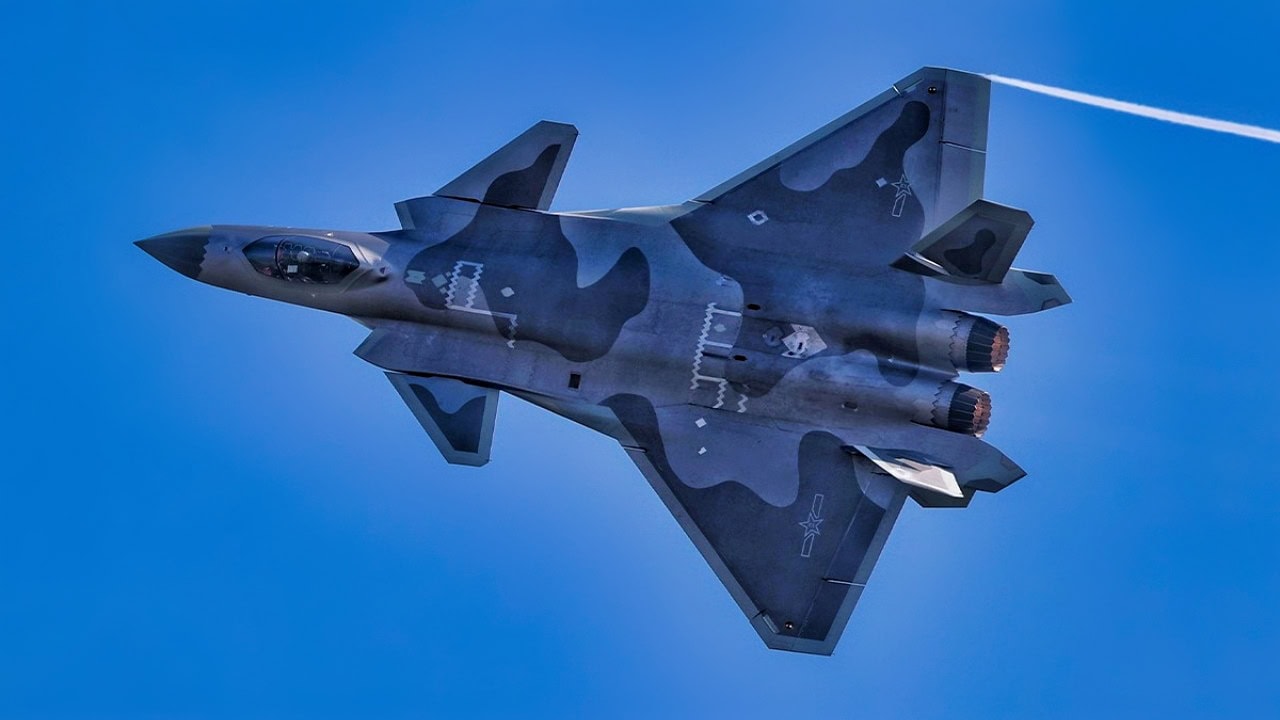
China’s J-20 by the Numbers: Possibly 500 Built, 120 a Year, $110 Million Each, and 6 Missiles Deep – As of August 26, 2026, the most consequential numbers in military aviation belong to a Chinese airplane. The Chengdu J-20 Mighty Dragon, the stealth fighter Beijing built to answer the F-22 and even the F-35 in some respects, has passed 300 documented airframes and may be approaching 500 by high-end estimates, rolling out of its factories at a rate no Western fighter line can match except the F-35’s, while the American jet it was designed against has been out of production for fourteen years.
This is the J-20 through its numbers as they matter, and is the way I like to look at how this plane as it develops. I have been watching this warplane become a powerhouse since 2011, and a lot has changed.
This is the story of where it came from, why it exists, what it costs, how fast it flies, what it carries, how many exist, and how it measures against the best fighters in the West.
J-20: From Blueprint to Brigade
The program began in the late 1990s as J-XX, China’s answer to the F-22’s arrival, and took its modern form in 2008 when the PLAAF endorsed Chengdu’s design under Project 718.
The first flight came on January 11, 2011, timed, by accident or by message, to coincide with the middle of a Beijing visit by US Defense Secretary Robert Gates.
The distinctive shape started arguments that have never stopped: a big delta wing with forward canards, a layout Western engineers debated as a stealth compromise, refined prototype by prototype into a genuinely low-observable design.
The fighter debuted publicly at Zhuhai in 2016, entered service in March 2017, and reached combat units in 2018, after which Beijing used it sparingly and mostly for patrols, in part, analysts assess, to keep Western intelligence from learning its signatures.
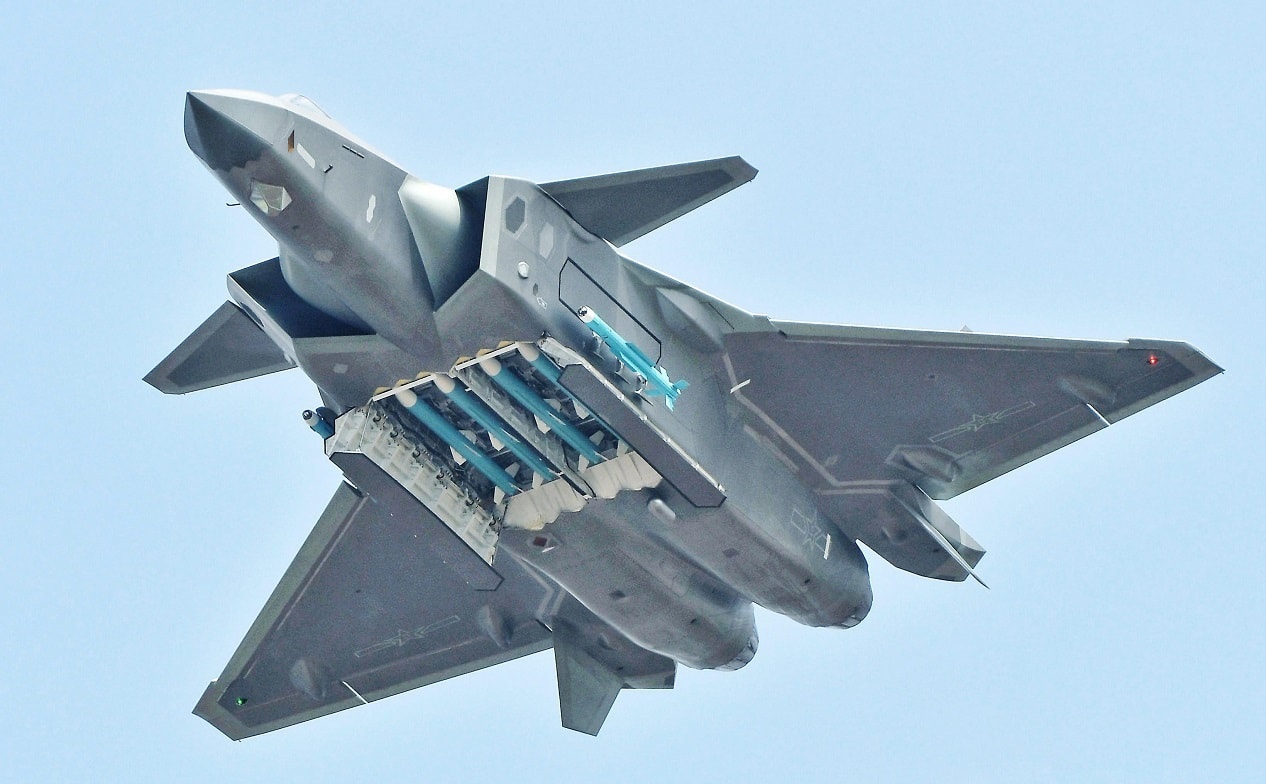
J-20 Stealth Fighter.
Since then, the family has branched into the baseline J-20, the improved J-20A, and the J-20S, the world’s first two-seat stealth fighter, unveiled formally at the September 3, 2025 Victory Day parade, with its back-seater managing electronic warfare and drone wingmen rather than flight controls. The long pole was always the engines.
Early jets flew on Russian AL-31 derivatives; most of the fleet now flies the Chinese WS-10C, and the purpose-built WS-15, intended to deliver genuine supercruise, is now entering service, though the performance claims come largely from Chinese sources and warrant a hedge.
Why China Built It
The J-20 exists because the F-22 and F-35 exist; those are the fighters it was designed to compete against, and Chinese commentary has never pretended otherwise. But the design is not a mirror.
The J-20 is a big airplane, larger than the F-22, with an airframe that spends its size on fuel and reach, a combat radius beyond 1,100 kilometers, and a doctrine to match: rather than duel American stealth fighters head-on, its cardinal mission is to lunge past them at the aircraft that make American airpower work over the Pacific’s distances, the tankers and radar planes that fighters cannot fight without.
Kill the enablers, and the F-35s over the strait become short-legged and blind.
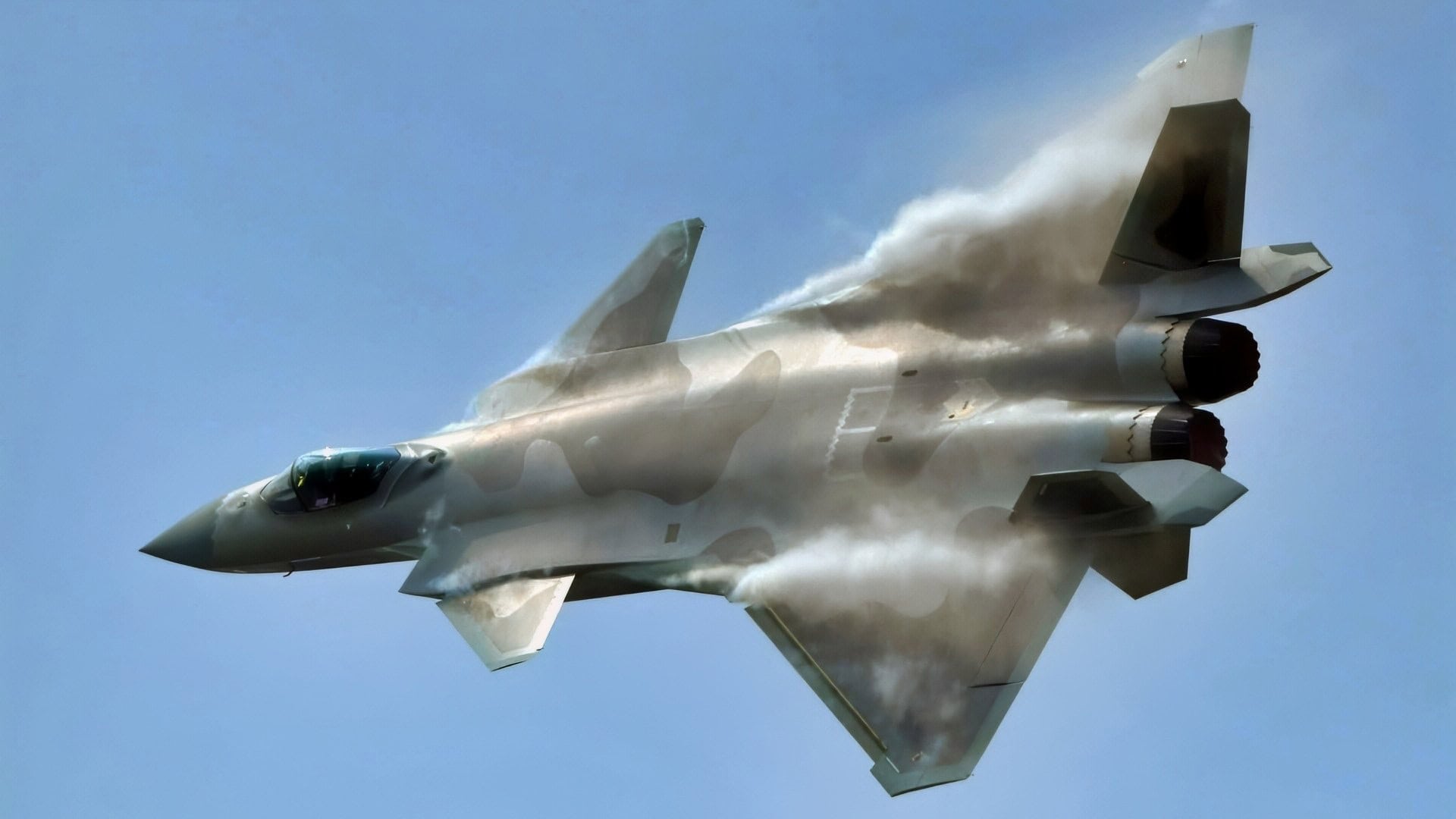
China J-20A Fighter. Image Credit: PLAAF.
The geography of the first island chain wrote the requirement; the J-20 is that strategy with wings, which is also the reading its designers reinforced by omitting any gun. It is not built for the merge.
It is built to shoot first from afar and leave, and the two-seat J-20S extends the same logic upward, a stealthy forward battle manager for drones and missiles in a force that lacks survivable radar planes of its own.
The Numbers of the Mighty Dragon
Cost:
Roughly $110 million per aircraft, by the widely cited Janes estimate, the figure still standing as of this summer, and cheaper than any published accounting of an F-22, though Chinese program costs are opaque and the comparison inexact.
Speed: Mach 2 class, around 2,100 kilometers per hour, with supercruise around Mach 1.8 reported for the newer engines but resting on Chinese claims.
Weapons:
Six missiles internally in standard configuration, four PL-15 long-range radar-guided weapons in the ventral bay and one PL-10 heat-seeker in each side bay on extending rails, with four underwing hardpoints that can add up to eight more PL-15s when stealth is worth sacrificing, against a stated maximum payload around 11,000 kilograms.
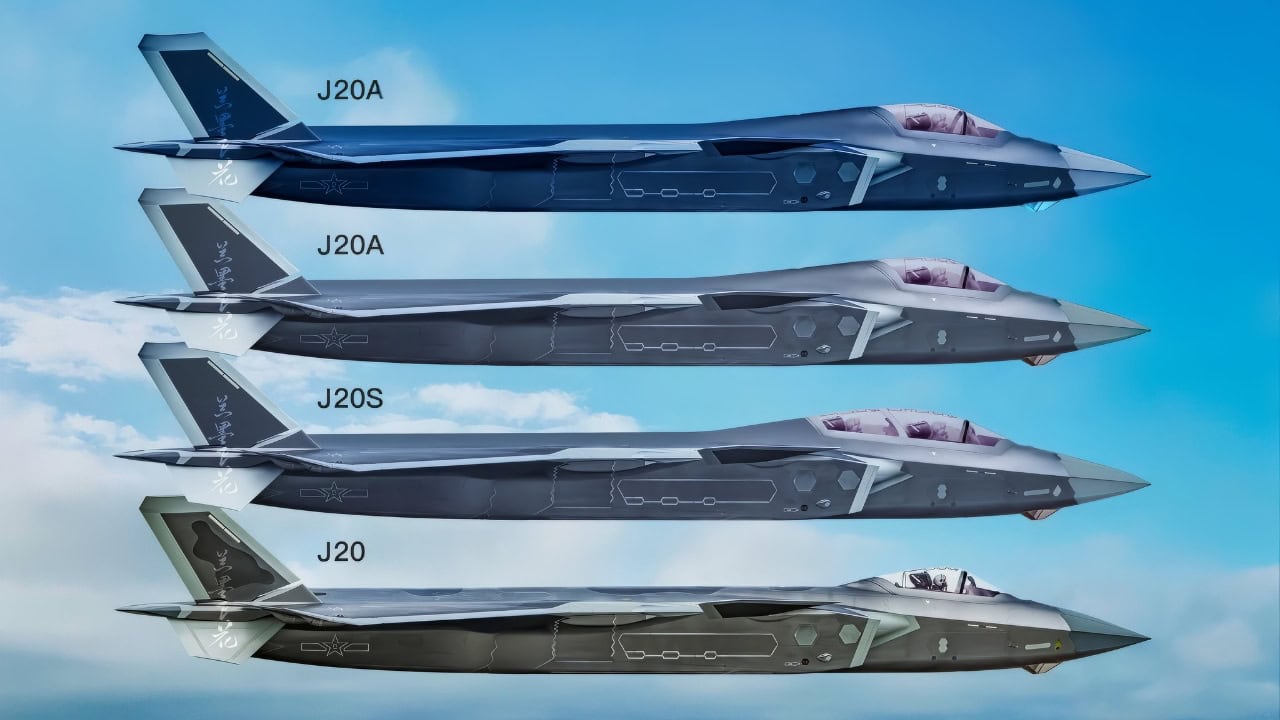
J-20 fighter diagram. Image Credit: Creative Commons.
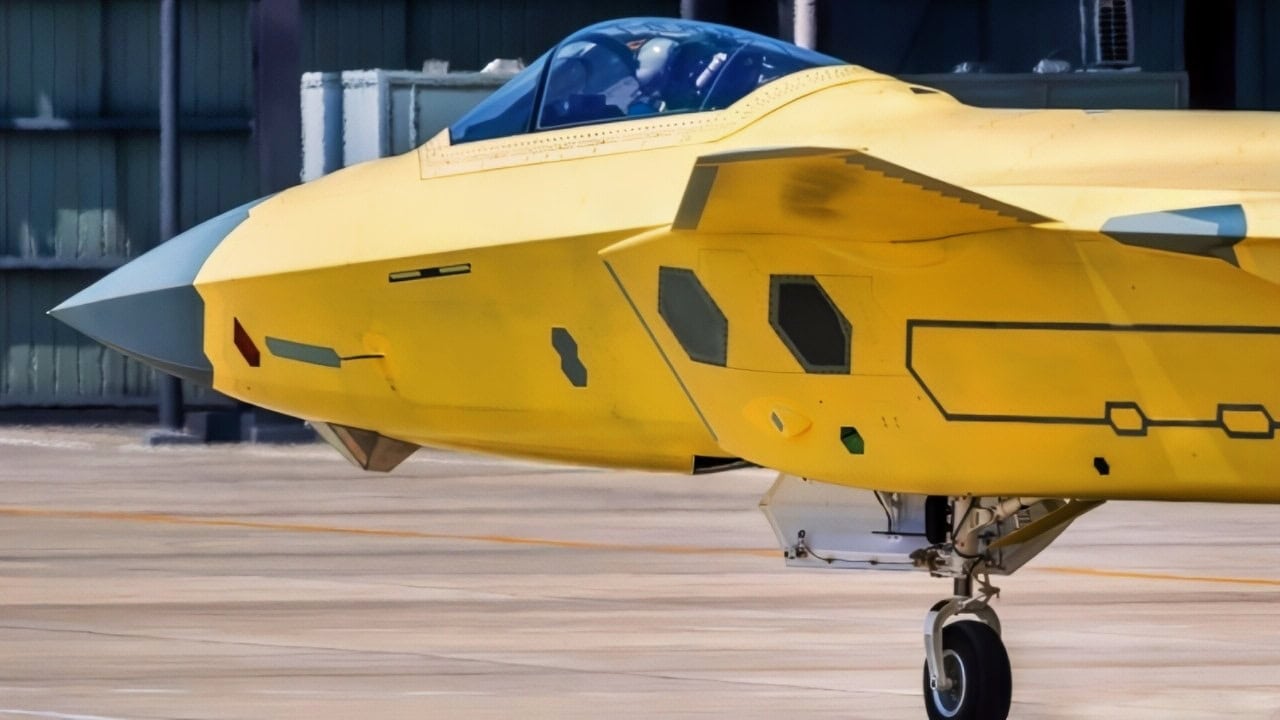
J-20 Fighter in Yellow Paint. Weibo Screenshot.
The PL-15 itself reaches 200 to 300 kilometers at speeds up to Mach 5, and a longer-reaching PL-17 exists for the biggest, slowest targets.
The sensors follow the American model:
AESA radar, electro-optical targeting, 360-degree infrared coverage, and fused cockpit displays. Built: more than 300 documented as of September 2025, with the fleet possibly approaching 500 by this summer on high-end estimates, at a production rate the Royal United Services Institute puts near 120 aircraft per year.
For scale, the F-35, the world’s busiest fighter line, delivers about 156 annually across all customers; the F-22 line has delivered zero since 2012; and the J-20 is now the second most produced stealth fighter in history, still accelerating, with the factories running and the smaller J-35 now joining them as a second stealth type in production.
Against the Best in the West
Measured jet against jet, the West still holds the edge.
The F-22 remains the standard: stealthy from every angle, whereas the J-20 prioritizes the frontal aspect, with published estimates putting the Raptor’s radar cross-section as much as 100 to 3,000 times smaller depending on geometry, plus thrust vectoring, proven supercruise, and a gun for the close fight the J-20 declines.
The F-35 concedes speed but leads the world in sensor fusion and flies in allied numbers past a thousand.
The J-20 is also untested; it has never fired a shot in anger, China publishes no availability rates, flying hours, or exercise results, and American fighter pilots still train against decades of institutional combat experience no parade can manufacture.
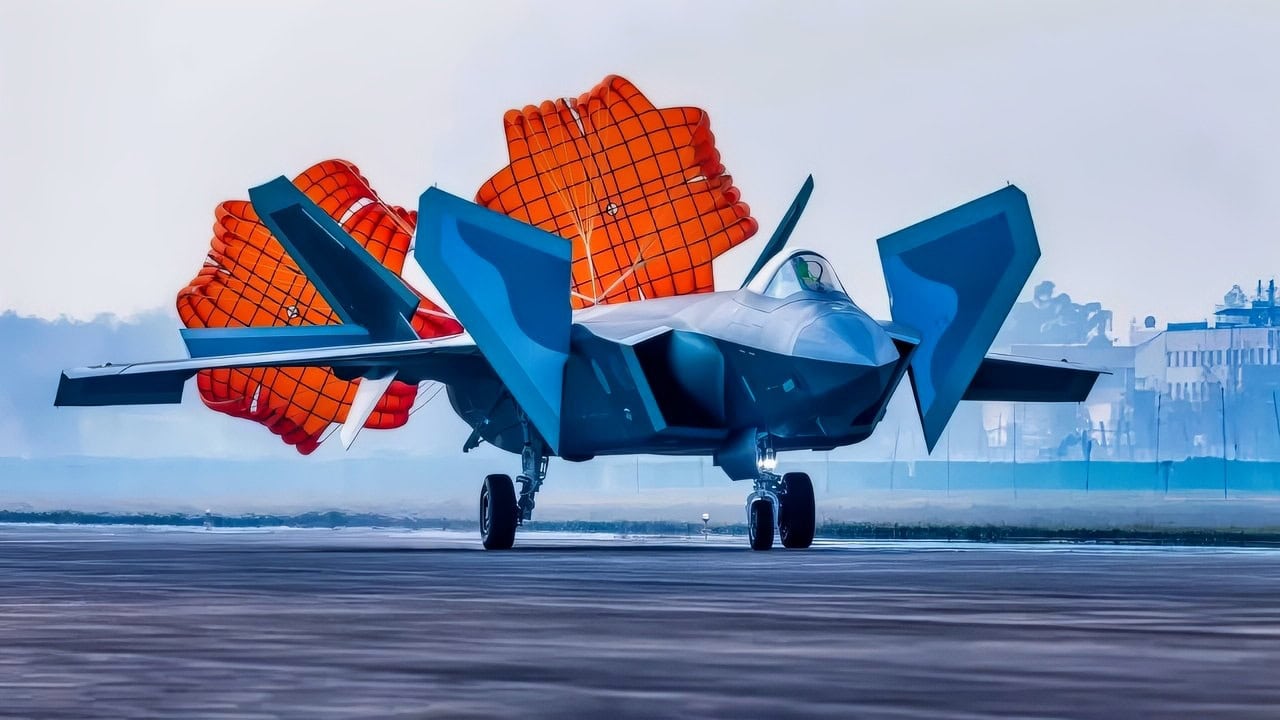
J-20S Fighter from China. Image Credit: Creative Commons.
The honest verdict, as the site’s own assessment puts it, is that the Mighty Dragon is a credible peer competitor, probably, but not yet a proven equal.
But the comparison that decides wars is not one cockpit against another.
China does not need the J-20 to win a duel over Kansas; it needs hundreds of long-armed stealth fighters inside the first island chain, forcing every American tanker orbit and radar aircraft further east, absorbing losses that a 183-jet Raptor fleet cannot, and it is buying exactly that at 120 airframes a year.
The individual answer still favors the West. But for how long? That’s the real question I honestly can’t answer right now.
About the Author: Harry J. Kazianis
Harry J. Kazianis (@Grecianformula) was the former Senior Director of National Security Affairs at the Center for the National Interest (CFTNI), a foreign policy think tank founded by Richard Nixon based in Washington, DC. Harry has over a decade of experience in think tanks and national security publishing. His ideas have been published in the NY Times, The Washington Post, The Wall Street Journal, CNN, and many other outlets. He has held positions at CSIS, the Heritage Foundation, the University of Nottingham, and several other institutions related to national security research and studies. He is the former Executive Editor of the National Interest and the Diplomat. He holds a Master’s degree focusing on international affairs from Harvard University.

