
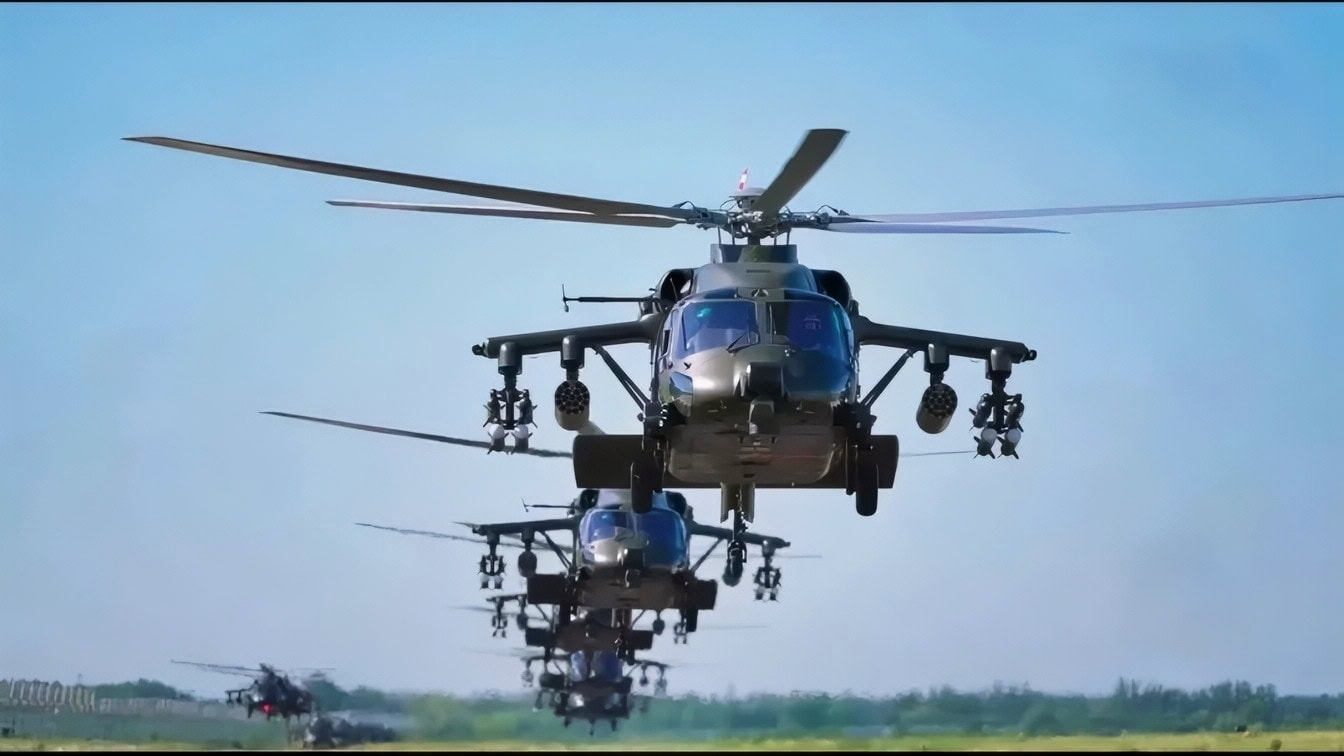
China’s homegrown medium-lift helicopter, the Z-20K, has just completed its most visible overseas showing to date, taking part in a joint airborne exercise with Belarusian forces that wrapped up this week.
Footage released by the People’s Liberation Army (PLA) Air Force showed troops rappelling from the aircraft during the drill, marking a milestone for a program that has quietly matured from a domestic utility helicopter into a platform Beijing is now willing to display to foreign and international audiences.
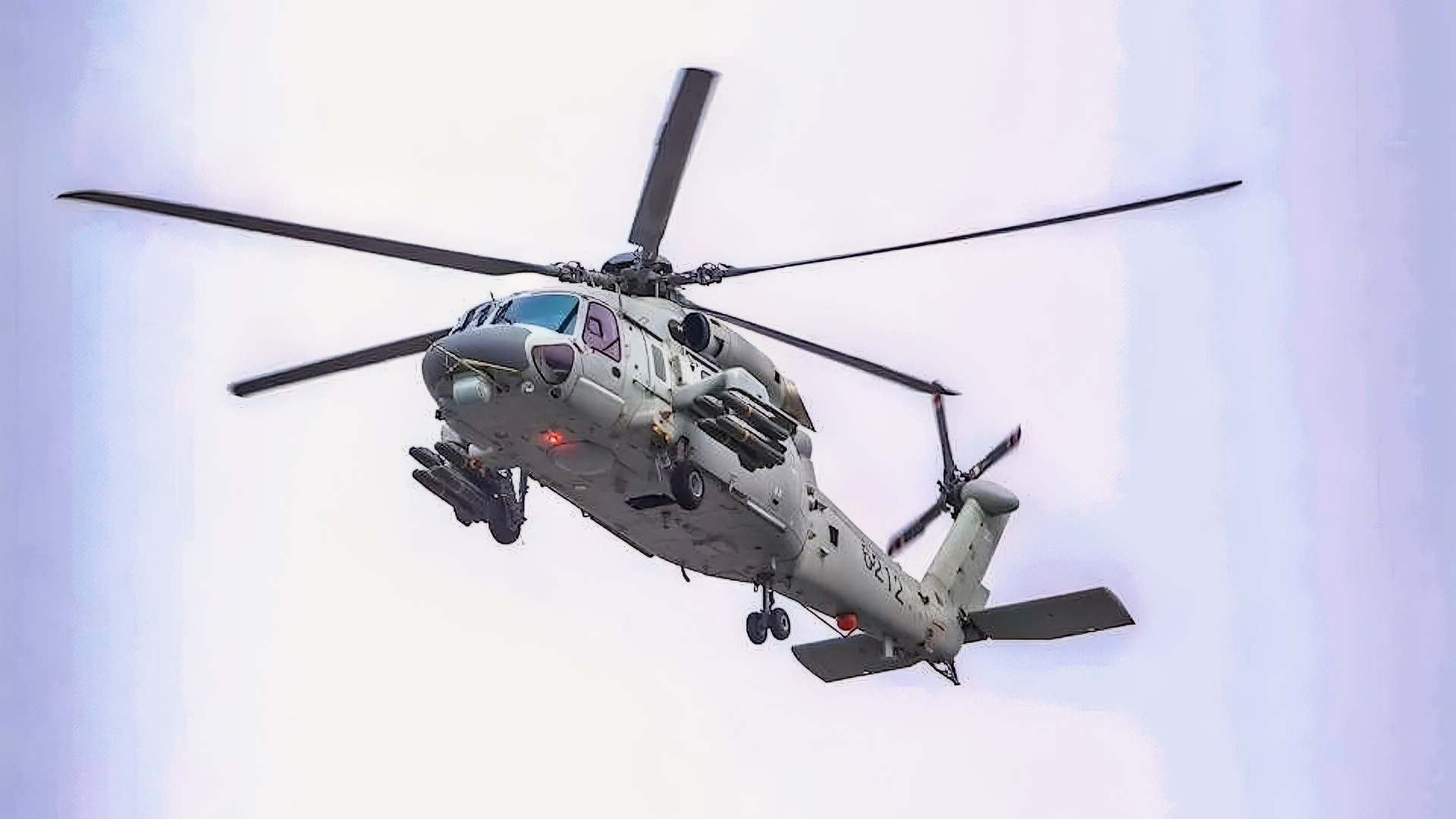
Z-20F Helicopter from China. Creative Commons Image.
It looks remarkably similar to the US Sikorsky Black Hawk helicopter and has similar performance and capabilities. Many analysts agree that the Z-20’s design stems from reverse engineering civilian S-70 Black Hawks that China bought in the 1980s.
The Swift Eagle 2026 Exercise
The helicopter appeared during “Swift Eagle 2026,” the fourth iteration of a joint training exercise between Chinese and Belarusian airborne troops.
Launched in mid-August, the exercise was structured in three phases: basic training, coordinated refinement, and comprehensive drills, and was hosted at a PLA Air Force training center rather than on Belarusian soil, with Belarusian personnel traveling to Hubei Province in China to participate alongside their Chinese counterparts.
The drills emphasized counter-terrorism and airborne assault skills: helicopter rappelling, air assault insertions, parachute jumps, coordinated movement with armored vehicles, and simulated urban combat.
Notably, organizers chose helicopter insertion methods over the fixed-wing parachute drops that have traditionally dominated Chinese airborne doctrine.
A Chinese military affairs expert quoted in state media argued this reflects a deliberate shift: counter-terrorism operations demand the kind of flexibility and precision that only rotary-wing assault platforms can provide, and the choice to lean on the Z-20K signals that the type has now reached a level of technical maturity and training reliability that commanders trust for this mission set.
According to the same commentary, having the aircraft perform in an international joint exercise is itself evidence that the Z-20K has moved past developmental testing and into a genuinely combat-ready phase, one likely to see it featured in more joint exercises abroad and in real PLA counter-terror taskings at home.
It’s worth noting that the exercise took place alongside a broader wave of Belarusian and Russian military activity this month, including a separate Belarusian Air Force and Air Defense Troops exercise running from late August into early September with a second phase held at a range inside Russia, a reminder that China’s engagement with Minsk is unfolding against the backdrop of Belarus’s deepening security relationship with Moscow.
Meet The Z-20K Helicopter
Despite sometimes being labeled an “assault helicopter” in casual reporting, the Z-20K is fundamentally a utility and troop-transport aircraft, not a dedicated gunship.
It is the airborne-forces variant of the broader Z-20 family developed by Harbin/AVICOPTER, and Chinese state broadcaster CCTV describes it as the airborne force’s primary air assault platform, meaning its job is to get an entire infantry squad into a landing zone quickly, not to loiter and provide fire support the way an attack helicopter like the Z-19 or Apache would.
The version seen in Belarus was painted in a distinctive silver-white model and is built to carry a full squad for air assaults while also handling equipment sling-loads and casualty or supply transport.
The broader Z-20 family is closely associated, visually and functionally, with the American Sikorsky UH-60 Black Hawk, a resemblance that has fueled years of debate over whether the design borrowed directly from Black Hawk airframes China obtained decades ago (including, some have speculated, examination of the stealth Black Hawk wreckage left behind after the 2011 raid that killed Osama bin Laden).
Chinese officials have pushed back on the “copy” framing, pointing to real engineering differences: a five-bladed main rotor instead of the Black Hawk’s four, domestically produced WZ-10 turboshaft engines rated in the 1,600 kW class, fly-by-wire flight controls, rotor de-icing for high-altitude operation above 4,000 meters, and active vibration and acoustic controls aimed at reducing detectability.
The aircraft can carry roughly 11 to 15 fully equipped troops internally, move about 1.5 tons of cargo inside the cabin, or sling-load up to 5 tons externally, figures broadly comparable to, and in some respects exceeding, the Black Hawk it visually echoes.
Why the Z-20K Appearance Is Significant
For years, the Z-20 family was primarily a story about replacing an imported airframe with a domestic one, filling gaps in Chinese ground, naval, and airborne aviation that a small, aging fleet of American-built Black Hawks acquired in the 1980s had previously covered.
Its deployment thousands of kilometers from home for a live joint drill is being read in Chinese state media as a different kind of signal: proof that the platform, and the airborne assault doctrine built around it, is ready for export-style demonstrations of reach.
The same week, PLA Air Force units were reported training separately with Thailand and Egypt, suggesting Beijing is using August’s exercise calendar to showcase, simultaneously across multiple regions, a Chinese air force capable of projecting training partnerships well beyond its home theater.
For Belarus, the exercise fits a now-established pattern of periodic “Swift Eagle” cooperation with China’s airborne forces, running alongside Minsk’s much deeper, longer-standing military dependence on Russia.
Whether the Z-20K’s appearance in Belarus leads to further Chinese-Belarusian defense cooperation, or was primarily a one-off training and messaging opportunity, will likely become clearer as the “Swift Eagle” series continues in future years.
About the Author: Steve Balestrieri
Steve Balestrieri is a National Security Columnist. He served as a US Army Special Forces NCO and Warrant Officer. In addition to writing on defense, he covers the NFL for PatsFans.com and is a member of the Pro Football Writers of America (PFWA). His work was regularly featured in many military publications.