
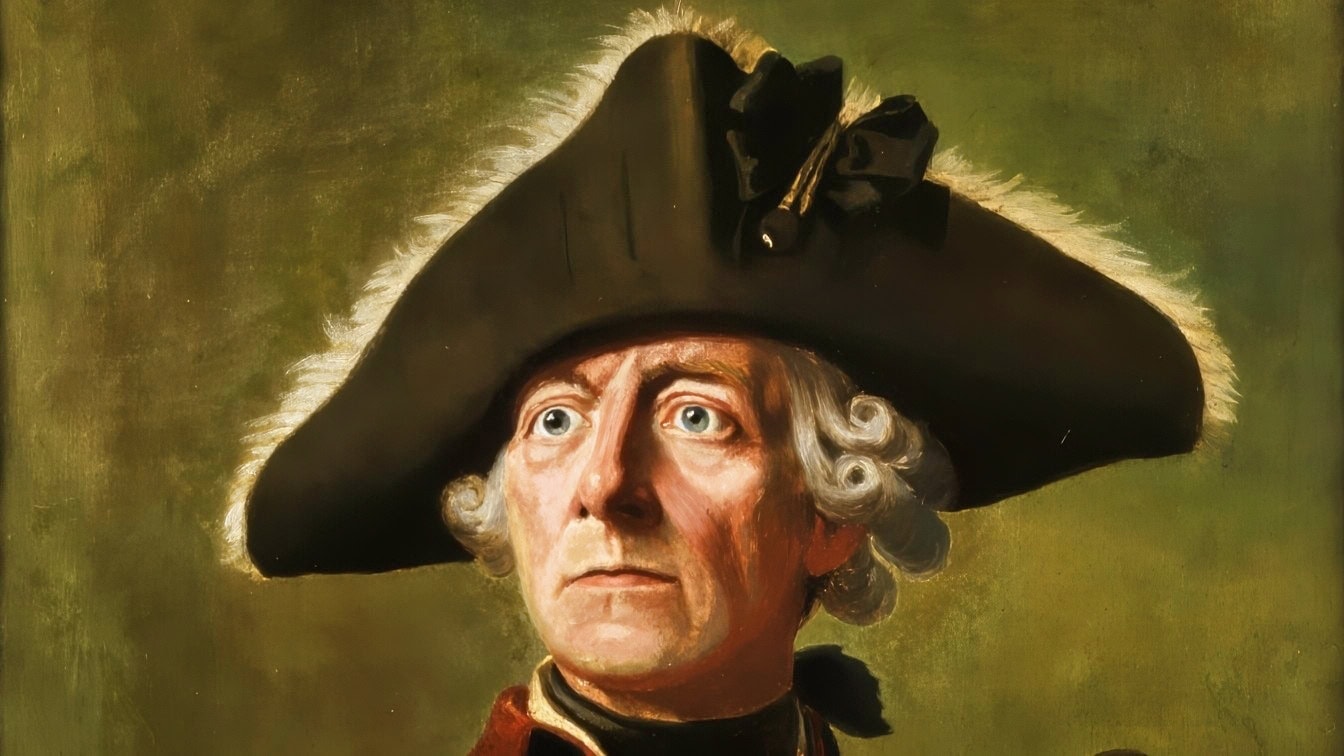
Summary and Key Points: “He who defends everything defends nothing.” Frederick II of Prussia — Frederick the Great — spent forty-six years on the throne, demonstrating his true military genius and ability to rule. Born in January 1712, the son of a hard soldier-king and the grandson of George I of England, he wanted to study music and philosophy but received military training instead. In 1730, at eighteen, he tried to escape to England. He was caught, court-martialed, and forced by his father to stand and watch his closest friend be beheaded. He submitted, studied, married the woman his father chose in 1733, and came to the throne in 1740 at twenty-eight.
Military Quote of the Day: “He who defends everything defends nothing.” – Frederick the Great
Frederick II, known as Frederick the Great, was the King of Prussia in the 18th century, serving from 1740 until his death in 1786.
According to a History Channel biography, Frederick led his nation through several wars during his reign.
“His daring military tactics expanded and consolidated Prussian lands, while his domestic policies transformed his kingdom into a modern state and formidable European power,” the History Channel bio said.
Known as a “philosopher-king,” Frederick was noted for his affinity for the Enlightenment and his appreciation for music and the arts.
His Early Life
According to the History Channel biography, Frederick was born in January 1712, the son of the previous king, Frederick Wilhelm I; his mother’s father was George I, king of England.
When his son expressed interest in the arts, his stern father sent him to military training instead.
In 1730, Frederick tried to escape to England, seeking “personal freedom and a new Prussian alliance with the British. He was caught, court-martialed, and forced by his father to watch as his best friend was decapitated.”
He eventually returned to Prussia and continued both his military studies and his artistic pursuits.
He married Elizabeth of Brunswick-Bevern in 1733.
Then, in 1740, when he was 28, Frederick assumed the throne of Prussia as Frederick II upon his father’s death.
The Wars Begin
Almost immediately, the new king invaded the Austrian region of Silesia, sparking the War of the Austrian Succession, which continued through 1748.
This led to the young king earning the moniker Frederick the Great through his military victories.
But Frederick had other plans for his rule.
“Over the next decade he enacted a number of major reforms and domestic projects. He began to revamp and standardize Prussia’s justice system along Enlightenment lines, banning torture and arguing for a uniform national criminal code,” the History Channel biography said. “He liberalized control of the press and supported a moderate level of religious freedom.”
He also expanded the capital, Berlin.
Another War, and More Domestic Projects
In 1756, war returned as the Diplomatic Revolution pitted Austria, France, and Russia against Prussia and England. In response, Frederick attacked Saxony that year.
This was called the Seven Years’ War, and it continued until 1763. At that point, the king once again turned his attention to domestic matters.
This included, the History Channel biography said, “reorganizing the Prussian government into separate ministries to allow rational division of tasks and easy executive control. He ordered the development and colonization of unused land in his expanded kingdom, and introduced the turnip and potato as major food crops.”

Cannon Firing. Image Credit: Creative Commons.
Frederick the Great died on August 17, 1786, at his palace in Potsdam.
“Frederick’s long reign unified Enlightenment rationalism and military tradition, yielding a highly trained army and a militaristic system of public education,” the History Channel biography says.
Later military leaders were influenced by him. According to the bio, Napoleon visited Frederick’s tomb in 1806, while Adolf Hitler “hid the king’s body in a salt mine” while the Allies were bombing Germany in World War II.
The Quote
“He who defends everything defends nothing” is a quote often attributed to Frederick the Great.
The quote is attributed to “Military Instructions from the Late King of Prussia to His Generals,” published in 1798, 12 years after the king’s death. There doesn’t seem to be much doubt about the quote’s authenticity.
What does it mean?
“Patience, audacity and offensive mindedness in equal measure seem to be essential too. Frederick’s example also cautions against expectations of a short war and the folly of dispersing one’s forces too broadly,” The Strategist wrote of the quote’s military meaning. “Concentration of force, after all, was the essence of Frederick’s genius.”
The quote has had numerous applications over the years, from information technology security to investing to the Trump Administration’s national security policies.
Americans for Prosperity, in an article in 2025 about Trump’s National Security Strategy, cited the Frederick the Great quote and called it “a central insight of strategy: not everything matters equally… Past National Security Strategies routinely ignored this reality and treated geographic breadth and moral ambition as substitutes for strategic focus.”
About the Author: Stephen Silver
Stephen Silver is an award-winning journalist, essayist, and film critic, and contributor to the Philadelphia Inquirer, the Jewish Telegraphic Agency, Broad Street Review, and Splice Today. The co-founder of the Philadelphia Film Critics Circle, Stephen lives in suburban Philadelphia with his wife and two sons. For over a decade, Stephen has authored thousands of articles that focus on politics, national security, technology, and the economy. Follow him on X (formerly Twitter) at @StephenSilver, and subscribe to his Substack newsletter.