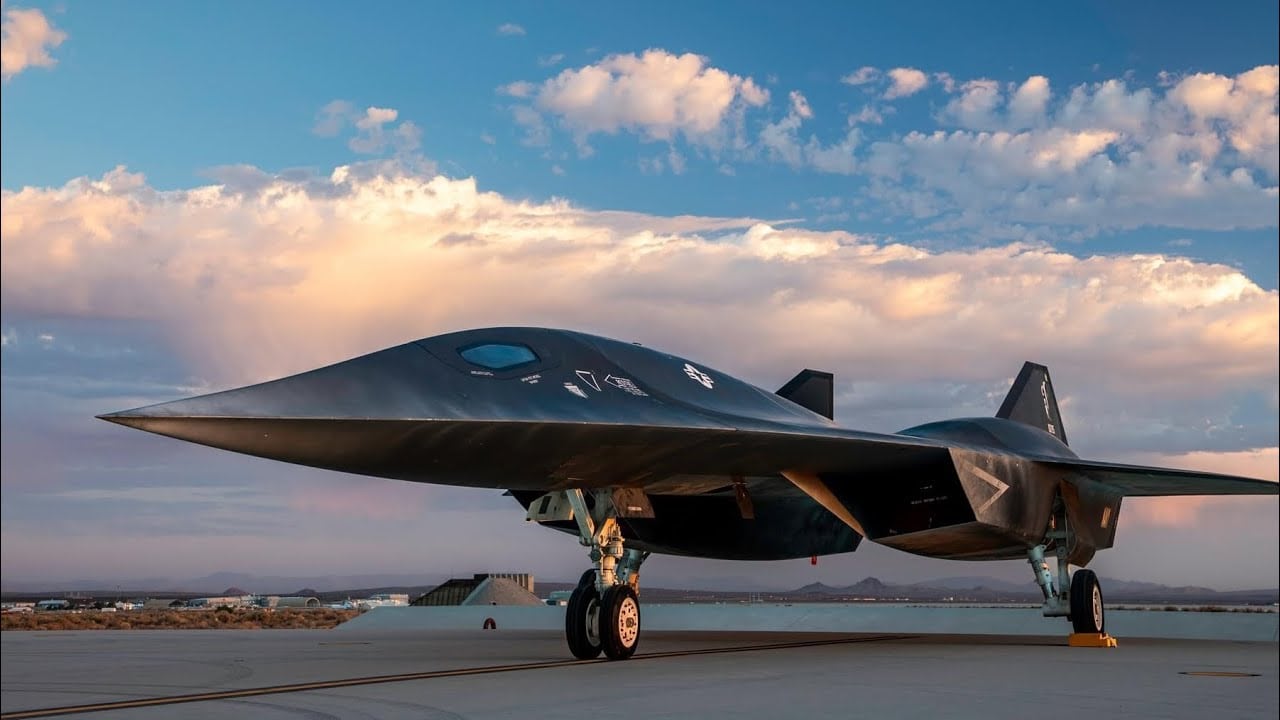
Key Points: Speculation about the existence of the SR-72 “Son of Blackbird” hypersonic aircraft surged after the Top Gun: Maverick movie featured a realistic “Darkstar” mockup, designed with Lockheed Martin input.
-Producer Jerry Bruckheimer confirmed reports the US Navy stated China re-tasked a spy satellite to photograph the prop, believing it was real. This incident underscores the interest in a potential Mach 6+ successor to the SR-71 for high-speed ISR.
-While hints from Lockheed persist, and advanced propulsion concepts exist, the SR-72’s actual development status remains highly classified and unconfirmed, facing future challenges from evolving air defense technologies.
SR-72 Darkstar in ‘Top Gun’ Wowed Audiences—It Also Worried the Chinese:
While filming the latest “Top Gun,” Chinese spy satellites trained their eyes on mockups of the SR-72, a proposed—but still speculative—hypersonic spy plane.
The SR-72 Darkstar Explained
The SR-72 is a proposed hypothetical aerospace project supposedly in development by Sunk Works, the secretive development arm of Lockheed Martin. It would be, in essence, a modern redesign of the Cold War-era SR-71 Blackbird reconnaissance jet.
Though still speculative, the SR-72 might, if realized, approach or achieve hypersonic Mach 6 speeds, roughly three times the speed of its predecessor. If realized, the SR-72 would be a difficult bird to bag with today’s air defenses.
Rumors, hearsay, and speculation about the SR-72—the so-called “Son of Blackbird” successor to the Cold War-era SR-71 spy plane have run rampant. But could the hypersonic manned jet be real? And if it is, could it exceed the capabilities of its impressive predecessor?
Some have certainly thought so.
Enough to Fool the Chinese—but Was it a Joke?
The SR-72 made its silver screen debut during the latest Top Gun franchise flick when Tom Cruise’s character piloted the air-breathing, hypersonic jet during a blistering test flight.
Though audiences were wowed, some believed the jet was the genuine article.
During a video interview with Sandboxx News, Top Gun director Jerry Bruckheimer confirmed that, according to the United States Navy, the Chinese trained some of their satellite assets to attempt seeing the SR-72, so great was its likeness to an aircraft that could actually fly.
“The Navy told us that the Chinese satellite turned and had a different route to photograph that plane—they thought it was real—that’s how real it looks,” Bruckheimer explained.
Powerplant
If realized, the power plants needed to propel a manned aircraft at Mach 6-plus speeds would be a remarkable feat of aeronautical engineering—but painfully, little is publicly known about an SR-72-like plane. Still, if that project is a reality, the jet’s engines would likely be akin to turbine-based combined cycle (TBCC) engines, which combine the qualities of conventional jet engines for flight at sub and supersonic speeds, and that of a scramjet for flight at hypersonic speeds.
Hypersonic flight offers several distinct advantages for an aircraft like an SR-72. While the current generation of fifth-generation aircraft leverages its stealth capabilities to avoid detection by enemy radar systems and minimize its own radar cross-section, hypersonic flight speeds could, in theory, allow an aircraft to simply outfly—outrun—enemy air defense missiles entirely.
An Aeronautical Arms Race?
However, pure speed alone, even hypersonic speeds, might not be enough in the future. At the present moment, a manned aircraft like an SR-72 could likely outfly most air defenses, particularly if it managed to retain some maneuverability. But defensive technology is rapidly becoming more sophisticated.
If a “demonstrator aircraft can maintain level flight at Mach 6 using the new technology, a new international race could be triggered to develop hypersonic combat aircraft comparable to the fifth-generation stealth fighter rivalry between the West, Russia, India and China,” a report on hypersonic flight by the Royal United Services Institute, a British defense and security think tank, explained.
“Certainly a Mach 6 cruise at operating altitudes of around 100,000ft would make SR-72 extremely challenging to intercept with traditional SAM systems,” the Royal United Services Institute said. “However, it is possible that progress in the anti-ballistic missile (ABM) field might challenge this theory.
“The Raytheon Standard Missile 3 (SM-3) series recently demonstrated its capability to shoot down both low-orbit satellites and ballistic missiles. Although the SM-3 is not designed for anti-aircraft work, its ability to intercept targets at extremely high altitudes and at closing speeds of over 22,000 mph could suggest that by the time SR-72 might enter service around 2030, SAMs could possess similar performance.”
A Capability Gap?
Following the retirement of the SR-71 Blackbird in 1998, the United States effectively lost the ability to push surveillance and reconnaissance assets to significant areas of land very quickly, opting instead to rely on more persistent—but less flexible—satellite assets.
However, recent reporting adds fuel to the SR-72 speculation fire.
Recent reporting from Aviation Week, an aerospace magazine, points to recent—costly—budget overruns by Lockheed Martin and its Skunk Works division.
Though that branch’s financials are a closely guarded secret, the significant losses the company has sustained could point to a pricey development process—maybe even for a project as ambitious as the SR-72.
What Happens Now?
The SR-72 Darkstar is indeed a highly ambitious platform—and, as of now, still decidedly unconfirmed—but Lockheed Martin, the firm that would be behind the design, should it see the light of day, has previously expressed assuredness in the possibility of the project becoming a reality.
Wishful thinking? Shrewd marketing? Or something else entirely? It’s too soon to tell.
If a hypersonic Mach 6-plus aircraft like the SR-72 can get off the drawing board and into the skies, it remains to be definitively seen.
About the Author: Caleb Larson
Caleb Larson is an American multiformat journalist based in Berlin, Germany. His work covers the intersection of conflict and society, focusing on American foreign policy and European security. He has reported from Germany, Russia, and the United States. Most recently, he covered the war in Ukraine, reporting extensively on the war’s shifting battle lines from Donbas and writing on the war’s civilian and humanitarian toll. Previously, he worked as a Defense Reporter for POLITICO Europe. You can follow his latest work on X.