
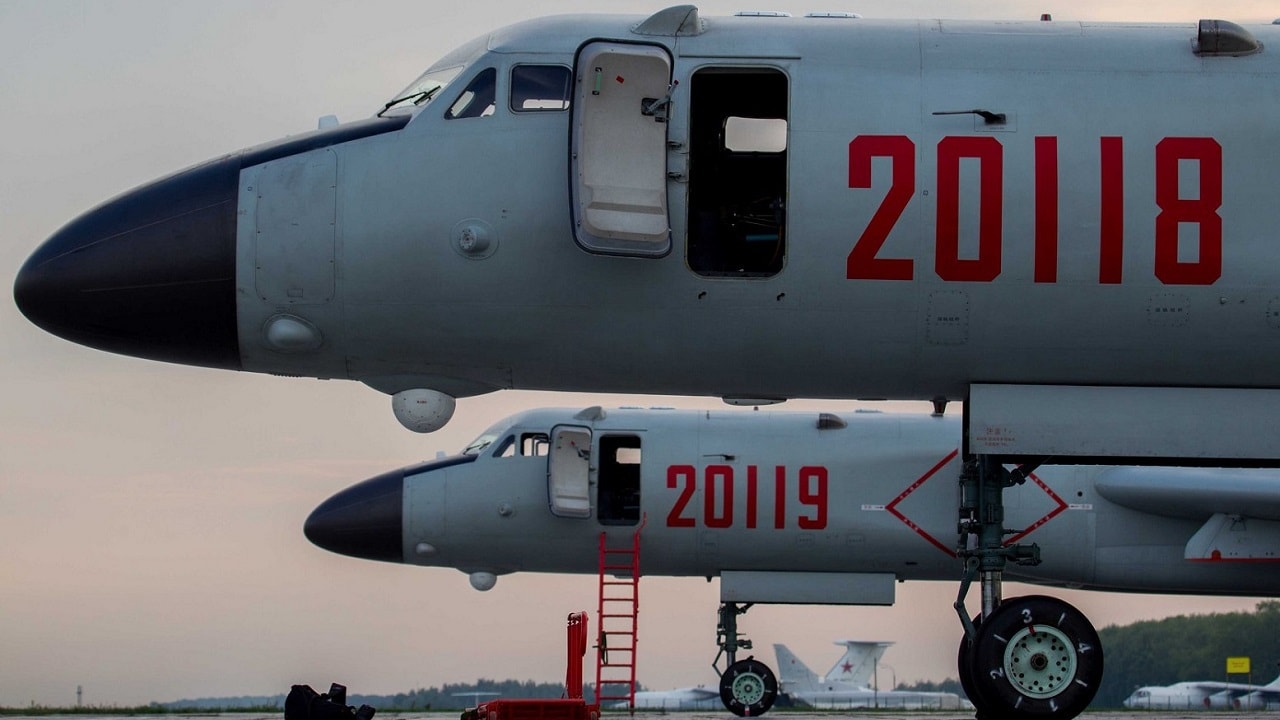
The H-6K Bomber from China: Article Summary
-China’s H-6K Zhanshen bomber may be based on a 1950s Soviet design, but it remains a serious long-range threat. A modernized Tu-16 clone built by Xi’an, the H-6K carries land-attack and anti-ship cruise missiles – including the KD-21 “carrier killer” with hypersonic speeds and 1,500 km reach.

H-6 Bomber.
-Backed by more than 200 airframes in PLAAF and PLANAF service, it gives Beijing a standoff strike option against bases and carrier groups across the Indo-Pacific.
-While the stealthy H-20 grabs headlines, the “War God” is the bomber U.S. and allied planners must still respect today.
H-6K Zhanshen (“War God”) Bomber Explainer
When it comes to China’s strategic bomber forces, a lot of focus understandably falls on the upcoming Xi’an H-20 sixth-generation stealth bomber.
But no one should sleep on China’s current strategic bomber, even if it is of Cold War vintage.
Make no mistake, the H-6K Zhanshen (“War God”)—which is also built by Xi’an—is still plenty deadly.
Xi’an H-6 Initial History
If the H-6 looks strangely familiar, it should. As is true of a number of Chinese warbirds, it is a copy of a Soviet-designed warplane. “Imitation is the sincerest form of flattery,” as the saying goes, and in this instance it is the Tupolev Tu-16 (NATO reporting name “Badger”) that should be flattered.
The Tu-16 made its operational debut in April 1952. In September 1957, the Soviet Union signed an agreement to license production of the Tu-16 to China.
Assembly of the Chinese Badger copies was assigned to the Xi’an Aircraft Industrial Corporation, headquartered in the Yanliang district of Shaanxi. The first Xi’an-built production H-6 bomber completely manufactured in China made its maiden flight on Dec. 24, 1968.
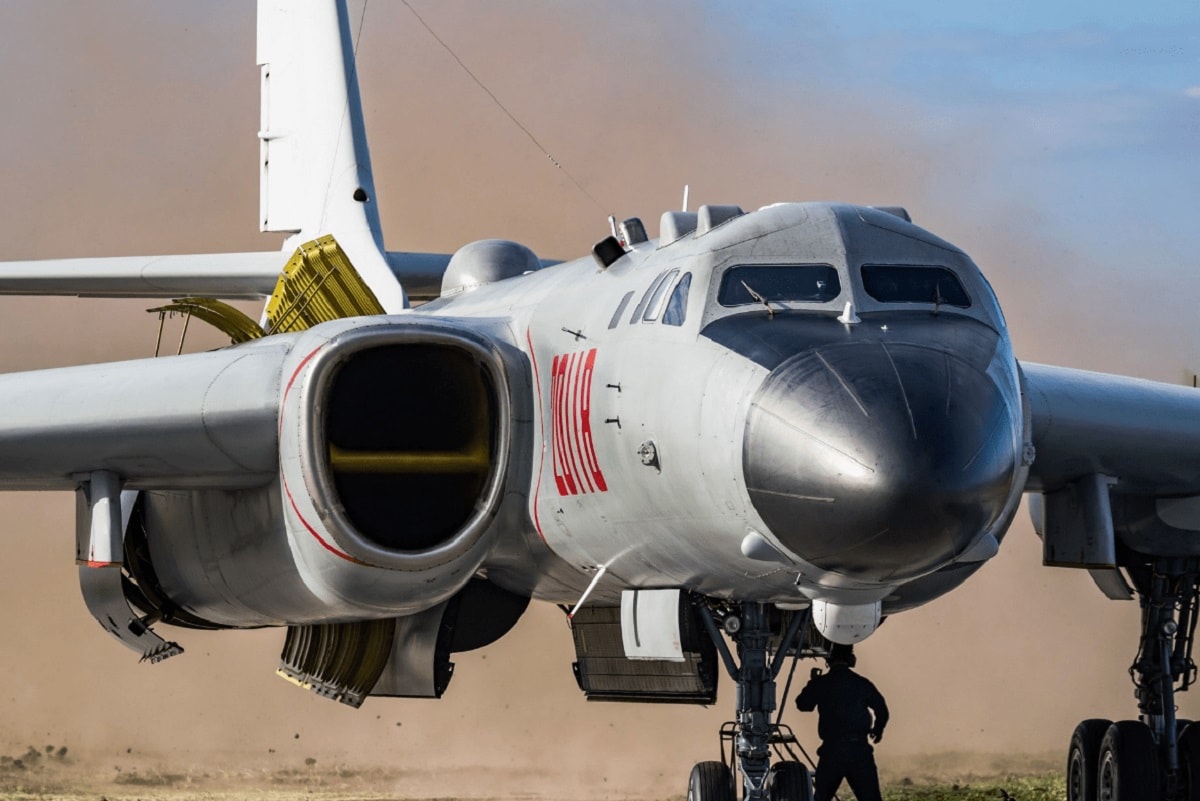
Image: Creative Commons.
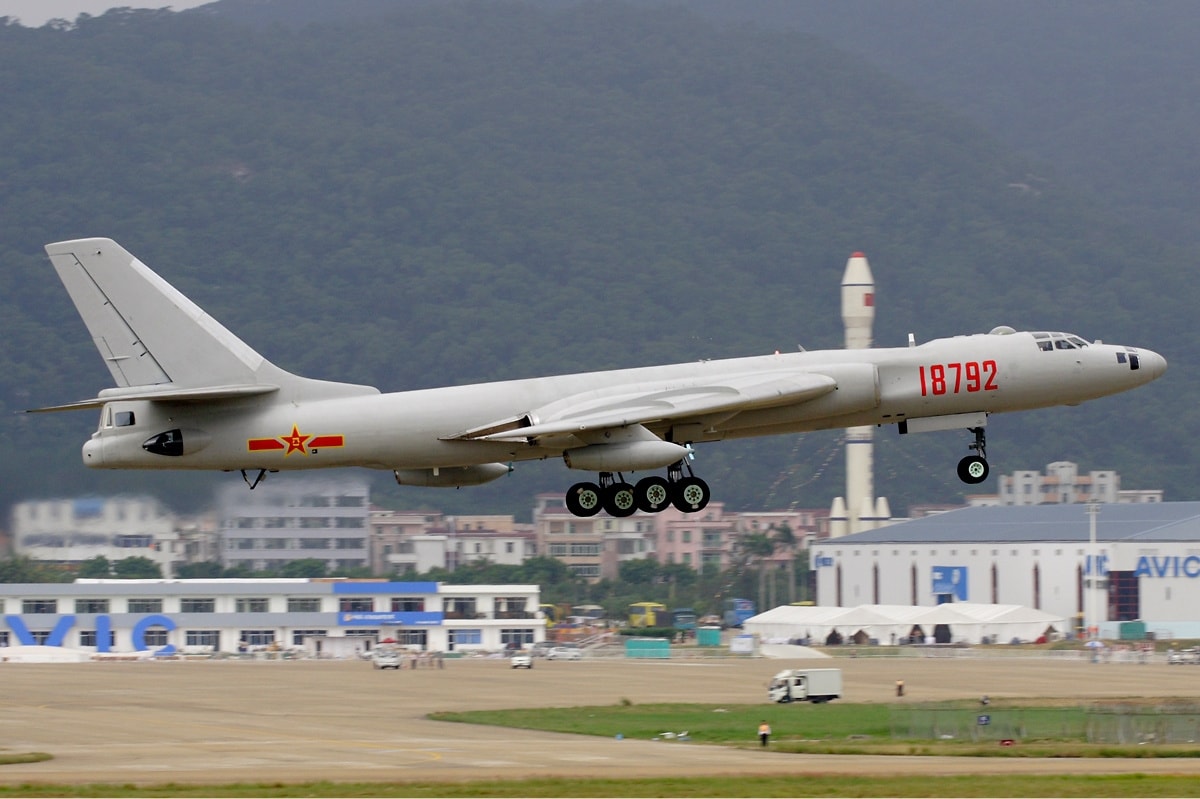
PLANAF HY-6U with aerial refuelling pods (2008) “The most distinct difference between HY-6U and HY-6D is that HY-6U has a metal nose cone, while HY-6D still has the transparent glass nose”.
The H-6 was initially designed as purely a nuclear bomber, but by 1976 it was converted to a dual nuclear/conventional bombing role.
Besides the People’s Liberation Army Air Force (PLAAF) and People’s Liberation Army Naval Air Force (PLANAF), the bomber was also purchased in modest numbers by the air forces of Egypt and Iraq.
H-6 Technical Specifications and Vital Stats
Crew: 4 (pilot, co-pilot, navigator/bombardier, gunner)
Fuselage Length: 34.8 m (114 ft 2 in)
Height: 10.36 m (34 ft 0 in)
Wingspan: 33 m (108 ft 3 in)
Max Takeoff Weight: 95,000 kg (209,439 lb)
Powerplant: 2 × WP-8 turbojet engines, generating 93.1 kilonewtons (20,900 pounds-force) of thrust
Max Airspeed: Mach 0.82 (1,014 km/h, 630 mph, 570 knots)
Ferry Range: 6,000 km (3,728 miles)
Combat Range1,800 km (1,120 miles)
Service Ceiling: 13,100 m (42,980 ft.)
Armament:
Guns: 2× 23mm cannons in remote dorsal turret, 2× 23mm cannons in remote ventral turret, 2× 23mm cannons in manned tail turret; some specimens also 1× 23mm cannons in the nose
Missiles: 6× YJ-63 missile (anti-ship or air-to-surface); 6× CJ-10/ CJ-20 (air launched land attack cruise missile); 6× YJ-12 (anti-ship cruise missile); 1× CH-AS-X-13 (H-6N variant only), 4× KD-21 (anti-ship ballistic missile) (H-6K variant only)
Bombs: 12,000 kg (26,400 lb.) of free-fall bombs or guide bombs
Of particular concern to U.S. Navy carrier strike groups operating in the Indo-Pacific region is the KD-21 ship-killing missile wielded by the H-6K variant of the War God. The KD-21 is the air-launched version of the Yīngjī-èryāo (“Eagle Strike”) YJ-21 missile, which reportedly has an operational range of approximately 1,500 kilometers, with estimates for max airspeed ranging between Mach 6 and Mach 10.
According to the World Directory of Modern Military Aircraft, the PLAAF has a total of 209 H-6s while the PLANAF has 30.
Operational History in Brief
As far as we can ascertain, the only entity to use the H-6 in combat was Saddam Hussein’s Iraqi Air Force against the forces of Ayatollah Ruhollah Khomeini during the Iran-Iraq War of the 1980s. (China has lacked real-world combat experience since the Sino-Vietnamese War of 1979.)
Configuring their bombers to fire the Silkworm anti-ship missile, Iraqi H-6 drivers managed to inflict some damage on Iran’s cargo vessels. On Feb. 5, 1988, an Iraqi Air Force H-6D scored a hit on the Iranian freighter Entekhab.
Over the remaining six months of that conflict, Iraqi H-6Ds scored hits with their Silkworms against an additional 14 Iranian tankers and bulk carriers. In addition, one Iraqi H-6D was shot down by an Iranian Air Force F-14.
The last three of Saddam’s H-6Ds were destroyed during U.S. bombing raids against Al Taqaddum Air Base in the 1991 Persian Gulf War.
About the Author: Christian D. Orr, Defense Expert
Christian D. Orr is a Senior Defense Editor. He is a former Air Force Security Forces officer, Federal law enforcement officer, and private military contractor (with assignments worked in Iraq, the United Arab Emirates, Kosovo, Japan, Germany, and the Pentagon). Chris holds a B.A. in International Relations from the University of Southern California (USC) and an M.A. in Intelligence Studies (concentration in Terrorism Studies) from American Military University (AMU). He is also the author of the newly published book “Five Decades of a Fabulous Firearm: Celebrating the 50th Anniversary of the Beretta 92 Pistol Series.”