
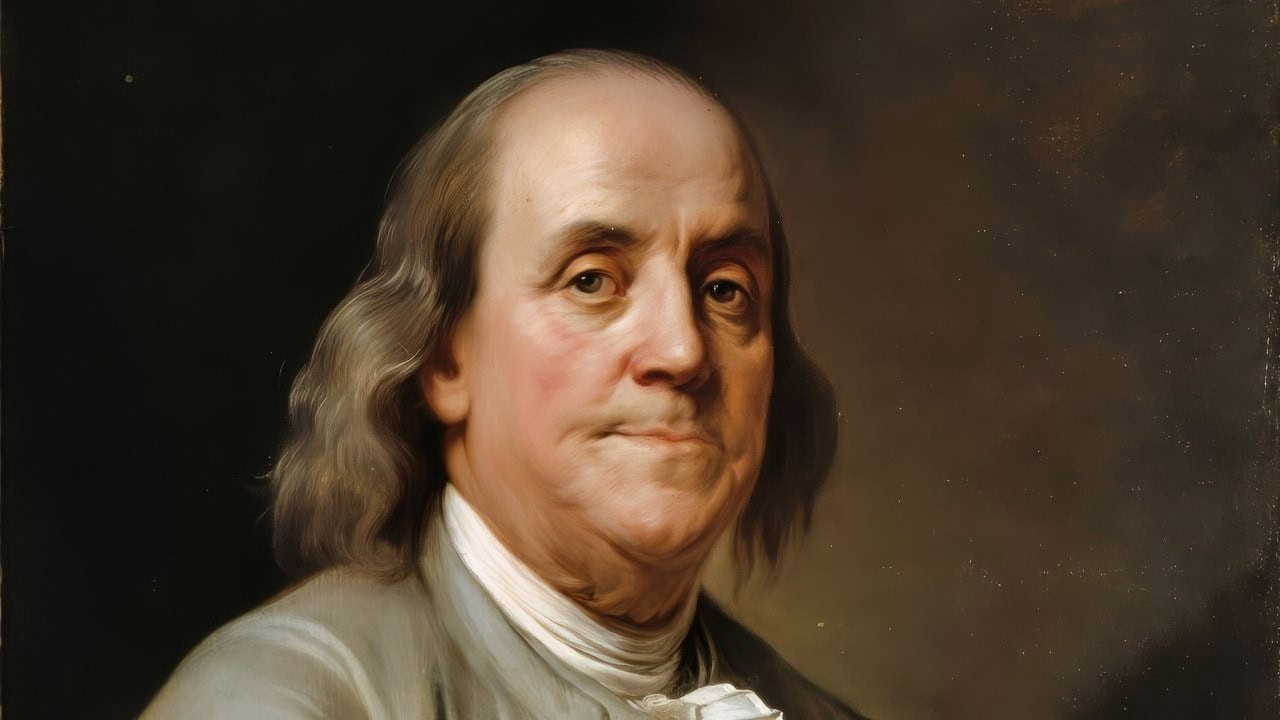
Key Points and Summary – Benjamin Franklin is remembered as a founding father, inventor, and diplomat—but he also briefly served as a wartime commander.
-During the French and Indian War, a 50-year-old Franklin raised and led a Pennsylvania militia to build forts and defend the frontier, gaining a new respect for discipline, logistics, and citizen-soldiers.
-One of the units he founded, today’s 1st Battalion, 111th Infantry Regiment of the Pennsylvania National Guard, still traces its lineage to “Ben Franklin’s Associators.”
-His famous line, “An investment in knowledge pays the best interest,” continues to guide debates over education, leadership, and national readiness.
Before the Revolution, Ben Franklin Built a Militia That Still Fights Today
Quote of the day: “An investment in knowledge pays the best interest”- Benjamin Franklin
Benjamin Franklin was one of the leading Founding Fathers, whose roles in the American Revolution included drafting and signing the Declaration of Independence, serving as the first Solicitor General, and the first US Ambassador to France. He even founded what would become the University of Pennsylvania, in addition to his notable work as an inventor and publisher.
Unlike some other Founding Fathers, Franklin wasn’t well known as a military leader. But, as a Smithsonian magazine article pointed out in 2010, Franklin did “meet the battlefield” before the Revolution began.
Benjamin Franklin at War
Franklin, at 50, was a commander in the French and Indian War in the 1750s, when the war touched his home state of Pennsylvania.
“Franklin was made a military commander because of his experience in the Pennsylvania Assembly. Having lived through clashes between the French and British in the 1740s, he understood the importance of a staunch defense and wrote a bill in 1755 calling for the creation of a militia,” the Smithsonian article said.

Benjamin Franklin. Image Credit: Creative Commons.
“Franklin had helped General Braddock the year before, so when news arrived of new raids by the French and Indians in the 70-mile stretch of frontier from Bethlehem to Reading, the Pennsylvania Colony’s governor, Robert Morris, felt obliged to turn to him to bolster the frontier. With scant military training, Franklin nonetheless became the most senior military leader in a critical part of British America.”
Franklin’s son, William, who would side with the British when the Revolution came two decades later, served as his aide-de-camp during this period.
“On January 15, Franklin began his march toward Gnadenhütten to build a fort that would blunt further French and Indian aggression and protect settlers. With cavalry, infantry, and five Conestoga wagons, he led his troops up trails along the Lehigh River, flankers well out to the sides and scouts in front, acutely aware of the Indians’ proclivity to ambush, the Smithsonian account said.
Franklin, per the account, “proved an able commander.” He built platforms so soldiers could fire through loopholes, built additional forts, and, at one point, encouraged church attendance, even letting his men know that their rations of rum would not be issued until worship services had concluded.
Not long after that, Franklin was named representative to the British government and therefore left the US for several years.
According to the Smithsonian account, Professor Alan Houston of the University of California discovered Franklin’s letters from this period. He realized they gave the relatively urbane Franklin a new appreciation for the frontier.
“Franklin’s life was spent in cities: Boston, Philadelphia, London, Paris. But he considered the western frontier a vital interest and in need of vigorous defense,” he says. “It also reinforced Franklin’s notion—especially in the ‘rum’ affair- that even if individuals had questionable motives, they could still be organized to effect a laudable end. Practicality was a Franklin hallmark.”
Houston noted to the Smithsonian that Franklin isn’t typically associated with military service in the popular mind.
“Being a soldier and commander does not fit our image of Franklin,” Houston said in that article. “We recall the kite flier, the clever writer of Poor Richard’s Almanack, the organizer of civic improvements, and the sage of the Declaration of Independence debate. Military chief does not seem to be a notion we want to place among these.”
A Unit That Survived
According to a US Army article from 2009, a Pennsylvania National Guard unit, the 1st Battalion, 111th Infantry Regiment, which was founded by Franklin during the French and Indian Wars, still exists and was stationed in Iraq at the time.
“We’re the founding unit in the Pennsylvania National Guard,” Lt. Col. Mark O’Hanlon, commander of the 1st Bn.., 111th Inf. Regt., said at the time. “We’re very proud of our lineage. We have been around since 1747, before there was a country.”
“Ben Franklin understood there was a need for a mechanism to defend the colony,” O’Hanlon, of Wallingford, Pa., added in the Army article. “He conceived of an association that would come together to defend the city in times of crisis.”
The unit has had a decorated history, going back to pre-Revolutionary times.
“The 111th Inf. Regt. The flag has battle streamers from almost every military engagement dating back to the Revolutionary War. O’Hanlon said the Soldiers serving in the 1st Bn.., 111th Inf. Regt., celebrate their heritage and educate any new Soldiers about the unit’s history,” the article said. “A regiment mess is held every year, complete with a reading of the Declaration of Independence and the attendance of an actor who portrays Benjamin Franklin.
A Facebook page associated with the unit calls them “Ben Franklins Associators.”
The Quote
Franklin is known for his quotations, many of which are about knowledge and leadership, drawn from a life spent in numerous, varied pursuits.
One such quote, long attributed to Franklin, is “if a man empties his purse into his head, no one can take it away from him. An investment in knowledge always pays the best interest.” The quote has been attributed to Franklin in his Poor Richard’s Almanack in the 18th century, although Bartleby’s lists it as “unverified.”
Per a CNBC analysis from 2017, many of the world’s most successful and wealthy people have taken that advice to heart.
The quote has also had other applications. Then-First Lady Laura Bush used it in a 2007 speech about the need to invest in education.
“Our country has learned that investing in education yields citizens who can develop their talents, who can pursue their passions, and make the very most of America’s opportunities. Investing in education yields a nation that’s healthier, more prosperous, and more secure,” the then-First Lady said at the time, after sharing the Franklin quote.
The quote is often shared at commencement ceremonies, including one this past June for the 70th ISR Wing, and is frequently cited on LinkedIn.
About the Author: Stephen Silver
Stephen Silver is an award-winning journalist, essayist, and film critic, and contributor to the Philadelphia Inquirer, the Jewish Telegraphic Agency, Broad Street Review, and Splice Today. The co-founder of the Philadelphia Film Critics Circle, Stephen lives in suburban Philadelphia with his wife and two sons. For over a decade, Stephen has authored thousands of articles that focus on politics, national security, technology, and the economy. Follow him on X (formerly Twitter) at @StephenSilver, and subscribe to his Substack newsletter.