
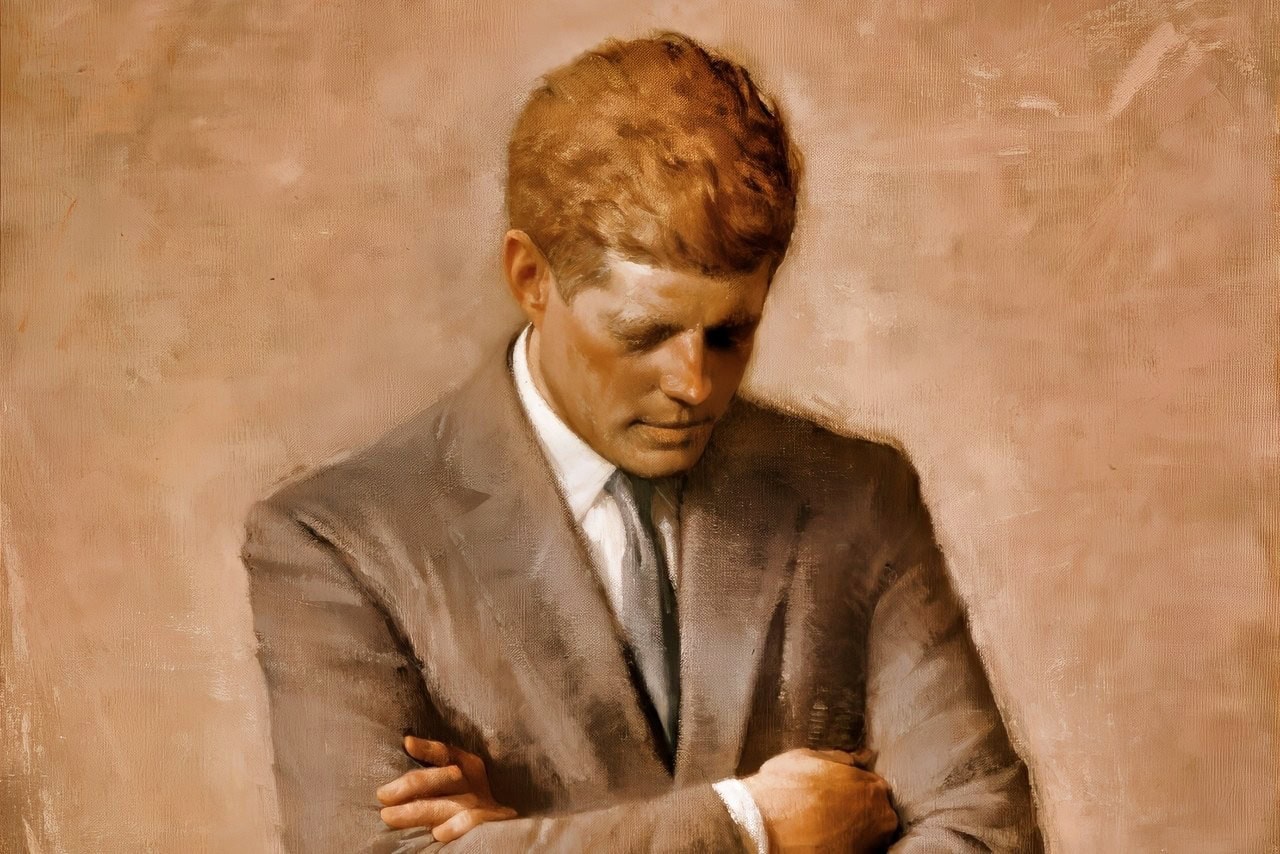
Key Points and Summary – The piece frames John F. Kennedy’s quote—“Mankind must put an end to war, or war will put an end to mankind”—as a defining Cold War message shaped by the nuclear arms race and repeated crises from Berlin to Southeast Asia.
-It argues the quote is less moralizing than strategic: in the nuclear era, “total war” becomes civilizational suicide, so disarmament and global cooperation are not idealism but survival policy.
-The essay then runs through Kennedy’s biography—from privileged but sickly childhood and Harvard education to PT-109 heroism, rapid ascent through Congress and the Senate, the 1960 election, and an administration dominated by Cold War flashpoints before his 1963 assassination.
JFK’s Quote of the Day Warning Has a Message for Today’s Nuclear Age
John F. Kennedy (JFK) was the 35th U.S. President, serving from 1961 until his assassination in 1963; he was born in 1917 to a prominent Boston family, he became the youngest elected president, a Harvard grad, a WWII naval hero (PT-109), and a Democrat who served in Congress before the White House, known for his youth, charisma, Cold War challenges, and the iconic “Camelot” era.
During the height of the Cold War, there was a nuclear arms race between the U.S. and the Soviet Union, and crises in Laos, South Vietnam, and Berlin. President John F. Kennedy made a speech to the United Nations General Assembly in 1961.
Kennedy’s Famous Quote
His famous quote, “Mankind must put an end to war, or war will put an end to mankind,” emphasized the necessity of peace through disarmament and global cooperation to avoid self-destruction. It highlights the catastrophic potential of modern warfare, predominantly nuclear, making peace a survival imperative for humanity.
Kennedy pointed out that in an age of nuclear weapons, total war means the end of all parties, requiring a rational, collective effort for peace, not just military might.
The quote remains a powerful call for global peace, disarmament, and human survival, influencing figures like Pope Paul VI.
Earlier that year, in his inaugural address, Kennedy eschewed partisan politics, and he announced that “we shall pay any price, bear any burden, meet any hardship, support any friend, oppose any foe to assure the survival and success of liberty.”
JFK Biography, Early Life:
Kennedy was born on May 29, 1917, in Brookline, Massachusetts, to Joseph and Rose Kennedy. All four of his grandparents were children of Irish immigrants. Kennedy had an older brother, Joseph Jr., and seven younger siblings: Rosemary, Kathleen, Eunice, Patricia, Robert, Jean, and Ted.
He grew up in wealth and privilege; his father had amassed a large fortune, but JFK suffered from frequent illnesses, including scarlet fever.
He attended the elite preparatory boarding school Choate. He later attended Princeton University but withdrew due to illness. He then graduated from Harvard University in 1940 cum laude with a Bachelor of Arts in government, concentrating on international affairs.
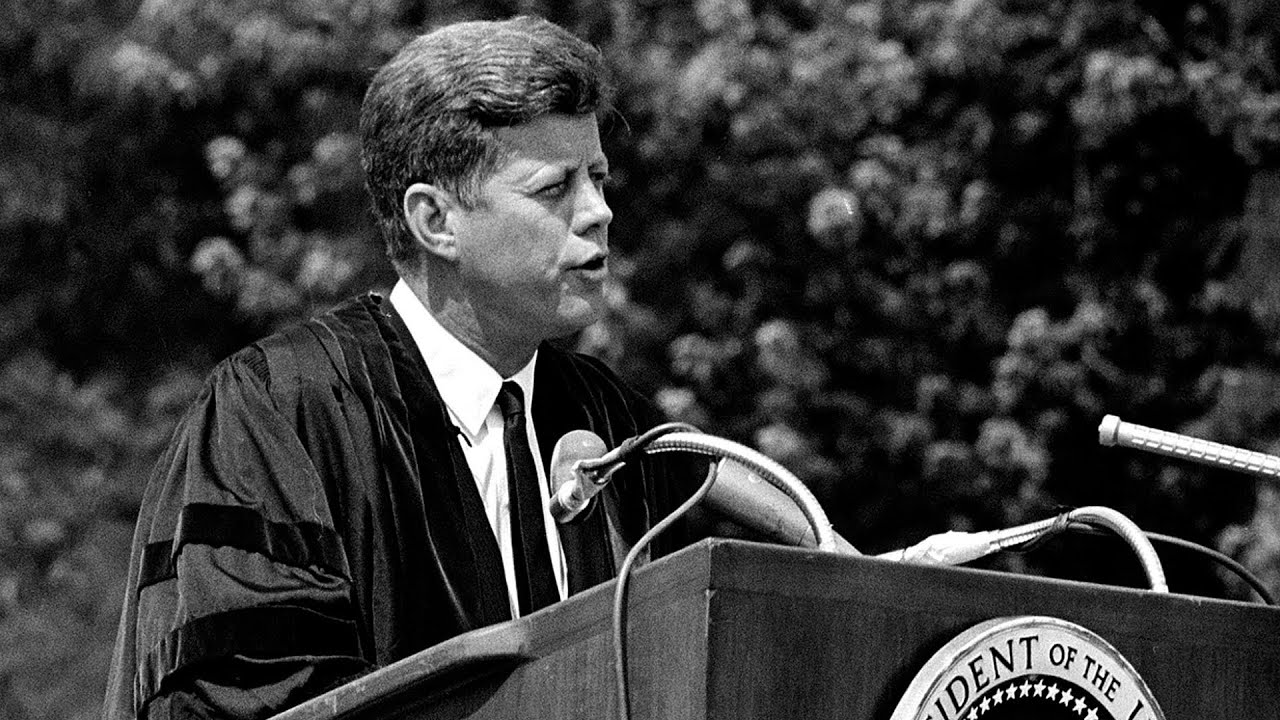
Peace Speech by John F. Kennedy. Image Credit: Creative Commons.
Before graduation, in 1938, he and his brother Joe sailed overseas to work at the American embassy in London, where their father was serving as President Franklin D. Roosevelt’s ambassador to the Court of St. James.
US Navy Service:
With US involvement in WWII seeming imminent, Kennedy attempted to enter the Army’s Officer Candidate School in 1940. Despite months of training, he was medically disqualified due to chronic back problems.
On September 24, 1941, with the help of Alan Goodrich Kirk—the director of the Office of Naval Intelligence (ONI) and former naval attaché to his father—Kennedy joined the United States Naval Reserve. He was commissioned as an ensign on October 26, 1941.
Kennedy had hoped to command a PT (patrol torpedo) boat, but his health problems seemed almost inevitable to prevent active duty. Kennedy’s father intervened by providing doctored medical records and convincing PT officers that his presence would bring publicity to the fleet.
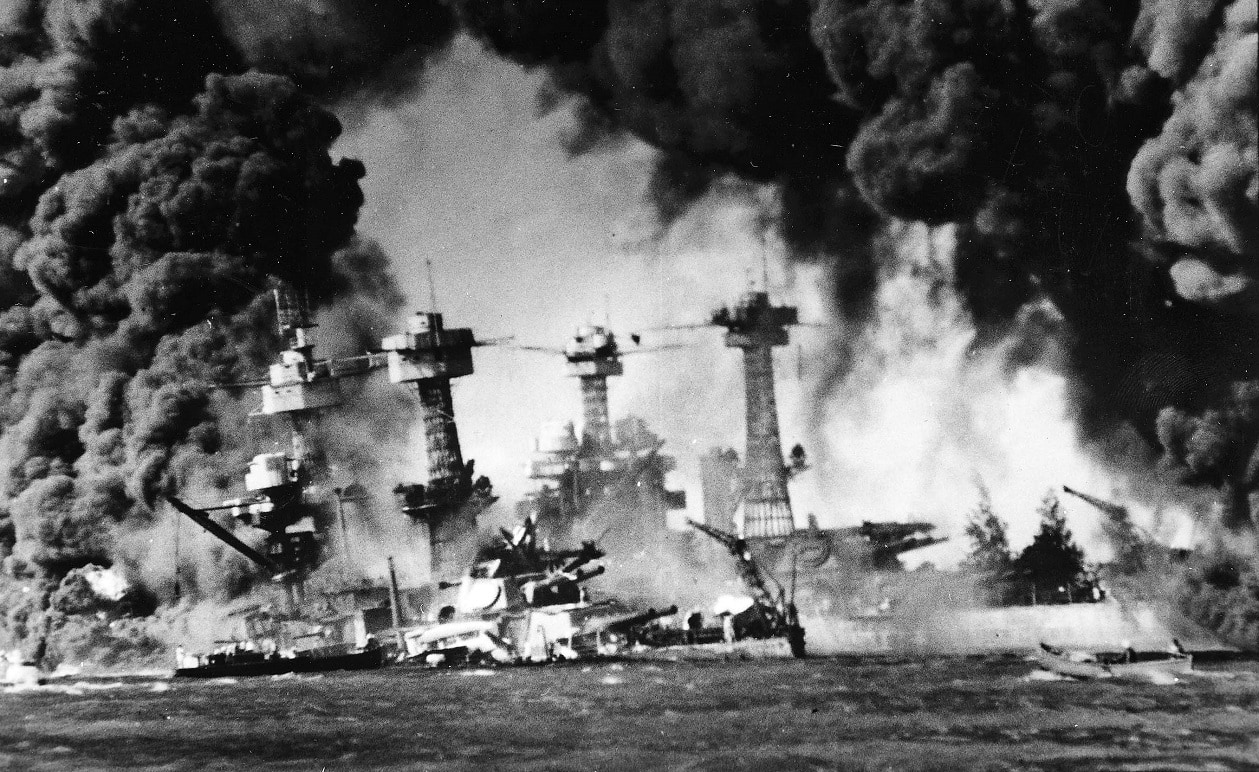
Battleship USS West Virginia sunk and burning at Pearl Harbor on Dec. 7, 1941. In background is the battleship USS Tennessee.
His first command was PT-101 from December 7, 1942, until February 23, 1943. Unhappy with his assignment to the Panama Canal, far from the fighting, Kennedy appealed to Senator David Walsh of Massachusetts, who arranged for him to be reassigned to the South Pacific.
In February 1943, the month after the Japanese retreated from Guadalcanal, Lieutenant Junior Grade (JG) John F. Kennedy took command of PT-109 and was based out of Rendova Island after the island’s capture that summer.
In the early hours of August 2, 1943, PT-109 was patrolling Blackett Strait, on the southern side of Kolombangara Island, when her starboard side was rammed, cut, and severely disabled by the Japanese destroyer Amagiri.
Eventually sinking, her eleven survivors abandoned the boat, with Kennedy towing one of the crew and ensuring the men returned to the PT Base at Rendova, after several harrowing days on an island, hiding from the Japanese. Kennedy would receive the Navy and Marine Corps Medal for his heroism.
The New Yorker picked up his story, and he became a famous war hero. This would benefit him in his political career. His injuries resulted in his medical separation from the service with the rank of Lieutenant.
Political Career:
His father’s connections assured him a place in Massachusetts politics. He ran for Congress in 1946 and won, taking over 73 percent of the vote. As a Congressman, Kennedy was lacking.
He had the highest absenteeism among his colleagues and showed little interest in his constituents’ needs. Despite this, he was re-elected twice and served in the House for six years, joining the influential Education and Labor Committee and the Veterans’ Affairs Committee.
In 1952, Kennedy ran for the Senate against a powerful political foe, Henry Cabot Lodge. His father swayed the press, getting the Boston Post newspaper to endorse JFK by loaning the paper $500,000.
He narrowly defeated Lodge and then married Jacqueline Bouvier in 1953. As a senator, he took a keener interest in constituents’ needs. He was re-elected in 1958 with the largest margin in Massachusetts’ history.
Presidential Campaign of 1960:
On January 2, 1960, Kennedy announced his candidacy for the Democratic presidential nomination. Kennedy faced several potential challengers, including Senate Majority Leader Lyndon Johnson, Adlai Stevenson II, and Senator Hubert Humphrey.
He won the nomination and chose Johnson as his running mate, hoping the Texas senator could help sway the Southern vote. Richard Nixon held an early six-point lead in the polls, but the presidential debates, the first on television, pointed to Kennedy winning over more than two million undecided voters.
Kennedy dominated the Electoral College 303 to 219, and the 14 electors from Mississippi and Alabama refused to support Kennedy because he supported the civil rights movement; they voted for Senator Harry F. Byrd of Virginia.
However, the popular vote was a very narrow victory with Kennedy taking 49.7 percent to Nixon’s 49.5 percent.
Confrontations with the Soviet Union and communist revolutions dominated Kennedy’s tenure in the White House, as he continued Eisenhower’s policy of containment.
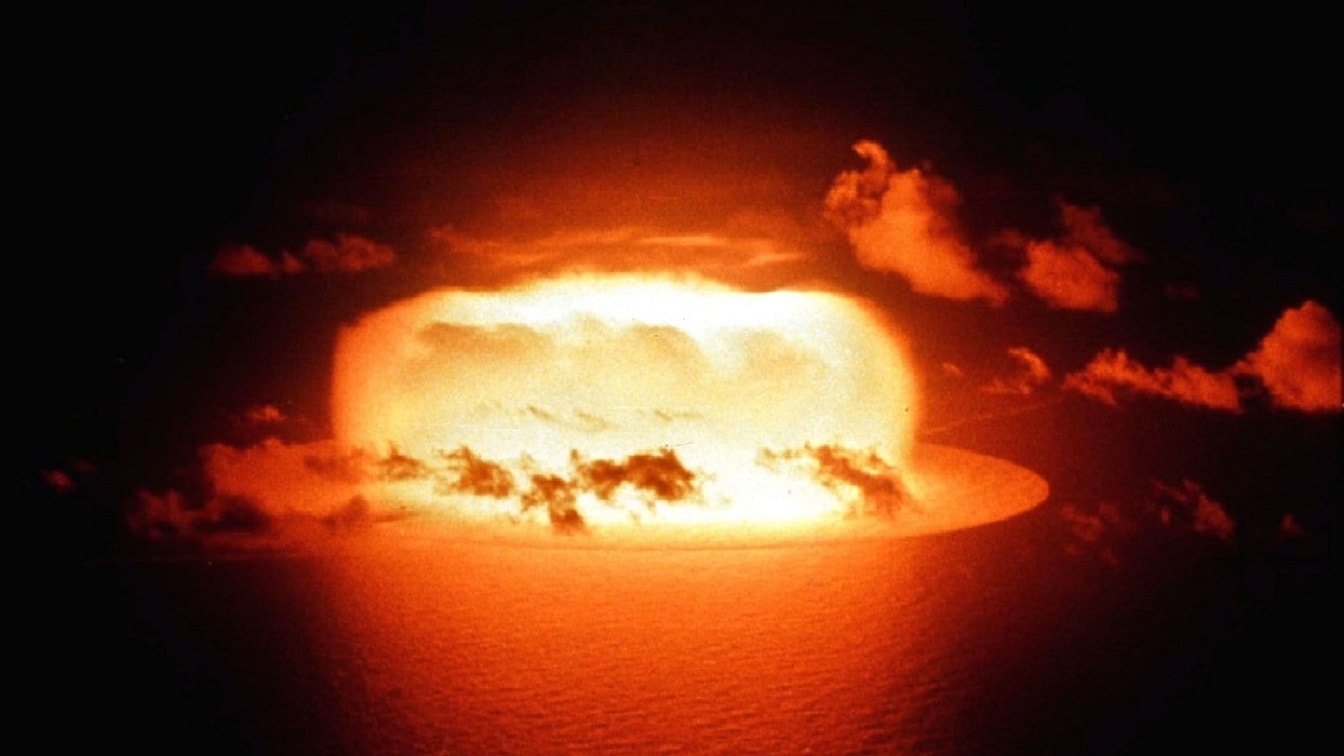
Nuclear Test During the Cold War. Image Credit: Creative Commons.
The Cuban Missile Crisis, the Bay of Pigs invasion, the crisis in the Congo, the war in Vietnam, and the Berlin Wall going up all happened within the three years he was in office.
Kennedy was assassinated on November 22, 1963, on a trip to Dallas. He was hit twice, once in the back that exited his throat, and once in the head. He was rushed to Parkland Hospital but died shortly after arriving.
He was buried in Arlington National Cemetery.
About the Author: Steve Balestrieri
Steve Balestrieri is a National Security Columnist. He served as a US Army Special Forces NCO and Warrant Officer. In addition to writing on defense, he covers the NFL for PatsFans.com and is a member of the Pro Football Writers of America (PFWA). His work was regularly featured in many military publications.