On May 9, 2026, Russia held its annual Victory Day parade in Red Square. It was the shortest in the event’s history. Just 43 minutes. For the first time since 2008, no tanks rolled across the square. No missiles. No artillery. The brief aerial flyby featured 1980s Su-25s and MiG-29s — not the Su-57, Russia’s premier stealth fighter. The foreign dignitaries flanking Putin were largely from unrecognized puppet states and minor authoritarian governments. Russia’s federal deficit has reached $78.9 billion — 55% over the planned annual figure with eight months still to go. Putin needed a 1,000-prisoner exchange with Ukrainian President Volodymyr Zelenskiy to secure a ceasefire over the parade. Day 1,535 of Russia’s “ten-day Special Military Operation.”
Putin’s WWII Victory Day Celebration Looked Like Defeat
The BBC’s Steve Rosenberg has been covering Russia for more than three decades. What he and almost every other Moscow correspondent watching the 9 May Victory in WWII parade are saying is “this year’s [parade] is different” from any of those that we have seen previously.
That “different” basically comes down to this parade having been dramatically scaled back, the traditional presentation of Russian military might deleted from the proceedings, and a visible receding of the international clout and legitimacy that Russia might still retain.
In addition to fewer soldiers, there were no foreign dignitaries of note sitting on the center stage with President Vladimir Putin. The former KGB Lt. Col. was instead surrounded by what one Ukrainian commentator described as a “collection of rent-a-politicians.”
These included the internationally unrecognized heads of the puppet states of South Ossetia and Abkhazia that were occupied by Moscow after the August 2008 invasion of Georgia, the Sultan King of Malaysia, and the Presidents of Laos, Uzbekistan, and Belarus.
For the first time since 2008, there were no tanks, no missiles, no artillery pieces, no demonstration of Russia’s supposed massive defense industrial complex rolling through Red Square for this year’s annual celebration.
The only hardware seen in the entire event was in the form of video clips projected on a giant screen set up for the occasion and – at the very end – a short fly-by of Russian military aircraft that was almost canceled in the days immediately before 9 May. Even these aircraft were carefully chosen – the centerpiece of Russia’s modern military technology, supposedly demonstrating parity with Moscow’s western military rivals, the Sukhoi Su-57 – was nowhere to be seen. Neither was its workhorse and much-ballyhooed predecessor model the Su-35.
Instead, the crowd was feted with a formation of 1980’s-era Su-25 and Mikoyan MiG-29 aircraft (the latter now having almost been eliminated from the Russian Aerospace Forces inventory) and the middle of the 1990s-design Su-30SM. In short, aircraft so old that Moscow would not be bothered if they had been downed by a Ukrainian drone attack on the parade.
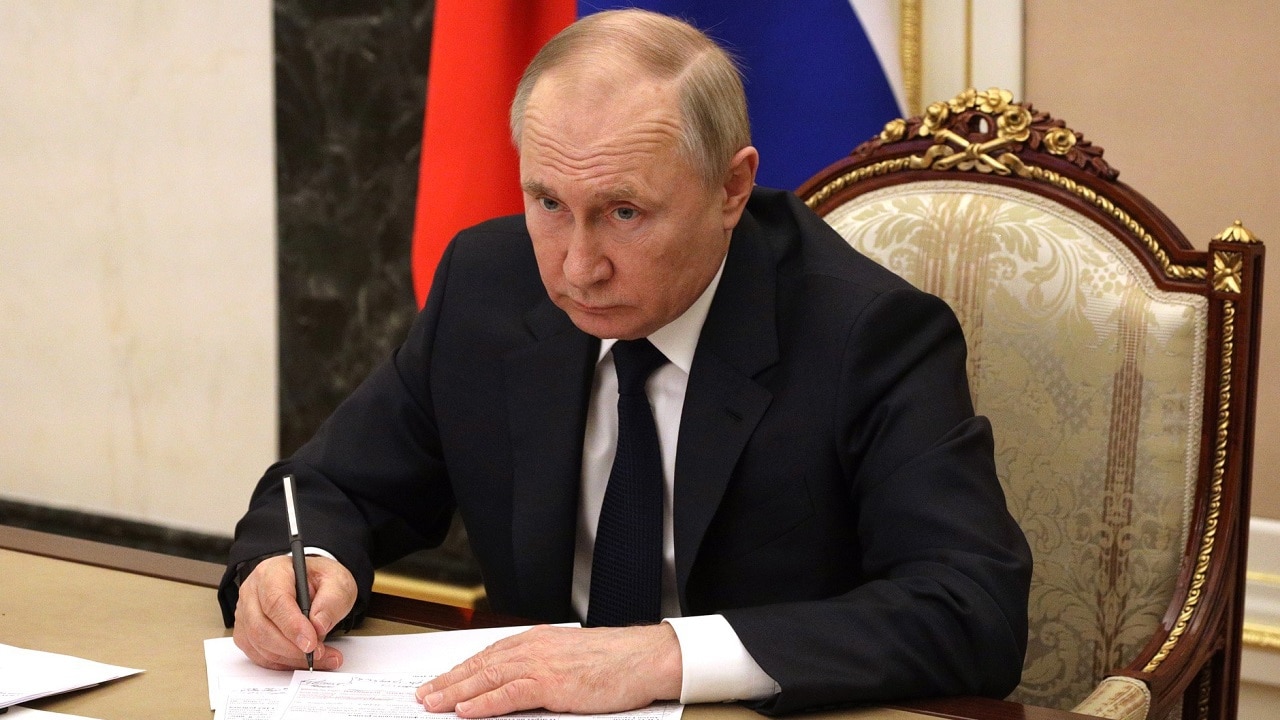
Russian President Putin. Image Credit: Russian Government.
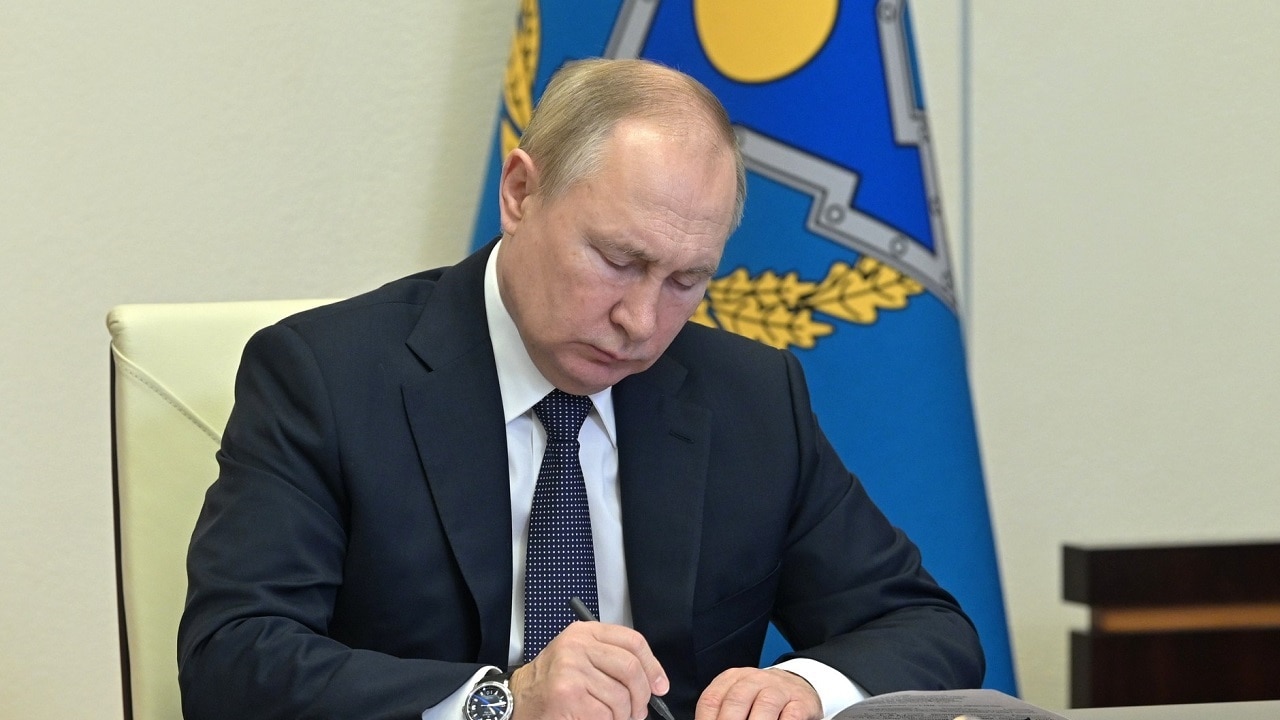
Russian President Putin. Image Credit: Creative Commons.
A Shrinking Regime
The parade was also the shortest in the event’s history. Only 43 minutes, including Putin’s harangue of an address before it even began. This was how the Russian president celebrated the 1535th day of his “ten-day Special Military Operation” that began on 24 February 2022.
Put simply, the lackluster parade is being seen as symbolic of a shrinking regime in Moscow.
Writing for The Conversation website, Penn State’s Lena Surzhko Harned observed: “the reality for Putin is that the war in Ukraine, now in its fifth year, continues to be a grueling drain on Russian men, its economy and resources – and may continue to be for some time.” Victory, it seems, is never more in doubt than it is today.
Exhibit A in that assessment of depleting resources is the metastasizing spread of red ink in the Russian state budget. As of this month, Russia’s federal deficit had reached US$ 78.9 billion, already exceeding the initially planned deficit for the entire year by 55 percent. The deficit for January–April 2026 alone was nearly $40.4 billion higher than during the same period in 2025.
Moscow had been counting on a sharp increase in oil prices due to the Iran war to solve its budget woes. Instead, Russia’s state coffers received only mild relief from the surge in crude prices on world markets. Meanwhile, the Russian economy as a whole is wobbling on the verge of recession.
Among other ills, the Russian state daily Izvestia reports that increasing numbers of Russian companies are continuing to miss debt payments. These amount to “11 technical defaults in 2024, 24 in 2025, and already 11 in just the first three months of 2026.”
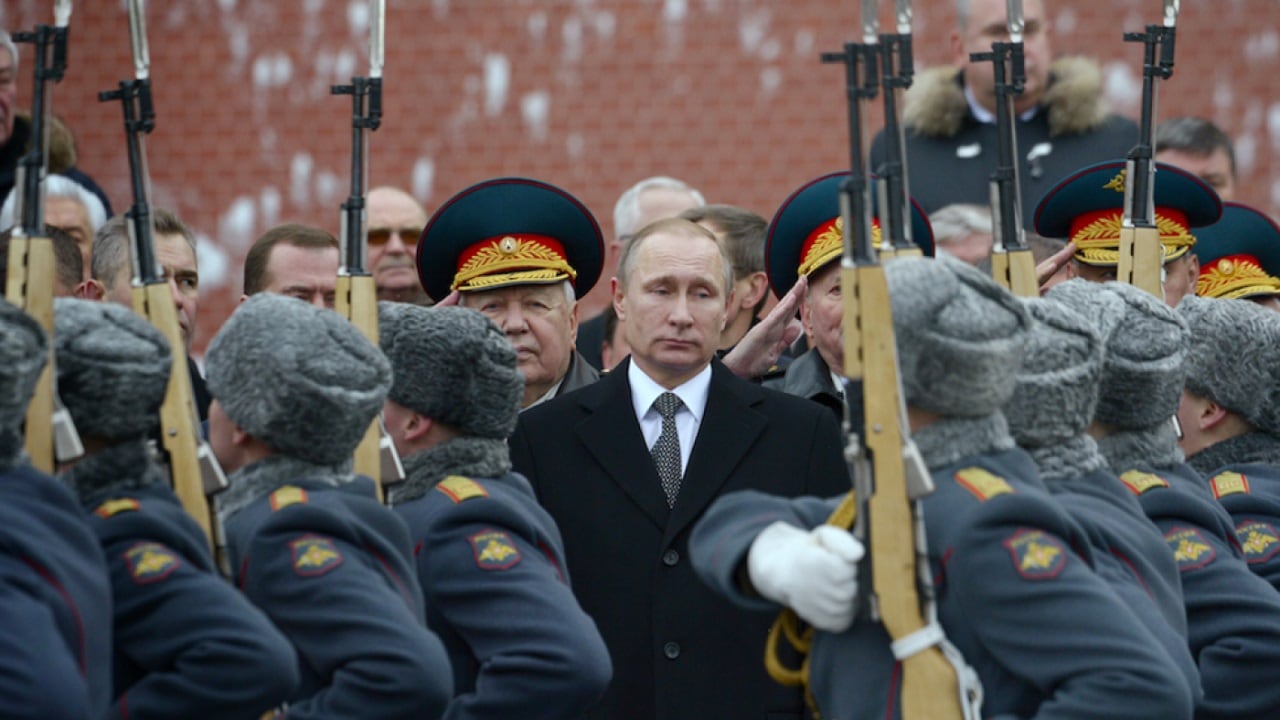
Russian President Putin with Russian Military Forces. Image Credit: Creative Commons.
Sources within the financial sector told the Russian newspaper that nearly 25 percent of the bond market is now at risk of default due to businesses that borrowed at low rates and are now finding they must refinance at much higher rates. The volume of debt that needs to be rolled over this year is about double that of last year.
This situation is placing increasing pressure on cash flows and liquidity. The paper’s source also said that the default issue was not an aberration but instead a “systemic trend.”
Final Humiliation
Putin’s greatest fear on Saturday was that his parade, as pared down as it was, would be hit with Ukraine drone strikes. The possibility of any drone strikes using mobile network towers for their targeting data was the motivation for the Kremlin shutting down the internet in Moscow for days prior to the event.
But what demonstrates the ultimate weakness of the Putin regime was how the Russian dictator had to humble himself to be guaranteed a 9-11 May ceasefire with Kyiv. The former KGB Lt. Col. had to agree to an exchange of 1000 Ukrainian prisoners-of-war to satisfy Ukrainian President Volodymyr Zelenskiy. The latter posted on his X account that he had agreed to the ceasefire because disrupting Putin’s parade with an attack on “Red Square is less important to us than the lives of Ukrainian prisoners who can be brought home.”
But wanting to get in a final shot at Putin, Zelenskiy issued a presidential decree stating this agreement had been reached with the assistance of the US. His statement, which was dripping with sarcasm, said he would “permit the holding of a parade” and would therefore forbid the use of Ukrainian weapons on the territory of Red Square in Moscow on 9 May. The decree then specified the exact coordinates that were not to be attacked on Saturday.
It did not state, however, that Ukrainian weapons were forbidden from being used on any other location on the territory of Russia.
It was a double, final humiliation. Firstly, the message to the Russian people was that their leader cares little to nothing for their safety and well-being. As oil-soaked rains fall on the cities that adjoin the refineries being hit by Ukrainian long-range weapons, their fearless leader only cares for his personal security and his sacrosanct Red Square celebration.
Secondly, it also gave rise to a narrative that Putin needed Zelenskiy’s “permission” to hold his parade on Saturday. The Russian president also showed his paranoia by nonetheless continuing to strip air defense locations throughout the country. They have moved them to create another ring of batteries around Moscow, leaving many other areas of Russia defenseless in the process.
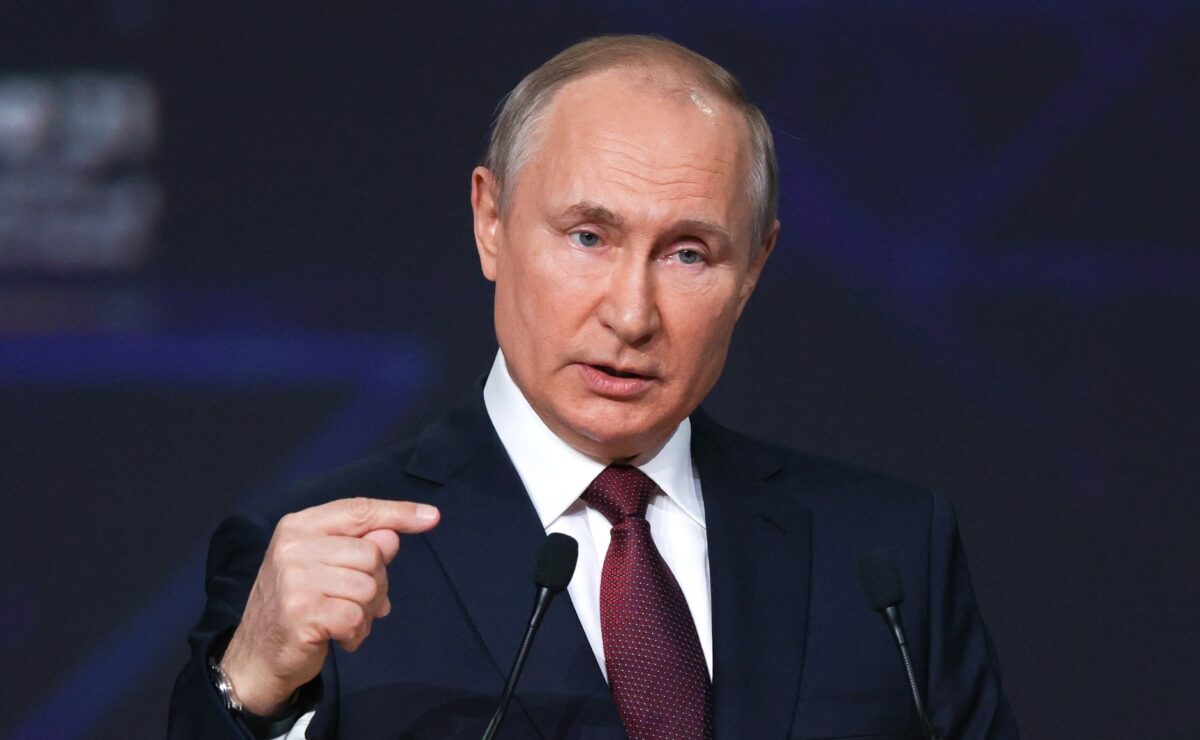
Putin at St Petersburg International Economic Forum plenary session. Photo: Russian State Media.
One Ukrainian analyst rather viscerally commented about Putin, describing him as a “Botox jellyfish sitting in the Kremlin with air defense emplacements piling up around him.” He also noted that the desperate atmosphere in Moscow makes the Russian leader appear to be “preparing for some kind of final battle.”
The BBC’s Rosenberg’s description of Moscow and Victory Day feeling “different” from previous years is putting it mildly. No one could have imagined in May 2025 that Russia’s situation today would appear so progressively weak and deteriorating, that its leader would be reduced to hiding in subterranean bunkers in fear of Kyiv’s drones, and that the Russian population would be feeling increasingly confused as to what this war with Ukraine is all about.
If there is a “glorious past” to be recounted in the WWII Victory, then Putin is cheapening it by always trying to capitalize on it by likening it to his war on the Ukrainian nation, and in the process making it a fading memory. Putin’s feckless celebration of the event and incessant references to this past triumph are also not safe bets, as he hopes they will provide him with the popularity he and his regime need to survive.
About the Author: Reuben F. Johnson
Reuben F. Johnson has thirty-six years of experience analyzing and reporting on foreign weapons systems, defense technologies, and international arms export policy. Johnson is the Director of Research at the Casimir Pulaski Foundation. He is also a survivor of the Russian invasion of Ukraine in February 2022. He worked for years in the American defense industry as a foreign technology analyst and later as a consultant for the U.S. Department of Defense, the Departments of the Navy and Air Force, and the governments of the United Kingdom and Australia. In 2022-2023, he won two consecutive awards for his defense reporting. He holds a bachelor’s degree from DePauw University and a master’s degree from Miami University in Ohio, specializing in Soviet and Russian studies. He lives in Warsaw.