
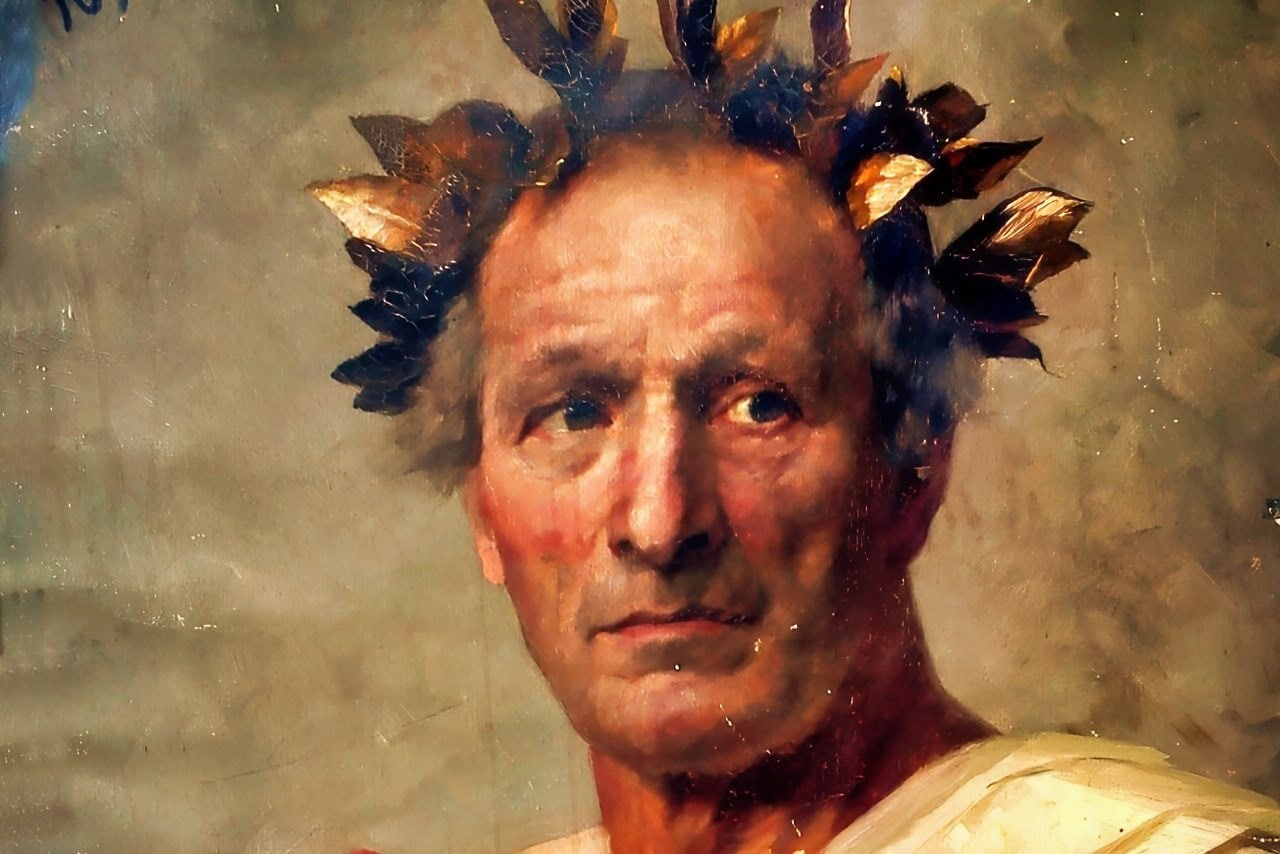
Julius Caesar Endured Exile, Captivity and Civil War Before the Ides of March: “It is easier to find men who will volunteer to die, than to find those who are willing to endure pain with patience.” The sentence appears in Julius Caesar’s Gallic War, where Caesar assigns it to Critognatus, a Gallic noble trapped inside Alesia in 52 BCE.
It is Caesar’s prose, not a securely documented personal remark. The thought still fits a life shaped by exile, captivity, debt, battlefield reversals, and political resistance.

Vercingetorix throws down his arms at the feet of Julius Caesar, painting by Lionel Royer in 1899. Musée Crozatier, Le Puy-en-Velay, France. Imave Credit: Creative Commons.
Born in 100 BCE into the patrician Julii, Caesar inherited an ancient name without the fortune of Rome’s strongest houses. His aunt had married Gaius Marius, placing him near the losing side of a Roman civil conflict.
When Sulla took power, he ordered Caesar to divorce Cornelia, daughter of Marius’s ally Cinna. Caesar refused, lost property and religious office, and went into hiding until relatives secured a pardon.
Sulla Tried to Break Caesar Before His Career Began
Caesar left Rome and served in Asia Minor, earning the civic crown for bravery at Mytilene. After Sulla died, he returned to public life and developed a reputation as an advocate and speaker.
His best-known early ordeal came during a voyage to Rhodes. Pirates captured him and held him for ransom. Plutarch recounts how Caesar mocked his captors, ordered them to be quiet when he wished to sleep, and promised to crucify them after his release. Once free, he raised ships, captured the pirates, and carried out the threat.
Ancient biographers polished the episode, but its central point is credible. Caesar rarely treated danger as a reason to lower his expectations.
Politics Rewarded Caesar’s Patience and Appetite for Risk
Caesar moved through Rome’s elected offices while spending heavily on public games and accumulating debt. He became pontifex maximus in 63 BCE, praetor in 62, and consul in 59. His alliance with Pompey and Crassus gave all three men a way around senatorial opposition.
Sallust described Caesar as generous, forgiving, tireless, and hungry for a great command. Gifts and clemency won loyalty; military glory promised money, soldiers, and status unavailable through debate alone.
The alliance later called the First Triumvirate was a private arrangement among powerful men who found republican restraints inconvenient. The marriage between Pompey and Caesar’s daughter Julia helped sustain it. Julia died in 54 BCE, and Crassus was killed at Carrhae the next year, removing two restraints on rivalry between the surviving partners.
Its success helped make Caesar the central figure in the collapse of the Roman republican government.
Gaul Made Caesar Rich, Famous and Dangerous
Caesar received a provincial command in 58 BCE and spent most of the next decade fighting in Gaul. His legions defeated tribal coalitions, crossed the Rhine, and twice entered Britain. The campaigns expanded Roman rule while bringing Caesar wealth, prestige, and an army increasingly loyal to him.
The conquest was brutal. Roman forces destroyed settlements, sold captives, and punished resistance. Caesar also turned the war into literature, writing controlled third-person accounts that defended his decisions and preserved his reputation among readers in Rome.
The siege of Alesia in 52 BCE became his greatest display of engineering and discipline. His army enclosed Vercingetorix, then built a second defensive line against a relief force arriving from outside. The quote about pain came from the starving defenders, while Caesar’s legionaries held miles of earthworks against attacks from two directions.
Caesar Recovered From Defeat and Took Rome
After Gaul, Caesar’s enemies demanded he surrender his command before seeking another consulship. Returning as a private citizen exposed him to prosecution and political ruin. In January 49 BCE, he crossed the Rubicon with troops, opening a civil war. The advance drove Pompey and much of the Senate from Italy.
Caesar did not win every battle. Pompey checked him at Dyrrhachium in 48 BCE, forcing a retreat. Caesar regrouped, held his army together, and defeated Pompey at Pharsalus weeks later. Pompey fled to Egypt and was murdered before Caesar arrived.
Caesar offered clemency to defeated Romans, distinguishing his rule from Sulla’s proscriptions and encouraging surrender. The policy saved lives, but it also placed former enemies under his personal discretion.
Campaigns followed in Egypt, Pontus, North Africa, and Spain. Caesar’s speed became part of his public identity, but patience mattered as much. The familiar image of a commander who preferred decisive action rested on years of preparation, marching, and recovery.
Caesar Reformed Rome While Concentrating Power
Caesar settled veterans, founded colonies, adjusted debt rules, expanded citizenship, and enlarged the Senate. His most durable reform was the Julian calendar, designed with expert advice to replace Rome’s badly disordered system. The Republic’s deeper crisis involved civil war, inequality, and institutions unable to control armed political competition.
His clemency spared former enemies, including men who later joined the plot against him. It also reinforced his supremacy, since pardon came from one man rather than republican law. Honors accumulated, and in early 44 BCE he accepted the title of dictator for life.
More than 60 conspirators joined the assassination plot led by Cassius and the two Brutuses. They attacked Caesar during a Senate meeting at the Theatre of Pompey on March 15, 44 BCE. Suetonius recorded 23 wounds, with only one wound to the chest judged fatal.
MORE – Admiral Chester Nimitz On How Great Leaders Lead
About the Author: Harry J. Kazianis
Harry J. Kazianis (@Grecianformula) was the former Senior Director of National Security Affairs at the Center for the National Interest (CFTNI), a foreign policy think tank founded by Richard Nixon based in Washington, DC. Harry has over a decade of experience in think tanks and national security publishing. His ideas have been published in the NY Times, The Washington Post, The Wall Street Journal, CNN, and many other outlets worldwide. He has held positions at CSIS, the Heritage Foundation, the University of Nottingham, and several other institutions related to national security research and studies. He is the former Executive Editor of the National Interest and the Diplomat. He holds a Master’s degree focusing on international affairs from Harvard University.

