
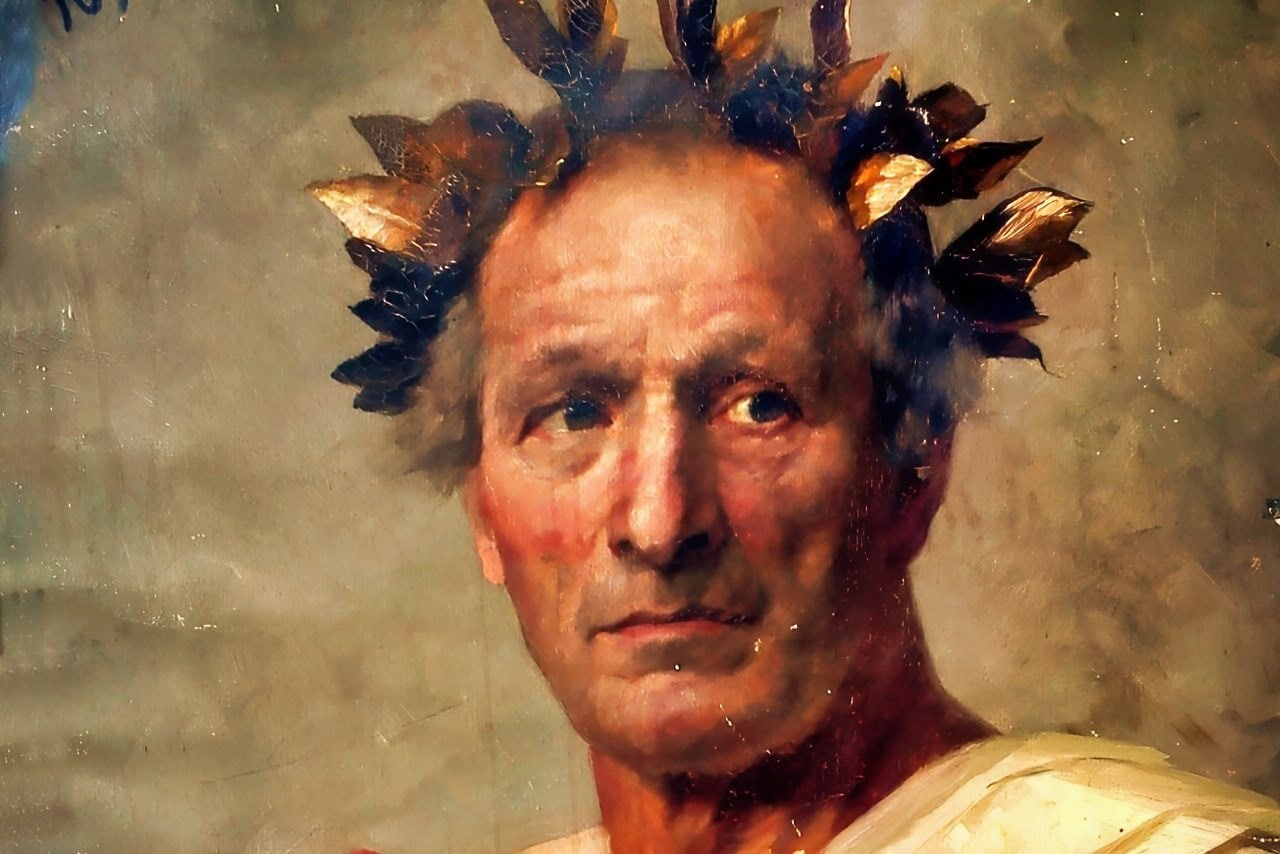
Summary and Key Points: Defense expert Christian D. Orr evaluates the Battle of Alesia, the decisive climax of the Gallic Wars (58–50 BC).
-Facing the Arverni leader Vercingetorix, Julius Caesar commanded 60,000 Roman legionaries against a combined Gallic force of over 330,000.
-This report analyzes Caesar’s construction of circumvallation and contravallation lines—defensive walls facing both inward and outward.
-Orr explores the failed Gallic relief efforts and the final cavalry maneuver that forced Vercingetorix’s surrender, concluding that this victory provided the wealth and military prestige necessary for Caesar to eventually cross the Rubicon.
The Alesia Blueprint: Why Caesar’s “Dual-Wall” Siege is Still Taught in Modern Military Academies
“Without training, they lacked knowledge. Without knowledge, they lacked confidence. Without confidence, they lacked victory.” – Quote of the Day from Julius Caesar.
That quote belongs to Gaius Julius Caesar—known to most in the modern world as simply Julius Caesar—the most famous leader in the history of the Roman Republic.
(Rome wasn’t yet officially an empire during Caesar’s dictatorial reign, but he certainly laid the groundwork for the Roman Republic to become the Roman Empire).
The above quote isn’t nearly as famous as Caesar’s “Veni, Vidi, Vici” (I came, I saw, I conquered). Nonetheless, it is a springboard to examine what most historians consider to be his greatest military victory (at least tactically speaking)—the Battle of Alesia, which took place in September 52 BC.
Backdrop to the Battle
The Battle of Alesia was part of the Gallic Wars between General Julius Caesar and the people of Gaul.
The Gallic Wars took place between 58 and 50 BC, and by the time the third year of the conflict rolled around, the Gauls realized that a united front was essential if they were to have any hope of defeating the Roman legions.
They named Vercingetorix of the Averni, who is considered the first national hero of France for his defense of the land, as their leaders. Vercingetorix’ name means “Victor of a Hundred Battles.” But Alesia would not be his 101st win.
After tabbing Vercingetorix as their leader, the Gauls initiated a wave of violence after which thousands of Roman soldiers and settlers were killed in Gaul.
Needless to say, this didn’t sit well with Julius, who emerged from his winter quarters at Cisalpine Gaul to deal with the threat. He won a few minor victories before suffering a temporary setback at the Battle of Gergovia.
The Battle Begins…and Ends
Patrick Lynch of History Collection picks up the story from there:
“However, [Caesar’s Roman troops] continued to harass the Gauls and Vercingetorix elected to retreat to the walled town of Alesia to plan his next move. This location offered an excellent defensive position for the Gauls as it was located on a hill and surrounded by river valleys. The Roman force of 60,000 attempted to lift the siege, but the 70,000-80,000 Gauls proved stubborn foes. Caesar knew Gallic reinforcements could arrive at any time, so he ordered his men to get to work quickly. … He began by spreading his legions into eight camps around the hill. Vercingetorix launched a surprise attack which was beaten off; the Roman suffered minimal losses in this exchange. Caesar ordered his men to dig a trench between the two rivers surrounding the town to protect themselves from future assaults. He also told the soldiers to create a variety of deadly traps while two more ditches were dug; one of which was flooded. The mud from these ditches was used to build a 15-foot wall with a ten-foot fence and watchtowers!”
Placing his confidence in the pending arrival of those Gallic reinforcements, Vercingetorix made the fatal mistake of allowing Caesar’s men to finish digging in.
The reinforcements did arrive—250,000 strong, no less—but by that time the Romans had finished their outer defenses.
Caesar’s soldiers were now surrounded and outnumbered at least 5:1.
The general didn’t panic, however. Instead, he showed a determined fighting spirit that calls to mind a more modern Western general, U.S. Marine Corps general Chesty Puller: “Sir, do you know they’ve cut us off? We’re entirely surrounded.”
“Those poor bastards,” Puller replied. “They’ve got us right where we want ’em. We can shoot in every direction now.”
Indeed, as Stuart McClung wrote for War History Online, “Point of fact, his victory at Alesia was unique in the greater history of warfare in that his army was forced to fight between two walls of defenses against enemy forces; those he had surrounded and those coming to their relief.”
The reinforcing soldiers launched a massive cavalry attack, and Vercingetorix ordered an infantry charge in an effort to add momentum.
However, the Gallic horses, cavalrymen, and infantrymen were cut to pieces by Roman booby traps, trenches, and archers. The Gauls elected to retreat. They decided to launch a night attack, but that too failed miserably.
According to Lynch:
“They launched one last assault with 40,000 men and focused on the Roman forces on the northern side of the town. In the midst of the fighting, Caesar ordered his cavalry to leave their positions and attack the rear of the enemy. It was a decisive move as the horsemen slaughtered the Gauls and forced a retreat. The fleeing Gauls were massacred by their enemy, and the great Battle of Alesia was finally over after three intense days of fighting. Vercingetorix surrendered to Caesar, was taken to Rome as a prisoner and executed several years later.”
Aftermath
Julius Caesar’s victory at Alesia—which is most likely located in present-day Alise-Sainte-Reine in eastern France—established Roman dominance in Gaul for the next 500 years.
The Roman Senate granted Caesar a thanksgiving of 20 days for his victory in the Gallic War. However, when his rivals wouldn’t let him run for consul, Caesar invaded the Italian peninsula, setting off the Roman Civil War.
This culminated in his famed crossing of the Rubicon and his triumph in the Battle of Pharsalus in 48 BC.
About the Author: Christian D. Orr, Defense Expert
Christian D. Orr is a Senior Defense Editor. He is a former Air Force Security Forces officer, Federal law enforcement officer, and private military contractor (with assignments worked in Iraq, the United Arab Emirates, Kosovo, Japan, Germany, and the Pentagon). Chris holds a B.A. in International Relations from the University of Southern California (USC) and an M.A. in Intelligence Studies (concentration in Terrorism Studies) from American Military University (AMU). He is also the author of the newly published book “Five Decades of a Fabulous Firearm: Celebrating the 50th Anniversary of the Beretta 92 Pistol Series.”