
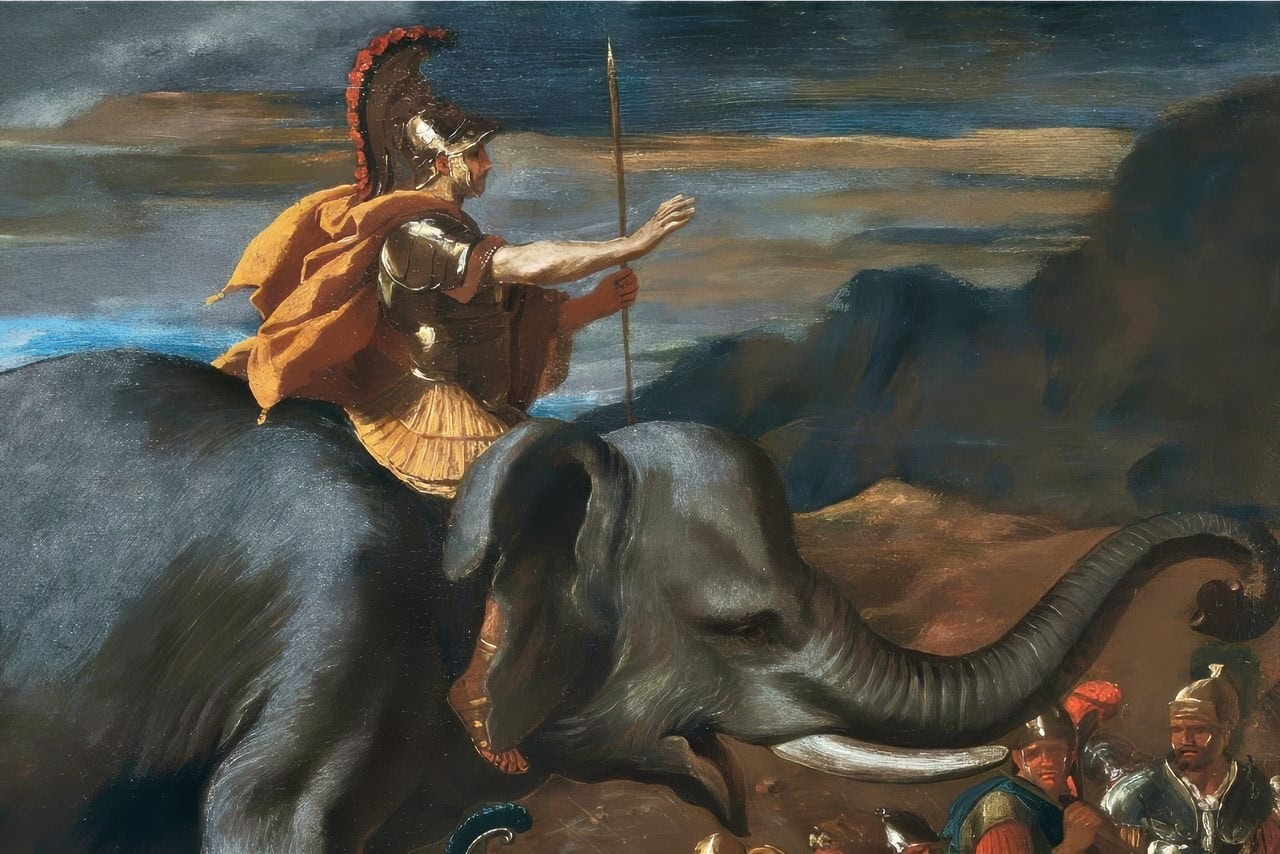
Synopsis – Hannibal Barca, Carthage’s greatest general, became Rome’s most dangerous enemy by taking the war onto Italian soil.
-Raised in a martial family and shaped by his father Hamilcar’s anti-Roman oath, Hannibal built his reputation in Iberia before Rome’s alliance with Saguntum helped spark the Second Punic War. His boldest move—crossing the Alps with tens of thousands of troops, cavalry, and war elephants—delivered a shock campaign that culminated in the slaughter at Cannae in 216 BC.
-Yet battlefield genius couldn’t overcome Rome’s manpower and strategic patience. Defeated at Zama, Hannibal turned to politics, then died in exile rather than be captured.
Hannibal Has a Quote for Modern Commanders: Audacity Wins Battles
Military Quote of the Day – “All good things to those who wait.” – Hannibal
That quote is associated by my American filmgoers with Dr. Hannibal Lecter, the fictitious character played by Anthony Hopkins in the 1991 blockbuster film “The Silence of the Lambs” (based upon the bestselling 1988 novel by Thomas Harris).
However, that quote didn’t originate with the fictitious cannibalistic serial killer, but rather a real-life historical Hannibal, Hannibal Barca (who is typically referred to simply by his first name).
This historical Hannibal was a great Carthaginian general and one of the Roman Republic’s (later the Roman Empire) greatest nemeses and thorns in its side.
We now take a look at Hannibal’s life story.
Early Life
Like many of the other famous military leaders we’ve recently profiled, Hannibal Barca grew up with a strong martial family tradition.
He was born in 247 BC in the city of Carthage, a powerful city in North Africa (in the present-day country of Tunisia), which was the major rival to the Roman Republic in the Mediterranean for many years.
His mother is unknown to history, but his father was Hamilcar Barca, a general in the Carthage army and had fought Rome during the First Punic War ((264–241 BC).
“Like father, like son,” as the saying goes, and growing up, young Hannibal wanted to follow in Hamilcar’s soldiering footsteps.
Accordingly, when the elder Barca went to the Iberian Peninsula (Spain) to gain control of the region for Carthage, the precocious kiddo begged to come along; his father only relented after Hannibal swore a sacred oath that he would always remain an enemy of Rome.
Initial Military Career of Hannibal
As noted by his Ducksters bio, “Hannibal rose quickly in the ranks of the army. He learned how to be a leader and a general from his father. However, his father died in 228 BCE when Hannibal was 18 years old. For the next 8 years, Hannibal studied under his brother-in-law Hasdrubal the Fair. When Hasdrubal was assassinated by a slave, Hannibal became the general of the Carthage army in Iberia.”
Hannibal wasted no time proving himself worthy of his father’s legacy, continuing Hamilcar’s conquest of the Iberian Peninsula and extending the reach of Carthage.
This became a major source of concern to Rome’s leadership, so they allied with the Spanish coastal city of Saguntum (near the modern town of Sagunto in the province of Valencia, Spain). When Hannibal conquered Saguntum, Rome declared war on Carthage, thus setting the Second Punic War in motion.
Scourge to the Romans (and Friend to the Elephants)
Instead of sitting passively by and fighting a purely defensive war, Hannibal decided to go on the offensive and take the war to Rome.
He and his army embarked on this ambitious crusade in the spring of 218 BCE, departing from New Carthage (Cartagena; not to be confused with the city in Colombia).
To reach this objective, Hannibal and his army had to cross the Alps, negotiating treacherous terrain, snow, and ice, and transiting mountain passes controlled by fierce, tough local tribesmen who could attack them from the high ground. It was also a huge logistical challenge, as Hannibal’s army consisted of 70,000 men, 20,000 horses—and 37 elephants.
Those elephants may have belonged to an extinct subspecies from the Atlas Mountains in Morocco and Algeria. They proved to be a valuable asset; in the words of the Roman historian Polybius, “The enemy were terrified by their strange appearance, and never dared approach the part of the column in which they were stationed.”
Yet incredibly, the utterly determined general and his hardy men and animals made the journey in just 16 days, according to the Roman historian Titus Livius (Livy). Patrick J. Kiger of History.Com picks up the story from there: “He spent the next several years fighting the Romans on their own territory, repeatedly defeating them and inflicting heavy losses. At the battle of Cannae in 216 B.C., his forces killed at least 50,000 Roman legionaries.”
Eventual Defeat and Exile
However, though Hannibal won multiple battles, he and his intrepid band of Carthaginians eventually ended up losing the war. They advanced to within a short distance of Rome but then stalled into a bloody stalemate.
Over several years, the Romans exploited their manpower advantage and eventually wore down Hannibal’s army through attrition.
Hannibal retreated to Carthage in 203 BCE.
During the Battle of Zama in 202 BCE, the Romans finally defeated Hannibal and brought the Second Punic War to an end. Carthage was forced to sign a peace treaty ceding control of Spain and the Western Mediterranean to Rome.
Despite this humiliating defeat, Hannibal found a successful second career in Carthaginian politics, serving as a respected statesman for several years. However, he continued to plot revenge against Rome.
Hannibal went into exile in Turkey, but the Romans, with their own thoughts of revenge in mind, pursued him in 183 BCE, forcing him to flee to the countryside of Libyssa, Bithynia, whereupon he poisoned himself sometime between 181 and 183 BCE (aged between 64–66) to avoid being captured.
About the Author: Christian D. Orr, Defense Expert
Christian D. Orr is a Senior Defense Editor. He is a former Air Force Security Forces officer, Federal law enforcement officer, and private military contractor (with assignments worked in Iraq, the United Arab Emirates, Kosovo, Japan, Germany, and the Pentagon). Chris holds a B.A. in International Relations from the University of Southern California (USC) and an M.A. in Intelligence Studies (concentration in Terrorism Studies) from American Military University (AMU). He is also the author of the newly published book “Five Decades of a Fabulous Firearm: Celebrating the 50th Anniversary of the Beretta 92 Pistol Series.”