
Iran is asking America to pay for something it already owns. Strip away the diplomatic packaging, and that is the mechanism of the proposed Hormuz deal — sanctions relief in exchange for Strait access that U.S. naval power already guarantees and international law already protects. With Pakistan-mediated talks live but stalled — and Iran’s formal counter-proposal explicitly demanding international recognition of its sovereignty over the Strait — the pressure to show movement is real. It doesn’t make the deal sound.
There are two things wrong with it. They operate at different levels, which is why the deal fails not once but twice. The first is a legal problem. The second is a strategic one. Either would be sufficient. Together, they describe a framework built on the wrong premise and structured around the wrong deliverable.
The Fiction Washington Would Be Buying from Iran the Strait of Hormuz
Start with the mechanism, because it is broken before negotiations begin.
Iran cannot legally close the Strait of Hormuz. Under UNCLOS, the Strait qualifies as an international strait used for international navigation — all states hold an unconditional right of transit passage, independent of Iranian consent or goodwill, and that has been true since 1994.
Iran’s closure threats are not a legitimate exercise of sovereignty over adjacent waters.
They are coercion — an attempt to monetize a legal nullity. U.S. naval power has maintained transit access for decades, not because Washington negotiated the right to it, but because no valid basis for closing the Strait exists in the first place.
A Hormuz deal changes that the moment it is signed. Offering concrete sanctions relief in exchange for Iranian non-closure converts a legal fiction — that Tehran owns the terms of Hormuz transit — into a negotiated fact.
The subtext is unmistakable: America paid for something it already owns. Tehran has already confirmed the logic. Its formal counter-proposal in the current talks explicitly demands international recognition of Iranian sovereignty over the Strait. That demand doesn’t appear by accident. It is the opening bid of a party that has correctly read Washington’s willingness to negotiate over something it has no legal right to claim.
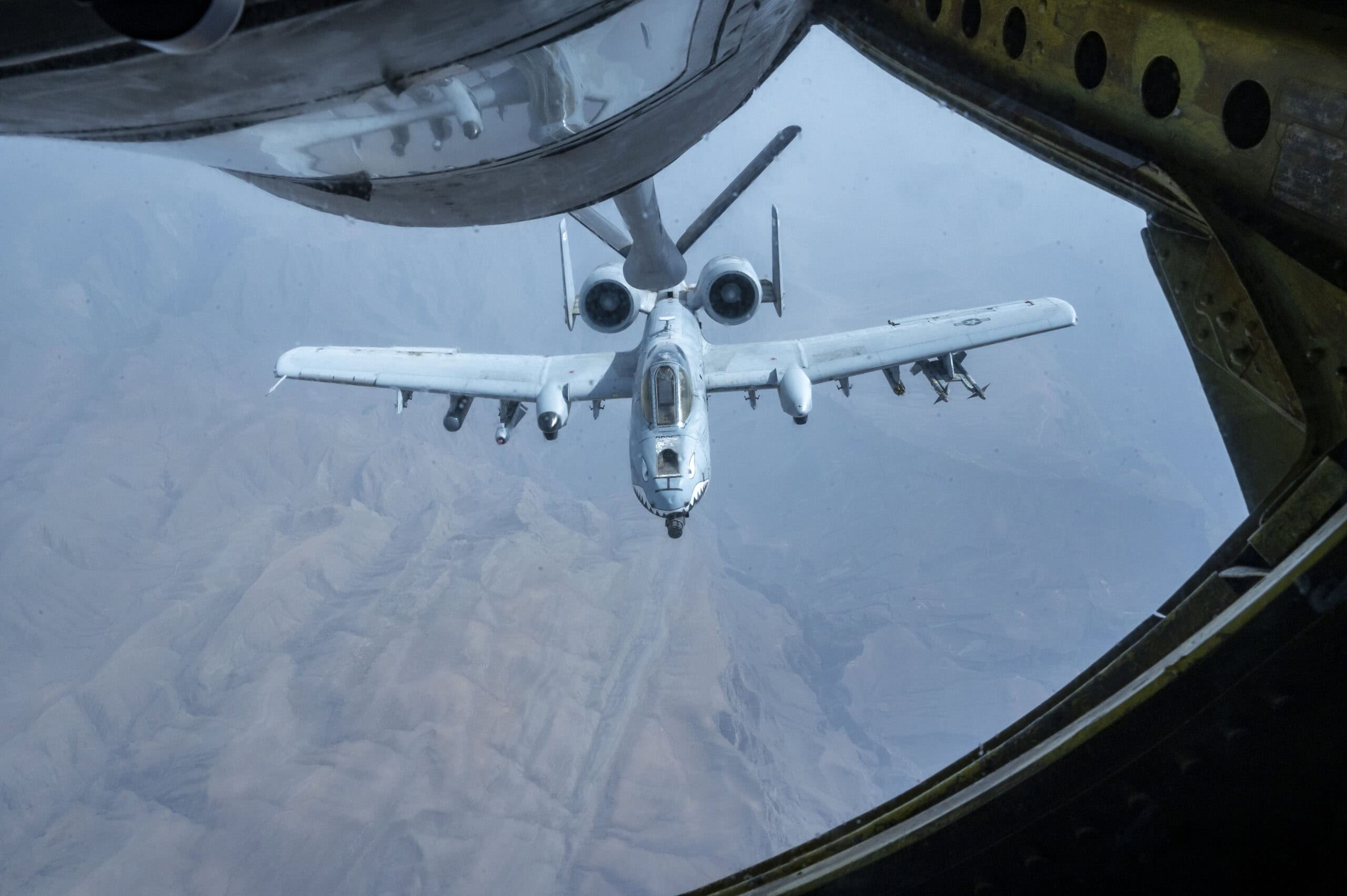
A U.S. Air Force A-10 Thunderbolt II from the 75th Expeditionary Fighter Squadron receives fuel from a KC-135 Stratotanker during air refueling operations above the Strait of Hormuz, July 21, 2023. In an ongoing effort to ensure the security and freedom of navigation in the region, U.S. Air Forces Central (AFCENT) reaffirms its unwavering commitment to maintaining stability and safeguarding global trade in this vital maritime route. (U.S. Air Force photo by Staff Sgt. Frank Rohrig)
The precedent does more damage than the concession itself.
Every future Iranian threat — against shipping lanes, against Gulf partners, against U.S. naval operations — now carries an implicit price tag. Tehran’s threat portfolio doesn’t shrink after a Hormuz deal. It gets a published rate card. The next crisis starts from a worse baseline than this one.
The Wrong Invoice
Set the legitimacy problem aside entirely. The strategic math still does not work.
Iran closed the Strait in early March. The closure is real, the mines are real, and the toll-charging on non-hostile shipping is real. So the proposed trade is now this: the full sanctions architecture — pressing simultaneously on the nuclear file, proxy financing, missile production, and domestic stability — in exchange for reopening a single chokepoint.
That is not a balanced exchange. It is the most consequential economic lever Washington holds, cashed in for relief on one front while the rest of the threat portfolio runs unchecked.
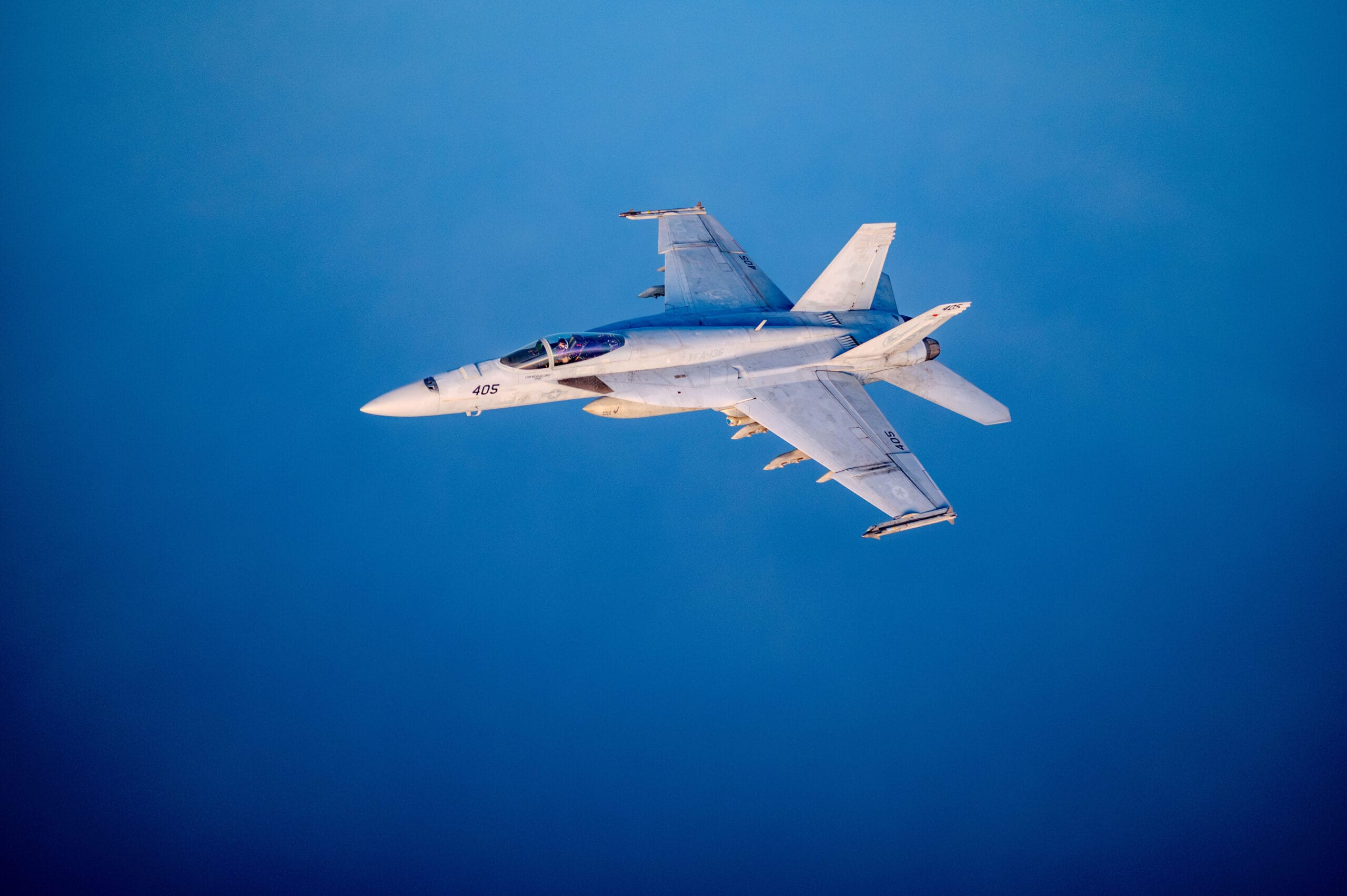
A U.S. Navy F/A-18 Super Hornet, assigned to the Harry S. Truman Carrier Strike Group, flies a mission over the U.S. Central Command area of responsibility, April 8, 2025. The HSTCSG is responsible for patrolling approximately 2.5 million square miles of ocean and includes the Arabian Gulf, Gulf of Oman, Red Sea, parts of the Indian Ocean and three critical choke points at the Strait of Hormuz, Suez Canal and Strait of Bab al-Mandeb. (U.S. Air Force photo by Staff Sgt. Jackson Manske)
The nuclear breakout timeline does not get extended. Hezbollah’s missile inventory does not shrink. The Houthi campaign against Red Sea commerce does not stop. The drone pipeline to Russia is not interrupted. The sanctions pressure that has been starving it all simultaneously — that’s the thing that goes.
That is not a deal. It is a receipt. And it is a receipt for the wrong item.
What the Signal Costs
The audience for this negotiation is not only Tehran. It is Riyadh, Abu Dhabi, Doha, and every Gulf partner that has spent two years watching the U.S. staying power under pressure and quietly hedging toward Beijing.
What they see in a Hormuz deal is not pragmatic statecraft. They see Washington liquidating its most durable lever because the costs of holding it became politically inconvenient.
The message received in those capitals is not “America remains a reliable partner.” It is “America has a price, and the price is manageable.” That perception, once established, does not reverse easily. The reputational damage from this particular concession would outlast the deal by years — and it would arrive at precisely the moment the Indo-Pacific competition requires the opposite signal.
Solving the Wrong Problem
None of this means no agreement is possible. It means the deal on offer is built around the wrong deliverable.
Real sanctions relief should be conditioned on verifiable, phased rollback across Iran’s full threat portfolio — enrichment limits with actual inspection architecture, documented constraints on proxy financing, measurable reductions in ballistic missile and drone production.

120511-N-WO496-003 STRAIT OF HORMUZ (May 11, 2012) Guided-missile cruiser USS Cape St. George (CG 71) and aircraft carrier USS Abraham Lincoln (CVN 72) transit the Strait of Hormuz. Both ships are deployed to the U.S. 5th Fleet area of responsibility conducting maritime security operations, theater security cooperation efforts and support missions as part of Operation Enduring Freedom. (U.S. Navy Photo by Mass Communication Specialist 3rd Class Alex R. Forster/Released)
The Strait of Hormuz is not the problem to solve. It was never the problem. It was the pressure point Tehran chose to elevate because Washington was paying attention to it.
Any framework that treats Hormuz access as the central deliverable has mistaken the symptom for the disease.
The blockade is an instrument, not a strategy — but the answer to an imperfect instrument is a sharper strategy, not selling it off for a promise that the symptom won’t recur while the underlying pathology runs unchecked.
Washington isn’t being offered a deal. It’s being handed a receipt and asked to call it a victory.
About the Author: Dr. Andrew Latham
Andrew Latham is a professor of international relations and political theory at Macalester College in Saint Paul, MN. You can follow him on X: @aakatham. He writes a daily column for 19FortyFive.com.