
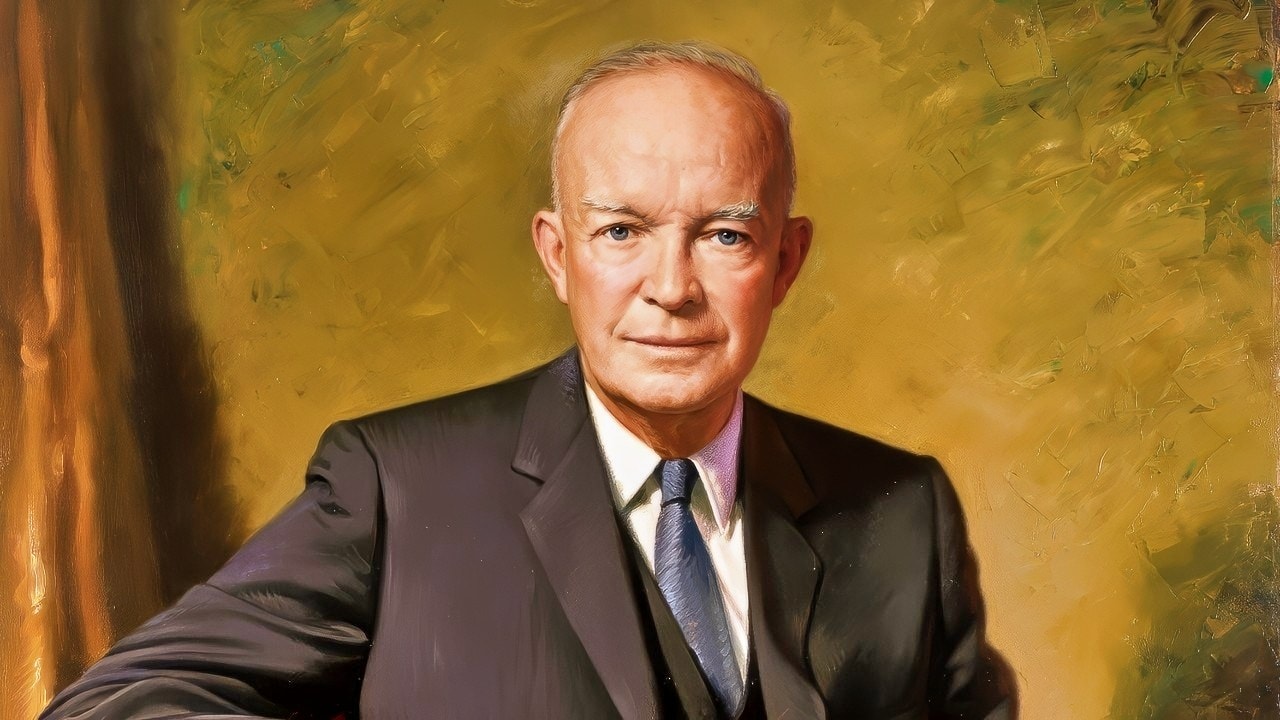
Summary and Key Points: Stephen Silver, an award-winning journalist and film critic, evaluates the complex military and political philosophy of Dwight D. Eisenhower.
-From his rapid ascent from lieutenant colonel to Supreme Allied Commander of the Allied Expeditionary Force (SHAEF), Eisenhower’s career was defined by the massive logistical success of Operation Overlord.
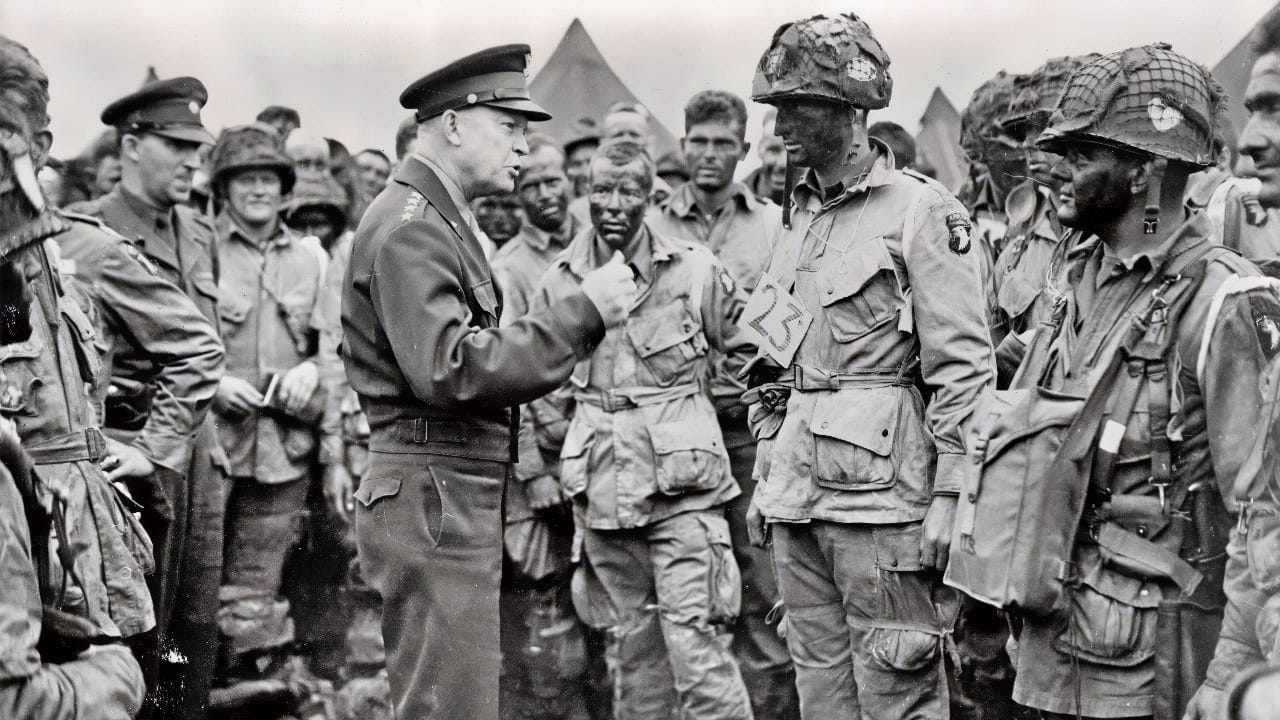
Dwight D. Eisenhower D-Day 1944. Image Credit: Creative Commons.
-This report analyzes a 2024 Army War College reappraisal by Richard D. Hooker Jr., which questions Ike’s “strategic missteps” alongside his famous 1961 warning against the military-industrial complex.
-Silver concludes that Eisenhower’s dual legacy as a victorious general and a vocal critic of war’s brutality remains a vital study for modern leadership.
The Reluctant Liberator: Why General Eisenhower Publicly Denounced the “Stupidity” of War in 1946
Military quote of the day: “I hate war as only a soldier who has lived it can, only as one who has seen its brutality, its futility, its stupidity”- General Dwight Eisenhower
“I hate war as only a soldier who has lived it can, only as one who has seen its brutality, its futility, its stupidity.” That was a quote from General Dwight Eisenhower, and the venue was the Canadian Club in Ottawa, in a speech he gave on January 10, 1946, just months after the end of World War II.
Eisenhower, of course, was later elected the 34th president of the United States, serving two terms throughout most of the 1950s. But before that, he was best known for his time serving as Supreme Allied Commander in Europe during World War II.
Ike in Europe
According to the bio of Eisenhower on the Miller Center’s website, at the start of World War II, Eisenhower returned to the United States from the Philippines, where he was stationed along with Gen. Douglas MacArthur.
First participating in planning the Third Army’s field maneuvers in Louisiana, and once Pearl Harbor was attacked, he headed to Washington to work on the war plans. This drew the eye of Army Chief of Staff George C. Marshall and led to a series of promotions for Eisenhower.
“In November 1942, Eisenhower commanded Allied troops that invaded North Africa in Operation Torch. The next year, he directed the invasions of Sicily and Italy,” the Miller Center bio said. “In 1944, he was the Supreme Commander in Operation Overlord, the Allied invasion of Nazi-occupied western Europe. In only a few years, Eisenhower had risen from an obscure lieutenant colonel to a four-star general in charge of one of the greatest military forces in history.”
As his Navy bio said, Eisenhower was chosen over General Marshall to lead the Allied forces in Europe.
“In December 1943, Roosevelt decided that Eisenhower—not Marshall—would be Supreme Allied Commander in Europe. In January 1944, he resumed command of ETOUSA and the following month was officially designated as the Supreme Allied Commander of the Allied Expeditionary Force (SHAEF), serving in a dual role until the end of hostilities in Europe in May 1945,: the Navy bio said.
But Eisenhower’s best-known victories would come in the final stretch of the war.
“By dealing sympathetically with Allied leaders, Eisenhower achieved the cooperative effort that enabled him to launch the D-Day invasion of Normandy,” the Miller Center bio continued. “June 6, 1944. His terse decision, “Okay, let’s go,” despite the chance of poor weather, won admiration from the Allied leaders and the troops that risked—and gave—their lives on the beaches of Normandy.”
“In these positions, he was charged with planning and carrying out the Allied assault on the coast of Normandy in June 1944 under the code name Operation Overlord, the liberation of western Europe, and the invasion of Germany,” the Navy bio said. “ A month after the Normandy D-Day landings on June 6, 1944, the invasion of southern France took place, and control of the forces which took part in the southern invasion passed from the AFHQ to the SHAEF. From then until the end of the War in Europe on May 8, 1945, Eisenhower, through SHAEF had supreme command of all operational Allied forces, and through his command of ETOUSA, administrative command of all U.S. forces, on the Western Front north of the Alps.
A Dissenting View
A 2024 article by Richard D. Hooker Jr., published by the Army War College, was titled “Eisenhower as Supreme Allied Commander: A Reappraisal,” and argued that Eisenhower’s time as commander was marred by “several strategic errors and missteps attributable to Eisenhower, which resulted in severe casualties and prolonged the war in Europe.”
What does Hooker, who works for the Atlantic Council, think Eisenhower did wrong?
“We cannot know if other generals would have outperformed Eisenhower. Montgomery’s battle experience and seniority did not produce striking results in 1944–45. The results of the campaign in northwest Europe in 1944–45 suggest, however, a more senior and experienced American would have enjoyed more prestige and credibility with the British and perhaps provided more forceful and aggressive leadership. Several leaders were available, all senior to Eisenhower at the outbreak of war and with superior professional résumés…
“Given his relative youth, inexperience, and meteoric rise, Eisenhower faced immense challenges, and leading the Allies to victory was no small achievement in the greatest war in history. The cost was high, however, and Eisenhower’s learning curve was steep. Given his advantages—overwhelming force, crushing air dominance, superior intelligence, secure sea lanes of communication, near-limitless industrial capacity, and the diversion of German resources to the far larger Eastern Front—an Allied victory by summer 1945 seemed inevitable. Most scholarship on Eisenhower’s generalship is laudatory and deferential.”
“A Grim, Cruel Business”
Eisenhower was widely known for having led a victorious war. But as the 1946 quote noted, Eisenhower had a somewhat complex view of war.
One trip widely attributed to Eisenhower had him describing war as “a grim, cruel business, a business justified only as a means of sustaining the forces of good against those of evil.”
And then, in January of 1961, at the end of his presidency, Eisenhower famously denounced the “military-industrial complex” in his farewell address.
“ This conjunction of an immense military establishment and a large arms industry is new in the American experience,” Eisenhower said in the address.
“Yet we must not fail to comprehend its grave implications. . . . In the councils of government, we must guard against the acquisition of unwarranted influence, whether sought or unsought, by the military-industrial complex. The potential for the disastrous rise of misplaced power exists and will persist.”
The speech, famously, was played at the beginning of Oliver Stone’s 1991 film JFK, to imply that the Kennedy Assassination, of Eisenhower’s successor, had been carried out by that complex.
About the Author: Stephen Silver
Stephen Silver is an award-winning journalist, essayist, and film critic, and contributor to the Philadelphia Inquirer, the Jewish Telegraphic Agency, Broad Street Review, and Splice Today. The co-founder of the Philadelphia Film Critics Circle, Stephen lives in suburban Philadelphia with his wife and two sons. For over a decade, Stephen has authored thousands of articles that focus on politics, national security, technology, and the economy. Follow him on X (formerly Twitter) at @StephenSilver, and subscribe to his Substack newsletter.