
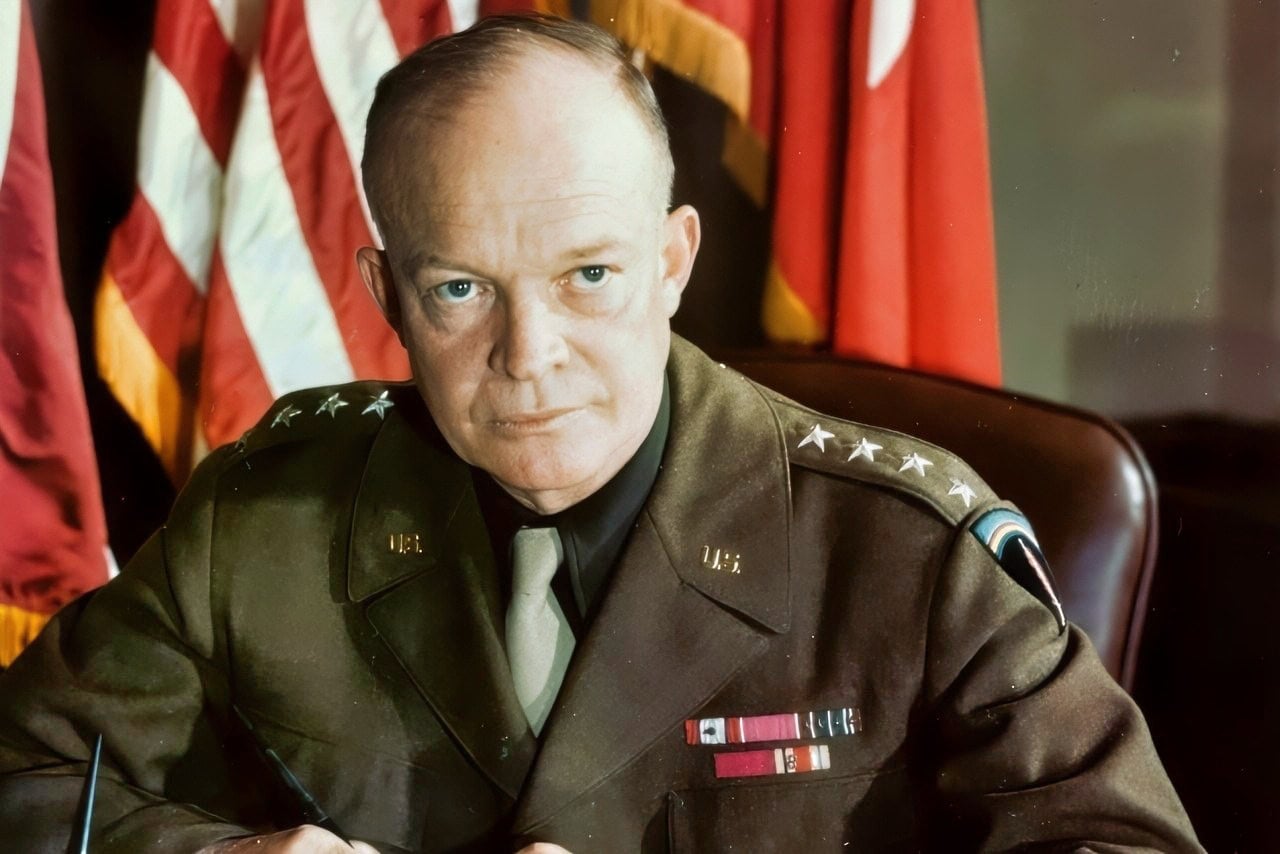
“A Theft From Those Who Hunger”: Eisenhower’s Powerful Warning
Quote of the day: “Every gun that is made, every warship launched, every rocket fired signifies in the final sense, a theft from those who hunger and are not fed, those who are cold and are not clothed” – Dwight D. Eisenhower
Dwight D. Eisenhower is one of the most celebrated generals in U.S. history. He was Supreme Commander of the Allied Expeditionary Force in Europe during World War II and the architect of the pivotal invasion of Normandy in 1944. Following his military service, Eisenhower became the 34th president of the United States and served two terms that lasted most of the 1950s.
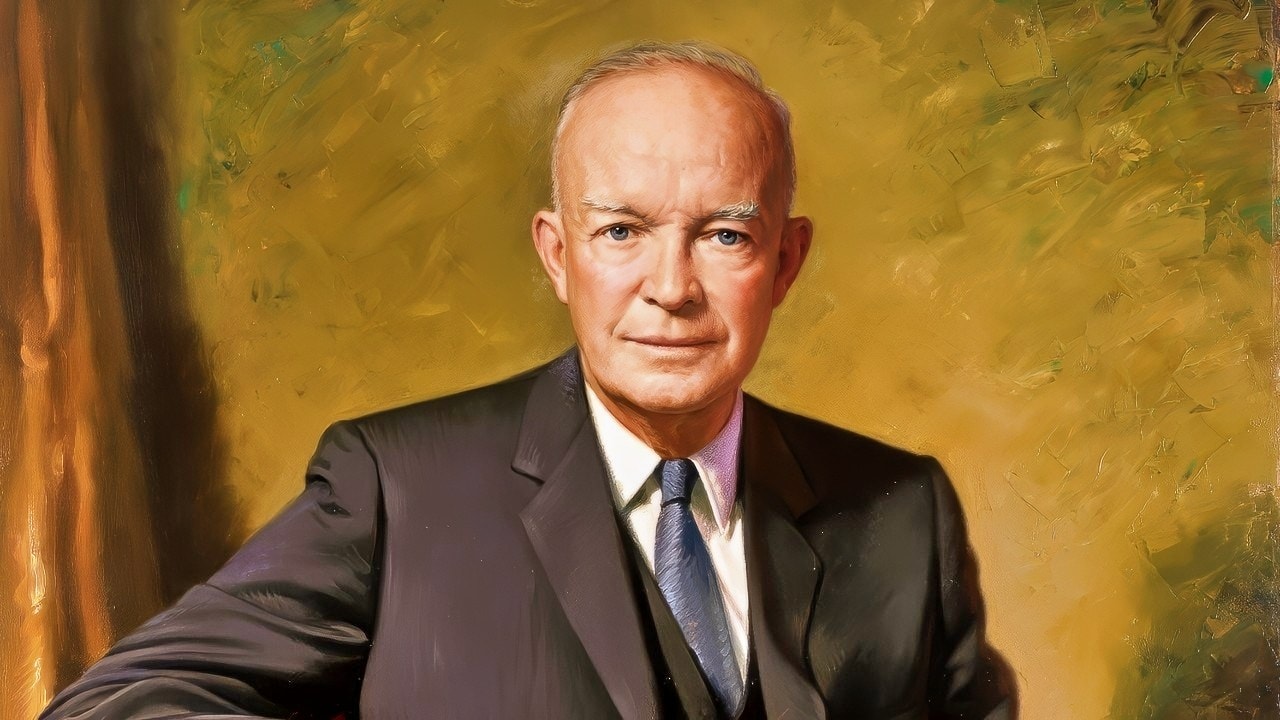
Former General Dwight D. Eisenhower. Image Credit: Creative Commons.
All About Eisenhower
Eisenhower was born in Texas in 1890, and he was raised in Abilene, Kansas.
According to the White House Historical Association, “In Eisenhower’s early army career, he excelled in staff assignments, serving under Generals John J. Pershing and Douglas MacArthur. After Pearl Harbor, General George C. Marshall called him to Washington to work on war plans,” the bio said. “He commanded the Allied Forces landing in North Africa in November 1942; on D-Day, 1944, he was supreme commander of the troops invading France.”
Then, it was on to various pursuits, including politics.
“After the war, he became president of Columbia University, then took leave to assume supreme command over the new NATO forces being assembled in 1951. Republican emissaries to his headquarters near Paris persuaded him to run for president in 1952. ‘I like Ike’ was an irresistible slogan; Eisenhower won a sweeping victory over Illinois Governor Adlai Stevenson.”
The Cost of War
The great general is also well known for a couple of quotes that question the use of military power and the cost societies must pay when they go to war.
Eisenhower’s farewell address, in 1961, famously warned of the power of the “military-industrial complex,” a speech that was included at the beginning of Oliver Stone’s film JFK. But many years before that, Eisenhower delivered what’s known as the “Chance for Peace” speech, also sometimes called the “Cross of Iron” speech.
“Every Gun That is Made…”
Eisenhower delivered that speech on April 16, 1953, shortly after the death of Joseph Stalin and during the second year of his presidency. It came eight years after the end of World War II. And it was very clearly a Cold War speech.
While, as Eisenhower noted, the U.S. and Soviet Union had met “at the center of Europe” at the moment of victory over the Nazis, that moment was not to last.
“This common purpose lasted an instant and perished. The nations of the world are divided to follow two distinct roads,” Eisenhower said. “The United States and our valued friends, the other free nations, chose one road. The leaders of the Soviet Union chose another.”
The president went on to look to the possible future.
“The worst to be feared and the best to be expected can be simply stated,” he said. “The worst is atomic war. The best would be this: a life of perpetual fear and tension; a burden of arms draining the wealth and the labor of all peoples; a wasting of strength that defies the American system or the Soviet system or any system to achieve true abundance and happiness for the peoples of this earth.”
Then, Eisenhower addressed the costs that war, and the preparation for war, exact on societies.
“Every gun that is made, every warship launched, every rocket fired signifies, in the final sense, a theft from those who hunger and are not fed, those who are cold and are not clothed. This world in arms is not spending money alone,” Eisenhower said. “It is spending the sweat of its laborers, the genius of its scientists, the hopes of its children.”
He got a bit more specific:
“The cost of one modern heavy bomber is this: a modern brick school in more than 30 cities.
It is two electric power plants, each serving a town of 60,000 population. It is two fine, fully equipped hospitals. It is some 50 miles of concrete highway.
“We pay for a single fighter plane with a half million bushels of wheat. We pay for a single destroyer with new homes that could have housed more than 8,000 people.”
He went on to recall William Jennings Bryan’s “Cross of Gold” speech, with a reference to a “Cross of Iron.”
“This is not a way of life at all, in any true sense. Under the cloud of threatening war, it is humanity hanging from a cross of iron,” he said.
A Speech’s Legacy
Eisenhower did not end or even de-escalate the Cold War during his presidency, and it would continue for about 30 more years.
He did make attempts to ease tensions. According to the White House’s official bio, “In Geneva in 1955, Eisenhower met with the leaders of the British, French, and Soviet governments. The president proposed that the United States and Soviet Union exchange blueprints of each other’s military establishments and ‘provide within our countries facilities for aerial photography to the other country.’ But the Soviets vetoed his ‘Open Skies’ proposal.”
In his farewell address, Eisenhower warned about the direction things were going.
“This conjunction of an immense military establishment and a large arms industry is new in the American experience,” Eisenhower said.
“Yet we must not fail to comprehend its grave implications. . . . In the councils of government, we must guard against the acquisition of unwarranted influence, whether sought or unsought, by the military-industrial complex. The potential for the disastrous rise of misplaced power exists and will persist.”
In 2011, the Eisenhower Presidential Library and Museum hosted a panel to look back at the legacies of Eisenhower’s major speeches.
“The book-end speeches show that Eisenhower was consistently concerned with the peace and freedom of all peoples throughout his presidency,” Karl Weissenbach, then the director of the presidential library, said.
About the Author: Stephen Silver
Stephen Silver is an award-winning journalist, essayist, and film critic, and contributor to the Philadelphia Inquirer, the Jewish Telegraphic Agency, Broad Street Review, and Splice Today. The co-founder of the Philadelphia Film Critics Circle, Stephen lives in suburban Philadelphia with his wife and two sons. For over a decade, Stephen has authored thousands of articles that focus on politics, national security, technology, and the economy. Follow him on X (formerly Twitter) at @StephenSilver, and subscribe to his Substack newsletter.