
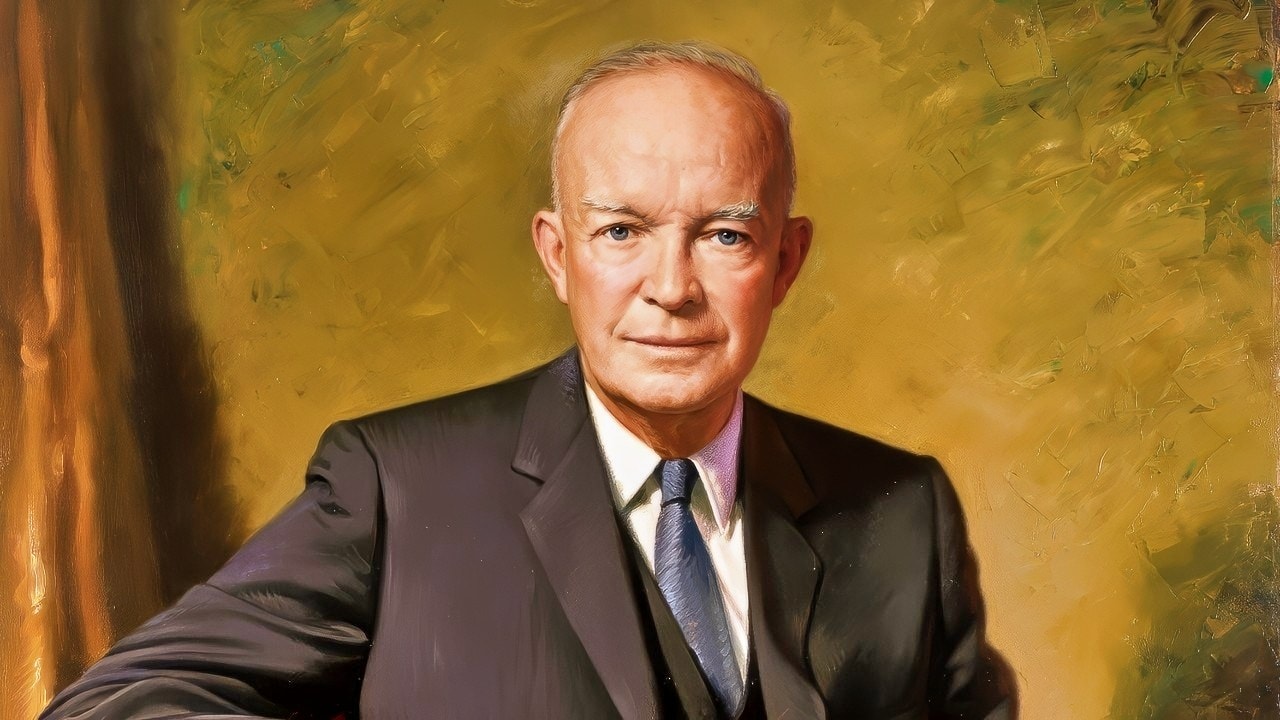
Key Points and Summary – Dwight D. Eisenhower’s life reads like a manual for modern leadership. Raised in Abilene, Kansas, he fought through early academic struggles, earned his place at West Point, and learned resilience after a football injury.
-He missed frontline World War I combat but gained organizational mastery in the Army’s tank program, shaping how he would later manage coalitions.
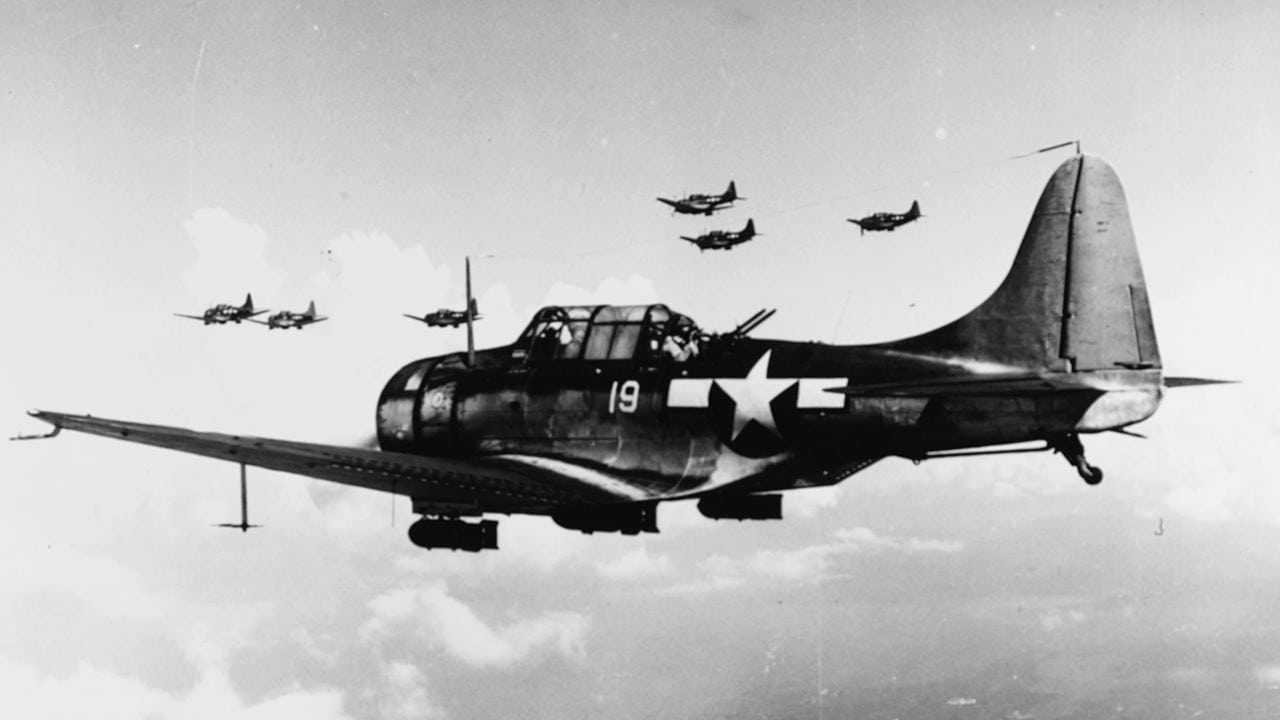
U.S. Navy Douglas SBD-5 Dauntless dive bombers of Bombing Squadron 16 (VB-16), Carrier Air Group 16, from the aircraft carrier USS Lexington (CV-16), fly over the invasion fleet off Saipan, on “D-Day”, 15 June 1944.
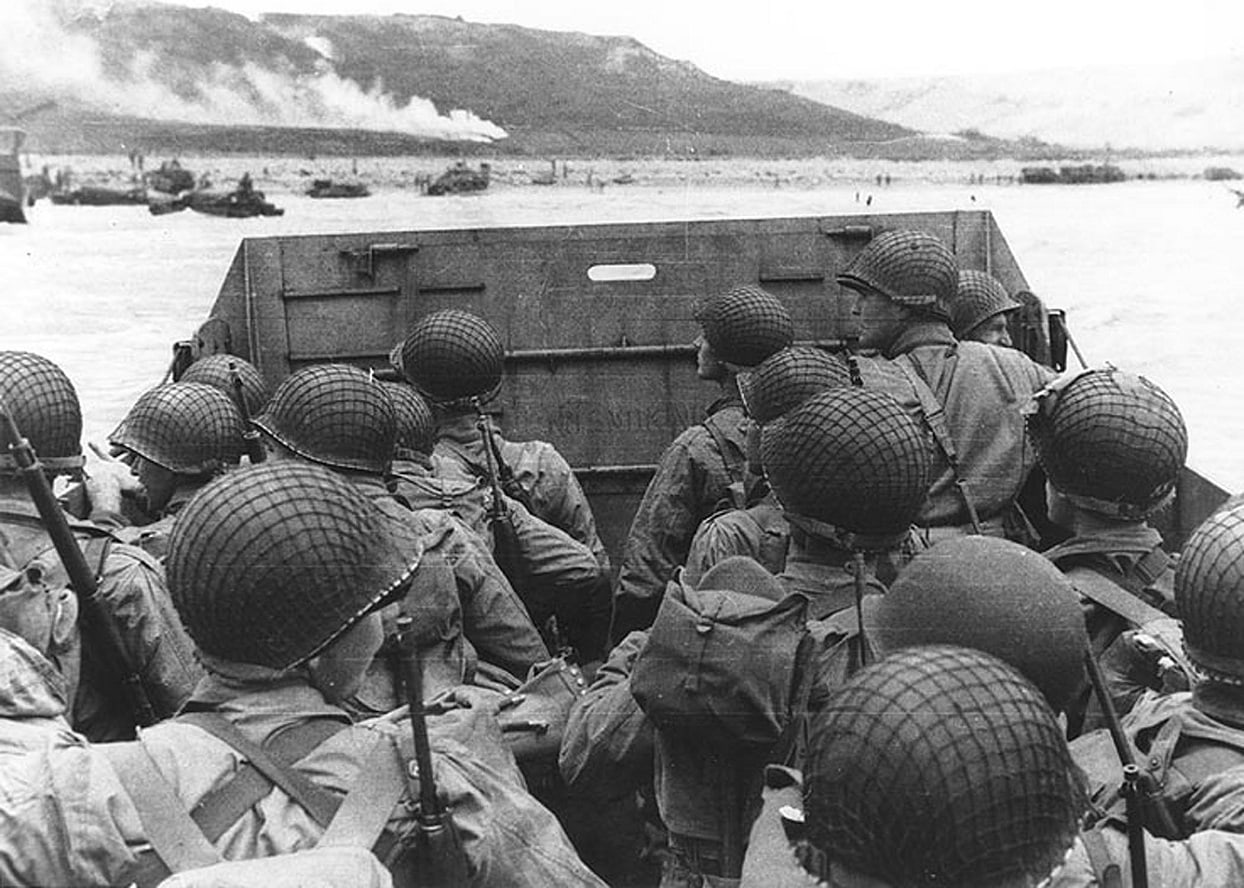
Troops in an LCVP landing craft approach Omaha Beach on D-Day, June 6, 1944.
Note the helmet netting, faint “No Smoking” sign on the LCVP’s ramp, the M1903 rifles and M1 carbines carried by some of these men.
-In World War II, Eisenhower became the Allied Supreme Commander and oversaw D-Day.
-Afterward he served as Army Chief of Staff, NATO’s first SACEUR, and two-term president.
-His enduring lesson—plans fail, planning matters—still defines how serious professionals prepare for chaos at every level.
The Quotable General Dwight D. Eisenhower
“In preparing for battle I have always found that plans are useless, but planning is indispensable.”
That quote is attributed to Dwight David “Ike” Eisenhower, and its paradoxical truth is corroborated by two other seemingly contradictory military truisms: “No battle plan survives contact with the enemy,” attributed to Field Marshal Helmuth von Moltke the Elder; and “Proper Prior Planning Prevents P***-Poor Performance (7P’s),” uttered by Commander Richard “Demo Dick” Marcinko and Colonel David Hackworth.
That opening quote reveals much about the character of the legendary General/President Eisenhower.
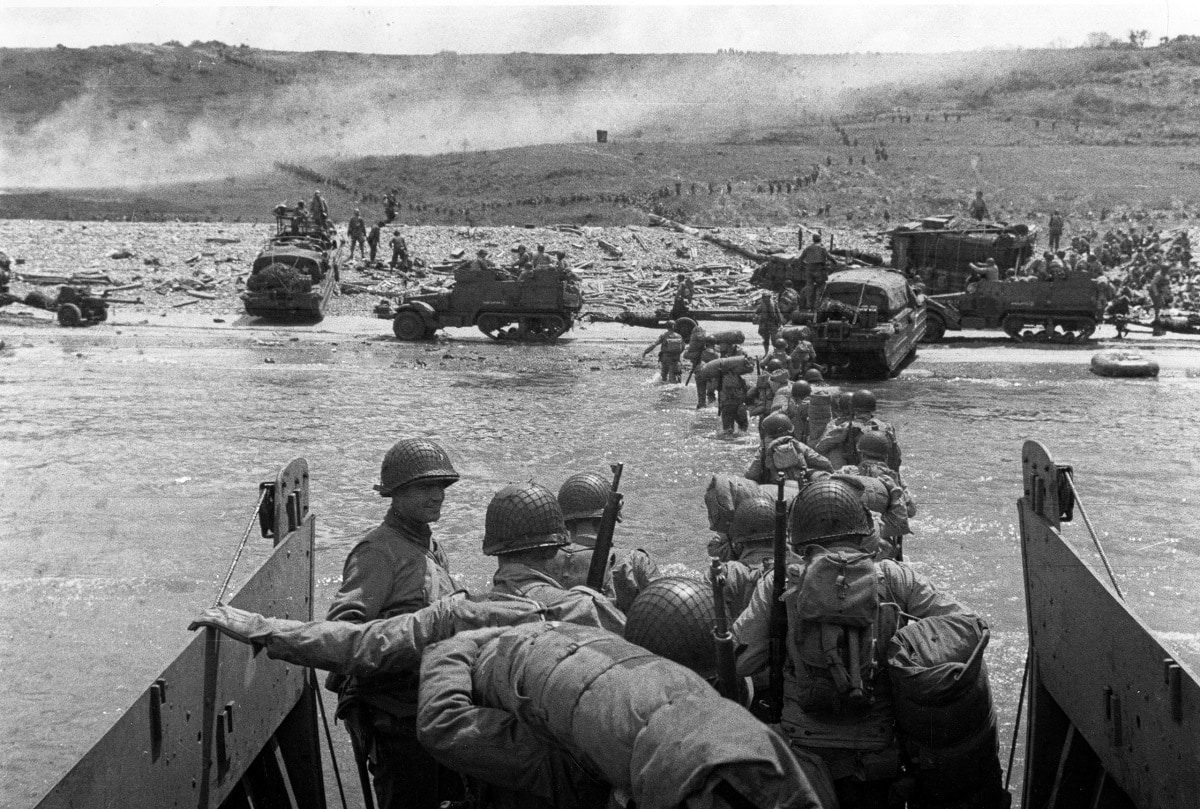
Troops wade ashore from a LCVP landing craft, off Omaha Beach, 6 June 1944. Note DUKWs and half-tracks at the water line, lines of men headed inland, and M1903 and M1 rifles carried by some of the troops leaving the landing craft. Photograph from the Army Signal Corps Collection in the U.S. National Archives.
Ike’s Childhood and Pre-Military Life
Dwight David Eisenhower was born in Denison, Texas on October 14, 1980, the third of seven sons born to Ida and David Eisenhower; he was raised in Abilene, Kansas. His actual legal birth name is David Dwight Eisenhower (in honor of evangelist Dwight Lyman Moody), but Ida reversed his two forenames after his birth to avoid the confusion of having two Davids in the family. . All seven of the boys were nicknamed “Ike”, e.g., “Big Ike” (Edgar) and “Little Ike” (Dwight), as an abbreviation of their surname.
Young Dwight graduated from Abilene High School in the spring of 1909, after which he spent the summer working a series of jobs to help put Edgar through college. He took a job the following autumn at the Belle Springs Creamery, remaining there for nearly two years.
West Point
On October 28, 1910, Kansas Senator Joseph L. Bristow nominated Dwight for an appointment at the U.S. Military Academy at West Point.
Ike reported for duty along with 245 other plebes on June 14, 1911. As noted by the Eisenhower Foundation, “At nearly 21 years of age, Dwight Eisenhower did not take it too seriously [the constant hazing inherent to plebe life, that is] and adapted quickly. But because he could not march in step when he arrived, he was assigned to the ‘Awkward Squad’ for more practice. “
After surviving that first year, Ike made the varsity football team but suffered a nasty knee injury during the 1912 season that nearly derailed his military career. He still managed to serve as junior varsity football coach and cheerleader.
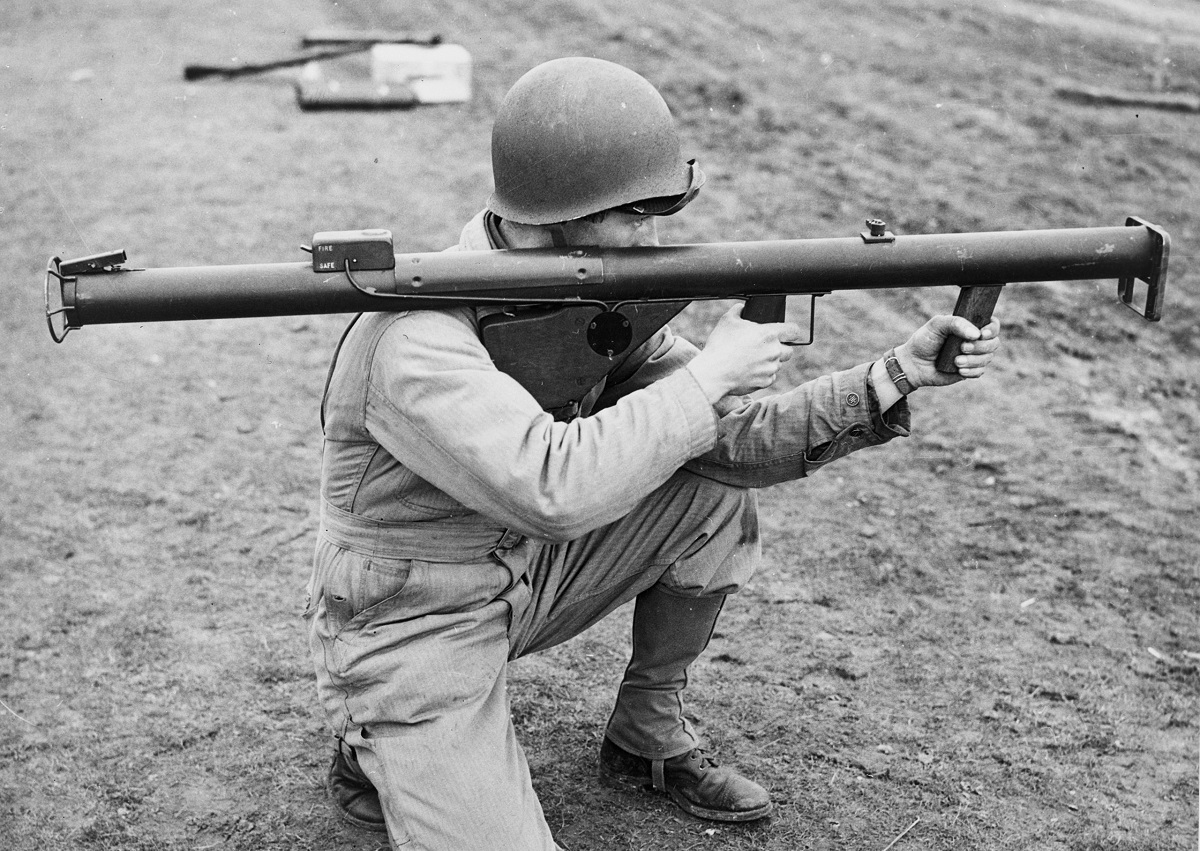
Bazooka Anti-Tank Weapon. Image: Creative Commons.
Ike graduated from West Point on June 11, 1915, ranked 64th out of 164 academically and 125th in discipline—statistically middling but enough to earn a commission as a second lieutenant in the U.S. Army. That West Point Class of 1915 became known as the “Class the Stars Fell On” because so many rose to the rank of general in World War II.
World War I
In 1915, World War I was already raging in Europe, but America’s entry into the “Great War” was still two years away. Ike’s first active-duty assignment was at Fort Sam Houston in San Antonio, Texas. It proved a fortuitous posting. There he met his wife, Mamie Geneva Doud, with whom he ended up having two sons.
Eisenhower missed seeing action in World War I, instead being ordered to the Tank Corp at Fort Meade, Maryland. He did finally receive orders to France, but the Armistice was signed the week before he was set to deploy.
Between the World Wars
According to the National Park Service, “To many historians, this lack of combat experience during World War I was an advantage to General Eisenhower [during World War II] because his strategic and tactical mindset was not trapped in the horrors of trench warfare.”
Eisenhower returned to Fort Meade. He befriended George S. Patton, who introduced Eisenhower to Major General Fox Conner, who became a great intellectual mentor—Ike served as Conner’s assistant in the Panama Canal Zone for several years. Eisenhower’s additional interwar assignments included serving under General John “Black Jack” Pershing at the American Battle Monuments Commission.
World War II and Beyond: From General to POTUS
So much has been written about General Eisenhower’s World War II service and presidency that we couldn’t possibly do it justice here, so we’ll give you the short version.
At the start of World War II, Ike was a brigadier general on the General Staff in Washington, D.C. He ended the war as Supreme Commander of the Allied Expeditionary Force in Europe, with the five-star rank as General of the Army, overseeing the D-Day invasion.

Map showing the swelling of “the Bulge” as the German offensive progressed creating the nose-like salient during 16–25 December 1944.

‘Cobra King’ on Rose Barracks in Vilseck, Germany, today. During the Battle of the Bulge the tank and its crew led an armor an infantry column that relieved the 101st Airborne Division at Bastogne.
After the war ended, Gen. Eisenhower served as Army Chief of Staff (1945–1948) and as NATO’s first Supreme Allied Commander Europe (1951–1952).
From there, of course, he was elected to two terms as president of the United States (1953–1961), during which service he helped bring about the Korean War Armistice.
Ike’s Death and Lasting Legacy
Dwight D. Eisenhower died of congestive heart failure at the age of 78 on March 28, 1969, at Walter Reed Army Medical Center. He was laid to rest in his beloved childhood hometown of Abilene.
Ike has been fittingly and comprehensively honored and memorialized.
To cite just one example, interservice rivalries notwithstanding, the U.S. Navy names a capital warship in his honor. The USS Dwight D. Eisenhower (CVN-69) is the second ship of the Nimitz-class of nuclear-powered aircraft carriers.
It was laid down on August 15, 1970, launched on October 11, 1975, christened at 11:11 a.m. on her launching date by Mamie Doud-Eisenhower, and commissioned on October 18, 1977. CVN-69 remains in-service today, and she is not expected to be retired by her Gerald R. Ford-class successor, USS Enterprise (CVN-80), until 2029.
Unsurprisingly, a leader of Ike’s historical magnitude has also been immortalized in cinema.
The two best examples are Ike: The War Years, made in 1979 and starring Academy Award winner Robert Duvall, and Ike: Countdown to D-Day, made in 2004 and starring Tom Selleck.
About the Author: Christian D. Orr, Defense Expert
Christian D. Orr is a Senior Defense Editor. He is a former Air Force Security Forces officer, Federal law enforcement officer, and private military contractor (with assignments worked in Iraq, the United Arab Emirates, Kosovo, Japan, Germany, and the Pentagon). Chris holds a B.A. in International Relations from the University of Southern California (USC) and an M.A. in Intelligence Studies (concentration in Terrorism Studies) from American Military University (AMU).