
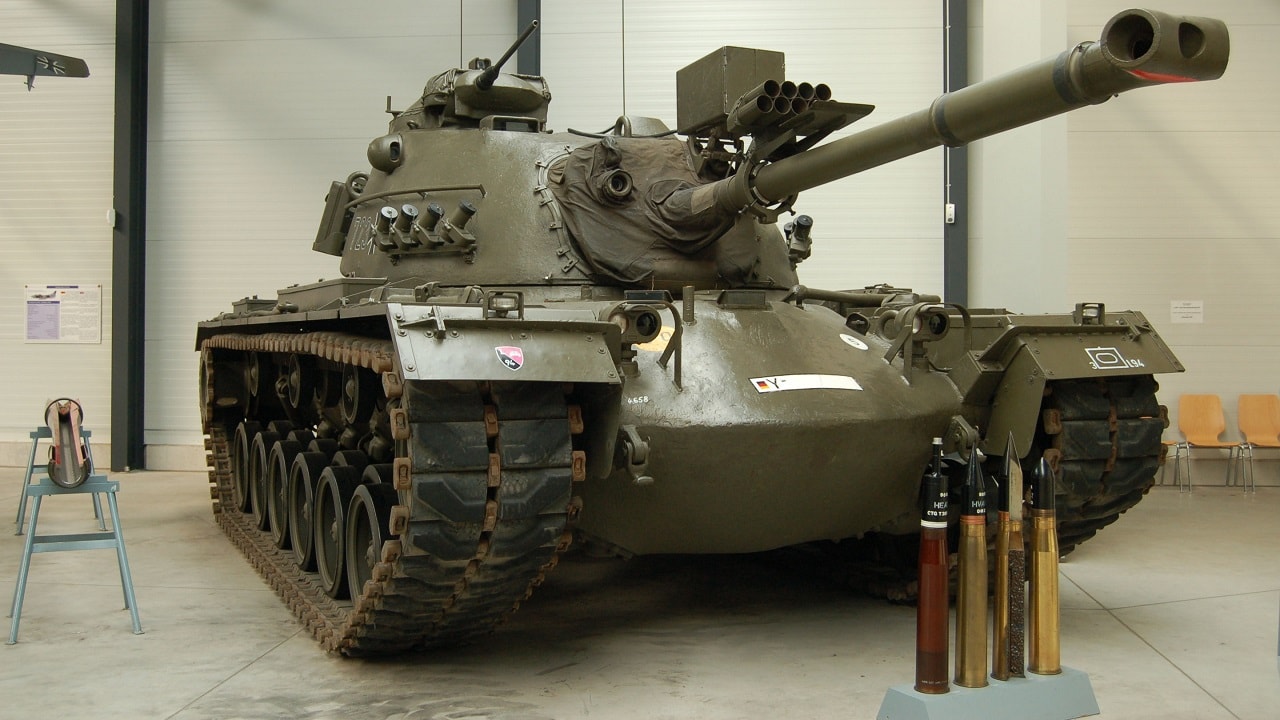
The U.S. Army built 3,200 M48 Patton tanks—a Cold War workhorse that fought through Vietnam, helped Israel crush Egyptian and Syrian armor in the Arab-Israeli wars, and served until 1987 when the Wisconsin National Guard finally retired the last one. Named after General George S. Patton himself, the M48 became one of the most battle-proven tanks in American history.
The M48 Patton Tank
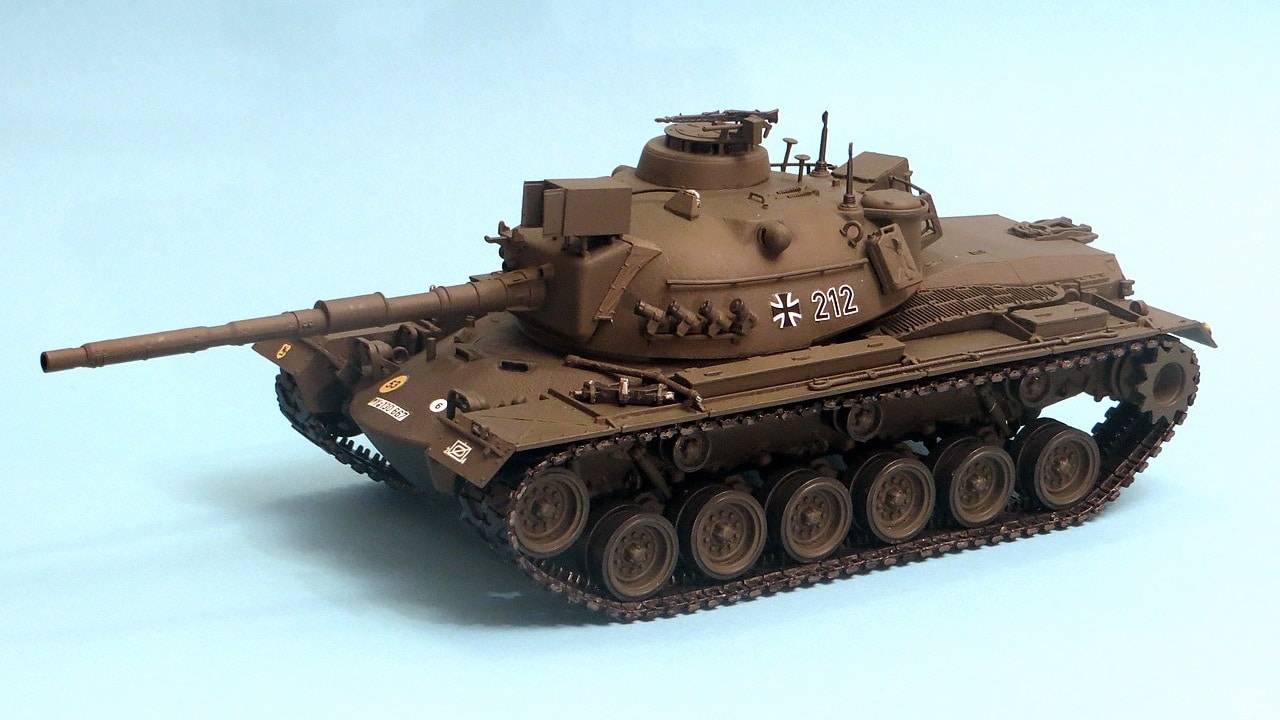
M48A2GA2 Bundeswehr Modell in 1:35
General George S. Patton was a visionary who saw that the main battle tank would dominate the battlefield. These armored beasts could pierce enemy lines and pursue them while taking and holding valuable terrain.
They could be decisive in battle and overawe adversarial troops who had little choice but to retreat.
That’s why the wily, profane, and fiery cavalry officer would have been proud that the M48 tank carried his namesake starting in 1952. This was a dependable armored vehicle that served in many conflicts over the years.
Dependable During the Cold War, Vietnam, and the Arab-Israeli Wars
The M48 Patton was a Cold War stalwart. It was handy in Vietnam, especially while street fighting during the Battle of Hue City. The M48 was a critical component of the Arab-Israeli wars, and it even served into the 1980s.
Over 3,000 Entered Service
The M48 was so popular that the United States made 3,200 of them. That’s a number that astounds me and shows just how the main battle tank became a critical instrument of armored warfare in the early and later parts of the Cold War.
The Americans knew that they were outnumbered and outgunned against overwhelming Soviet and Warsaw Pact forces.
The M48 was going to make mincemeat out of the enemy armored columns filled with Russian tanks like the T-54/55 and armored vehicles such as BMPs and BTRs.
The Answer for Cold War Needs
The M48 replaced the M47 and M46. The design featured a newly shaped hull. The turret was improved, and the suspension could now handle better. The Americans quickly realized they had a hit on their hands, and orders multiplied.
They sent the new models to Germany and held their breath, hoping this was the answer to the Soviet hordes that could stream through the Fulda gap and take out U.S. and NATO troops at will.
Early M48S had risky gas engines
There was a problem with the M48. It had a gasoline engine. One hit from a high-explosive round was going to make an inferno that would have sizzled everyone inside. Then there was the fuel capacity issue. The M48 could carry only 200 gallons of gas. That yielded a short 70-mile range.
The M48’s Lack of Long Range Was a Problem
It didn’t take long to realize that the M48 would need a long supply chain of refueling vehicles to allow it to fight over a large territory. This would have been a problem against the Soviets and would have kept the M48 from serving as the effective spearhead into the enemy’s rear echelons that Patton always envisioned for ultimate victory.
New Engines Helped on the A3 Variants
American engineers got to work on a new diesel engine for the M48A3. These were less dangerous and put out more speed with a greater range. The baseline 50-ton M48S and its gas V-1790, 12-cylinder engine could reach 28 miles per hour at 810 horsepower. The M48A3 improved on that output.
Underpowered Gun Could Have Been a Disadvantage in Europe
Another worry for the designers and end users was the less powerful 90mm main gun. This may have been a liability against Soviet armor. However, the gun could fire a diverse range of ammunition such as “high-explosive anti-tank, high-explosive, and anti-personnel with canister pellets and flechettes.”
The M48 was not the most heavily armored tank, with a maximum armor thickness of five inches, but since they were so numerous, the Americans figured they could attrit many Soviet tanks while taking a pounding. Even if they succumbed to enemy fire, there would be more tanks to take their place.
Different Uses in Vietnam
The M48 saw action during the Vietnam War, with about 600 serving in that conflict. Since there were only rare tank-on-tank battles, the M48 was more of an armored support vehicle and a mobile artillery system. They often helped protect roads and key junctions, but they were effective on the streets of Hue, helping the Leathernecks in that critical battle. The Marines fought house-to-house, and they needed effective supporting fires and protection against enemy snipers. The M48 was actively engaged during the urban combat. The Pattons could draw fire and alert the Marines to enemy positions.
The Time M48S Dished Out Damage to NVA Tanks
There was one tank-on-tank engagement during the Vietnam War that stood out. The Battle of Ben Het in 1969 near the border with Laos and Cambodia was an outlier. The NVA attacked an Army Special Forces compound, and M48S from the 1st Battalion 69th Armor rushed to help. They engaged a force of NVA tanks and eliminated two PT-76s and a BTR.
Spurring Israel to Victory
Israel loved the M48, and many were used during the Arab-Israeli wars in tank battles not seen since World War Two. The Israelis drove the updated M48A2 and A3S to blast myriads of Egyptian and Syrian tanks.
Rotated to National Guard Units
By 1975, the Americans had updated the M48 to the A5 standard. The gun was exchanged for a 105mm model, and a coaxial machine gun was added. The powerplant was a twin-turbo diesel with 300 gallons of fuel on board. By then, most M48S had been reassigned from active duty to Army National Guard units. The last Patton was retired in 1987 by the Wisconsin Army National Guard.
The M48 was a dependable, battle-tested, and versatile tank. This beast had staying power. Produced in large numbers and improved over the years, it made the enemy think twice before advancing or attacking. The best use case was probably during the Arab-Israeli wars, but it also did a decent job in Vietnam. It would have been excellent against the Soviets and Warsaw Pact armies if World War Three would have started. Engineers knew how to make different versions that improved it greatly over time.
Patton would have been proud to see how long this tank served the U.S. military. Old Blood and Guts would have witnessed his name carried on for decades with a beloved tracked vehicle that packed a punch and made the enemy pay the price.
About the Author: Brent M. Eastwood, PhD
Author of now over 3,500 articles on defense issues, Brent M. Eastwood, PhD, is the author of Don’t Turn Your Back On the World: A Conservative Foreign Policy and Humans, Machines, and Data: Future Trends in Warfare, plus two other books. Brent was the founder and CEO of a tech firm that predicted world events using artificial intelligence. He served as a legislative fellow for US Senator Tim Scott and advised the senator on defense and foreign policy issues. He has taught at American University, George Washington University, and George Mason University. Brent is a former US Army Infantry officer. He can be followed on X @BMEastwood.