
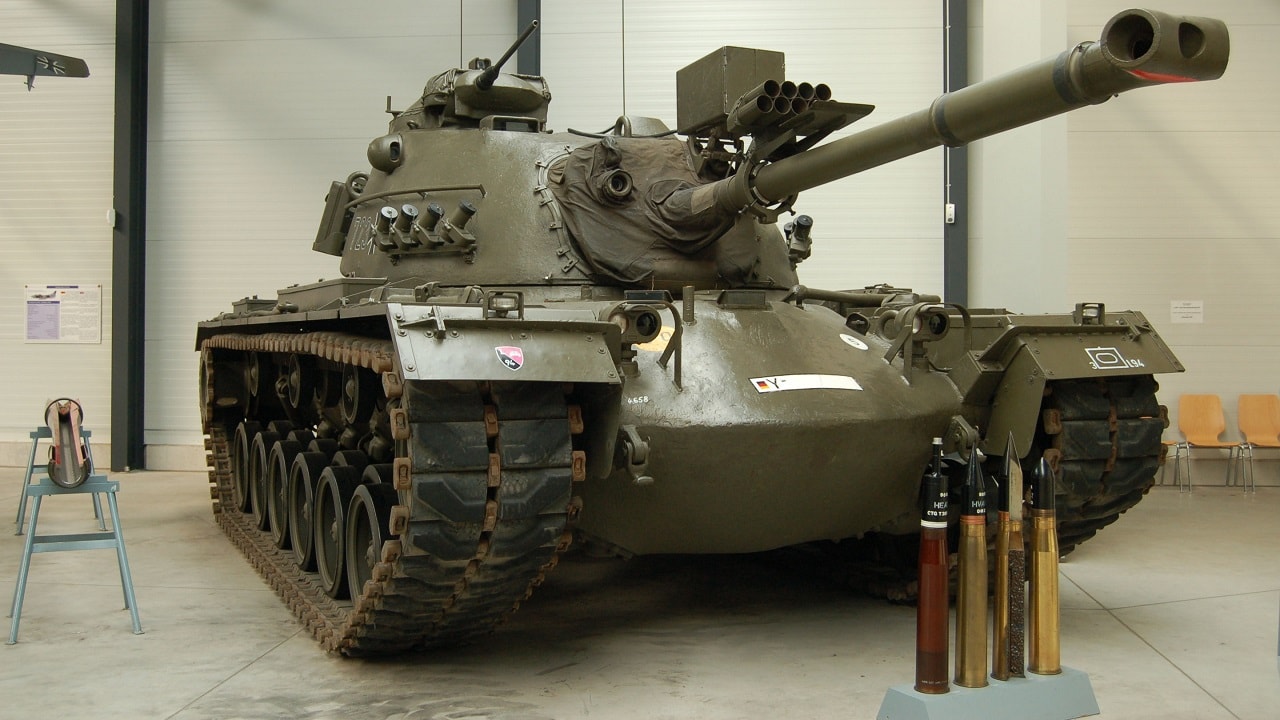
The M60 “Patton” tank (not to be confused with the M60 “Pig” machine gun) is arguably second only to the M1 Abrams as the most successful main battle tank (MBT) of all-time, thus giving American-made tank manufacturers a double-dose of bragging rights (too bad, so sad, T-72and other Soviet-made MBTs).
However, it was never *officially* designated the “Patton,” hence the quote marks.
That said, its immediate predecessor in America’s line of MBTs was indeed officially named after General George Smith Patton Jr. (November 11, 1885 – December 21, 1945; one of my boyhood heroes).
We’re talking about the M48 Patton tank, and not only was it worthy of the iconic general, but it was also worthy of a “King” (so to speak; more on this in a bit).
M48 Initial History
The M48 was indeed America’s first generation of tanks to fit the definition of an MBT. Still, it was actually the third tank to bear the famous general’s name, following a direct linear alphanumeric sequence from the M46 and M47 Patton tanks.
The development of the M48 variant, in particular, was given added urgency by the painful lessons of the Korean War.
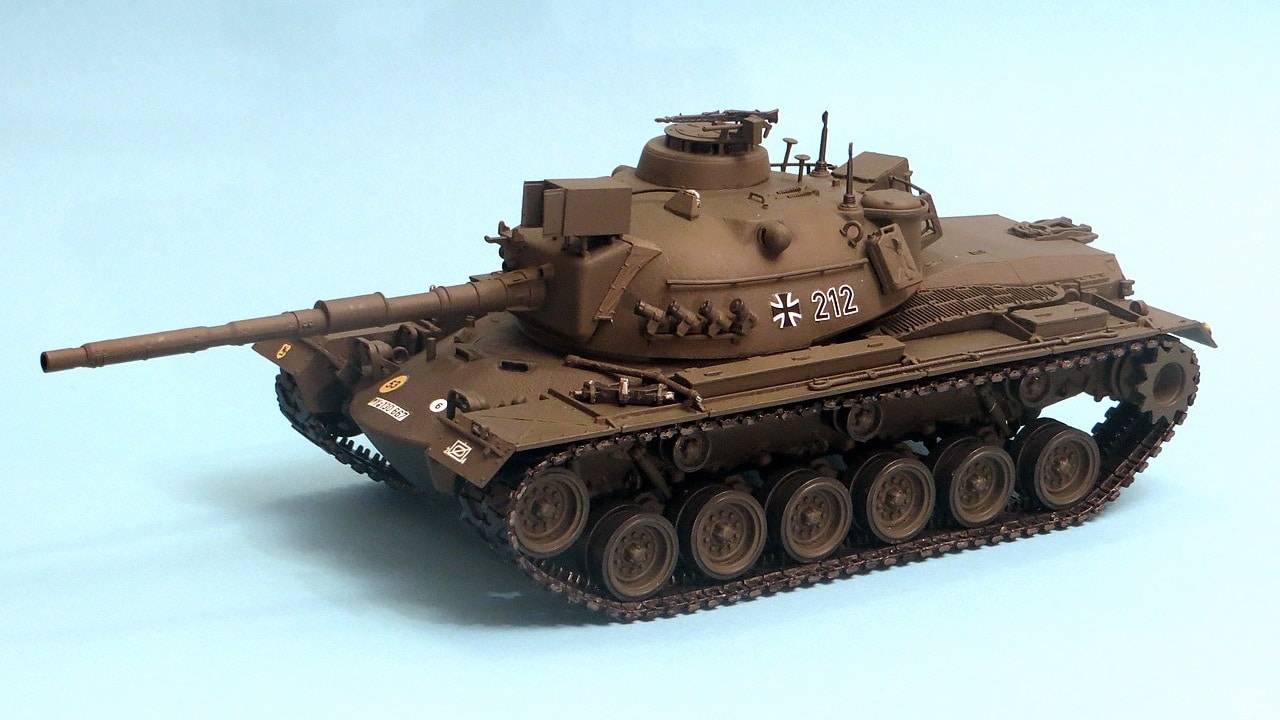
M48A2GA2 Bundeswehr Modell in 1:35
Design, research, and development were conducted by Chrysler Defense Engineering beginning in 1950.
However, in a fine example of the “Big 3” Stateside automakers putting aside their salesmanship rivalries for the sake of a patriotic common cause, actual production, which began in 1952, was carried out by Chrysler, Ford Motor Company, and the Fisher Body Division of General Motors … along with the American Locomotive Company (AKA “Alco”) for good measure.
This Fab Four of factories ended up building a total of 12,000 M48 specimens over nine years.
M48 Patton Tech Specs and Vital Stats
-Crew: 4 (commander, gunner, loader, driver)
-Length: 30 feet 6 inches (9.3 meters)
-Width: 12 feet (3.65 meters)
-Height: 10 feet 2 inches (3.1 meters)
-Max Speed: 30 mph (48 km/h) on paved roads
-Armament: 90mm M41/T139 main gun on the M48—M48A3 variants, 105 mm M68/T254E2 main gun on A5 variant; Browning M2 “Ma Deuce” .50 caliber (12.7mm machine gun) on all variants; Browning M1919/M37/T153 .30 caliber machine up variants to A3, M73/M219 7.62mm NATO machine gun on A5 variant
M48 Operational History/Combat Performance
Ironically enough, although the Patton tank was built by and for Americans for the purpose of fighting Soviet tanks, it was actually “blooded” in combat at the hands of a non-NATO nation, and against the tanks built by a NATO ally no less.
More specifically, the Patton tank was the mainstay for the Pakistani Army in their fight against India’s British-made Centurion tanks during the 1965 Indo-Pakistani War.
During this South Asian subcontinental conflict, on the one hand, the American-made MBT performed reasonably well against Indian armor and was well-regarded by both sides.
Alas, the poorly-shaped armor of the M48, combined with its relative thinness on the sides – a mere 76mm in thickness – left the American-designed tanks distressingly vulnerable to the Centurions’ 20-pounder (84mm) guns.
As far as combat use of the Patton by American troops was concerned, the M48 was the most widely used tank by the U.S. – and its Army of the Republic of Vietnam (ARVN) allies – during the Vietnam War, with over 600 deployed to the Southeast Asian conflict.
The majority of the M48s used herein were in the infantry support role, as tank-versus-tank engagements during this war were relatively few and far between.
In the Battle of Ben Het in March 1969, which was the only tank battle between the U.S. and the North Vietnamese Army (NVA), the tally was one Patton tank damaged with two crew members KIA vs. two PT-76 amphibious tanks and one BTR-50 armored personnel carrier (APCs) destroyed.
(Since the Cold War luckily never blossomed into a “Hot War,” i.e., the Third World War, American M48 crews in Europe never got to test their mettle against their Soviet adversaries.)
“Tank Ya, Tank Ya Very Much”
So then, going back to what I said about the M48 Patton being “fit for a King”…I meant the King of Rock ‘n’ Roll, Elvis Aaron Presley, of course!
During his brief but momentous Army career, Private (eventual Sergeant) Presley first served with the 2nd Armored Division (“Hell on Wheels”) at Fort Hood, Texas, followed by the 3rd Armored Division in Friedburg, Germany. Regarding Elvis’s M48 training at Ft Hood, in particular, TexasMonthly columnist Michael Hall provides us this backstory, which also ties in nicely with the tank’s namesake:
“During the long days at Fort Hood, Elvis was in the middle of advanced individual training, learning to be a tanker. This was Patton’s division, and they trained on the sixty-ton M48 Patton Tank. (Elvis was gung-ho about the general. When one of his lieutenants in Germany quoted to him Patton’s famous line, ‘I don’t want to die for my country; I want the other son of a b*tch to die for his country,’ Elvis replied, ‘Damn right!’) The soldiers cleaned tanks and fired them out on the range; they took the engines out and put them back, changed the tracks, and ran formations. Elvis placed third in tank gunnery. He liked tanks—perhaps they reminded him of his beloved Cadillacs—and he liked being in charge. Dorton Matthews remembers how, once, after he put Elvis in command of a tank, the other recruits begged him to put someone else in charge. ‘He’s working us to death,’ they complained.”
Where are they now?
The U.S. Army officially retired the M48 Patton in 1987; this was in the National Guard.
However, they amazingly remain in service with the armed forces of eight countries, including Thailand and Morocco. Meanwhile, static display specimens can be found in several museums around the globe, including, appropriately enough, the Patton Museum in Fort Knox, Kentucky.
About the Author: Christian D. Orr
Christian D. Orr is a Senior Defense Editor. He is a former Air Force Security Forces officer, Federal law enforcement officer, and private military contractor (with assignments worked in Iraq, the United Arab Emirates, Kosovo, Japan, Germany, and the Pentagon). Chris holds a B.A. in International Relations from the University of Southern California (USC) and an M.A. in Intelligence Studies (with a concentration in Terrorism Studies) from American Military University (AMU). He is also the author of the newly published book “Five Decades of a Fabulous Firearm: Celebrating the 50th Anniversary of the Beretta 92 Pistol Series.”