

Benjamin Franklin Built a Fortune, Retired at 42 and Helped Build a Nation: “Money never made a man happy yet, nor will it. There is nothing in its nature to produce happiness. The more a man has, the more he wants. Instead of filling a vacuum, it creates one.”
The warning is widely attributed to Benjamin Franklin, but the earliest traceable printed version appears in David Alfred Doudney’s Old Jonathan’s Jottings, published in 1869, 79 years after Franklin died. The documented trail leads to Doudney, not a surviving Franklin text. The sentiment still fits Franklin’s life because he built wealth early and used financial independence to pursue work that mattered more than another year of profit.
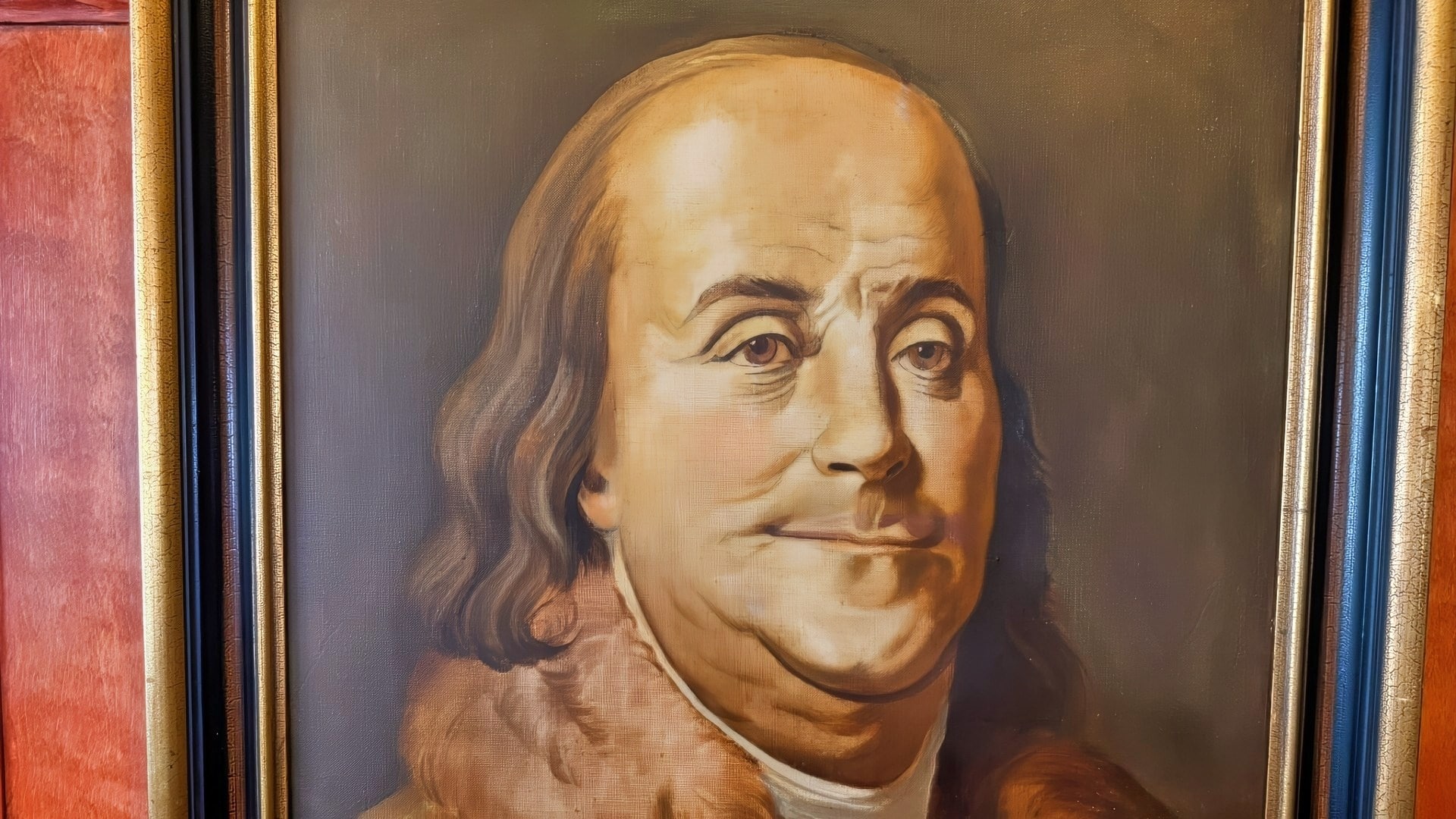
Benjamin Franklin 19FortyFive Image. Taken by Harry J. Kazianis at the Hall of Presidents at Walt Disney World, Florida.
Franklin was born in Boston on January 17, 1706, the fifteenth child of soap and candle maker Josiah Franklin. His formal schooling ended early, and at 12 he became an apprentice to his brother James, a printer.
At 16, he secretly wrote the satirical Silence Dogood letters, slipping them under the print shop door because James would not knowingly publish his younger brother.
The relationship collapsed, and Franklin left Boston for Philadelphia at 17. He arrived with little money, found work as a printer and survived a failed trip to London before establishing his own business.
At 23, he took control of the Pennsylvania Gazette, which became one of colonial America’s most successful newspapers.
Franklin Used Wealth to Buy Independence
Franklin understood money better than the quotation suggests. He printed government forms, currency, pamphlets and newspapers, while Poor Richard’s Almanack turned thrift and self-discipline into memorable advice. The Library of Congress says he had built the largest printing business in colonial America by the time he retired in 1748.
He was 42. Retirement did not mean inactivity. It meant printing income and business partnerships no longer controlled his days. The idea behind the line now circulated under Franklin’s name matches this choice: wealth served him best when it created time and independence rather than another reason to keep accumulating it.
Science Made Franklin Famous Before Independence
Franklin turned toward experimentation, especially electricity. He helped establish the language of positive and negative charge, demonstrated the electrical nature of lightning and developed the lightning rod.
The lightning rod protected homes and ships, while his experiments made him one of the best-known Americans in Europe before the Revolution.
He also developed bifocal glasses, improved the stove that bears his name and designed a glass armonica. He studied ocean currents, weather, population growth and medicine, treating each subject as a practical problem open to measurement. The Smithsonian describes his electrical work as a shift from viewing lightning as divine wrath toward understanding it as a natural phenomenon.
Philadelphia Became Franklin’s Civic Laboratory
Franklin applied the same method to public life. He organized the Junto discussion club, helped establish the Library Company of Philadelphia, supported a volunteer fire company and played a leading role in creating the academy that became the University of Pennsylvania.
These institutions pooled private effort to provide services the colonial government often lacked.
His model was neither charity alone nor government alone. Citizens identified a need, organized, contributed money, and built something durable. That institutional habit became as important to Franklin’s legacy as any invention. His fortune gave him the time, reputation, and network to turn proposals into organizations.
Franklin Became America’s Most Valuable Diplomat
Franklin did not begin as an advocate of separation from Britain. He spent years in London seeking a workable place for the colonies inside the empire. British policy and political humiliation pushed him toward independence.
In 1776, at 70, he served on the committee that drafted the Declaration of Independence and then sailed for France.
His scientific reputation opened doors in Paris, but diplomacy required more than celebrity. Franklin helped secure French recognition, loans, arms and the 1778 alliance after the American victory at Saratoga. French military and naval intervention transformed the balance of the Revolutionary War, forcing Britain to fight a wider global conflict.
Franklin later negotiated with Britain alongside John Adams and John Jay. He rejected offers that stopped short of recognizing American independence and resisted a separate peace that abandoned France. The resulting Treaty of Paris ended the war in 1783 and recognized the United States. His authentic observation that there was never a good war or a bad peace came from this period.
Franklin’s Final Years Carried Hard Contradictions
At 81, Franklin was the oldest delegate to the Constitutional Convention.
He doubted parts of the finished document, yet urged other delegates to sign it with humility, acknowledging that better information had changed his own opinions before. Thirty-nine delegates signed on September 17, 1787.
His moral record also changed.
Franklin had owned enslaved people and printed advertisements for slave sales in the Gazette. Late in life, he became president of the Pennsylvania Abolition Society and publicly demanded an end to slavery and the slave trade.
On February 3, 1790, Franklin signed the society’s petition to the first Congress.
Lawmakers debated it, rejected immediate federal action and tabled the matter. Franklin died in Philadelphia on April 17, 1790, at 84.
About the Author: Harry J. Kazianis
Harry J. Kazianis (@Grecianformula) was the former Senior Director of National Security Affairs at the Center for the National Interest (CFTNI), a foreign policy think tank founded by Richard Nixon based in Washington, DC. Harry has over a decade of experience in think tanks and national security publishing. His ideas have been published in the NY Times, The Washington Post, The Wall Street Journal, CNN, and many other outlets worldwide. He has held positions at CSIS, the Heritage Foundation, the University of Nottingham, and several other institutions related to national security research and studies. He is the former Executive Editor of the National Interest and the Diplomat. He holds a Master’s degree focusing on international affairs from Harvard University.

