
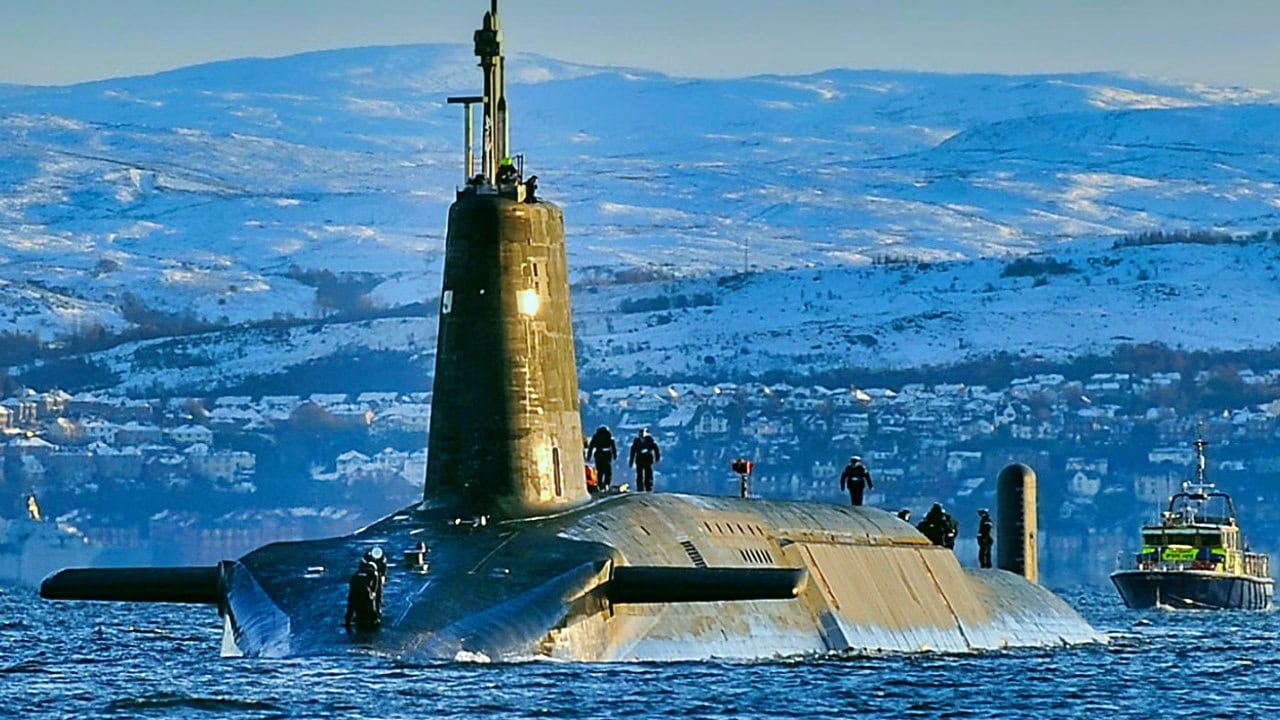
On the night of February 3rd, 2009, two NATO nuclear submarines collided while conducting routine patrols.
The two ships, a British Vanguard-class and a French Le Triomphant-class, were nuclear ballistic missile submarines capable of carrying 16 ballistic missiles and more than 40 nuclear warheads.
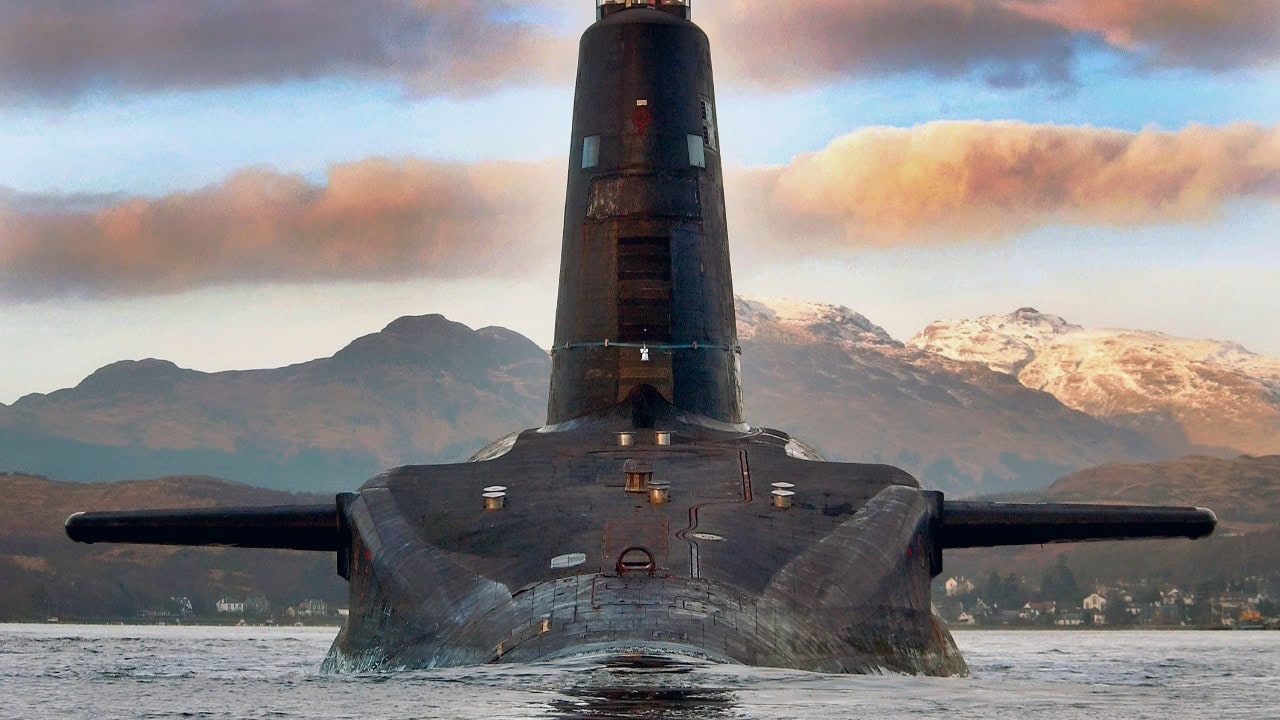
Vanguard-Class Submarine Royal Navy
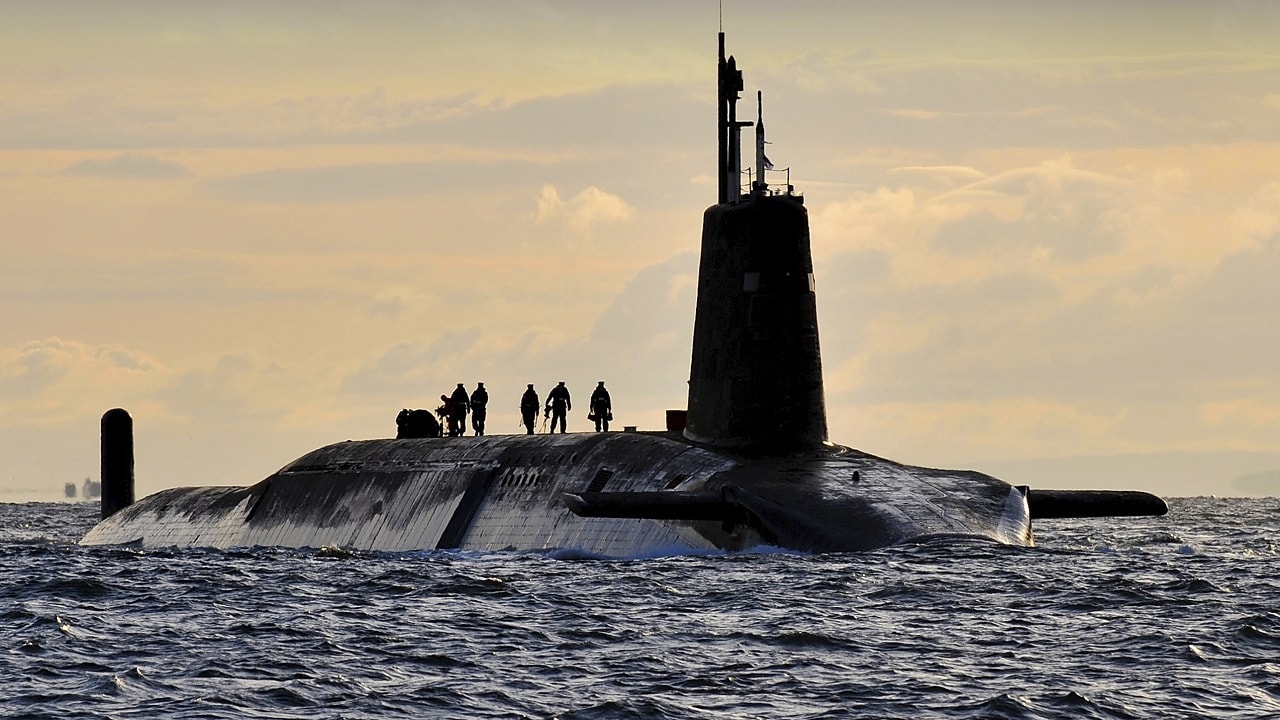
Nuclear submarine HMS Vanguard arrives back at HM Naval Base Clyde, Faslane, Scotland following a patrol.
The two submarines collided at low speed, which thankfully prevented any injuries.
Both the Ministries of Defense of Britain and France tried to downplay and cover up the incident, which drew immense criticism from the press.
On the bright side, the incident validated the stealth characteristics of both subs, as neither ship was able to detect the other until it was too late.
Two Nuclear Submarines Collide
The collision occurred on the night of February 3rd/morning of February 4th.
The ships involved were the HMS Vanguard of the British Royal Navy and Le Triomphant of the French Navy.
Ironically, both are the lead ships of their respective classes.
Both ships were traveling slowly, which fortunately meant no sailors on either ship were injured. On the flip side, both submarines suffered visible external damage.
Vanguard received damage to the outer casing of her missile compartment on her right side, while Le Triomphant received damage to her active sonar dome under her bow. It is likely that Le Triomphant ran into Vanguard from above amidships (center).
Both MoDs were slow to acknowledge the incident.
Two days after the incident, the French MoD reported that Le Triomphant had “collided with an immersed object (probably a container).” Some sources suspect the French were initially unaware they had collided with another submarine, although it is equally likely that the government in Paris was trying to downplay the incident to avoid a major scandal.
Meanwhile, the British did not acknowledge the incident until February 16, more than a week later, by First Sea Lord Sir Jonathon Band.
Band confirmed that the two subs had collided but emphasized that there were no injuries to the crew nor damage to any nuclear reactors/weapons.
So Stealthy They Couldn’t See Each Other
The announcement that two submarines wielding nuclear weapons had crashed into each other was received rather poorly by the public.
The MoD’s delayed reporting of the incident drew further criticism, with news outlets accusing them of trying to cover it up.
In the UK, the incident threatened to turn into a full-blown scandal, and ministers in Parliament demanded an investigation.
Environmental activists were likewise furious since the accident, if the collision had been worse, could have had a disastrous effect on marine life.
The incident was further exacerbated by the UK’s history of failing to report past incidents involving nuclear submarines, particularly fuel leaks.
Some officials noted, somewhat ironically, that the incident had successfully validated the stealth characteristics of both submarines.
Hervé Morin, then-Minister of Defense of France, noted sardonically that they “face an extremely simple technological problem, which is that these submarines are not detectable.” Both the Vanguard-class and the Le Triomphant-class were designed to be non-detectable.
As nuclear ballistic missile submarines, both submarines are instrumental to the nuclear deterrence strategies of their respective navies.
As such, both must operate in potentially hostile waters without being detected by enemy sensors and sonar. Modern submarines are designed and shaped to reduce their acoustic signatures.
They incorporate anechoic tiles to absorb sound waves, and their equipment is specifically designed to minimize vibration.
Lack of Communication and Bad Luck
The collision between Le Triomphant and Vanguard resulted from a combination of poor communication and bad luck.
While most submarines have powerful active sonar systems that can, on paper, detect a stealth submarine, most operate without active sonar to reduce their own visibility.
Active sonar systems produce a loud ping, which is excellent at detecting ships and any other structures, but comes at the cost of stealth and makes them light up like a Christmas tree on enemy ASW systems.
Instead, most submarines rely on passive sonar, especially on patrol missions that require stealth. Passive sonar systems detect noise from other ships and structures and are less reliable at detecting stealthy submarines.
In the open Atlantic Ocean, the odds of two nuclear submarines colliding with each other are astronomically low, but never zero.
Vanguard and Le Triomphant just so happened to be at the wrong place at the wrong time.
What’s more, neither France nor the UK coordinated with the other to determine when their submarines would be where in the Atlantic.
This is somewhat understandable to maintain secrecy, and since the odds of a collision are inherently low.
However, as some officials pointed out after the fact, the two should not have been in the same place at the same time.
France and the UK failed to coordinate with each other and nearly lost two nuclear submarines as a result. After the incident, the two agreed to coordinate submarine deployments going forward.
About the Author: Isaac Seitz
Isaac Seitz, a Defense Columnist, graduated from Patrick Henry College’s Strategic Intelligence and National Security program. He has also studied Russian at Middlebury Language Schools and has worked as an intelligence Analyst in the private sector.