
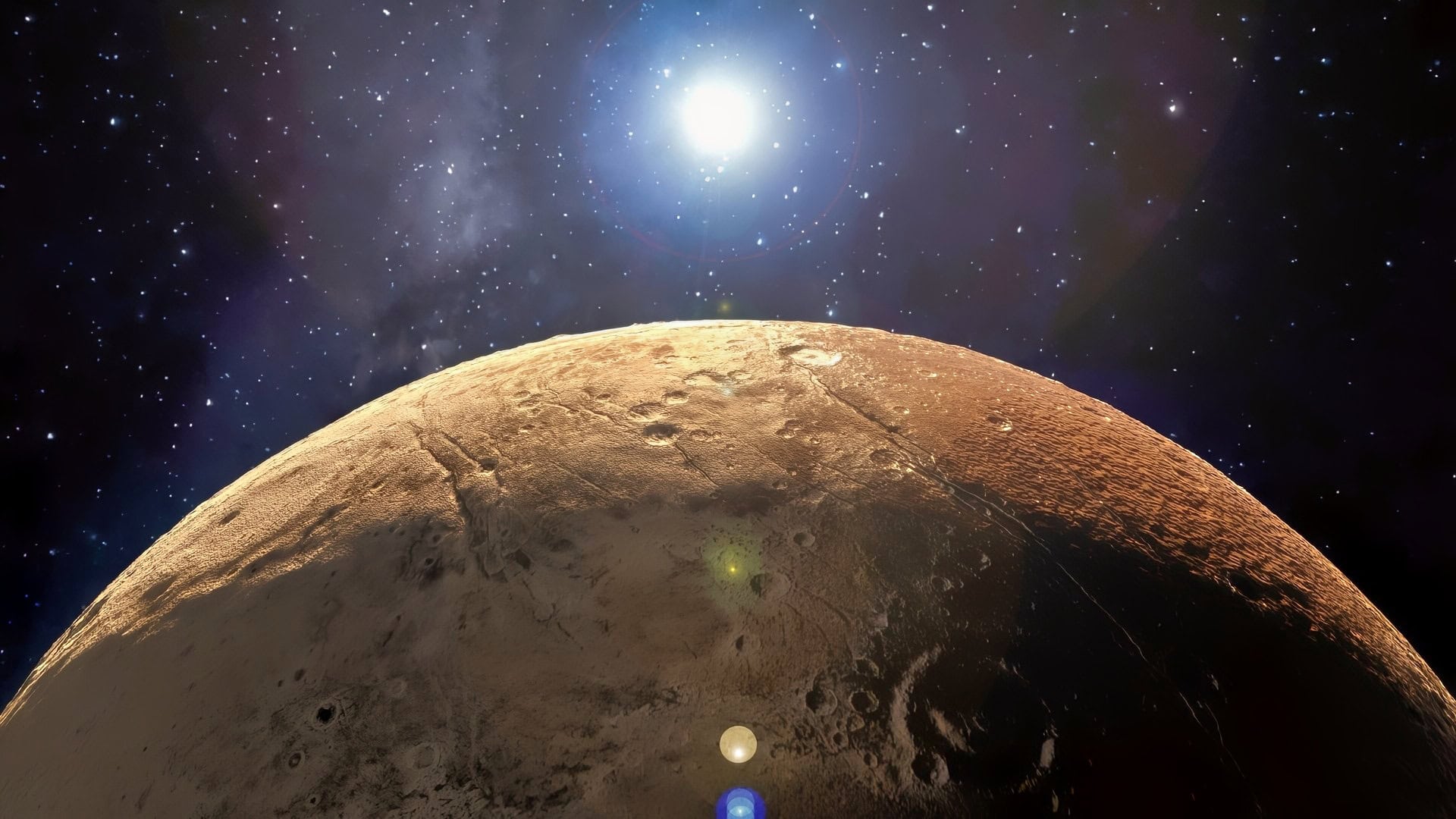
Twenty years ago today, on the afternoon of August 24, 2006, in a conference hall in Prague, roughly 424 astronomers raised yellow voting cards, and every textbook, placemat, and classroom mobile on Earth became obsolete by dinner. The International Astronomical Union’s General Assembly had voted, on its final day, after most of the roughly 10,000-member profession had flown home, to adopt a formal definition of the word planet, and Pluto, a planet for 76 years, failed it.
The decision remains the most publicly contested act of scientific taxonomy in living memory, litigated ever since by planetary scientists, state legislatures, lexicographers, schoolchildren, and a piano-sized spacecraft that left Earth seven months before the vote, bound for a planet, and arrived nine years later at a dwarf.
This is the story of how it happened.
The Farm Boy’s Planet
Pluto was discovered on February 18, 1930, by Clyde Tombaugh, a 24-year-old Kansas farm boy hired by Lowell Observatory in Flagstaff to compare photographic plates in a machine that flipped between them, hunting for anything that moved.
The name came from Venetia Burney, an 11-year-old English schoolgirl who suggested the Roman god of the underworld over breakfast, and for 76 years, the ninth planet sat in every diagram of the solar system.
But it was always the odd one.
Its orbit is tilted and eccentric enough to cross Neptune’s; it is smaller than Earth’s Moon; and every generation of better measurement shrank it further, from the massive Planet X Percival Lowell had predicted down to less than a fifth of one percent of Earth’s mass, a number finally pinned after its moon Charon turned up in 1978.
Pluto was grandfathered into planethood by the accident of being found first and alone.
The Trap
The trouble was that it was not alone.
Beginning in 1992, astronomers started finding other icy bodies beyond Neptune, confirming the long-predicted Kuiper Belt, and the trickle became a flood: hundreds, then thousands of objects, some of them large, in Pluto’s own neighborhood.
The trap snapped shut in 2005, when Mike Brown’s Caltech team announced the object, eventually named Eris, initially believed to be larger than Pluto itself, and briefly celebrated in NASA’s own announcement as a tenth planet.
The fork in the road had no third path: either the solar system was about to gain a rolling parade of new planets, Eris first and dozens behind it, or Pluto’s category needed rethinking.
The IAU convened in Prague in August 2006 with the question formally on the table, and the first draft its committee floated would have gone the other way, expanding the club to twelve planets, including Eris, the asteroid Ceres, and even Pluto’s moon Charon.
The reaction across the assembly’s final week was hostile, with astronomers accusing the leadership of springing a half-baked scheme on them, and the drafts were rewritten repeatedly on the fly.
The Last Afternoon in Prague
What passed on August 24 was Resolution 5A, and its definition has three clauses: a planet orbits the Sun, is massive enough for its own gravity to pull it round, and has cleared the neighborhood around its orbit.
Pluto sails through the first two and fails the third, since it shares its zone with the swarming Kuiper Belt, and so it was reassigned to a category created that afternoon, dwarf planet.
The mechanics became controversy fuel instantly: the vote was held on the last day, when only about 424 astronomers of a profession of some 10,000 remained in the hall, a participation rate critics never stopped citing.
Even the consolation prizes misfired; an amendment to name Pluto-like objects “plutonian objects” failed by 186 votes to 183, leaving the new class briefly nameless, and the term plutoid arrived only two years later.
The discoverer whose find had forced the question was, remarkably, on the demotion’s side: monitoring the vote by teleconference, Brown pronounced Pluto dead and declared that “there are finally, officially, eight planets” in the solar system, forfeiting his own tenth-planet claim to the principle.
The Revolt over Pluto
The counterattack began within the hour.
Alan Stern, principal investigator of the spacecraft then en route to Pluto, said he was “embarrassed for astronomy” and called the definition scientifically indefensible, and his central objection has never been answered to the dissenters’ satisfaction: no planet fully clears its neighborhood.
It is, he argued, “patently clear that Earth’s zone is not cleared,” with asteroids crossing our orbit constantly and Jupiter sharing its lane with tens of thousands of Trojan asteroids; read strictly, the critics say, the third clause imperils everyone.
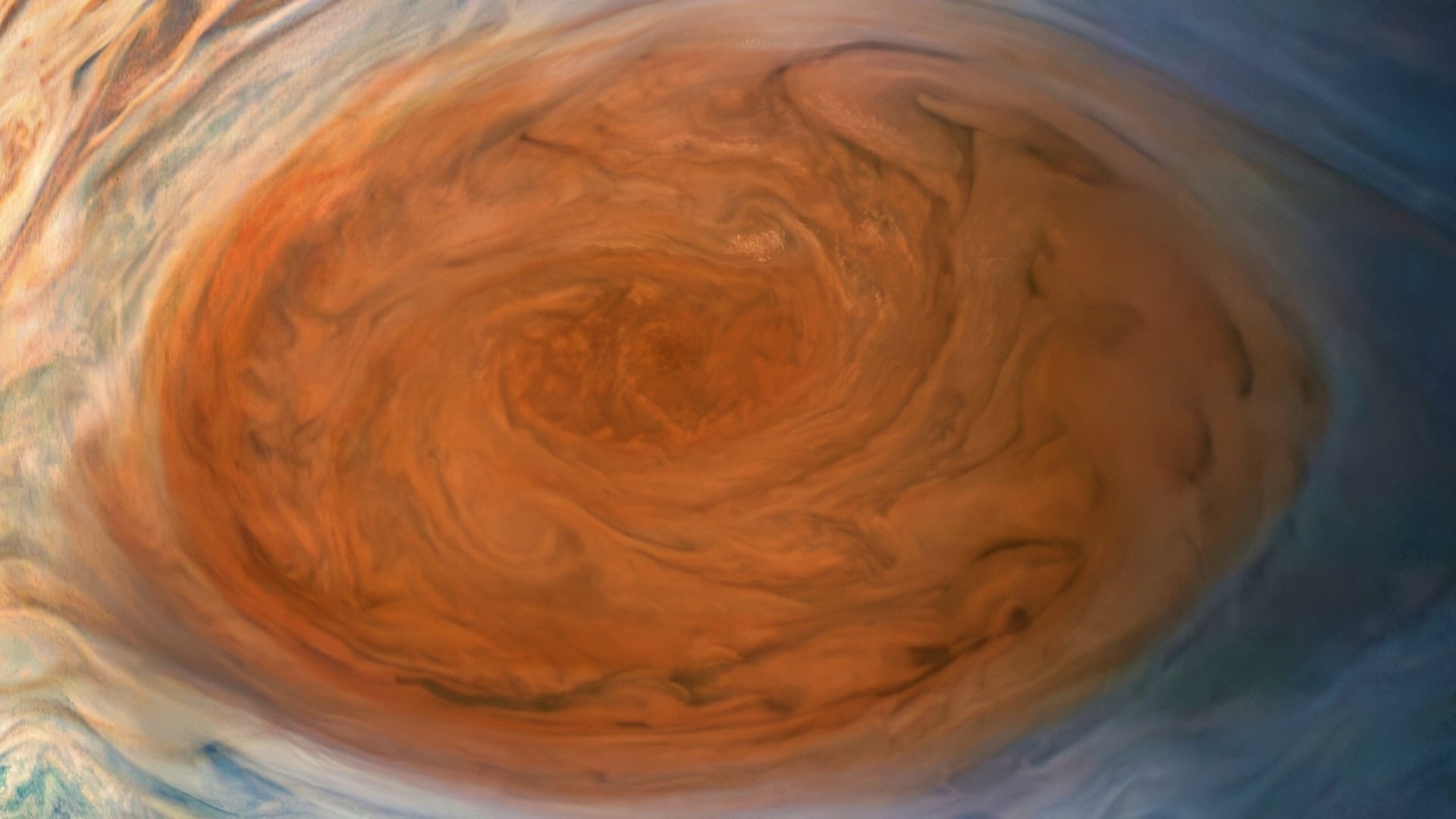
Jupiter Giant Red Spot NASA Photo
Even Owen Gingerich, the Harvard historian who had chaired the definition committee, called the adopted language confusing and unfortunate.
A rival school, the geophysical definition, holds that planethood should describe the body, not its address: anything round by its own gravity is a planet, which would readmit Pluto alongside many other worlds. And the public simply refused.
The American Dialect Society crowned “plutoed” its 2006 word of the year, meaning to demote or devalue, and two state legislatures went further: New Mexico, where Tombaugh spent his last decades, and Illinois, where he was born, each passed resolutions declaring that Pluto is a planet whenever it passes overhead, taxonomy by jurisdiction.
The World That Reopened the Case
Then the spacecraft arrived, and the argument got new evidence.
New Horizons had launched on January 19, 2006, the fastest Earth departure ever flown, carrying instruments, half a million names on a disc, and thirty grams of Clyde Tombaugh’s ashes.
On July 14, 2015, it swept within 7,800 miles of the world it had left home to visit and found not a frozen full stop but a working planet by any intuitive measure: the thousand-kilometer heart now named Tombaugh Regio, flowing nitrogen glaciers, mountains of water ice the height of the Rockies, blue atmospheric hazes, evidence pointing to a possible subsurface ocean, and terrain so young it demanded active geology at the solar system’s cold edge.
To Stern and the dissenters, the images were the argument: as this publication’s own account of the mission put it, a world that had spent 85 years as a dot turned out to have everything a planet has except the approved paperwork.
The probe flew on to the Kuiper Belt object Arrokoth in 2019, the most distant world ever explored, and it is still out there, six billion miles from home, having woken from hibernation last month for new science beyond Pluto.
Why It Isn’t Settled
Twenty years on, the vote stands, and the peace never came.
The IAU has never revisited the definition; planetary scientists in significant numbers simply ignore it, calling Pluto a planet in published papers and conference talks; and the definition’s own text contains a time bomb the exoplanet era keeps illuminating, since it applies only to bodies orbiting the Sun, meaning the thousands of worlds found around other stars are not, by the strict letter of the 2006 language, planets at all.
The dispute endures because it was never entirely about science: it is about whether categories should describe dynamics or bodies, about who gets to decide, and about 424 hands in a half-empty hall rewriting what every living person had memorized in childhood.
About the Author: Harry J. Kazianis
Harry J. Kazianis (@Grecianformula) was the former Senior Director of National Security Affairs at the Center for the National Interest (CFTNI), a foreign policy think tank founded by Richard Nixon based in Washington, DC. Harry has over a decade of experience in think tanks and national security publishing. His ideas have been published in the NY Times, The Washington Post, The Wall Street Journal, CNN, and many other outlets. He has held positions at CSIS, the Heritage Foundation, the University of Nottingham, and several other institutions related to national security research and studies. He is the former Executive Editor of the National Interest and the Diplomat. He holds a Master’s degree focusing on international affairs from Harvard University.

