

Napoleon’s Favorite Quote Can’t Be Sourced. His Comeback Can: 20 Days From a Beach to the Throne Without Firing a Shot. – “Courage isn’t having the strength to go on; it is going on when you don’t have strength.” The line is attached to Napoleon Bonaparte on a million posters and coffee mugs, and honesty requires saying up front that no letter, memoir, or witness account has ever been found that shows him saying it; it is, as careful publications put it, often attributed to him and never sourced.
And yet the attribution refuses to die, for a reason worth taking seriously: whether or not Napoleon said the sentence, in the spring of 1815, he performed it, staging the most audacious comeback in political history with no army, no treasury, no allies, and a death sentence waiting for him, and winning back an empire in twenty days without firing a shot.
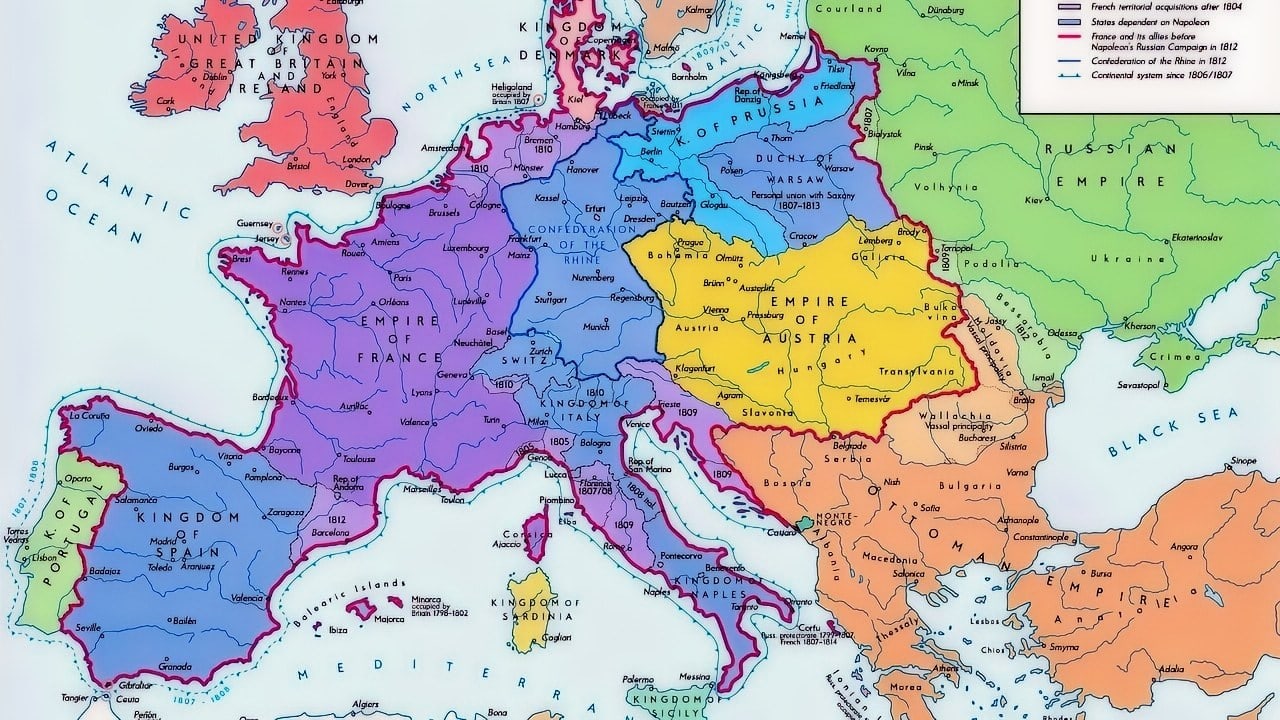
Map of Napoleon’s Empire. Image Credit: Creative Commons.
The Fall of Napoleon
By April 1814, the man who had mastered Europe had run out of everything.
The catastrophe in Russia had consumed his Grande Armee, the allied powers had fought their way to Paris, his own marshals refused to march further, and Napoleon abdicated at Fontainebleau.
The treaty that ended his reign was almost mocking in its generosity: he would keep the title of Emperor and receive full sovereignty over Elba, an island of 86 square miles off the Tuscan coast, with an allowance of a small guard of his old soldiers.
The ruler of 44 million now governed 12,000 people. Characteristically, he governed them at full throttle, reorganizing the island’s roads, mines, and tiny army, because the habit of empire does not switch off.
But his French pension went unpaid, his wife and son were kept from him, and there was talk among the victors of moving him somewhere far more remote.
He had been on Elba barely ten months when he decided the safest move left was the most dangerous one imaginable. Time to fight.
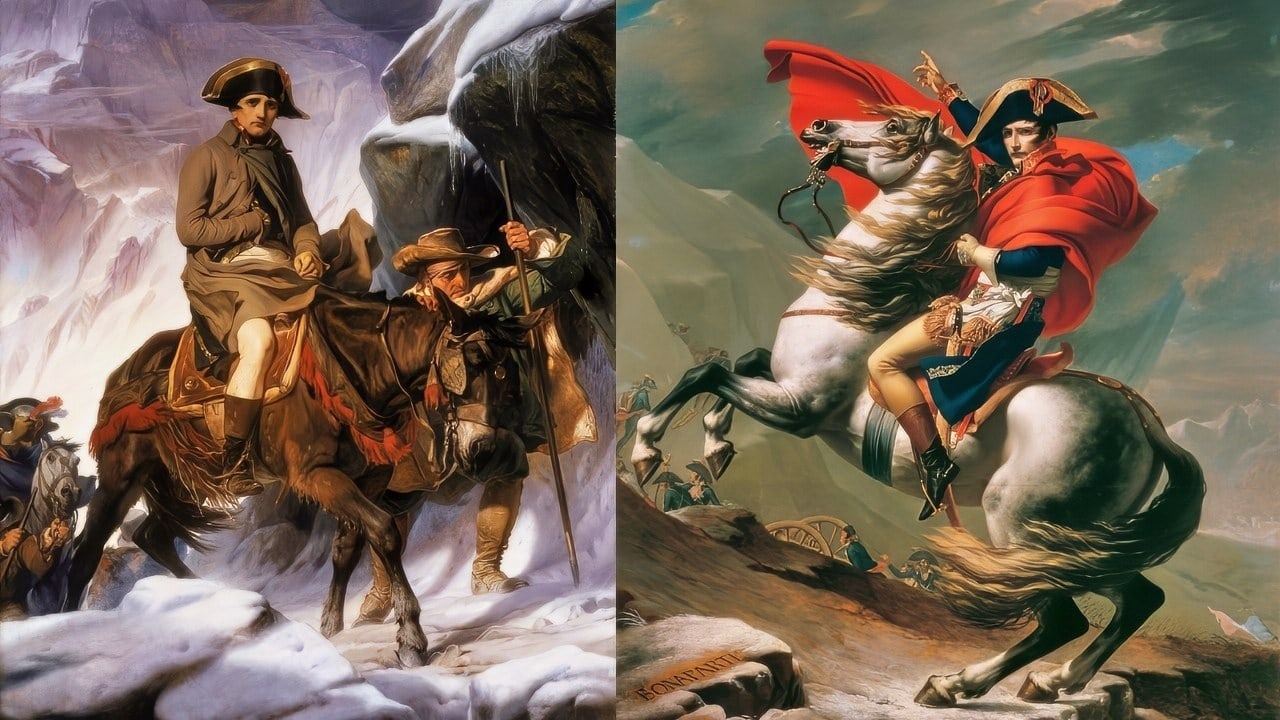
Napoleon Quote of The Day Two Looks. Image Credit: Creative Commons.
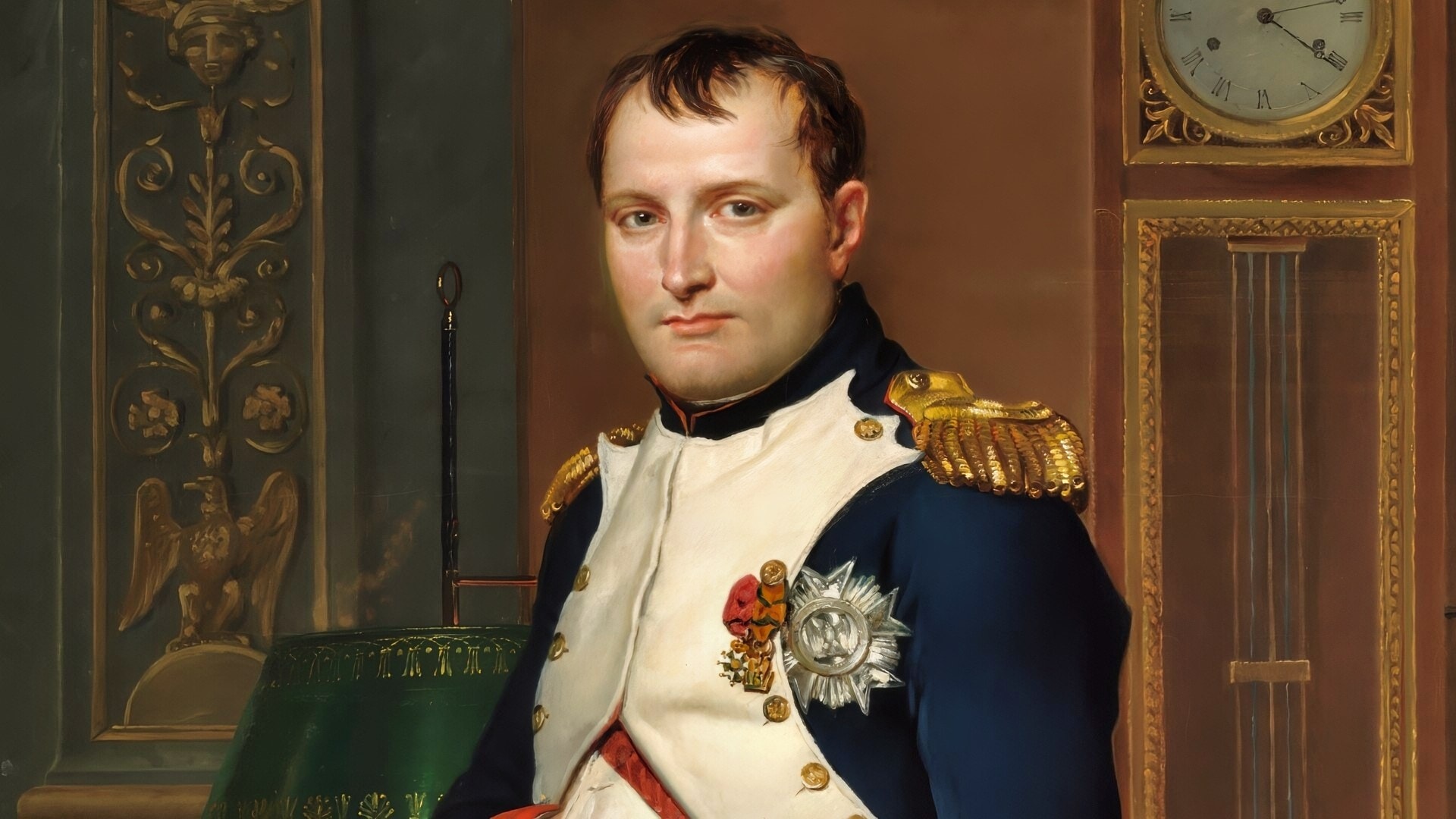
Napoleon Painting Creative Commons Image
The Escape
On the evening of February 26, 1815, the brig Inconstant slipped out of Elba’s harbor leading a tiny flotilla of transports and feluccas, carrying Napoleon and roughly a thousand men, most of them grenadiers of his Old Guard.
The timing was exquisite: the British patrol ship assigned to watch him had sailed for the mainland days earlier, and the convoy slid past French royalist warships that, then and since, were suspected of preferring not to see it.
On March 1, the little fleet anchored at Golfe-Juan on the French Riviera, and Napoleon came ashore with a plan that was a wager: avoid royalist Provence, march the hard mountain roads toward Grenoble, and bet everything on the proposition that the soldiers of France would not shoot him.
The Coat
Here is where he made his move. On March 7, at the village of Laffrey south of Grenoble, where a battalion of the 5th Regiment of the Line stood blocking the road with orders to stop him, the government in Paris had already decreed him a traitor to be court-martialed and shot on sight.
What happened next became one of the most retold scenes of the nineteenth century. Napoleon halted his own men, walked forward alone, well inside musket range, opened his gray coat, and invited any soldier who wished to kill his Emperor to do it now.
The wording survives in several versions; the result survives in one.
The battalion broke into cheers of Vive l’Empereur and changed sides on the spot, and the pattern repeated all the way north.
Marshal Ney, dispatched by King Louis XVIII with a promise to bring Napoleon back in an iron cage, embraced him instead.
On March 19, the king fled Paris; on March 20, Napoleon entered the Tuileries, carried up the stairs on the shoulders of a delirious crowd.
Twenty days from a beach to a throne, and not one shot fired.
Going On Without Strength
This is why the unsourced quote sticks to him.
Napoleon’s genius was never the absence of defeat; he was beaten in Egypt and came home to seize a state, watched half a million men die in Russia and conscripted a new army by spring, lost France itself and took it back with a rowboat armada.
What he possessed was the specific quality the sentence describes, the ability to act at maximum capacity precisely when every measurable form of strength was gone.
The comeback’s coda was written at Waterloo a hundred days later, and this time the exile, on Atlantic St. Helena, was chosen to be escape-proof; he died there in 1821.
But the defeats are one ledger and the resilience is another, and the twenty days of March 1815 remain the purest documented case of a man continuing when continuing was impossible.
Nobody can prove Napoleon ever said the words on the poster.
Nobody needs to. Between February 26 and March 20, 1815, he recorded them instead.
About the Author: Harry J. Kazianis
Harry J. Kazianis (@Grecianformula) was the former Senior Director of National Security Affairs at the Center for the National Interest (CFTNI), a foreign policy think tank founded by Richard Nixon based in Washington, DC. Harry has over a decade of experience in think tanks and national security publishing. His ideas have been published in the NY Times, The Washington Post, The Wall Street Journal, CNN, and many other outlets. He has held positions at CSIS, the Heritage Foundation, the University of Nottingham, and several other institutions related to national security research and studies. He is the former Executive Editor of the National Interest and the Diplomat. He holds a Master’s degree focusing on international affairs from Harvard University.

