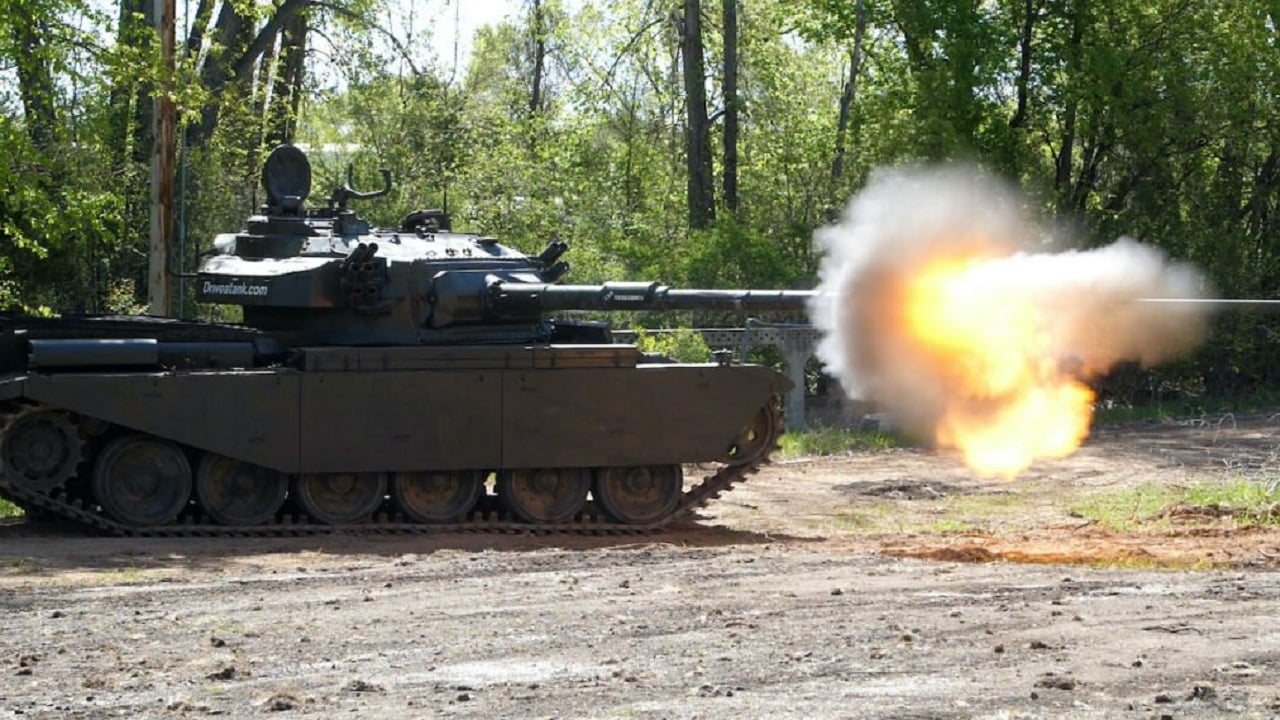
In 1945, six prototypes of the FV4007 Centurion tank arrived on the European continent for testing just weeks after World War II ended.
Entering service in 1946, the tank had missed the war it was designed to win and never saw combat against any German tanks.
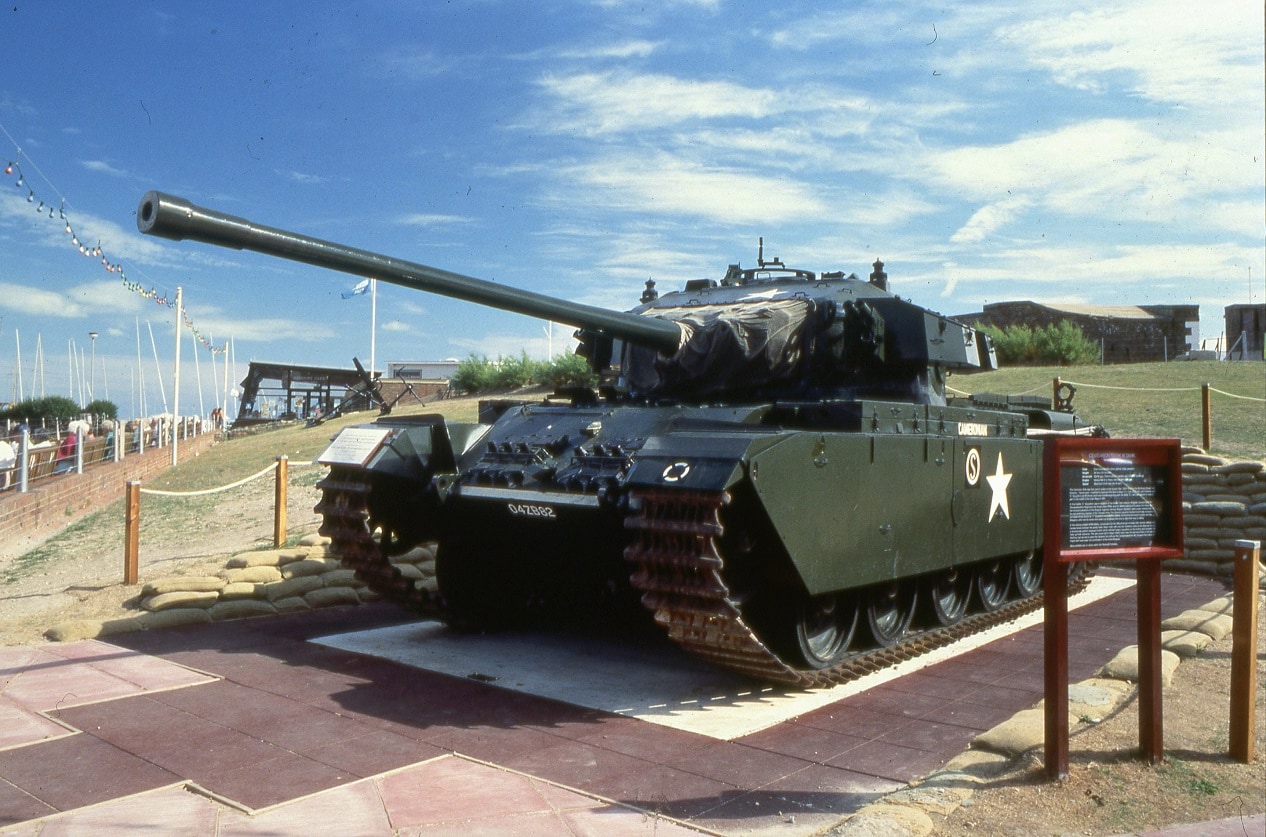
Centurion Tank. Image Credit: Creative Commons.
This, however, did not stop the Centurion from becoming one of the most influential and successful tanks of the early Cold War period.
Combining speed, survivability, and firepower, the tank pioneered the concept of the Main Battle Tank (MBT) and left an indelible mark on the history of armored warfare. Despite being designed in the 1940s, the Centurion served well into the 1970s in armies around the world and remained in service until the 80s in some cases.
The British Tank That Missed the War
Development of the Centurion began in 1943, when the Directorate of Tank Design in the UK was tasked with developing a new heavy cruiser tank in response to German tanks armed with 88mm guns.
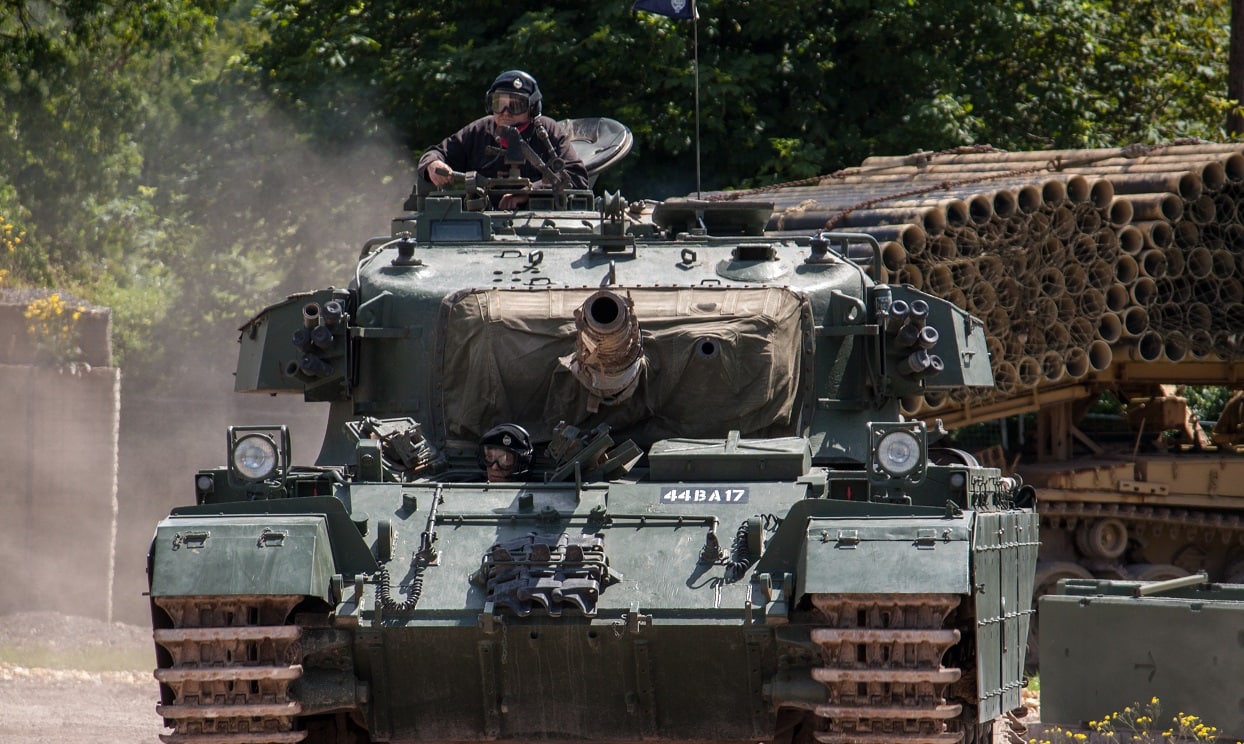
Image: Creative Commons.
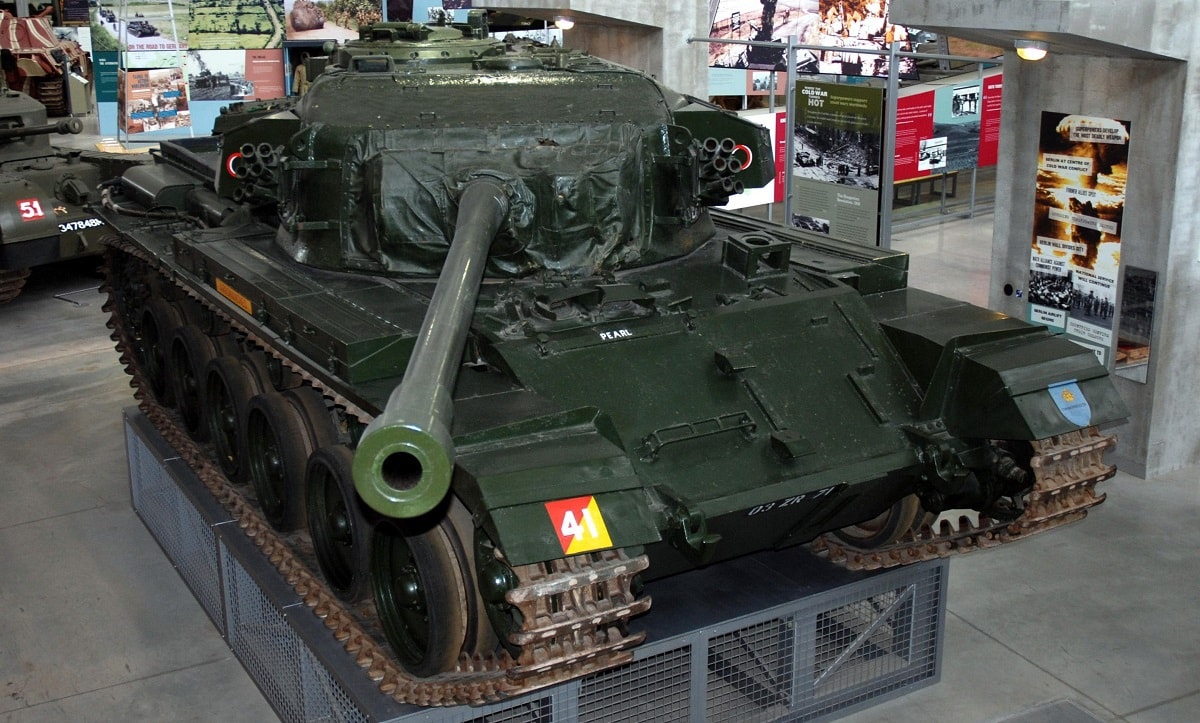
Centurion Tank
Throughout the war, the UK’s tank industry was unremarkable, producing a number of underwhelming designs.
The new tank, designated A41, had to withstand a direct hit from a German 88mm cannon, provide greater protection against mines, and not exceed 45 tons.
Additionally, the British War Office required the tank to have a high reverse speed, as experience in Africa had shown that it could sometimes mean the difference between life and death in certain scenarios.
As the tank continued its development, its weight increased from 45 tons to 50 tons to accommodate thicker armor and the more powerful 76mm gun.
This unfortunately meant the tank would be harder to transport by rail and would be prohibited from crossing certain bridges.
On the flip side, the design was shaping up to be truly exceptional for its time.
With improved suspension and a higher-performance engine, the A41 promised cross-country performance comparable to a light tank.
The first Centurion prototypes had thinner armor than the UK’s Churchill heavy tanks. However, the heavily sloped front glacis significantly increased its effective thickness.
The Centurion Mk II further increased the armor and entered production in 1945. It was officially accepted into service a year later.
Pioneering the Main Battle Tank Concept
Although the Centurion had just barely missed the war, the British still had an exceptional tank on their hands.
It combined the armor of a heavy tank with the performance of a light tank and the size and versatility of a medium tank.
Although it was originally designed as a heavy cruiser tank, the Centurion truly was one of the first MBTs.
It was equipped with a Rolls-Royce Meteor 4B 650 hp petrol engine. Abandoning the British-favored Christie suspension, the Centurion featured a modified Horstman suspension system.
Although it did not provide the same smoothness as the Christie system, the new suspension took up less space and was easier to maintain and replace.
Speed was not a major concern of the project.
The Centurion had a modest speed of 35 km/h (which was not bad for a tank of that time) and two reverse gears, per Army requirements.
In 1948, the Centurion Mk III replaced the 76mm gun with a new Royal Ordnance 84 mm QF 20 Pounder.
This gun also had a fully automatic stabilization system, allowing it to fire accurately while moving. In 1959, with the Mk 5/2 onward, the Centurion would be equipped with the new L7 105 mm gun.
This gun was capable of penetrating contemporary Soviet tanks, such as the T-54/55 and even the heavy armor of the IS-3.
With advancements in fin-stabilized discarding sabot (APFSDS) ammunition, the Centurion was capable of punching well above its weight.
Later iterations added night vision sights and other improvements to the tank’s accuracy and survivability.
The Centurion Tank in Action
The Centurion may have missed WWII, but that did not stop it from participating in combat in other theaters around the world.
The tank made its combat debut in the Korean War, where it battled captured British tanks and Soviet T-34s in Korea’s rugged terrain.
The tanks performed well in Korea and helped to stop the North Korean/PLA attempt to turn the tide of the war.
The Centurion also saw combat in Vietnam, India, and the Middle East, where Israel’s modified tanks performed exceptionally against Egypt and Syria’s Soviet-made T-55 and T-62 tanks. Although the tank was phased out of British service in the 60s-70s, the armored recovery variant remained in service for decades and was even used during Operation Desert Storm.
The Centurion was a remarkable and revolutionary tank.
It ushered in the concept of the Main Battle Tank and changed the course of Western armor design.
While it arrived too late for the Second World War, it was just in time for the Cold War, when it was needed to deter Soviet armor in East Germany.
Of course, the Centurion was quickly outclassed by some of its contemporaries, but it was reliable for its time and paved the way for modern MBT designs.
About the Author: Isaac Seitz
Isaac Seitz, a Defense Columnist, graduated from Patrick Henry College’s Strategic Intelligence and National Security program. He has also studied Russian at Middlebury Language Schools and has worked as an intelligence Analyst in the private sector.