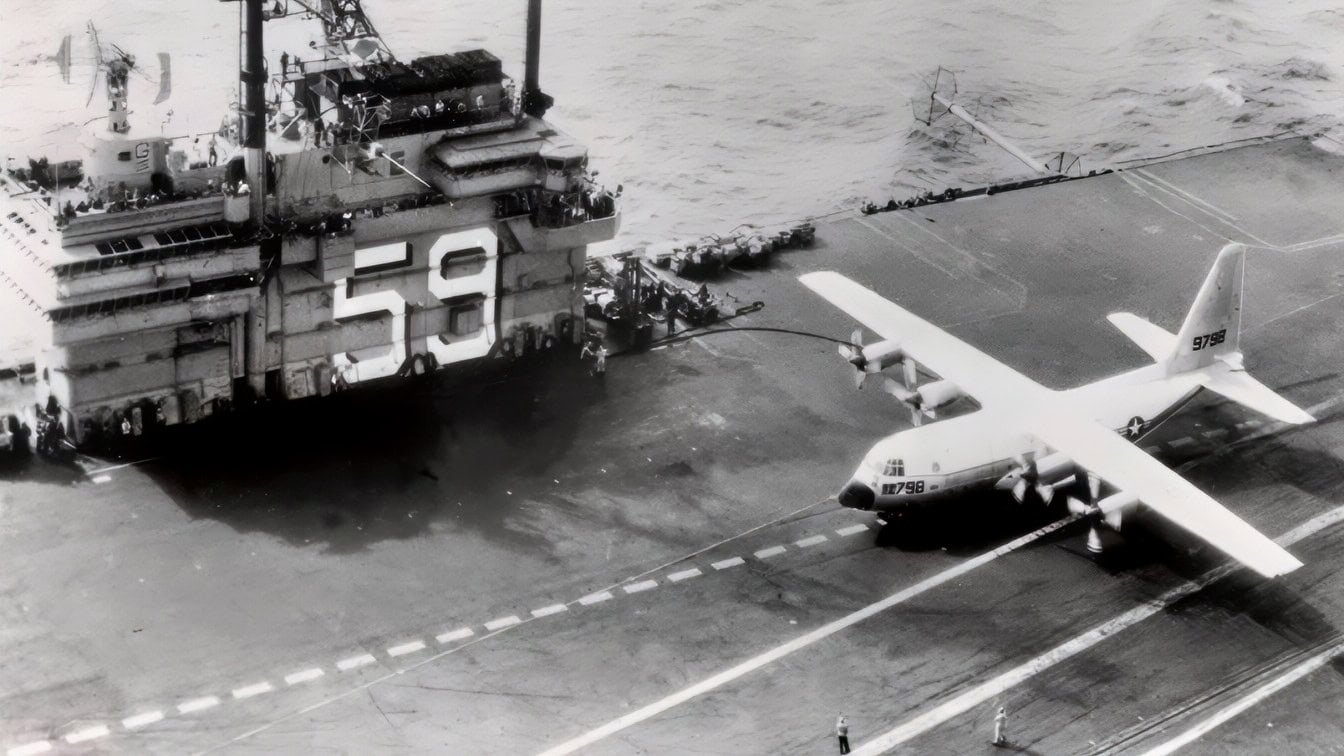
On October 30, 1963, roughly 500 miles off Boston in the North Atlantic, a Marine Corps KC-130F Hercules flown by Navy Lt. James H. Flatley III made its first landings on the deck of USS Forrestal, in 40-knot winds and moderately rough seas, with no tailhook and no catapult. Before the trials ended in late November, the crew had logged 29 touch-and-goes, 21 full-stop landings, and 21 unassisted takeoffs. It remains the largest and heaviest aircraft ever to operate from an aircraft carrier. In 63 years, no one has attempted to break the record.
The Problem the US Navy Wanted Solved
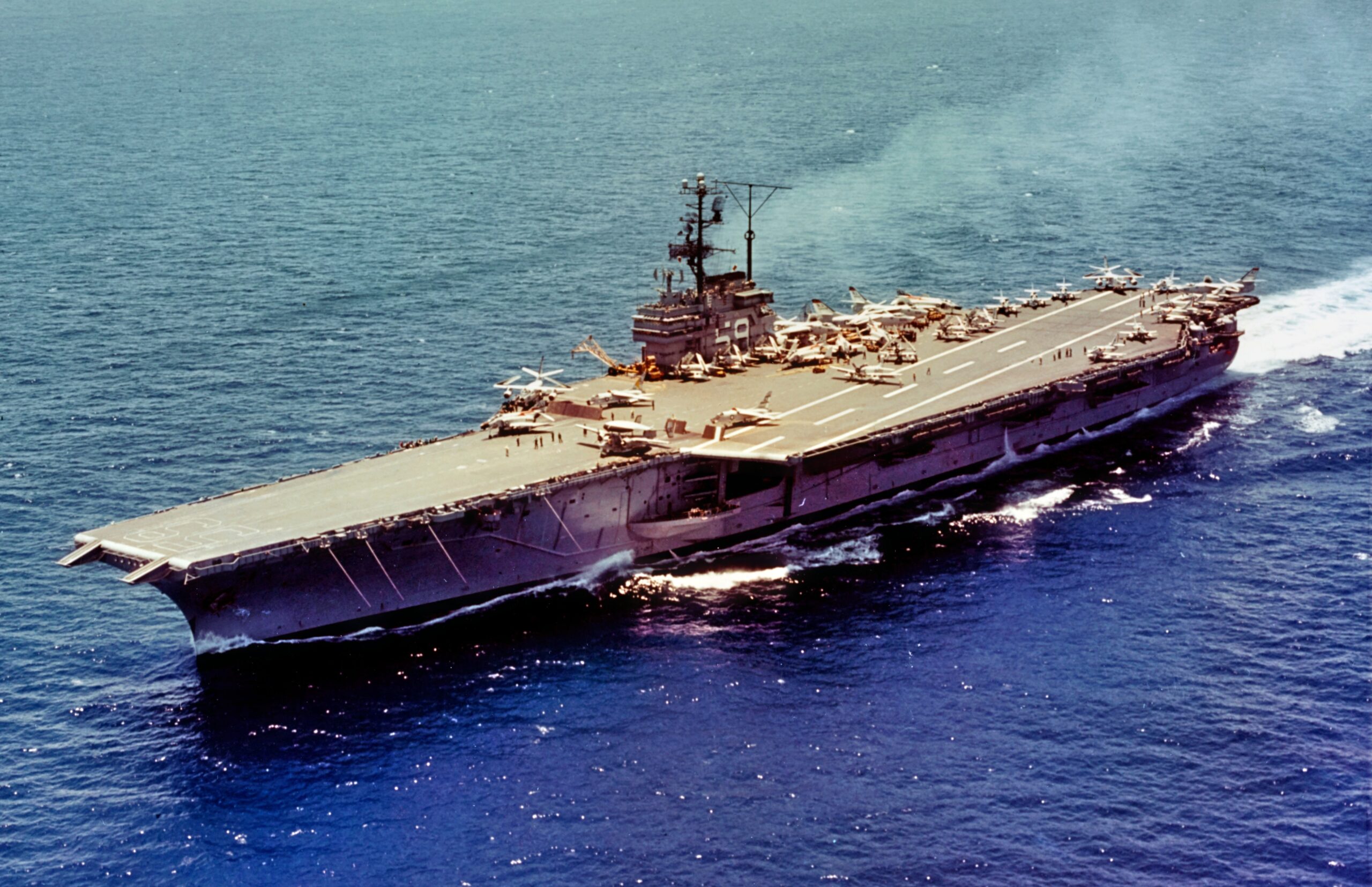
USS Forrestal Aircraft Carrier. Image Credit: Creative Commons.
The order came from the Chief of Naval Operations himself. In 1963 a carrier at sea received its urgent cargo, spare parts, and mail from the Grumman C-1 Trader, a twin-piston aircraft with a range near 300 miles and a payload of 3,500 pounds.
The KC-130F carried ten times the load ten times as far. If the Hercules could operate from a deck, a $217 million carrier could stay on station far out at sea and still be resupplied from shore. The Navy called the concept the Super-COD, for carrier onboard delivery, and assigned a crew to find out whether it was physics or fantasy.
Fifteen Feet
The airplane was never designed for any of it. The Hercules spans 132 feet, an eighth of the entire length of the 1,039-foot Forrestal.
On approach, its wingtip would pass the carrier’s island superstructure with just under 15 feet to spare, tracking a line painted on the deck specifically for the tests.
There was no arresting gear to catch it and no catapult to throw it off, only brakes, reverse thrust, and wind over the deck.
Flatley worried most about the landing gear surviving a nine-foot-per-second sink rate onto a moving ship. His landing signal officer, Jack Daugherty, gave him the cut signal with the aircraft three or four feet above the deck. The crew flew with a message painted on the fuselage for the occasion: Look Ma, No Hook.
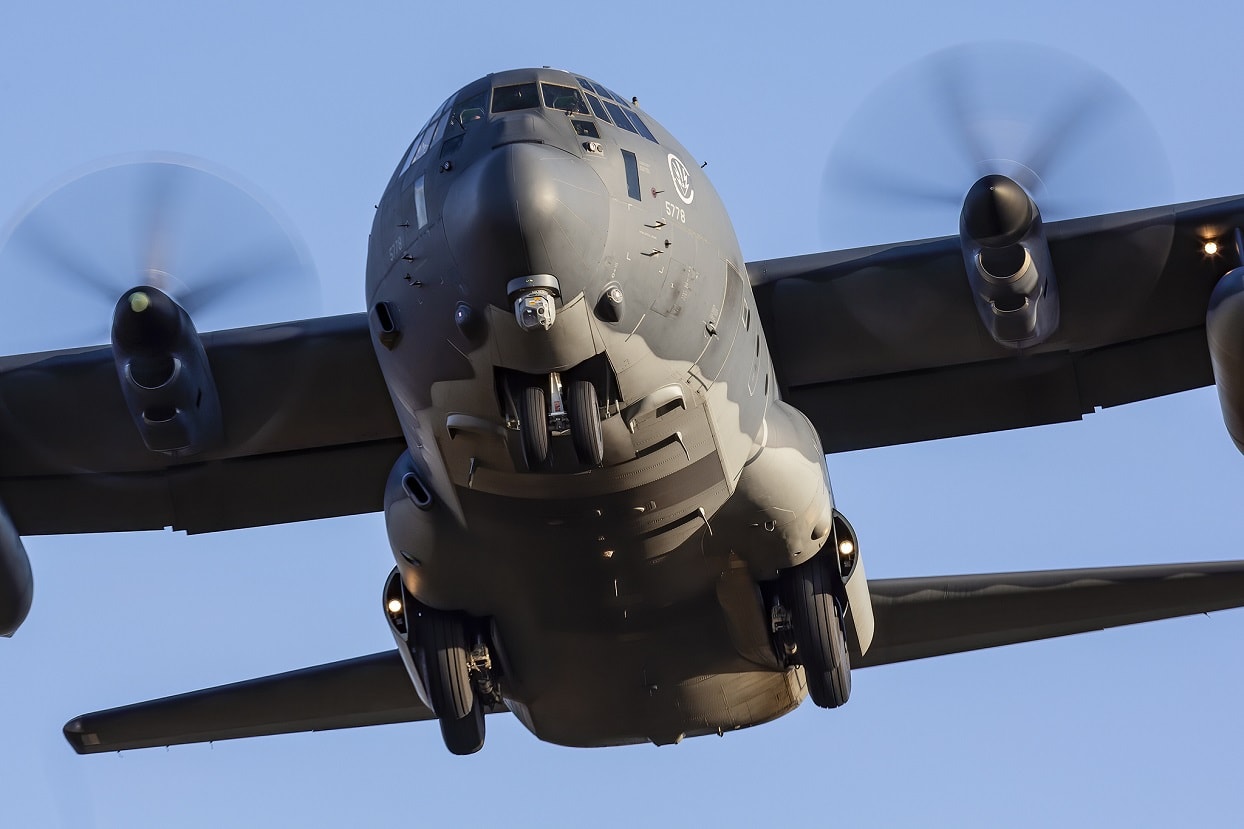
MC-130J. Image: Creative Commons.
Twenty-One Times
The record was not one heroic pass. It was a program, built up across flying days from October 30 into November, with the full-stop series completed on November 8, 21, and 22 by the Navy’s own account.
Flatley, co-pilot Lt. Cmdr. W.W. Stovall, and flight engineer ADR-1 Ed Brennan flew the aircraft at gross weights from 85,000 to 121,000 pounds. At the lighter weight, the Hercules needed just 267 feet of deck to stop, barely double the span of its own wings. At maximum weight it lifted off in 745 feet, from an aircraft designed for runways of 3,000 feet or more.
On most passes the crew set down inside the first 150 feet of deck, used less than 300 more to stop, and departed again from that spot. “We still had a couple hundred feet left when we lifted off,” Flatley said afterward. The data said a Hercules could deliver 25,000 pounds of cargo across 2,500 miles and land it on a carrier at sea.
Why It Never Happened Again
The tests were completely successful, and the Navy still said no. Flatley received the Distinguished Flying Cross. The concept received a file drawer. The stated verdict was that routine C-130 carrier operations were too risky, and the physics behind that word were unforgiving: the Hercules could never be struck below, being far too large for the ship’s elevators and hangars, so every minute it sat topside it froze the flying of the 100-aircraft air wing the carrier existed to operate.
The Navy chose the purpose-built Grumman C-2 Greyhound instead, a smaller, catapult-compatible aircraft first flown in 1964 that fit the carrier’s rhythm rather than interrupting it. The mission it pioneered continues today under the C-2’s successors.
No other carrier has ever operated a Hercules; Forrestal holds that distinction alone.
Where the Airplane Is
The aircraft, BuNo 149798, flew on with the Marine Corps into the 2000s before being retired to the National Naval Aviation Museum in Pensacola, Florida, where it is preserved today.
About the Author: Harry J. Kazianis
Harry J. Kazianis (@Grecianformula) was the former Senior Director of National Security Affairs at the Center for the National Interest (CFTNI), a foreign policy think tank founded by Richard Nixon based in Washington, DC. Harry has over a decade of experience in think tanks and national security publishing. His ideas have been published in the NY Times, The Washington Post, The Wall Street Journal, CNN, and many other outlets worldwide. He has held positions at CSIS, the Heritage Foundation, the University of Nottingham, and several other institutions related to national security research and studies. He is the former Executive Editor of the National Interest and the Diplomat. He holds a Master’s degree focusing on international affairs from Harvard University.