
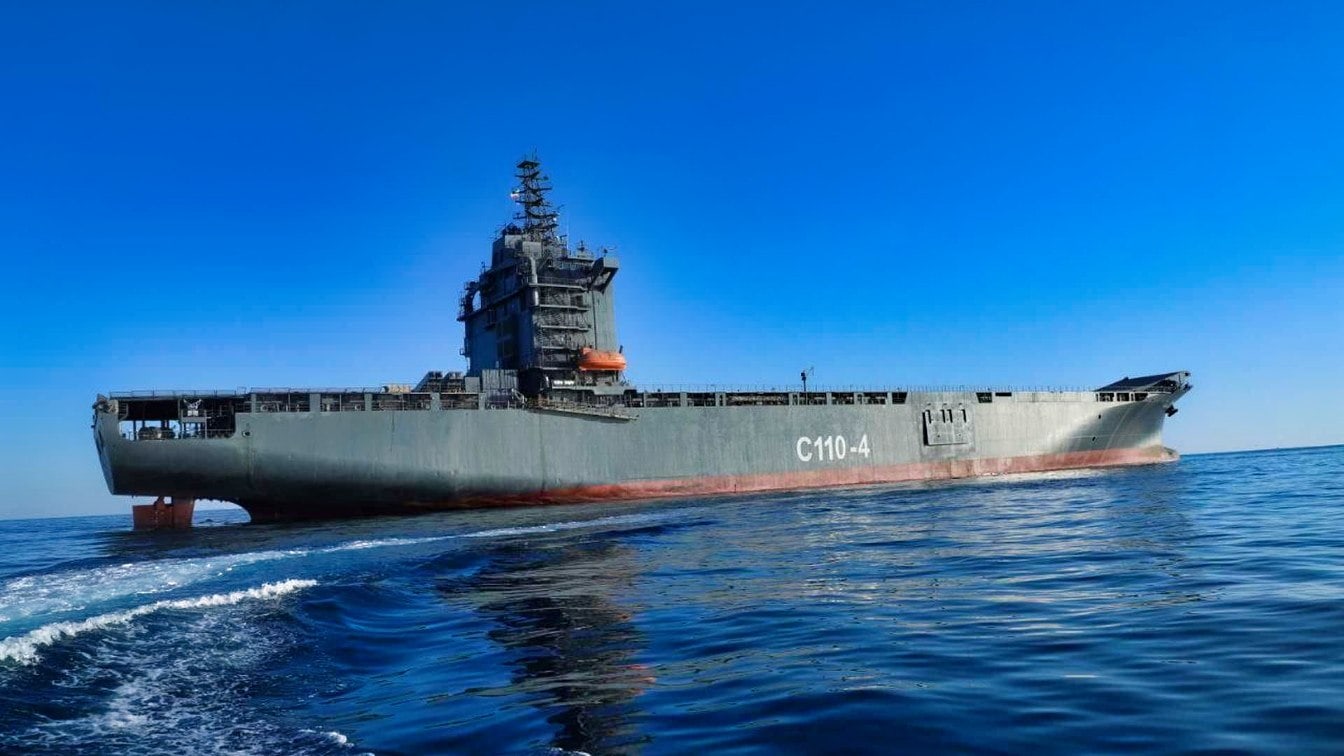
Iran Built a 42,000-Ton Drone Carrier. The U.S. Sank It 13 Months Later – Iran spent more than two years converting a commercial container ship into Shahid Bagheri, a 42,000-ton drone carrier for the Islamic Revolutionary Guard Corps Navy. The vessel entered service on February 6, 2025. U.S. forces struck it within the opening hours of Operation Epic Fury on February 28, 2026. On March 10, Joint Chiefs Chairman Gen. Dan Caine said the United States had “struck and sank” the ship.
Iran’s Drone Aircraft Carrier: What We Think We Know
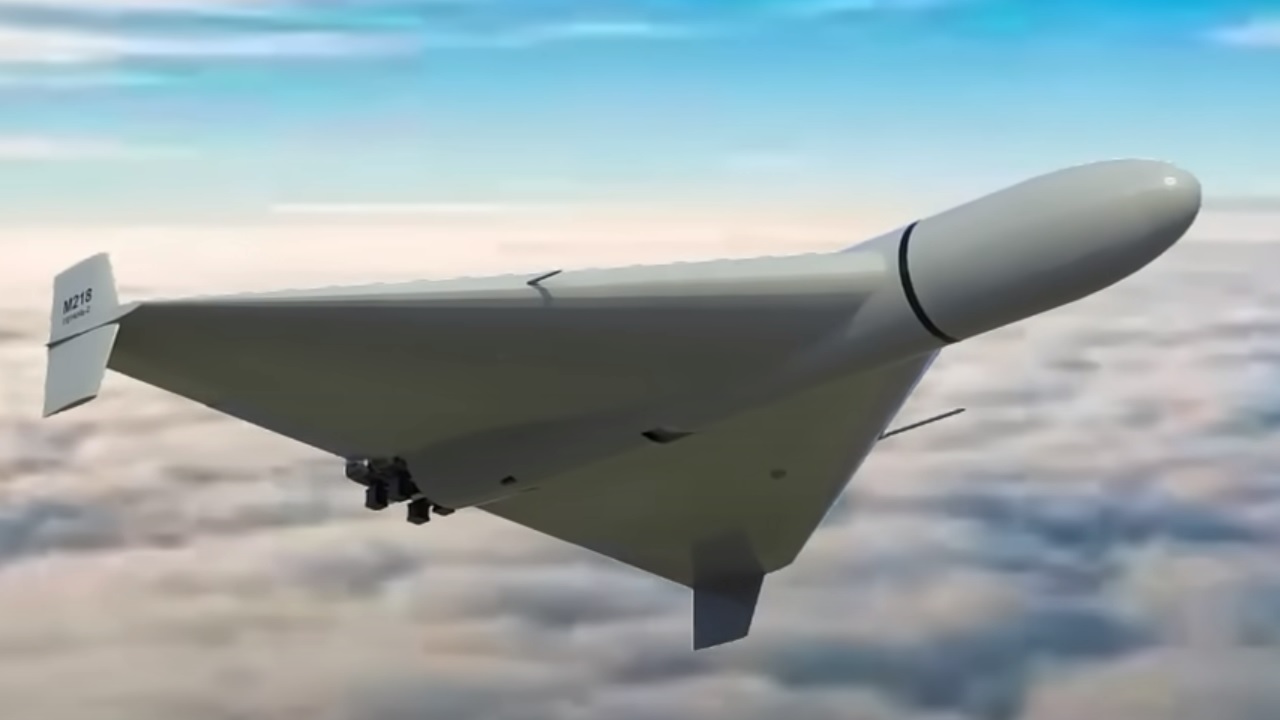
Shahed-136 Drone. Image Credit: YouTube Screenshot.
The project never had a public price. Tehran released no contract, budget line, or audited conversion cost.
That missing number matters because Iran avoided the expense of designing a purpose-built carrier by reusing Perarin, a South Korean-built container ship completed in 2000.
The shortcut quickly produced a large aviation platform, but it also left the IRGC with a merchant hull lacking the protection, redundancy, and layered defenses of a true warship.
Shahid Bagheri measured about 240 meters, or 787 feet, with a displacement of above 40,000 tons.
Its most visible feature was a 180-meter flight deck built around the original superstructure.
A ski-jump-supported drone launches. Iranian officials claimed a speed of over 20 knots, a range of 22,000 nautical miles, and enough endurance for a year away from port.
The ship was never meant to match a U.S. supercarrier. It was a mobile base for unmanned aircraft, helicopters, fast attack craft, intelligence collection, command functions, plus cruise missiles. Its value came from moving Iranian sensors or weapons beyond the Persian Gulf, not from launching dozens of high-performance fighters.
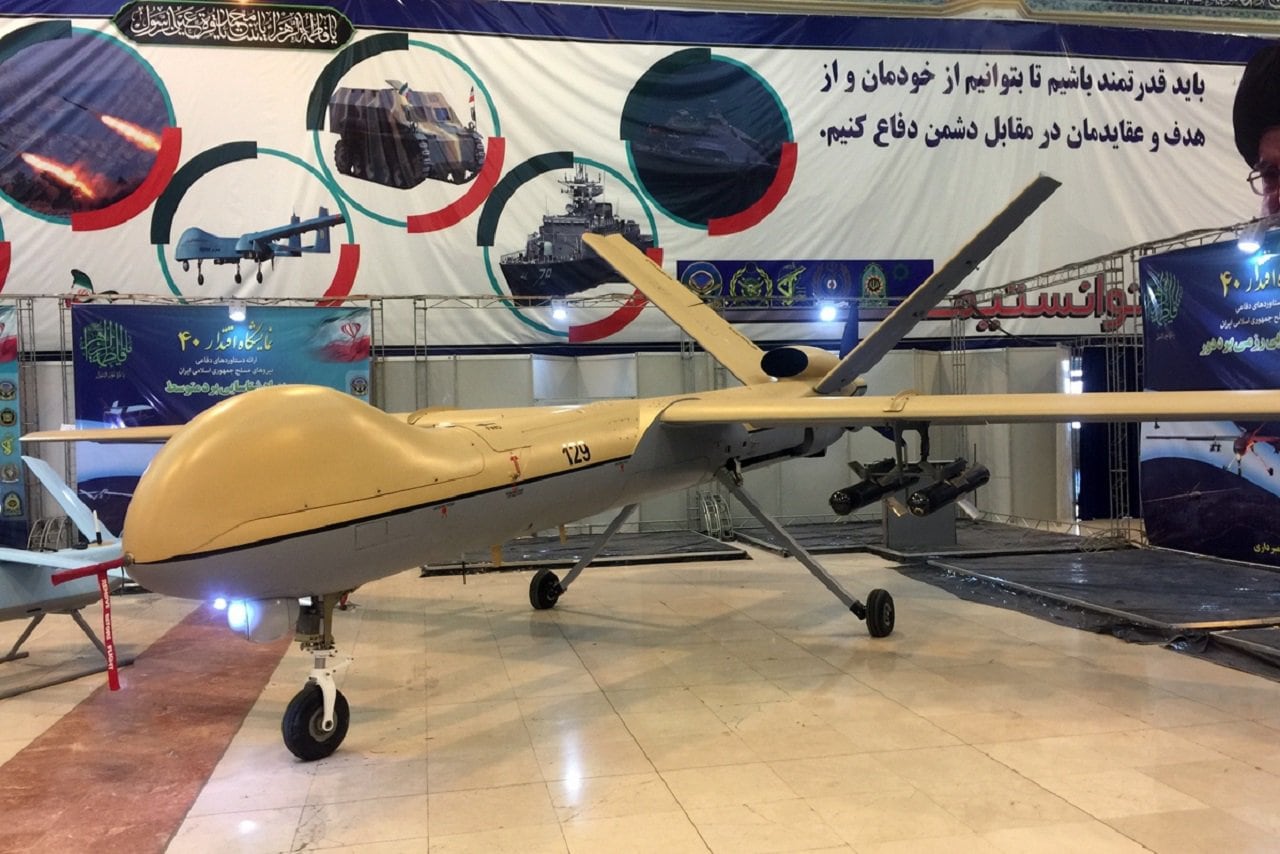
Shahed 129 UAV seen during the Eqtedar 40 defence exhibition in Tehran.
A South Korean Container Ship Became an IRGC Carrier
Perarin had spent its first two decades carrying commercial cargo.
By May 2022, open-source imagery showed it inside the Iran Shipbuilding and Offshore Industries Complex near Bandar Abbas. USNI News documented the conversion in January 2023, when workers had removed parts of the container deck to make room for an aviation surface.
The unchanged superstructure blocked a normal straight flight deck. Iranian engineers solved that problem with a reverse-angled runway passing to port before turning across the bow. Specialist analysis placed the available takeoff run just below 175 meters, with roughly 65 meters for landing. Sea trials began in November 2024. The IRGC accepted the vessel less than three months later.
The Ship Was a Mobile Drone Base, Not a Conventional Carrier
At the commissioning ceremony, Iranian media displayed modified Ababil drones, JAS-313 unmanned aircraft, Mohajer-6 systems, and several helicopters. Iran claimed the ship could carry several drone squadrons, guided submersibles, cruise missiles, and helicopters.
It also contained a hospital, flight-control facilities, plus crew spaces for prolonged operations.
Reports credited Shahid Bagheri with anti-ship missiles, short-range air defense systems, electronic warfare equipment, and the internal capacity to build fast boats. Some Iranian accounts claimed room for as many as 30 attack craft. Those figures were never independently verified. Public footage proved that helicopters or small fixed-wing drones could use the deck.
It did not prove a sustained wartime sortie rate, reliable recovery in rough weather, or the ability to service a large air group for months.
The most practical missions were surveillance, communications relay, maritime targeting, drone launch support, and small-craft delivery.
A ship operating in the Arabian Sea could move sensors closer to shipping routes, extend drone range, or support raids beyond Iran’s coastline.
That made the container-ship conversion more than a publicity stunt, even though it never became a peer of a purpose-built carrier.
Its Low-Cost Logic Created a Survivability Problem
Reusing a merchant ship saved design time, shipyard capacity plus money. It also concentrated drones, boats, fuel, command equipment, or missiles on one slow target. Commercial ships are designed to carry cargo efficiently, not to absorb blast, fragmentation, fire, or progressive flooding while continuing combat operations.
Shahid Bagheri had no carrier strike group comparable to the escorts around an American flattop. Its reported defenses could threaten small aircraft or boats, but they were not built to defeat a coordinated attack by stealth aircraft, cruise missiles, electronic warfare systems, or submarines.
A 2025 assessment of the carrier’s vulnerability argued that a single precision weapon might disable or sink it.
The U.S. Strike Left the Carrier Burning, Then Grounded
CENTCOM said on March 2 that American forces had hit Shahid Bagheri within hours of launching Operation Epic Fury. On March 5, the command released a video showing two impacts on the port side, followed by visible fires. Naval News noted that the public record did not establish whether the footage showed the first attack or a second engagement.
The Pentagon never identified the aircraft, missile, or bomb used against the ship. Caine said the wider naval campaign employed artillery, fighters, bombers and sea-launched missiles.
His March 10 statement described Shahid Bagheri as sunk. Later satellite analysis showed the wreck grounded in shallow water in the Khuran Strait, leaking heavy fuel toward the Hara mangrove reserve.
The terminology does not change its military status. Shahid Bagheri was destroyed as an operational platform. The loss of the 41,000-ton carrier removed Iran’s only dedicated fixed-wing drone ship. It did not eliminate the decentralized threat posed by mines, shore missiles, fast craft, or smaller unmanned systems around Hormuz.
The Carrier Never Proved Its Combat Concept
No public evidence shows Shahid Bagheri launching a wartime strike, supporting a long-range combat patrol, or deploying a full drone air group before the United States attacked it. Its documented career consisted mainly of conversion work, sea trials, demonstrations, plus limited operations near Iran.
By August 11, Iran had not announced a salvage plan, a replacement conversion, or any route for returning the grounded wreck to service.
About the Author: Harry J. Kazianis
Harry J. Kazianis (@Grecianformula) was the former Senior Director of National Security Affairs at the Center for the National Interest (CFTNI), a foreign policy think tank founded by Richard Nixon based in Washington, DC. Harry has over a decade of experience in think tanks and national security publishing. His ideas have been published in the NY Times, The Washington Post, The Wall Street Journal, CNN, and many other outlets worldwide. He has held positions at CSIS, the Heritage Foundation, the University of Nottingham, and several other institutions related to national security research and studies. He is the former Executive Editor of the National Interest and the Diplomat. He holds a Master’s degree focusing on international affairs from Harvard University.

