
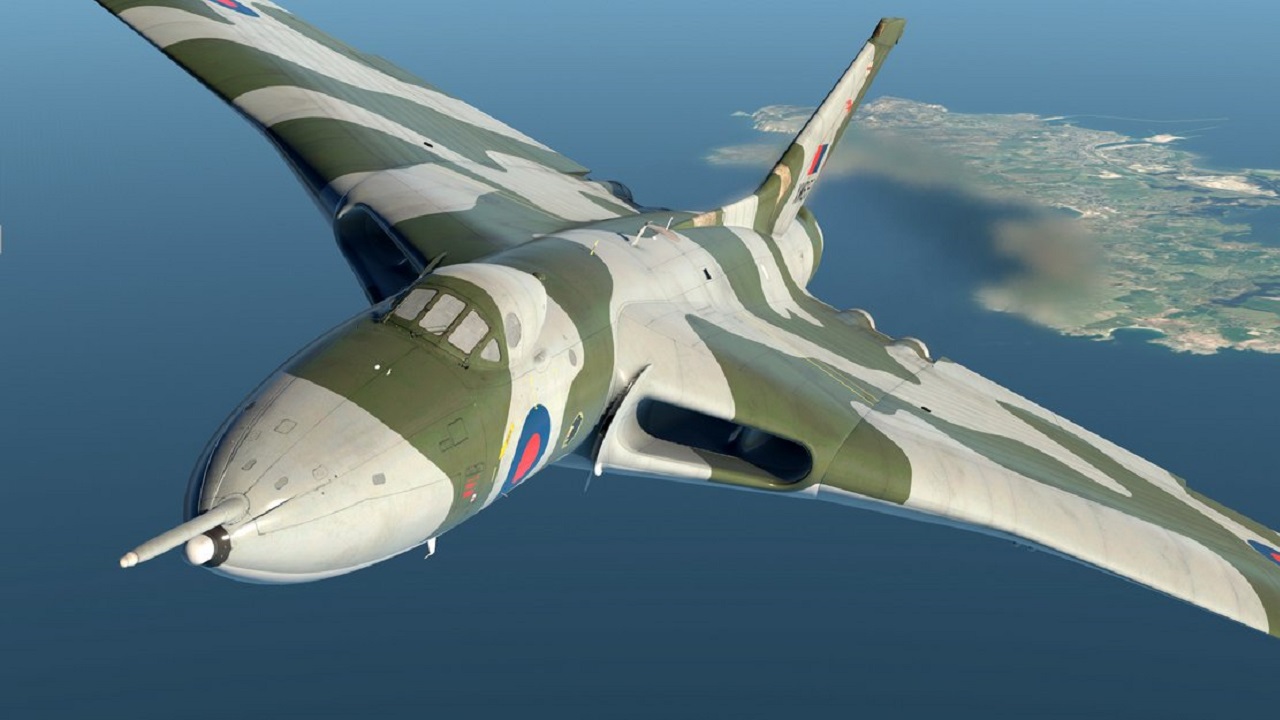
Meet the Avro Vulcan Bomber: Unbeknownst to most people, the UK once operated a fairly large fleet of strategic bombers.
While it may be hard to imagine given the current state of the Royal Air Force, the UK once operated three models of medium- to long-range strategic bombers known as the V-Force.

Avro Vulcan. Image Credit: Creative Commons.
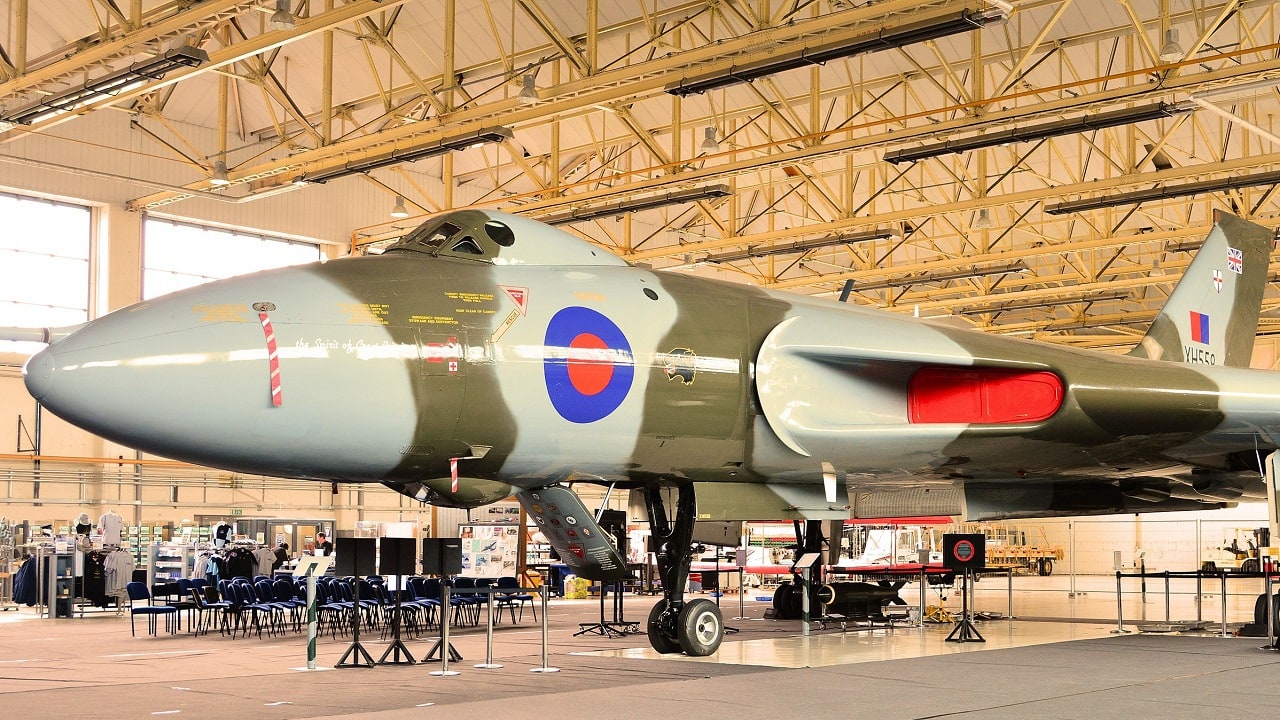
Avro Vulcan. Image Credit: Creative Commons.
One of the most distinct-looking members of the V-Force was the Avro Vulcan.
Sporting a very noticeable delta-wing configuration, the Vulcan was one of the most advanced bombers ever fielded by the RAF.
While it couldn’t quite reach supersonic speeds, the bomber was designed to fly above the range of Soviet air defenses and deliver strategic nuclear strikes.
As air defenses and nuclear missiles grew more sophisticated in the 1970s, however, the Vulcan was eventually withdrawn from service.
Development and Requirements
In the immediate aftermath of WWII, the UK government sought a medium-range bomber that was capable of carrying a nuclear bomb.
The Ministry of Supply issued Specification B.35/46 to aviation designers all across the country, listing the requirements for the new nuclear bomber.
The aircraft had to have a range of at least 1,500-2,000 nautical miles, a service ceiling of 35,000-50,000 feet, and the ability to carry one 10,000-lb nuclear bomb. The bomber also had to have a cruising speed of around 930 kilometers per hour.
Several companies, including Avero, would submit their proposals to the government.
Never before had a bomber of this type been built in the UK. While the Americans, by necessity, needed long-range bombers, the British, who had been much closer to the war, rarely needed such aircraft.
To meet the RAF’s new requirements, the team at Avero needed a completely new approach for this latest project.
The team experimented with a number of wing designs, all of which exceeded the weight requirements.
Eventually, the designers settled on a delta-wing design, which reduced the overall wingspan without compromising its performance.
Since the aircraft’s design was both novel and risky, extensive testing was required to validate it. Over the course of these tests, the design was refined.
The wings were given straight leading edges, and the aircraft was overall lengthened to shorten its takeoff run.
Technical Specifications
Finally, in September 1956, the Avro Vulcan B.1 officially entered service with the RAF. In 1956, the B.2 variant entered into service.
The Vulcan B.2 was fitted with four Bristol Siddeley Olympus 200-series engines, which improved the bomber’s performance.
Its four engines were buried deep in the wings, with a pair positioned on either side of the fuselage.
Likewise, air intakes were integrated into the aircraft’s wings, giving it a very distinct look among its peers. The aircraft had a top speed of 1,039 km/h (Mach 0.96), and a maximum service ceiling between 45,000 and 60,000 ft.
The airframe itself was quite massive, measuring 105 ft in length and 111 ft in wingspan. It had a maximum takeoff weight of 204,000 lb, and a combat range of 2,265 nautical miles (4,195 km).
Over time, the Vulcan’s role changed, as did its primary armaments.
In keeping with the RAF’s requirements, the bomber’s primary armament was a single free-fall nuclear bomb. The bombs could vary in size and blast yield, ranging anywhere from 0.5 kilotons to 1.1 megatons.
The Vulcan could, however, carry conventional bombs as well. In its bomb bay, the aircraft could be fitted with 21 1,000-lb conventional bombs; B.2 variants had the option to fit extra fuel tanks in the bomb bay.
As missile technology improved, it became clear that free-fall bombs were too risky for strategic aircraft, considering the advances in air defenses.
As a result, the UK developed the Blue Steel stand-off cruise missile for its bombers.
With a range of 926 km, these missiles could be armed with a conventional or nuclear payload, allowing bombers to operate beyond the range of most air defenses at the time. However, only one missile could fit inside the Vulcan at a time.
Service History and Retirement
With 136 airframes built, the Avro Vulcan was the most numerous strategic bomber ever built and operated by the UK. The bomber’s only combat experience came during the Falklands War in 1982.
During the war, Vulcans routinely had to fly 6,259 km to reach the Falklands and carry out combat operations.
The electronic countermeasures aboard the bomber frequently proved successful against Argentine radars, allowing the aircraft to perform its combat missions over enemy territory.
At the time, the Vulcan held the record for the longest combat missions, a record which it held until the 90s, when the U.S. launched Operation Desert Storm.
As time went on, the Avro Vulcan grew obsolete. As air defenses grew more sophisticated, the bomber’s defenses were insufficient against modern surface-to-air missiles.
Its role as the UK’s nuclear deterrent was also superseded by the Royal Navy’s nuclear submarines, which could employ more missiles from a much more survivable platform.
The Vulcan, therefore, offered too little for its rising sustainment costs. In 1984, the aircraft was finally retired from active service.
Many Vulcans were preserved in museums, and some were kept in taxiable condition for airshows.
One aircraft, B.2 XH558, named The Spirit of Great Britain, remained flightworthy for several years. In 2015, however, the bomber made its final flight at an airshow before it too was finally retired.
MORE – USS Kentucky: The 58,000-ton Iowa-class Battleship Use for Spare Parts
About the Author: Isaac Seitz
Isaac Seitz, a Defense Columnist, graduated from Patrick Henry College’s Strategic Intelligence and National Security program. He has also studied Russian at Middlebury Language Schools and has worked as an intelligence Analyst in the private sector.