
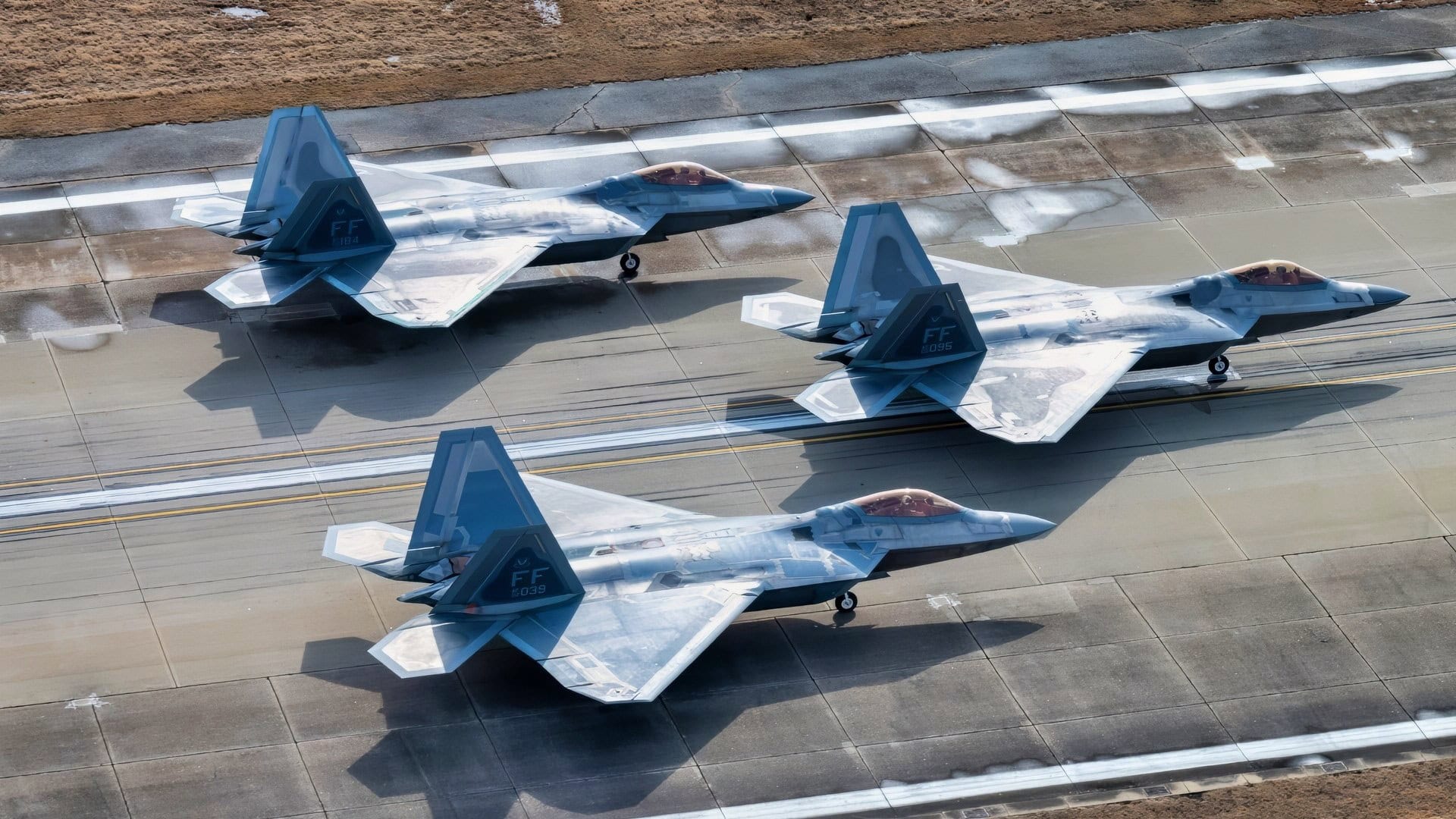
In the annals of the Office of the Secretary of War (OSW)—officially known as the Office of the Secretary of Defense (OSD) from 1947 to 2025—one of the worst decisions ever to emanate from that office was then-U.S. Secretary of Defense (SECDEF) Bob Gates’s incredibly short-sighted decision back in 2009 to kill the F-22 Raptor program after only 187 airframes were built out of the original 381 planned, which thus explains we can’t build any more of the world’s first operational 5th Generation stealth fighter.
Not only was this a major slap in the face to Lockheed Martin’s famed “Skunk Works” division and the United States Air Force alike, but it has also resulted in a major area of concern vis-à-vis Russia’s and China’s ongoing stealth fighter developments.
Fortunately, not all is lost for the Raptor, as indicated by a recent Congressional panel’s vote.
Bottom Line Up Front (BLUF)
Our key source of information and inspiration for this story is a June 4, 2026 article by Stephen Losey of Air & Space Forces Magazine titled “House Panel Votes to Prohibit F-22 Retirements Through Fiscal 2032.”
To wit, the specific House panel in question is the House Armed Services Committee (HASC), and the specific vehicle by which they cast that vote was their version of the National Defense Authorization Act (NDAA): “In a June 4 markup, the committee approved by voice vote a plethora of amendments related to the Air Force and its fleet…One of the most noteworthy amendments, though, came from Rep. Austin Scott (R-Ga.), who proposed extending the current prohibition on retiring any Raptors until Sept. 30, 2032.”
There was already language in place left over from the 2023 NDAA that prohibited the USAF from retiring any Raptors in response to an attempt by the service to divest 32 of its oldest “Block 20” editions of the warbird.
Air Force officials said at the time that the Block 20s were not combat-capable, could only be used for training, and would cost too much to upgrade to a more capable configuration.
That original language prohibits any F-22 divestments through fiscal year (FY) 2027, which ends Sept. 30, 2027.
Congressman Scott’s amendment goes one better by extending that through FY 2032, i.e., two years beyond the 2030 timeline the Air Force once envisioned for starting to sunset the F-22.
In any event, that previous 2030 sunsetting plan already seemed to have been placed in cold storage, as the Air Force brass has already stopped asking to retire those Block 20 F-22s, thanks to the sobering realization that the overall fighter fleet is aging and slowly shrinking.
In the case of the Raptor, that previously-cited figure of 187 specimens has whittled down to 184 (by Mr. Losey’s count) or 183 (according to World Directory of Modern Military Aircraft [WDMMA] statistics).
Yes, the Air Force and Boeing are currently working on that 6th Generation wunderkind fighter known as the F-47 Next Generation Air Dominance (NGAD), which will render the F-22 and F-35 Lightning II (a Skunk Works product just like the Raptor) alike obsolescent.
However, the NGAD is still very much in the research & development (R&D) stage, a long way off from the prototype’s maiden flight, let alone an actual operational, production-phase plane.
The extension of the F-22’s retirement prohibition into at least 2032 would help the service retain some of its stealth fighter capabilities of countering Russia and China while the Air Force fighter pilot community awaits the F-47’s official debut.
Enter the Super Raptor
Even before Rep. Scott’s amendment, there were already plans afoot to develop a so-called “Super Raptor.” Among the features that would make it so super are:
-The Infrared Defensive System (IRDS), which gives the F-22 eyes in the thermal spectrum, capable of detecting long-range missile launches from multiple vectors, thus complementing the radar warning systems and improving 360-degree situational awareness (SA).
An electronic warfare (EW) suite that is being comprehensively updated with a new generation of software-defined countermeasures and miniaturized decoys inspired by the BrightCloud concept.
These decoys are expendable and can mimic the F-22’s radar signature, thus drawing enemy missiles off target.
-Paired Infrared Search and Track (IRST) pods that provide stereo thermal imaging, enabling passive heat detection at long range, able to spot rear-aspect stealth aircraft (like the aforementioned J-20) at 70–90 kilometers (43.5–55.9 miles) in wide-search mode and up to 130 kilometers (80.7 miles) in focused tracking.
This passive detection capability allows F-22s to track targets without blowing their cover via radar signal emissions—a massive tactical advantage in stealth-versus-stealth engagements.
-The AIM-260 Joint Advanced Tactical Missile (JATM)—yet another Lockheed Martin product—which will replace the active radar-guided AIM-120 AMRAAM (Advanced Medium-Range Air-to-Air Missile; nicknamed the “Slammer”).
The JATM features roughly 30 percent more propellant, and if it employs a dual-pulse motor, it could achieve a range over 50 percent greater, giving the Raptor overwhelming standoff capability, thus boosting the probability of beyond-line-of-sight (BLOS) kills.
A-10 Analogy
Congress’s refusal to allow the F-22 to die quietly brings to mind another USAF warbird that has resisted bigwigs’ effort to kill (or at least retire) it, that being the Fairchild A-10 Thunderbolt II, far better known by its affectionate nickname, the “Warthog.”

A U.S. Air Force A-10 Thunderbolt II conducts a combat air patrol over the U.S. Central Command area of responsibility, May 13, 2025. The A-10 Thunderbolt II can patrol over battle areas for extended periods of time and operate in low visibility conditions. (U.S. Air Force Photo by Staff Sgt. John C.B. Ennis)

A-10 Warthog. Image Credit: 19FortyFive.com
Along the lines of Rep. Scott’s Raptor life extension bill, Congressman Abe Hamadeh (R-AZ) introduced the Bolstering Recognition, Resurgence, Retention, and Remembrance of the Thunderbolt Act, known as the BRRRRT Act—an homage to the distinctive sound of the A-10’s GAU-8 Avenger 30mm cannon—on July 20. This piece of legislation is co-led by Congressman Don Davis (D-NC) and has several cosponsors.
The Raptor and the Warthog alike are exemplifying the immortal words of Welsh poet Dylan Thomas: “Do not go gentle into that good night/Old age should burn and rave at close of day/Rage, rage against the dying of the light.”
About the Author: Christian D. Orr
Christian D. Orr is a Senior Defense Editor. He is a former Air Force Security Forces officer, Federal law enforcement officer, and private military contractor (with assignments worked in Iraq, the United Arab Emirates, Kosovo, Japan, Germany, and the Pentagon). Chris holds a B.A. in International Relations from the University of Southern California (USC) and an M.A. in Intelligence Studies (with a concentration in Terrorism Studies) from American Military University (AMU). He is also the author of the book “Five Decades of a Fabulous Firearm: Celebrating the 50th Anniversary of the Beretta 92 Pistol Series,” the second edition of which was recently published.