
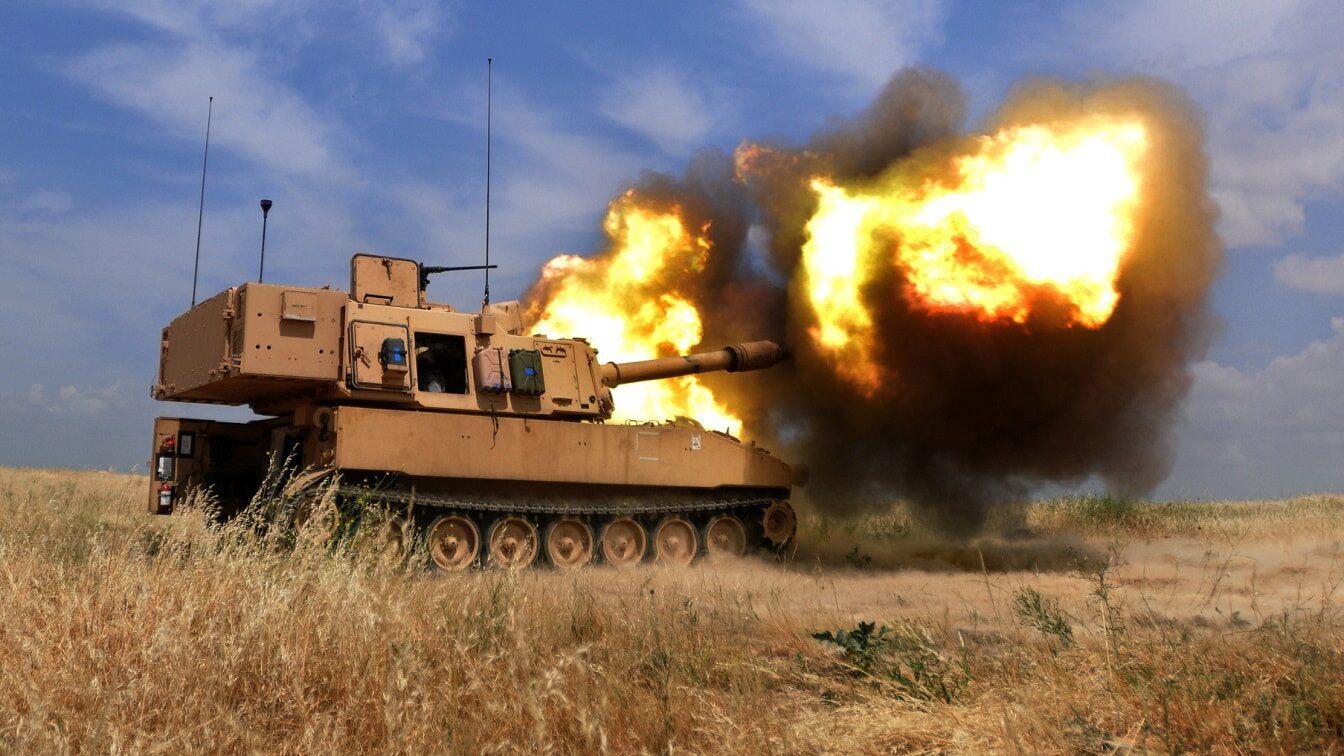
Ask the Army general pushing to get 155mm shell production to 100,000 rounds a month where the raw material comes from, and he won’t say Pennsylvania.
Maj. Gen. John Reim, the Joint Program Executive Officer for Armaments and Ammunition, has said plainly that the United States cannot yet make enough of the high-grade nitrocellulose those shells require, and has been importing it from France, the Czech Republic, and South Korea to cover the shortfall.
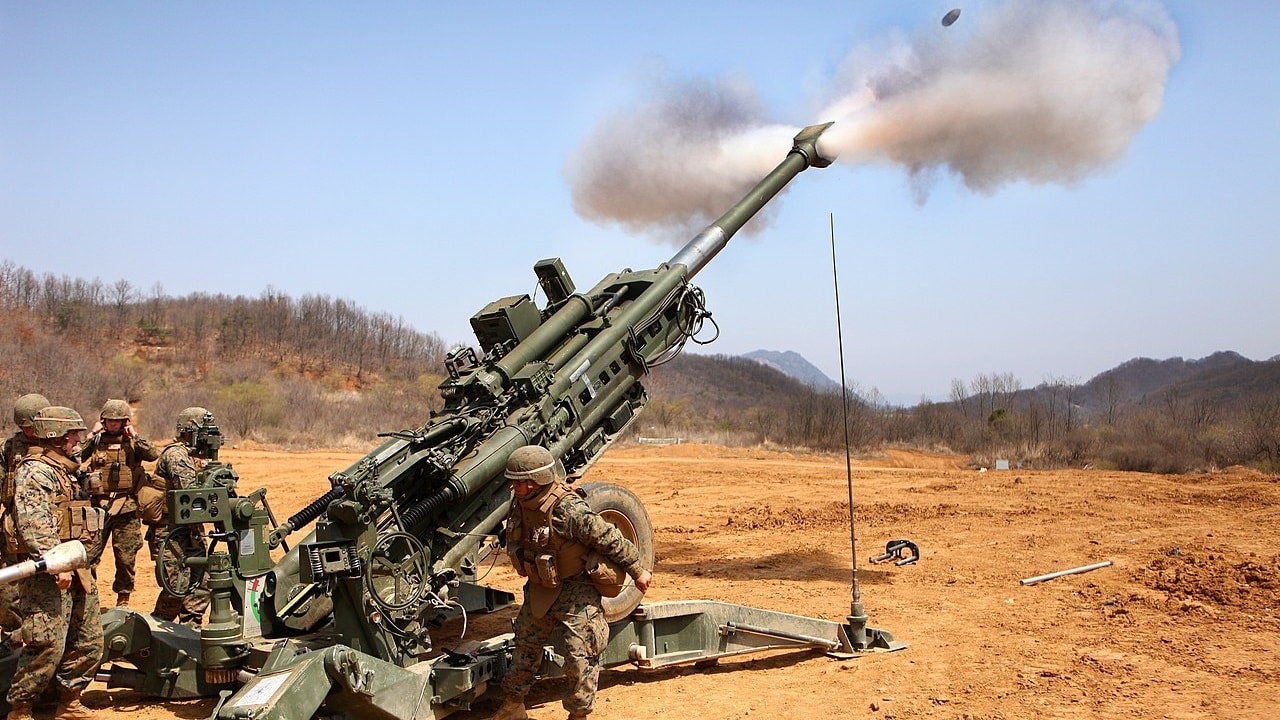
U.S. Marines with Alpha Battery, 1st Battalion, 12th Marine Regiment, 3rd Marine Division, III Marine Expeditionary Force attached to 3rd Marine Regiment, 3rd MarDiv, III MEF, fire the M777A2 155mm howitzer in support of a combined arms live-fire exercise at Rodriguez Live-Fire Complex during Korean Marine Exchange Program 13-5, part of Ssang Yong 13 in the Republic of Korea April 17, 2013. The CALFEX illustrates how the annual exercise Ssang Yong supports ongoing efforts to strengthen combat readiness in both U.S. and ROK forces. (U.S. Marine Corps photo by Lance Cpl. Jose D. Lujano III MEF PAO/Released)
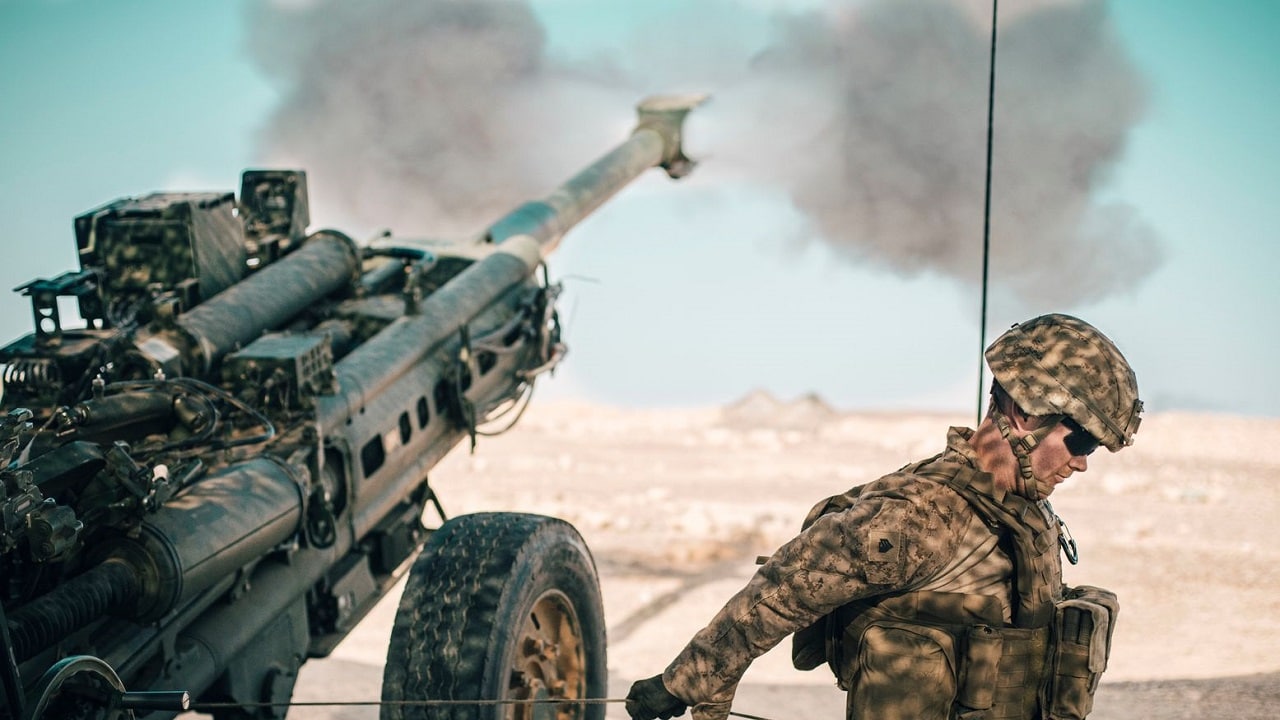
155mm Howitzer. Image Credit: Creative Commons.
Separately, the Army depends on a General Dynamics facility on the south shore of Montreal called Valleyfield for the M31A2 propellant that goes into those same shells.
The US Army has put more than half a billion dollars into expanding that Quebec plant’s output.
Call that a footnote to the U.S.-Canada relationship and you’re missing the point. It’s close to the whole relationship, compressed into a single supply contract.
It also sits uneasily next to a separate fact. Since last year, Washington has treated Canadian steel, aluminum, and copper as national security threats serious enough to justify tariffs running as high as 50 percent, under a statute built for exactly that purpose.
One part of the U.S. government is expanding a Canadian factory to feed the Army’s most urgent munitions program.
Another is telling Canadian metal it doesn’t belong. Both claims get made in the name of national security. They point American industrial policy in different directions, and Washington has yet to explain how they fit together.
Two Theories of Security
The Pentagon’s current acquisition rules put it plainly. The Defense Federal Acquisition Regulation Supplement states that “for production planning purposes, Canada is part of the defense industrial base.” It reads like boilerplate, but that clause has shaped how the Pentagon buys from Canadian suppliers for decades, treating them almost like domestic vendors.
Section 232 of the Trade Expansion Act is interpreted differently by different countries.
The tariffs it authorizes on those metals, revised again by a June 1 proclamation, make it clear that reducing reliance on imported metal, Canadian metal included, is itself the security goal.
These aren’t the tariffs that made headlines this month, the 50 percent hit on roughly $20 billion in Canadian goods that landed after talks collapsed on August 21.
Those rest on a different statute entirely, provoked by fights over dairy, alcohol, and autos, and they’re about market access, not national security. Section 232 is based on a security claim, and it runs counter to the Pentagon’s own procurement rules regarding the same country.
A fair defender of the administration would point out that the Pentagon has a workaround. DoD maintains duty-free certification mechanisms for supplies from what the regulations call “qualifying countries,” including Canada.
This argument doesn’t need to settle whether that mechanism covers any particular Valleyfield shipment.
A customs exemption, if one applies, tells you what happens at the border on one shipment.
It says nothing about whether the country supplying that shipment is one Washington intends to keep building on for the next decade, or one it will eventually need less of.
The Army doesn’t put more than half a billion dollars into Canadian production capacity based on this year’s customs treatment. It does that based on a bet about where American policy is headed.
Right now that bet is being placed in two directions by two parts of the same government.
The Evidence Is in the Shell Casings
Look at what’s actually happening on the ground, and the abstraction becomes much more concrete. The Army missed its October 2025 target of producing 100,000 rounds a month, and a Pentagon Inspector General report released in July explained why in blunt terms.
By the time the inspector general reported, the limiting factor had shifted from propellant to projectile metal parts, the steel bodies of the shells themselves.
The showcase domestic facility for that stage, a $469 million plant in Mesquite, Texas, run by General Dynamics, had produced zero projectile metal parts meeting Army specifications as of March.
The Army has instead leaned on its three other metal-parts plants in Scranton and Wilkes-Barre, Pennsylvania, and in Ingersoll, Ontario, where a facility run by a company called IMT survived a labor strike during construction and was built to produce fifteen thousand shell bodies a month.
So the flagship American reshoring project has yet to produce a single usable part, while the plant in Ingersoll is one of only three now carrying the load Mesquite was supposed to share. Ottawa isn’t treating this as charity, either.
In March, Canada’s own government put another C$305 million into a new Ingersoll facility, explicitly framed around reducing dependence on foreign suppliers while backstopping North American supply more broadly.
Ottawa is building sovereign capacity at the same moment Washington is reconsidering how much Canadian capacity it wants to depend on. Both governments are betting on the same industrial base.
Two Clocks, One Country
Timing makes the collision harder to ignore, not easier.
The production race began with Ukraine, and the munitions strains exposed by the war with Iran have only sharpened the sense inside the Pentagon that industrial depth matters more than it did five years ago.
That argues for locking in every available reliable supplier, including Canadian ones.
A second clock is running on its own schedule, though, independent of anything happening in artillery production. Canada’s retaliatory tariffs begin September 8.
Trump has threatened a 50 percent tariff on Canadian vehicles and parts starting January 1. July’s mandatory USMCA review ended without the sixteen-year extension the agreement was designed to produce.
The agreement remains fully in force and could still be extended before its scheduled 2036 expiration, but for now it runs on annual review instead of settled ground.
Two clocks are running inside the same administration, pointed at the same country, and nothing suggests either one is checking the other.
What actually matters isn’t whether Ottawa retaliates on schedule.
It will.
It’s whether the Pentagon keeps sending investment dollars to Quebec and Ontario as the tariff fight grinds on, or whether the acquisition file quietly starts losing to the trade file.
DFARS tells Pentagon planners they can build around Canadian capacity.
Section 232 increasingly rewards moving critical industrial inputs and metal production back inside the United States.
Washington hasn’t explained how those two strategies are meant to coexist over the long run. Watch where the next round of Pentagon industrial-base investment actually goes.
About the Author: Dr. Andrew Latham
Andrew Latham is a professor of international relations and political theory at Macalester College in Saint Paul, MN. You can follow him on X: @aakatham.