
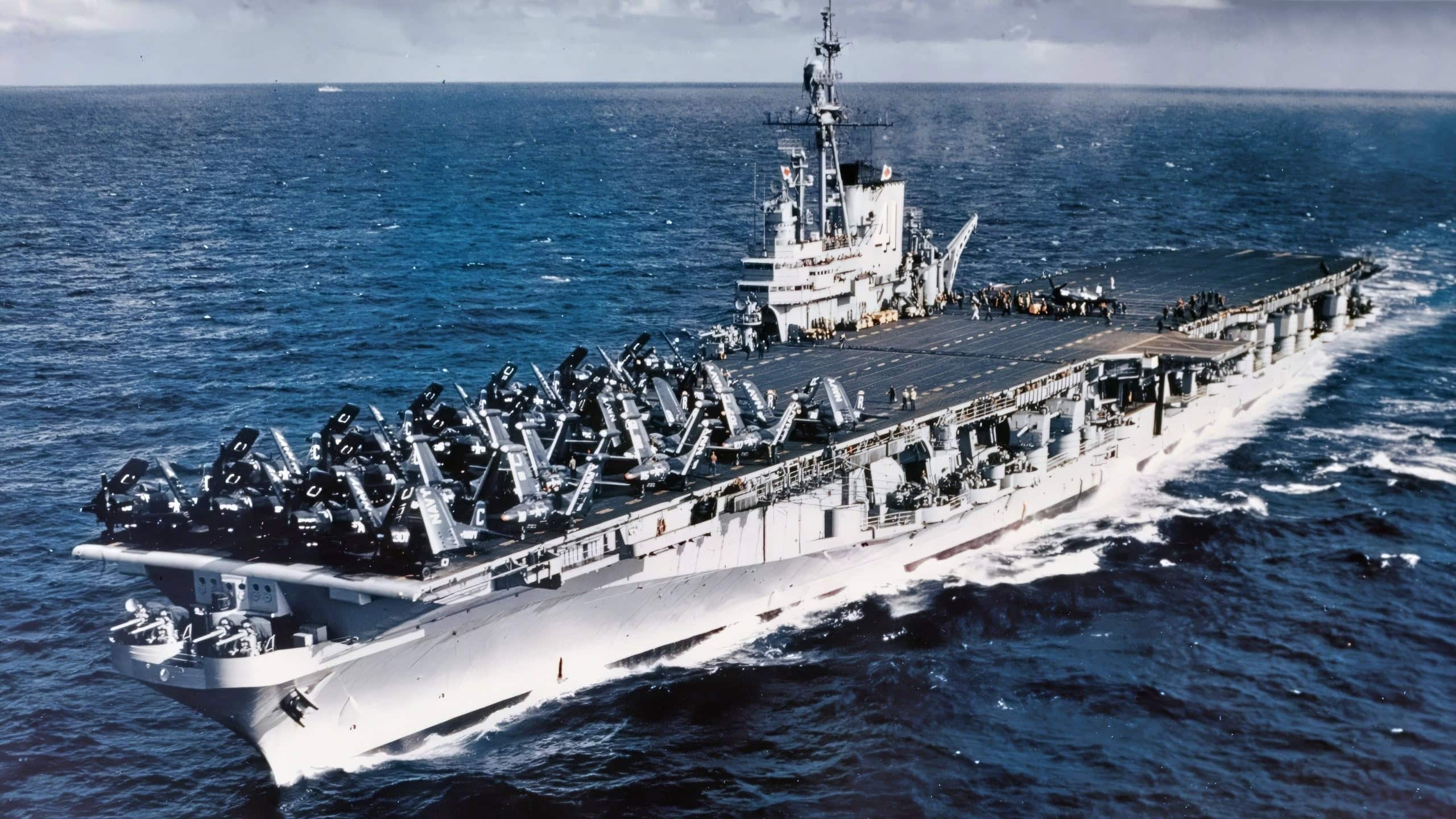
USS Midway by the Numbers – $85.6 Million, 212,000 Horsepower, and 120 Aircraft: Retired US Navy aircraft carrier USS Midway cost $85.6 million to build. The money produced a carrier displacing 45,000 tons under standard conditions and 60,100 tons at full load, making her as heavy as an Iowa-class battleship and the largest warship in the world when commissioned.
Four Westinghouse geared steam turbines served as Midway’s main engines. Twelve boilers produced the steam, while the turbines delivered a combined 212,000 shaft horsepower to four shafts and four propellers. The plant drove the carrier to 33 knots and gave her an endurance of 15,000 nautical miles at 15 knots.
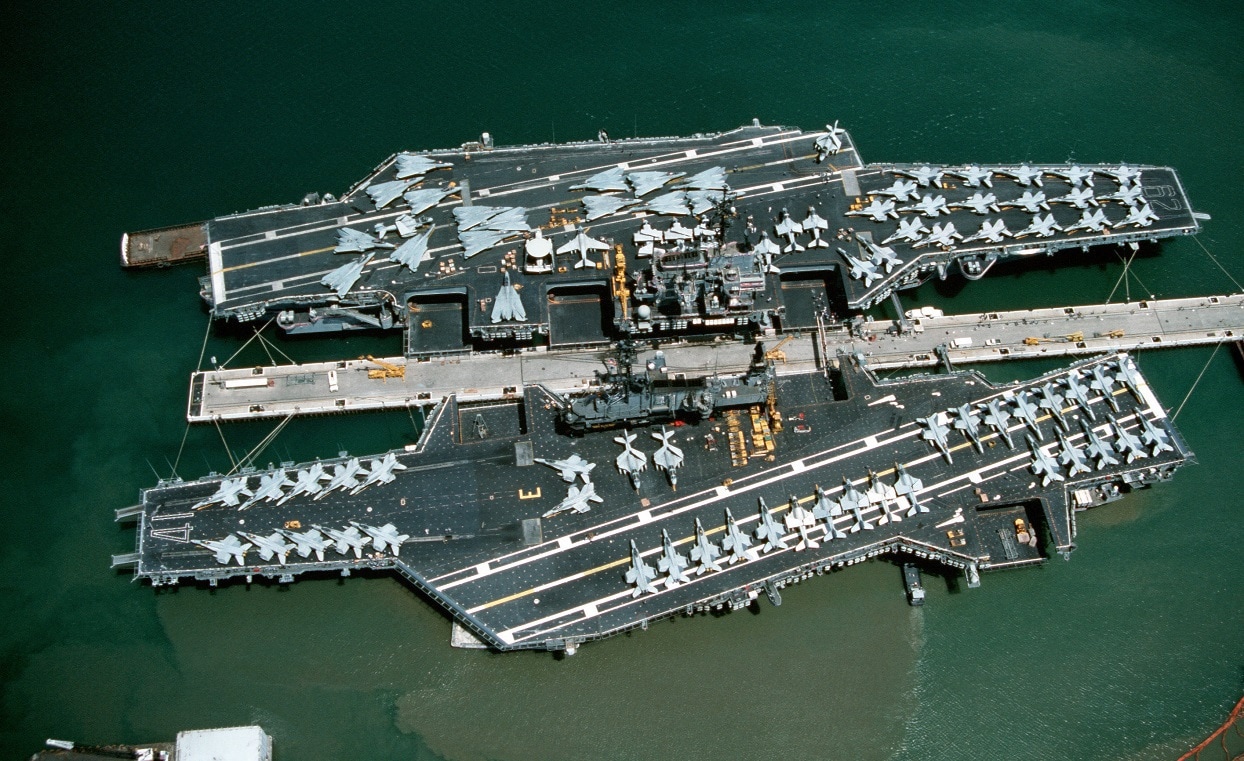
An aerial view of various aircraft lining the flight decks of the aircraft carrier USS INDEPENDENCE (CV-62), right, and USS MIDWAY (CV-41) moored beside each other in the background. The MIDWAY is en route from Naval Station, Yokosuka, Japan, to Naval Air Station, North Island, California, where it will be decommissioned in the spring of 1992. The INDEPENDENCE will travel to Yokosuka to take over as the Navy’s forward-based aircraft carrier.
Aircraft capacity depended on the era. Naval architects provided space for as many as 144 World War II aircraft, while the USS Midway Museum uses 120 planes as the practical early air group. By the 1980s, larger jets had reduced the embarked force to roughly 65 to 75 aircraft.
Midway also changed from a heavily gunned battle carrier to a ship whose aircraft supplied nearly all of its offensive firepower. In 1945, she carried 18 5-inch guns, 84 40mm Bofors guns, and 28 20mm Oerlikons. A detailed late-career reference lists two Sea Sparrow launchers and two Phalanx close-in weapon systems by 1985.
$85.6 Million Built a 60,100-Ton Battle Carrier
Newport News Shipbuilding laid Midway’s keel on October 27, 1943. The hull entered the water 17 months later, and the Navy commissioned the ship on September 10, 1945, eight days after Japan’s formal surrender. The carrier measured 968 feet overall, with a 113-foot beam at the waterline and a 136-foot-wide flight deck.
The Navy wanted an armored carrier able to survive bombs and kamikaze attacks without sacrificing a large air group. Midway received 3.5 inches of flight-deck armor, 2 inches over the hangar deck, and a waterline belt reaching 7.5 inches around critical spaces. The combination made the three Midway-class ships genuine battle carriers. The 113-foot waterline beam also made Midway the first American warship designed from the outset without access to the original 110-foot-wide Panama Canal locks.
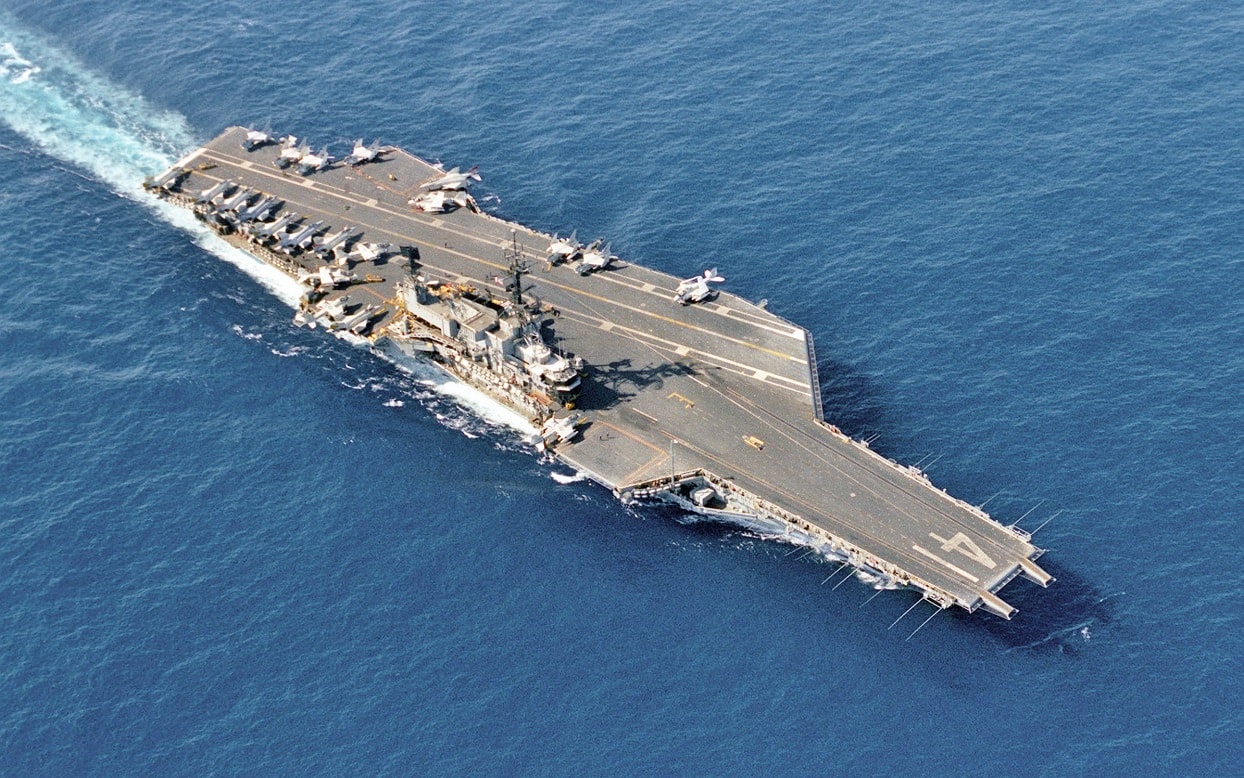
An elevated starboard bow view of the aircraft carrier USS MIDWAY (CV 41) underway off the coast of Okinawa, Japan.
Four Steam Turbines Produced 212,000 Shaft Horsepower
Midway had four main engines, not 12. The 12 boilers produced steam for four separate turbine sets, which in turn turned four propellers. The engineering plant was distributed across 26 main compartments, including 12 boiler rooms and four widely separated engine rooms, to limit damage from a single bomb, torpedo, or machinery casualty.
The machinery was based on the propulsion plant developed for the Iowa-class battleships. Its 212,000 shaft horsepower pushed the broad, armored hull to 33 knots. The 15,000-nautical-mile endurance at 15 knots was exceptional for a conventionally powered carrier, although Midway still needed regular replenishment. The museum lists total fuel capacity at 3.4 million gallons.
The Air Wing Fell From 120 Aircraft to Roughly 65
Midway’s early aircraft numbers require one distinction. The design maximum was 144 piston-engine aircraft, although operational plans generally called for 120 to 136. The museum uses 120, still a substantially larger force than the normal complement aboard an Essex-class carrier.
That count fell as aircraft became bigger, heavier, and more complicated. Midway’s later air wings carried roughly 65 to 75 F-4 Phantoms, A-6 Intruders, F/A-18 Hornets, electronic-warfare aircraft, airborne early-warning aircraft, and helicopters. The ship never operated the F-14 Tomcat as a regular fleet aircraft because its weight, landing demands, and support requirements left the Midway class too small for the Navy’s largest Cold War fighter.
The Flight Deck Expanded From 2.8 to Four Acres
As built, Midway had a 924-foot flight deck 136 feet wide. The original axial layout reflected World War II practice. A later conversion added an angled landing area, while the reconstruction begun in 1966 widened the flight deck by 33 percent, increasing its area from 2.8 acres to 4 acres.
Workers extended the landing runway by 100 feet, set its angle at 13 degrees, installed two C-13 steam catapults, and fitted stronger arresting gear with three deck pendants. Three deck-edge elevators moved aircraft between the hangar and the flight deck. Their initial 55-ton rating later rose to 65 tons.
The rebuilt carrier eventually measured about 1,001 feet long with a flight deck spanning more than four acres. Its maximum deck width approached 238 feet, while full-load displacement rose toward 64,000 tons. The armored deck gave the hull unusual structural strength as heavier jets entered service. The reconstruction had been projected at roughly $87 million but finished at $202 million, only $75 million less than the new USS John F. Kennedy.
Eighteen Five-Inch Guns Became Sea Sparrow and Phalanx
Midway’s original defensive battery was unusually heavy for an aircraft carrier. The 18 single 5-inch/54-caliber guns engaged aircraft and surface targets. Twenty-one quadruple Bofors mounts supplied 84 barrels of 40mm fire, while 28 single 20mm Oerlikons covered the closest approaches.
Guided missiles and radar-directed guns eventually replaced that battery. The two Mk 25 Sea Sparrow launchers each held eight missiles, giving Midway 16 missiles ready in the launchers. Two Mk 15 Phalanx systems added radar-controlled 20mm Gatling guns for the last defensive layer.
Midway’s larger weapons inventory sat below decks for the air wing and varied by deployment. Its aircraft carried Sidewinder and Sparrow air-to-air missiles, bombs, rockets, and precision-guided weapons.
A late-service F/A-18 was rated to carry roughly eight tons of bombs, rockets, or guided munitions in addition to its missiles and 20mm cannon. No reliable public figure provides a single, fixed total for every weapon held in the carrier’s magazines.
4,500 Sailors Kept the Carrier Operating
The completed carrier required about 4,100 officers and enlisted personnel to be embarked with the air group.
The museum uses 4,500 as a representative crew figure for the ship’s later career. Midway’s barbers completed about 80,000 haircuts each year, while the laundry handled 43,000 pounds every week.
Keeping the carrier operating across the propeller and jet eras required an airfield, power plant, weapons depot, hospital, and repair yard inside one hull.
Forty-Seven Years Produced More Than 3,000 Desert Storm Sorties
Midway’s career stretched from September 1945 to April 1992. During Operation Frequent Wind in 1975, the ship helped evacuate 3,073 refugees over two days. In 1991,
Midway served as the flagship for naval air operations in the Persian Gulf and launched more than 3,000 combat missions during Operation Desert Storm without losing an aircraft.
Local News: You Can Visit USS Midway in San Diego Right Now
The Navy decommissioned Midway in San Diego on April 11, 1992, after a career spanning 47 years. The ship entered the reserve fleet, was donated to a nonprofit museum organization in 2003, and opened to the public in June 2004.
Midway remains moored at 910 North Harbor Drive alongside Navy Pier in San Diego.
About the Author: Harry J. Kazianis
Harry J. Kazianis (@Grecianformula) was the former Senior Director of National Security Affairs at the Center for the National Interest (CFTNI), a foreign policy think tank founded by Richard Nixon based in Washington, DC. Harry has over a decade of experience in think tanks and national security publishing. His ideas have been published in the NY Times, The Washington Post, The Wall Street Journal, CNN, and many other outlets worldwide. He has held positions at CSIS, the Heritage Foundation, the University of Nottingham, and several other institutions related to national security research and studies. He is the former Executive Editor of the National Interest and the Diplomat. He holds a Master’s degree focusing on international affairs from Harvard University.

