
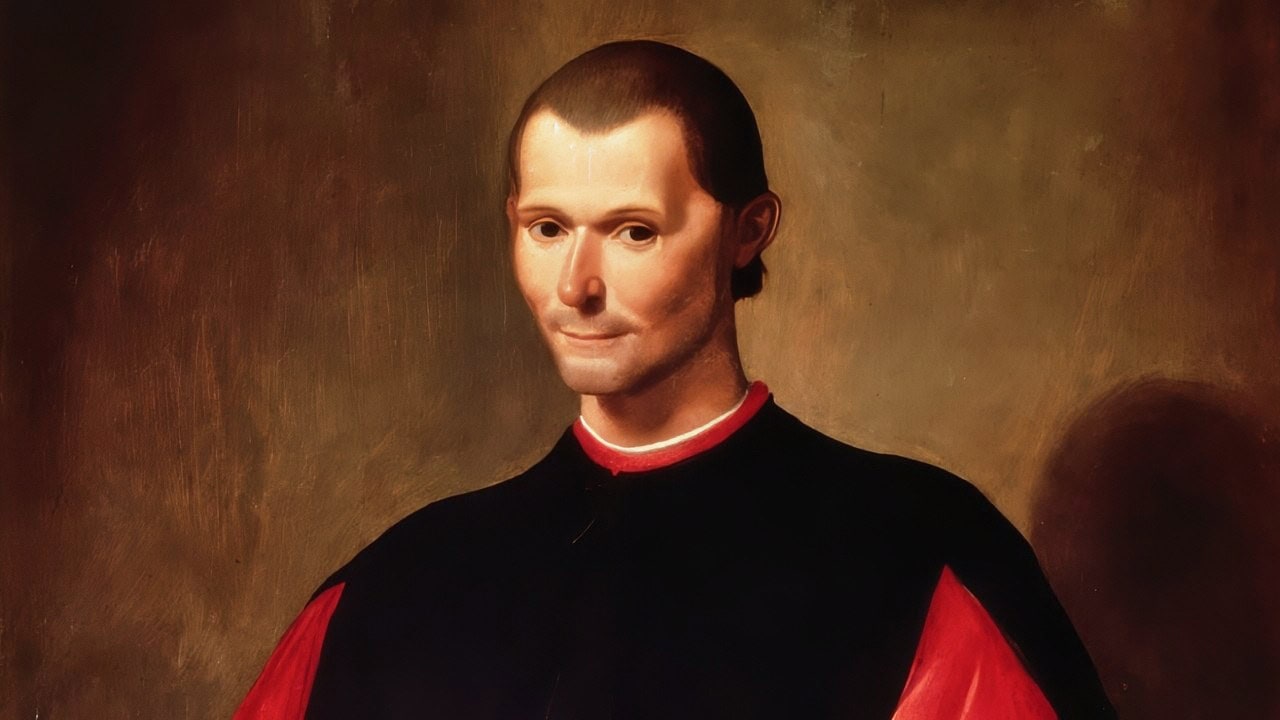
Everyone knows the eight words. Better to be feared than loved has escaped its book and its century, and now runs loose through boardrooms, locker rooms, and television villains as the distilled essence of ruthless leadership. Almost nobody quotes what Niccolò Machiavelli wrote immediately afterward, and the omission reverses his meaning, because the second half of the passage is not a boast but a safety warning. The famous line appears in Chapter 17 of The Prince, written in 1513 by an unemployed Florentine official recently released from a torture chamber and printed only in 1532, five years after his death.
Read the chapter to its end, and the lesson is not that fear wins.
It is that a ruler who lets fear curdle into hatred has signed his own death warrant, and that the difference between the two comes down to keeping his hands off exactly two things.
What the Chapter Says First
Machiavelli opens by saying a prince should wish to be both loved and feared, and only because the two are difficult to unite does he conclude that, if one must be dropped, it is much safer to be feared than loved.
The reasoning is his bleak reading of human nature: men are ungrateful, fickle, false, and covetous, devoted while danger is distant and gone when it arrives. Love binds a ruler to his people with a chain of obligation, and obligation, being inconvenient, breaks whenever breaking it pays.
Fear binds by the dread of punishment, and dread never takes a day off.
A ruler who builds on being loved builds on something others control, since men love at their own pleasure.
Fear is the one instrument held entirely in the prince’s own hand.
That is the argument the world remembers, and on its own it is half an argument.
The Warning Nobody Quotes
The next movement of the chapter is the point of it.
A prince ought to make himself feared in such a way that if he earns no love he at least escapes hatred, because being feared, and not hated can go together perfectly well.
Then he tells the ruler precisely how: abstain from the property of your citizens and subjects, and abstain from their women. When an execution is unavoidable, carry it out only with proper justification and manifest cause. And above everything else stay away from other men’s possessions, because men will more quickly forget the death of their father than the loss of their patrimony. It is the coldest sentence in a famously cold book, and it is also an observation about grievance that five centuries have not refuted.
He adds a corollary: a ruler who begins living by seizure never runs out of pretexts for the next confiscation, while reasons for taking a life are harder to find and sooner exhausted, so the thieving prince slides downhill in a way the merely severe prince does not.
The chapter closes by restating the whole structure. Men love at their own will and fear at the will of the prince, so a wise ruler stands on what is his, and his one overriding obligation is to avoid being hated.
Chapter 19 then hardens the warning into a survival rule: what makes a prince hated above all is being rapacious, and where property and honor go untouched, most men live content, leaving only a handful of ambitious rivals to manage.
The Man Who Wrote It Had Watched the Alternative
Machiavelli spent fourteen years, from 1498 to 1512, as secretary of the second chancery of the Florentine Republic, handling diplomacy and war, carrying missions to the French court, to the emperor, and, most formatively, to Cesare Borgia in 1502 and 1503, watching the most feared new prince in Italy at close range.
He built Florence’s citizen militia and saw it retake Pisa in 1509. Then, in 1512, Spanish troops restored the Medici; the republic collapsed, and Machiavelli was dismissed by decree in November. Within months, his name appeared on a list carried by two conspirators against the new regime. He was imprisoned and tortured, subjected to the rope drop that dislocates shoulders, and confessed to nothing; he was freed in the general amnesty that followed the election of a Florentine, Giovanni de’ Medici, as Pope Leo X.
He withdrew to the family farm at Sant’Andrea in Percussina, and in the famous letter to his friend Francesco Vettori of December 10, 1513, he described his evenings there: stripping off the mud-caked clothes of the farm, dressing in his old court garments, and entering the ancient courts of the classical writers to question them about their states, hours in which he felt no boredom, no poverty, and no fear of death.
Out of those evenings came The Prince, composed that year as a bid for employment from the family that had wrecked his career, dedicated to a Medici, printed after his death, and eventually placed on the Church’s index of forbidden books.
Why the Second Half Was the Point
Between the French invasion of 1494 and the year he wrote, Machiavelli watched a parade of rulers rise and fall, and the pattern he extracted was that force alone rarely killed a prince, but hatred reliably did, because hatred is what a conspiracy runs on.
A plotter against a feared ruler must reckon that the people may side with the throne; a plotter against a hated one can count on the crowd, and Machiavelli says elsewhere in the book that the best fortress a prince can possess is not to be hated by his own people. That is why the second half of the famous sentence carries the operative advice. Fear was never a goal, only a bond stronger than affection, and the moment it breeds hatred it stops securing the ruler and starts recruiting his assassins.
The trigger he named, property, is the part with the longest afterlife: dispossession radicalizes in a way even bloodshed does not, a truth visible in every confiscation and expropriation that has detonated a rebellion in the five centuries since.
The eight words the world quotes are a fragment of a machine. Run the whole machine and the instruction is almost conservative: be severe if you must, be lawful in form even when ruthless in fact, take lives rarely and property never, because the hatred of the governed is the one force no prince survives.
About the Author: Harry J. Kazianis
Harry J. Kazianis (@Grecianformula) was the former Senior Director of National Security Affairs at the Center for the National Interest (CFTNI), a foreign policy think tank founded by Richard Nixon based in Washington, DC. Harry has over a decade of experience in think tanks and national security publishing. His ideas have been published in the NY Times, The Washington Post, The Wall Street Journal, CNN, and many other outlets. He has held positions at CSIS, the Heritage Foundation, the University of Nottingham, and several other institutions related to national security research and studies. He is the former Executive Editor of the National Interest and the Diplomat. He holds a Master’s degree focusing on international affairs from Harvard University.

