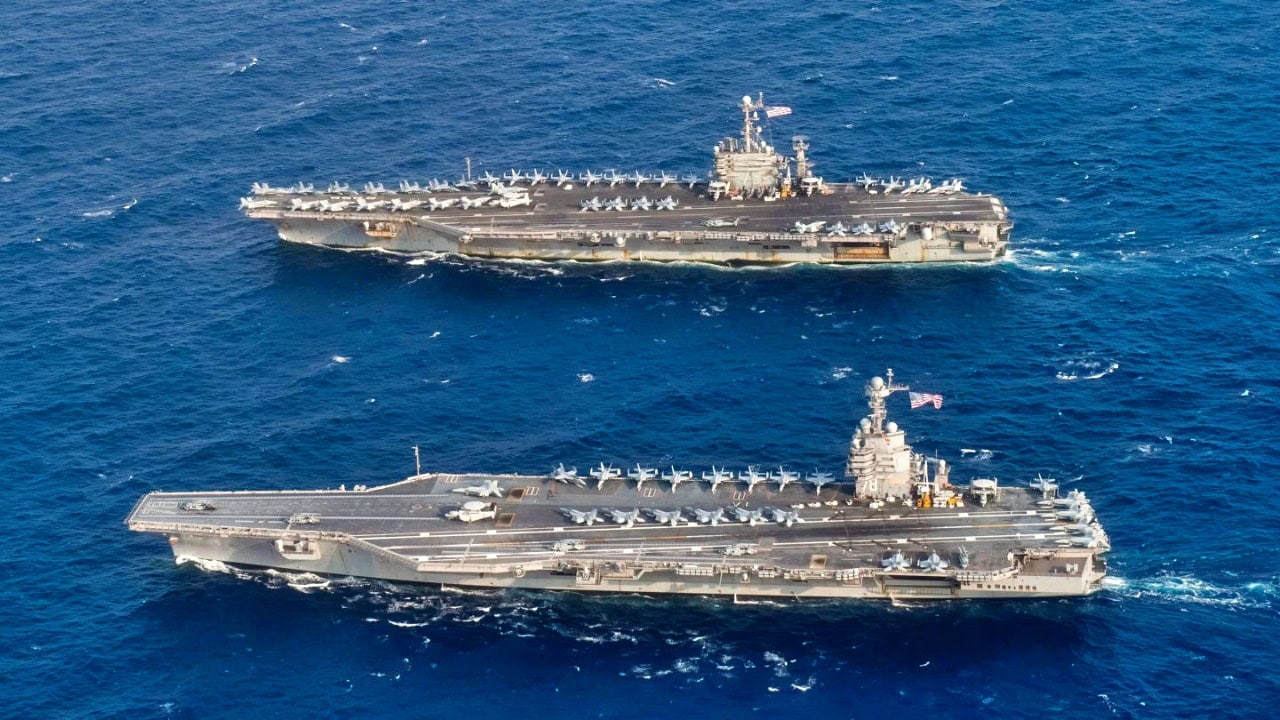
Summary and Key Points: Expert Brandon J. Weichert argues the aircraft carrier has become a sunk cost: Iranian anti-ship weapons have pushed the Navy’s Hormuz blockade line hundreds of kilometers back, the Houthi mission was effectively abandoned, Congress mandates 11 carriers of which only three deploy at a time, and the Gerald R. Ford cost $13 billion.
Aircraft Carriers RIP?
The United States Navy is doing everything it can to keep its surface warfare fleet deployed to the Middle East out of the crosshairs of what appear to be increasingly effective Iranian anti-ship capabilities.
Indeed, the ongoing blockade line has moved from floating at the mouth of the contested Strait of Hormuz (SoH) to several hundred kilometers away, and now even farther, hiding in what looks like Pakistani territorial waters.
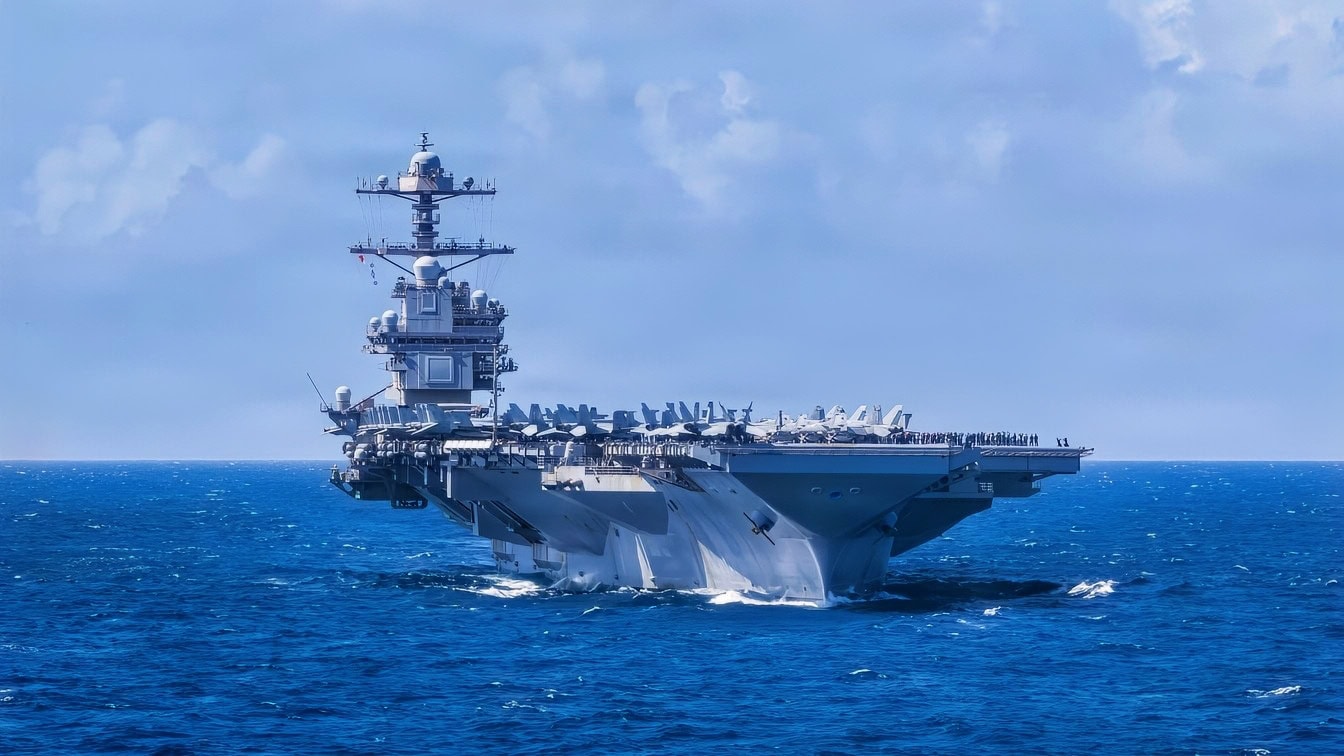
U.S. Navy Carrier Air Wing 8 aircraft fly in formation over the world’s largest aircraft carrier, Ford-class aircraft carrier USS Gerald R. Ford (CVN 78), during Carrier Air Wing 8’s aerial change of command ceremony while underway in the Caribbean Sea, Jan. 19, 2026. U.S. military forces are deployed to the Caribbean in support of the U.S. Southern Command mission, Department of War-directed operations, and the president’s priorities to disrupt illicit drug trafficking and protect the homeland. (U.S. Navy photo)
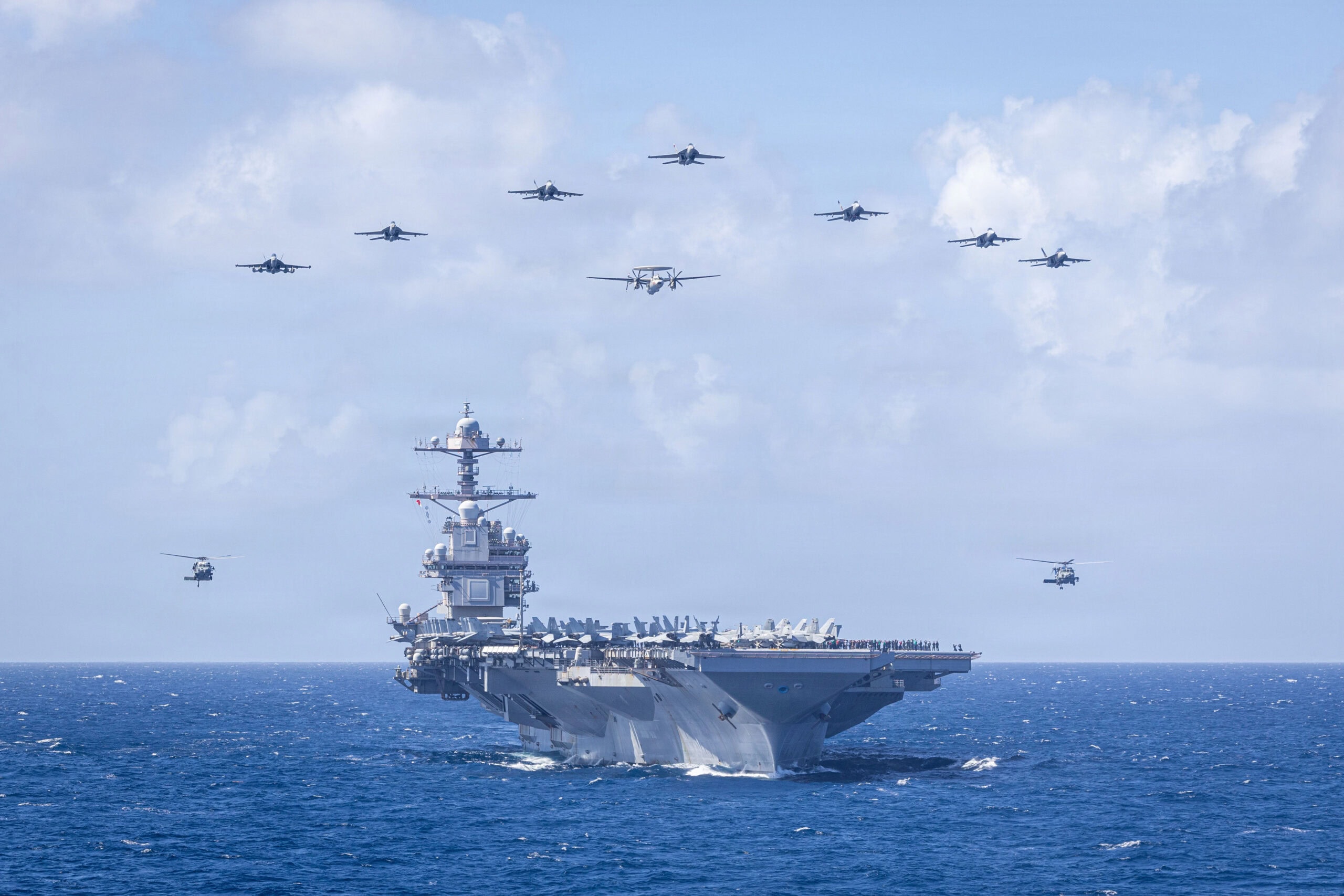
U.S. Navy Carrier Air Wing 8 aircraft fly in formation over the world’s largest aircraft carrier, Ford-class aircraft carrier USS Gerald R. Ford (CVN 78), during Carrier Air Wing 8’s aerial change of command ceremony while underway in the Caribbean Sea, Jan. 19, 2026. U.S. military forces are deployed to the Caribbean in support of the U.S. Southern Command mission, Department of War-directed operations, and the president’s priorities to disrupt illicit drug trafficking and protect the homeland. (U.S. Navy photo)
This comes after the United States Navy essentially abandoned its mission against the Houthis of Yemen because of the Houthi anti-ship threat to US Navy warships.
Iran’s anti-ship capabilities are far more advanced than the Houthis’.
And China’s ability to target large US Navy warships–especially aircraft carriers–is even greater than that of either the Iranians or Houthis.
Not Worth the Cost
Right now, the Navy’s primary power projection platform is the aircraft carrier.
Congress mandates that the Navy maintain a fleet of 11 aircraft carriers.
At any given time, maintenance cycles mean only three are available for deployment.
The newest Gerald R. Ford-class aircraft carrier, which is replacing the aging Nimitz-class aircraft carrier, initially cost the Navy $13 billion to build.
While that price has come down since the first ship was built and deployed, these ships remain cost-intensive for a Navy increasingly strapped with global threats and diminishing shipyard capabilities.
On land, the world has seen the way that main battle tanks (MBTs), the so-called kings of battle, have been relegated to sideline roles because of the rise of drone swarms.
Similarly, aircraft carriers are far too easy targets for these cheaper, newer defense methods.
What’s more, the carriers remain vulnerable to submarine attacks (despite what US naval planners argue).
Modern warfare has become dominated by cheap, easily mass-produced, expendable systems that operate through a decentralized network approach.
The carriers are holdovers from the twentieth century. They are the apotheosis of that generation’s naval warfare doctrine.
These systems are as relevant to today’s warfare as battleships were then.
In other words, carriers represent endlessly diminishing returns.
So, what might happen if the Americans deprioritized the carrier?
Aside from sending some of the previous generation of naval thinkers into spasms, the Navy could conceivably plug the gaps created by deprioritizing aircraft carriers by giving it a distributed, mixed surface-warfare capability augmented by submarines.
The key is penetrating any potential enemy’s protective anti-access/area-denial (A2/AD) envelope to get close enough to contested territory to wage war there.
The goal of Iran, the Houthis, China, or any other challenger to the US Navy is to prevent those warships from getting within range.
The Navy Needs Smaller, Nimbler Systems
The Navy must go smaller, more automated, and nimbler. Some systems that can help include large numbers of unmanned autonomous systems.
Think about systems like large uncrewed undersea vehicles that can deploy swarms of smaller drones. Surface drones can do the same.
Existing destroyers and frigates must also be fitted with expanded Vertical Launch Systems (VLS) so these ships can take advantage of enhanced drone capabilities.
Another concept is to build more smaller, amphibious-type aircraft carriers like those the United States Marine Corps employs.
This would allow the military to sustain its conventional carrier capabilities without risking a supercarrier against these enhanced A2/AD capabilities.
Of course, the Navy is currently constrained by diminishing shipyard capacity.
That is why they must emphasize drones.
These systems can be built faster, are easier to maintain, and are expendable.
Then, of course, there’s the submarine factor. Shipyards cannot build enough submarines. That should be the priority of naval planners (and Congress).
Do whatever it takes to produce more submarines, notably guided-missile submarines.
Right now, the Navy is on track to decommission its four Ohio-class SSGNs within the next decade.
Its Virginia-class submarines cannot match the firepower that these behemoths brought to the fight.
The Navy needs an in-kind replacement for the Ohio-class SSGNs.
Failing that, the Navy should build a drone mothership that has the same VLS capabilities that the Ohio-class did (plus the ability to deploy smaller drones) so that the Navy can get within range of its targets in any war and threaten them like the Navy used to do in the 1990s, when there were no peer rivals.
Piercing the Bubble
The Navy’s key function must be to preserve its older systems until the enemy’s A2/AD capabilities are sufficiently degraded.
Only the systems discussed here can perform the function carriers and their air wings once did, without threatening the safety of the carriers and their air wings before those ships even get within range of the enemy.
Instead, a new layer of offensive capabilities must be placed ahead of existing systems.
Once the A2/AD bubble is popped, the Navy can move its forces closer and wage war on its own terms.
One thing is clear, though: under current conditions, continuing the investment in carriers is a sunk cost. Enemy A2/AD networks are too powerful.
About the Author: Brandon J. Weichert
Brandon J. Weichert is the Senior National Security Editor at 19FortyFive.com. He also manages The Weichert Brief on Substack. Weichert is the co-host for The Mario Nawfal Show on Twitter/X. He is the author of four bestselling national security books, most recently A Disaster of Our Own Making: How the West Lost Ukraine (Encounter Books). His next book, Fortress Americas: A New Monroe Doctrine (Tucker Carlson Books), is due out December 8. Follow him via Twitter/X @WeTheBrandon. The opinions expressed are the author’s own.