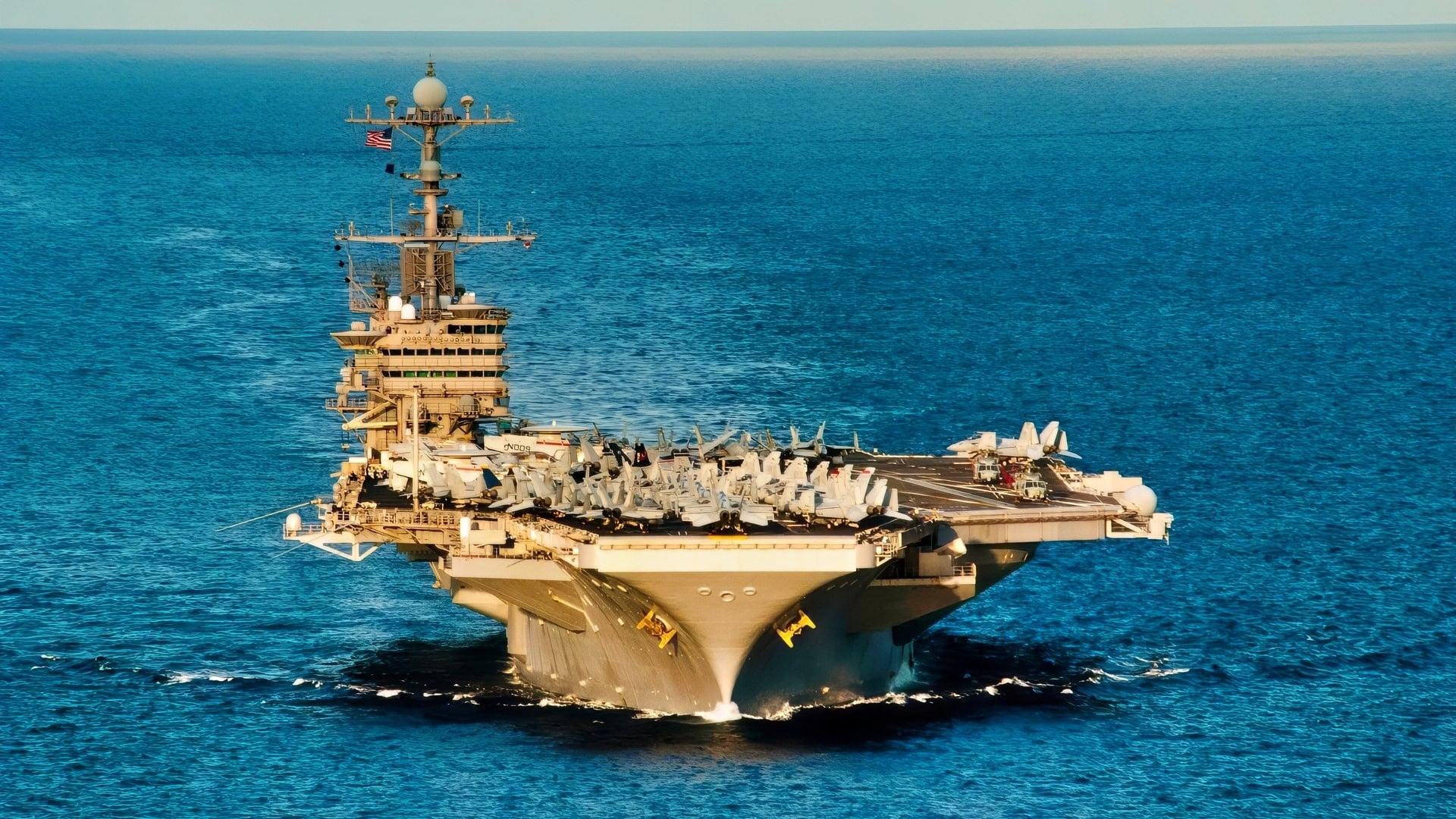
Summary and Key Points: The Navy awarded HII $336,000,000 this month to begin purchasing long-lead materials for CVN-82, the future USS William J. Clinton — a carrier that does not yet exist and will not for years. The money goes toward propulsion-plant components, which are the parts of a carrier almost nobody sees and that produce the only statistic the Navy publishes about how fast these ships go: “30+ knots.”
The US Navy’s Nuclear Aircraft Carriers Aren’t Slow
The Navy awarded HII a $336 million contract this month to procure long-lead materials for CVN-82, the future USS William J. Clinton. Bryan Caccavale, Newport News Shipbuilding’s vice president of program management, called the purchase a “critical first step” in planning for the carrier. He said it also sends an “important demand signal” to the “thousands of suppliers” that make up the carrier industrial base.
The “undefinitized” award covers advance procurement, not the carrier’s full construction contract. HII said the money will begin purchasing propulsion-plant material “critical” to CVN-82’s eventual construction.
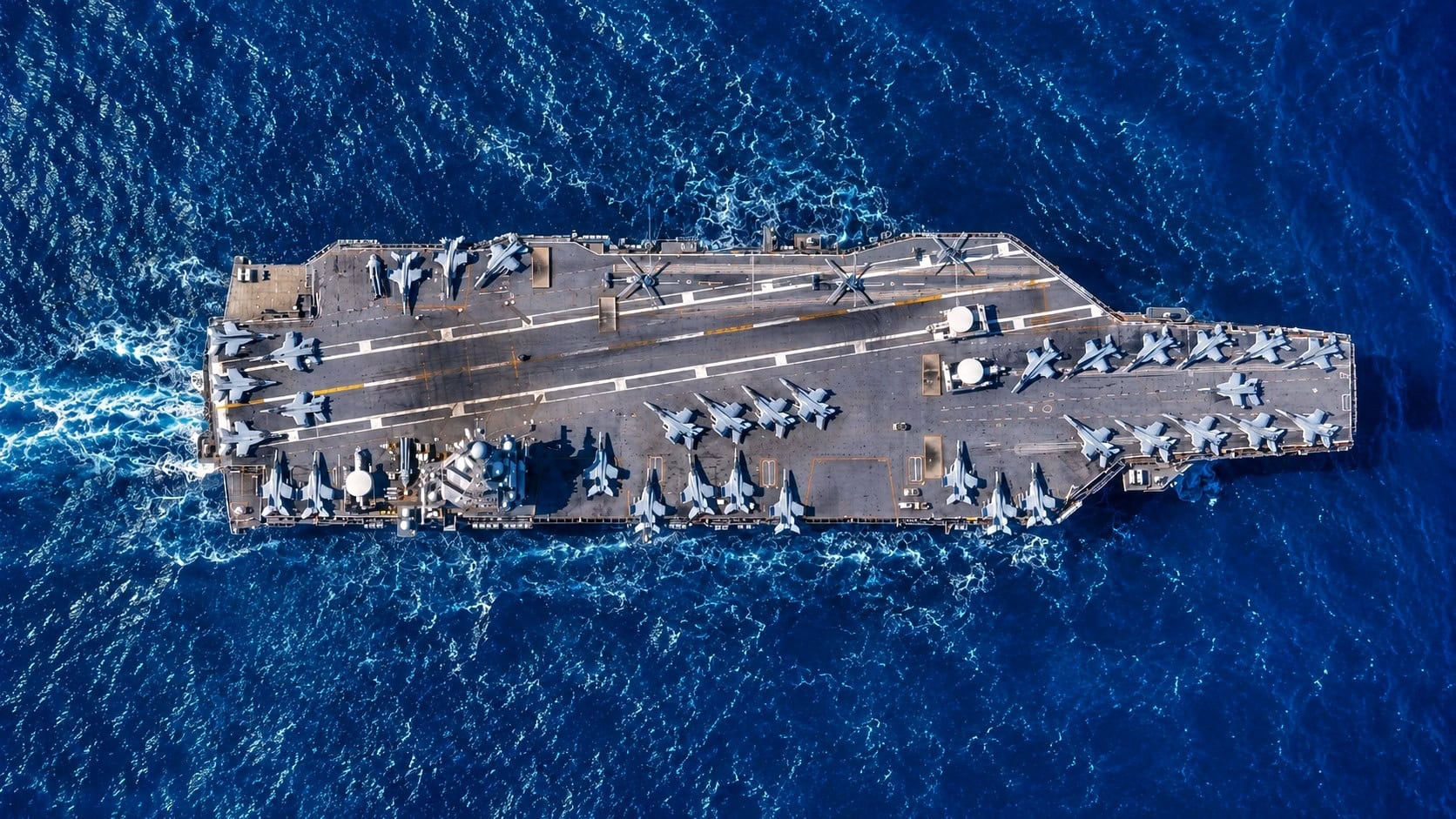
USS Gerald R. Ford. Image Credit: Banana Nano.
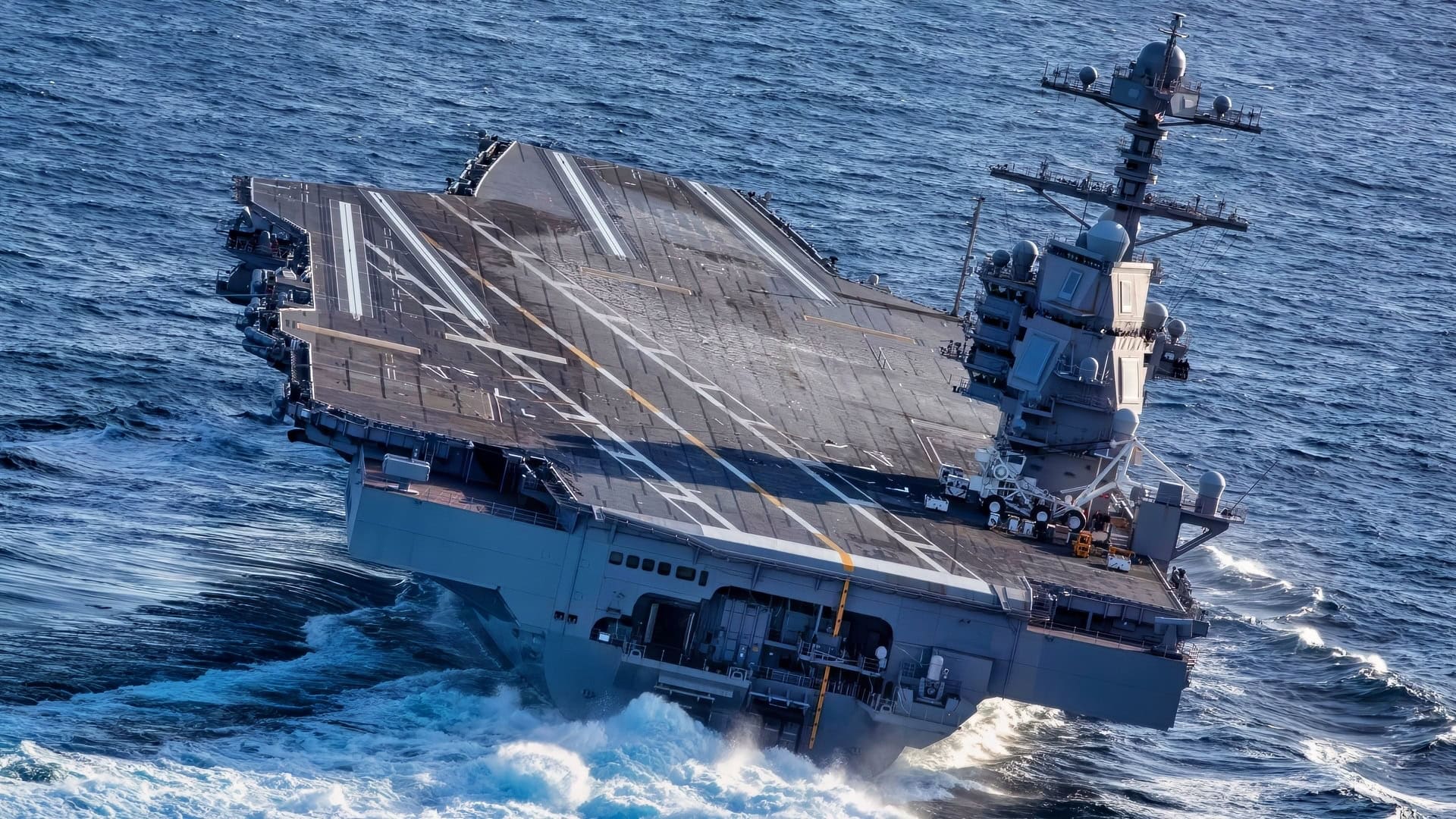
ATLANTIC OCEAN (Oct. 29, 2019) USS Gerald R. Ford (CVN 78) conducts high-speed turns in the Atlantic Ocean. Ford is at sea conducting sea trials following the in port portion of its 15 month post-shakedown availability. (U.S. Navy photo by Mass Communication Specialist 3rd Class Connor Loessin)
‘Sea Beginning to Boil’?
Ross Hall, identified as a carrier tactical action officer and anti-submarine officer, recalled an Indian Ocean rendezvous with a returning amphibious group.
The amphibious ships demonstrated their Landing Craft Air Cushion (LCAC) vehicles, while the carrier supplied two flybys.
When the ships separated, the carrier’s commanding officer announced: “Let’s show them what an aircraft carrier can do.” The ship was “barely making way,” Hall recalled, when the order came to depart at flank speed.
Hall went to the aft end of the hangar deck to watch.
His account, republished by the Aviation Geek Club, describes power being applied to four shafts while torque was controlled to protect them.
The four propellers, he wrote, are approximately 25 feet across and weigh about 30 tons apiece.
The view astern changed first.
The water began to churn until “it looks like the sea is beginning to boil.” Then came the physical sensation: “You can feel the ship vibrating” as the plant increased power and the propellers gathered speed.
Hall’s answer to the timing question was admirably qualified: “After about 10 minutes (I didn’t time it), we were at flank speed.” He said that the rooster tail rose “15-20 feet above sea level” and joked that, given a long enough cable and “a death wish,” somebody could waterski behind the carrier.
19FortyFive is unable to independently verify this figure.
It was not clear from this account what the carrier’s loading, sea state, starting speed or precise final speed were.
What Does the Navy Actually Say?
According to the U.S. Navy’s public fact file on aircraft carriers, the Nimitz-class speed is “30+ knots” (around 34.5 mph). It lists two nuclear reactors and four shafts for ships approximately 1,092 feet long, with a full-load displacement the fact file puts at around 97,000 tons.
These public figures help explain why the claims of HII, the carrier’s builder, are so striking. It has referred to nuclear carriers as “one of the most complex machines ever made by man.” Under the flight deck is a “bustling city” of two power plants, catering, medical facilities, waste management,and desalination plants turning seawater into fresh water.
Back in March, the Navy extended the service of the USS Nimitz by 10 months. “Accordingly, the U.S. Navy plans to inactivate the ship in 2027,” one anonymous U.S. official told USNI News.
HII, meanwhile, says the first six Nimitz-class carriers have completed their once-in-a-lifetime refueling overhauls.
The U.S. Government Accountability Office wrote in a March 2025 report that its “military superiority depends on its ability to project strength across all warfighting domains.”
GAO also noted that “its body of work has shown that U.S. military readiness has been degraded over the last 2 decades due to a variety of challenges, including maintaining existing systems” while acquiring new ones “that can overcome rapidly evolving threats.”
Competition With China
Meanwhile, Beijing is investing in its growing carrier force.
Its third carrier, Fujian, entered service last fall.
Unlike China’s older Liaoning and Shandong carriers, Fujian deploys electromagnetic catapults rather than the more primitive ski-jump ramps.
Reuters reported that, after its commissioning, the system enables the ship to launch advanced aircraft, including the J-35 stealth jet and the KJ-600 airborne early-warning aircraft.
China is nowhere near rivaling the mature U.S. carrier force yet. Still, this hardly means Washington can afford complacency, especially as global tensions continue to spiral amid conflict in the Middle East and Eastern Europe.
As warnings over war against NATO loom, anxieties do too.
Last March, the European Union advised its 450 million residents to keep a minimum of 72 hours’ worth of food, water, medicine, cash and emergency supplies.
This week, the US State Department announced a security alert warning Americans in the Middle East that conflict between Saudi Arabia and the Iran-backed Houthi terror group in Yemen could “escalate rapidly.”
About the Author: Georgia Gilholy
Georgia Gilholy is a journalist based in the United Kingdom who has been published in Newsweek, The Times of Israel, and the Spectator. Gilholy writes about international politics, culture, and education.