
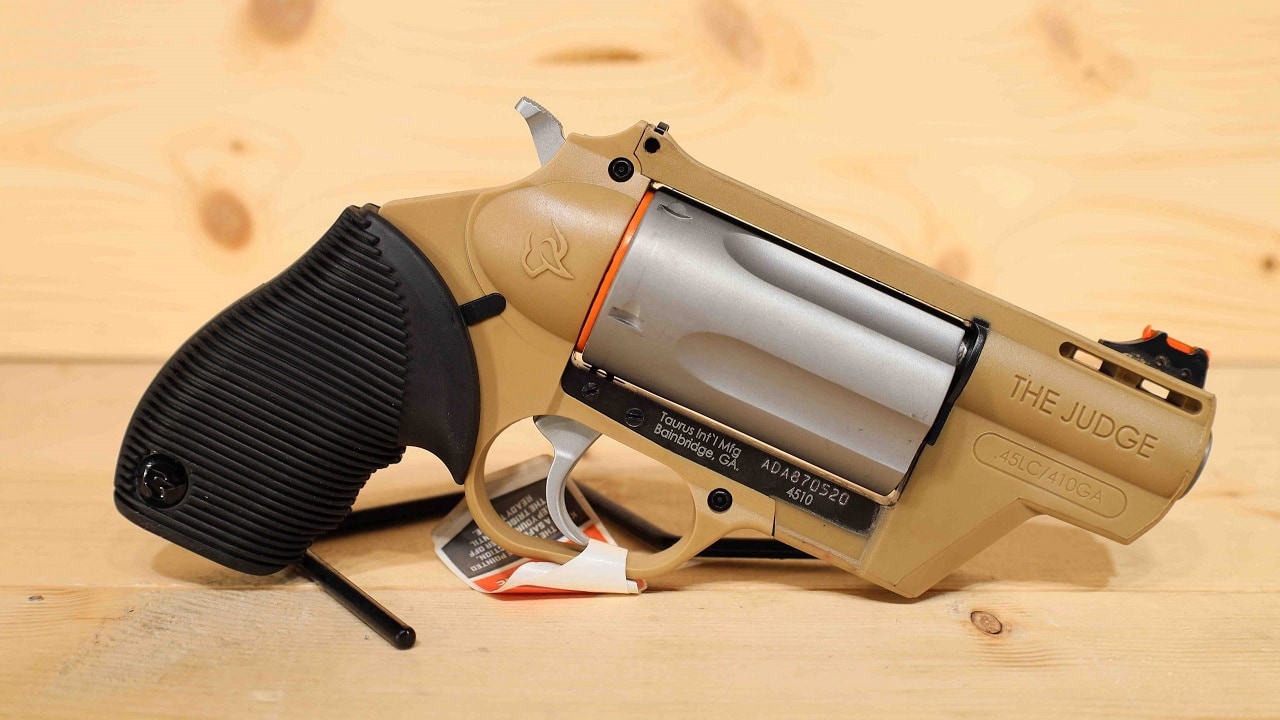
Summary and Key Points: The Taurus Judge does not look like a revolver. The cylinder is oversized, the barrel is wide enough that people look twice, and there is a reason for both: it fires .45 Colt and .410-bore shotgun shells from the same cylinder, interchangeably. Taurus got there with a slow 1:12 rifling twist — aggressive enough to stabilize a single lead bullet, gentle enough not to shred a shotshell’s payload on the way out — and that one engineering decision does two things at once.
The Taurus Judge Explained
Well-known for its line of economical semi-automatic pistols and revolvers, Taurus, has one model that stands out from the rest.
Few handguns spark as much debate at the range as the Taurus Judge.
It doesn’t look like your average revolver: the cylinder is oversized, the barrel is wide enough to make people do a double-take, and the whole thing feels like it belongs in a different category of firearm entirely.
That’s because, in a sense, it does.
The Judge isn’t just a revolver. It’s a .45 Colt revolver that also functions as a compact .410 shotgun, and that dual identity is why it’s sold of the hundreds of thousands since it hit the market.
The Origin Story Of The Judge
The Judge’s backstory is almost too fitting. According to Taurus’s own history, the concept took off around 2006 after company executives learned that judges in the Miami area were buying revolvers specifically for courtroom and personal self-defense.
Taurus leaned into that connection hard, branding the gun “The Judge” and marketing it as a carjacking and home-defense deterrent.
It worked.
By 2009, it was Taurus International’s best-selling firearm, and the lineup has since grown from about 10 models to nearly 20, according to a USCCA review, a level of staying power that competitors like Smith & Wesson’s Governor never quite matched.
The Real Source of Its Power: Dual-Caliber Chambering
Here’s the mechanical trick that makes the Judge what it is.
The cylinder and barrel are engineered to safely fire both .45 Colt cartridges and .410 bore shotgun shells. Interchangeably, out of the same weapon.
Taurus achieved this with a shallow rifling twist (1:12) that’s aggressive enough to stabilize a single lead bullet but gentle enough not to shred a shotshell’s payload apart as it exits the barrel.
Getting that balance right reportedly took Taurus “numerous experiments,” per the Firing Line, and it’s the design detail that separates the Judge from a novelty gimmick.
The practical result: load .410 shells, and a 5-round cylinder puts out roughly the equivalent buckshot payload of three blasts from a 12-gauge shotgun.
Load .45 Colt instead, and you’ve got a genuinely stout defensive revolver round.

Taurus Judge. Image: Creative Commons.
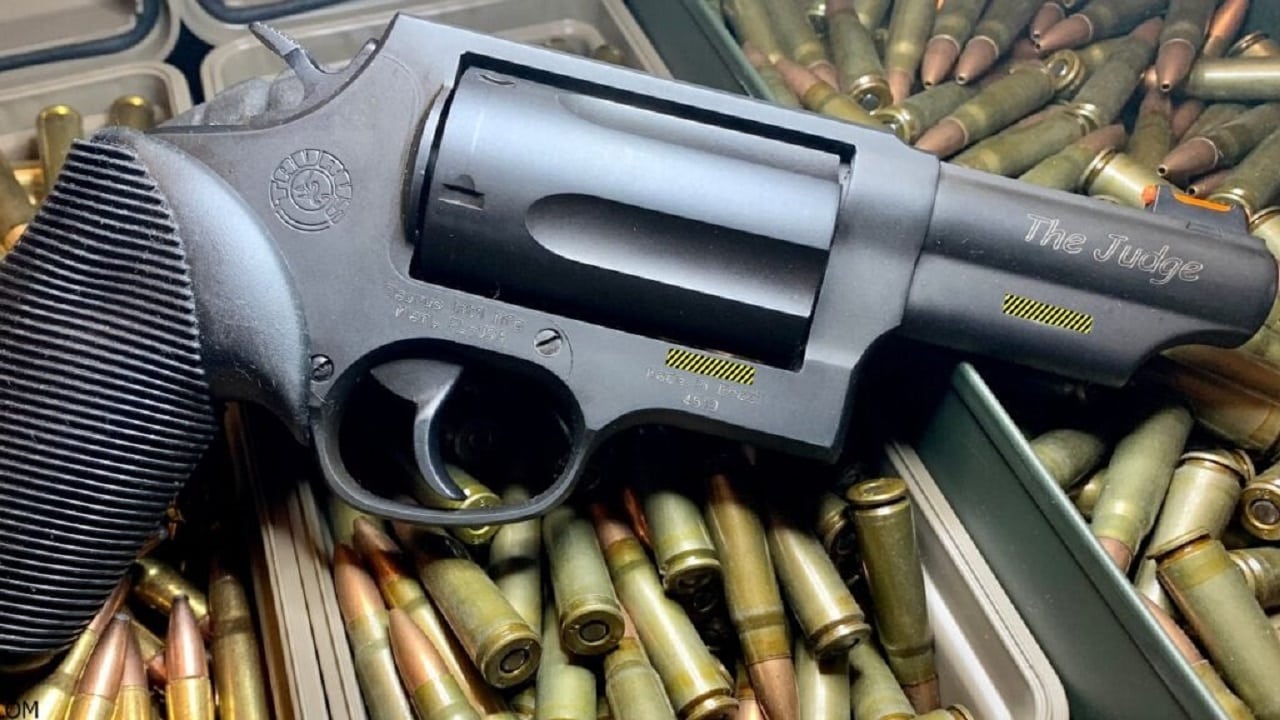
Revolver Shotgun Taurus Judge. Image Credit: Creative Commons.
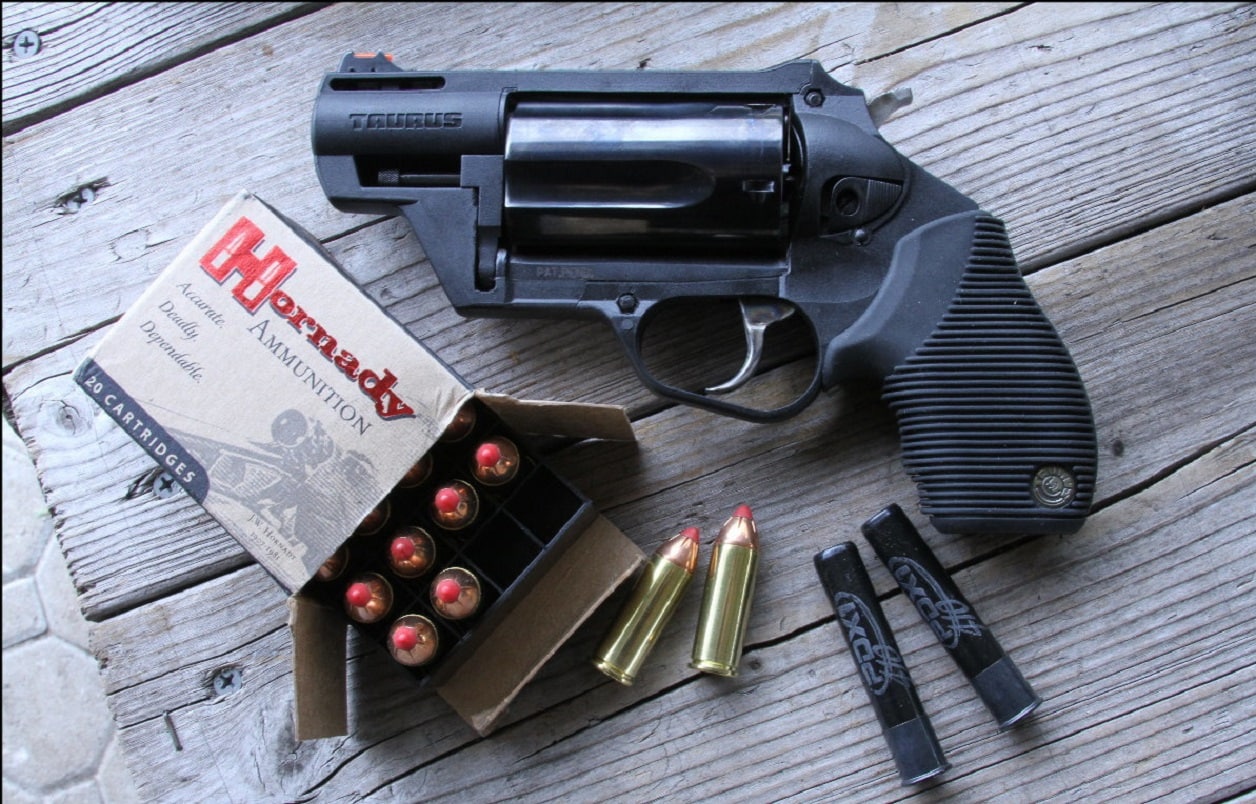
Taurus Judge Revolver. Image Credit: Creative Commons.
Buffalo Bore’s loads clock in around 1,100 feet per second and 537 foot-pounds of energy, according to testing cited by USCCA.
Few other handguns let you toggle between “shotgun” and “hard-hitting revolver” just by changing what’s in the cylinder.
Why It’s Legal Where A Sawed-Off Shotgun Isn’t
This detail surprises many people.
Federally, the Judge is classified as a handgun, not a shotgun, because of that rifled barrel, which means it sidesteps the National Firearms Act restrictions that make short-barreled shotguns a regulated item.
As noted here, “anyone who can legally own a firearm can own a Taurus Judge.” (One notable exception: it’s illegal to purchase or ship into California under state law.)
The Judge Specs
The standard Taurus Judge runs a 3-inch barrel, holds 5 rounds, and weighs about 36 ounces unloaded, compact enough for a nightstand or a glove box.
Barrel lengths across the lineup range from 3 inches up to 6.5 inches, and Taurus also builds the Public Defender (a smaller-frame carry version) and the Raging Judge Magnum, which adds .454 Casull capability for even more raw power.
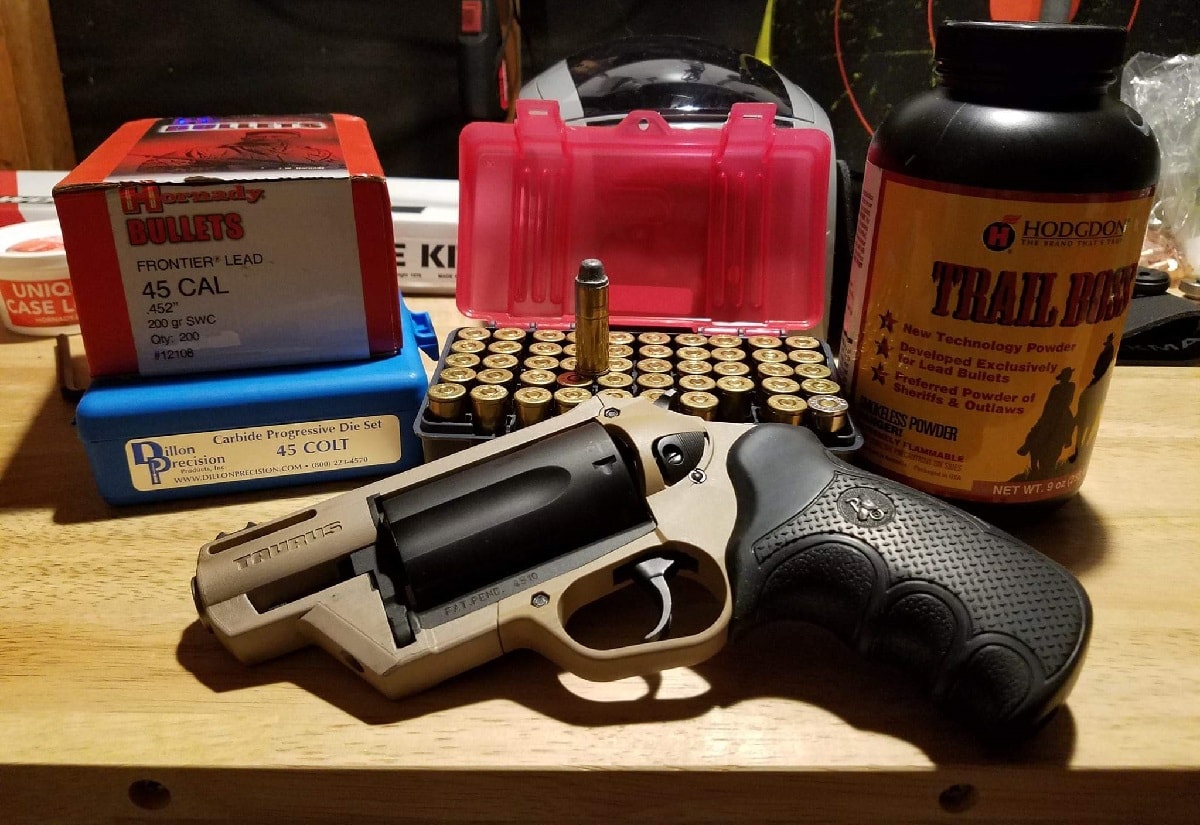
Taurus Judge. Image: Creative Commons.
There’s even an 18.5-inch carbine variant, the Circuit Judge, co-produced with Rossi.
The Honest Trade-Off
Power isn’t the same as precision, and this is where the Judge draws its fair share of criticism.
Loaded with .410 buckshot, patterns can spread to around 10 inches at just 30 feet, meaning stray pellets can miss a target entirely at anything beyond close range.
Scott Wagner noted in an older review he conducted that, even with quality defensive buckshot, 30 feet is “the safe maximum range for self-defense,” and there’s still real risk that not every pellet lands where it should.
However, law enforcement data and civilian self-defense statistics show that the vast majority of self-defense shooting encounters happen at very close range, typically between 3 and 7 yards (9 to 21 feet), often summarized by the traditional training rule of thumb of about 3 yards.
Purpose-built defensive .410 loads like Hornady Critical Defense tighten that up considerably, closer to a 2-inch group at 30 feet, but the lesson holds: the Judge trades some precision for its versatility, and shot selection matters enormously.
The Judge Is A Good Combination Self-Defense Weapon
What makes the Taurus Judge powerful isn’t one single spec; it’s the combination.
A shotshell option that turns a handgun into a close-range shotgun, a hard-hitting .45 Colt option for when precision matters more, legal accessibility a short-barreled shotgun doesn’t have, and nearly two decades of continuous refinement into its current lineup.
It’s not a gun built to win a target-shooting competition.
It’s built to be the thing you reach for when you need options to get out of trouble in a hurry, and that’s exactly the reputation it’s earned.
About the Author: Steve Balestrieri
Steve Balestrieri is a National Security Columnist. He served as a US Army Special Forces NCO and Warrant Officer. In addition to writing on defense, he covers the NFL for PatsFans.com and is a member of the Pro Football Writers of America (PFWA). His work was regularly featured in many military publications.