
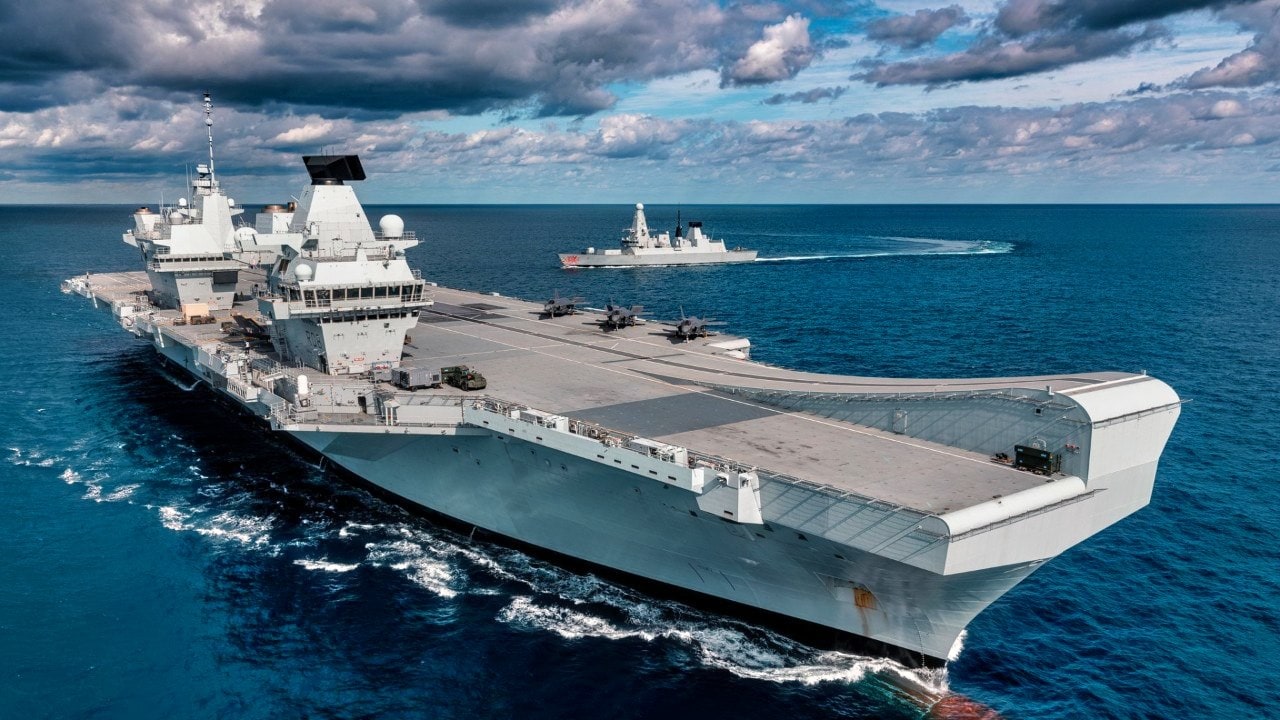
In 2010, Britain’s new Conservative-led government attempted to reduce defense spending as part of the Strategic Defense and Security Review. One obvious target for cutbacks was the massive Queen Elizabeth-class carrier program, which the preceding Labour government had conceived.
Two carriers were planned, each at 65,000 tons: the HMS Queen Elizabeth and the HMS Prince of Wales. The incoming Conservative government re-evaluated the program, however, and concluded that Britain’s doctrine only called for one carrier to be available for operations.
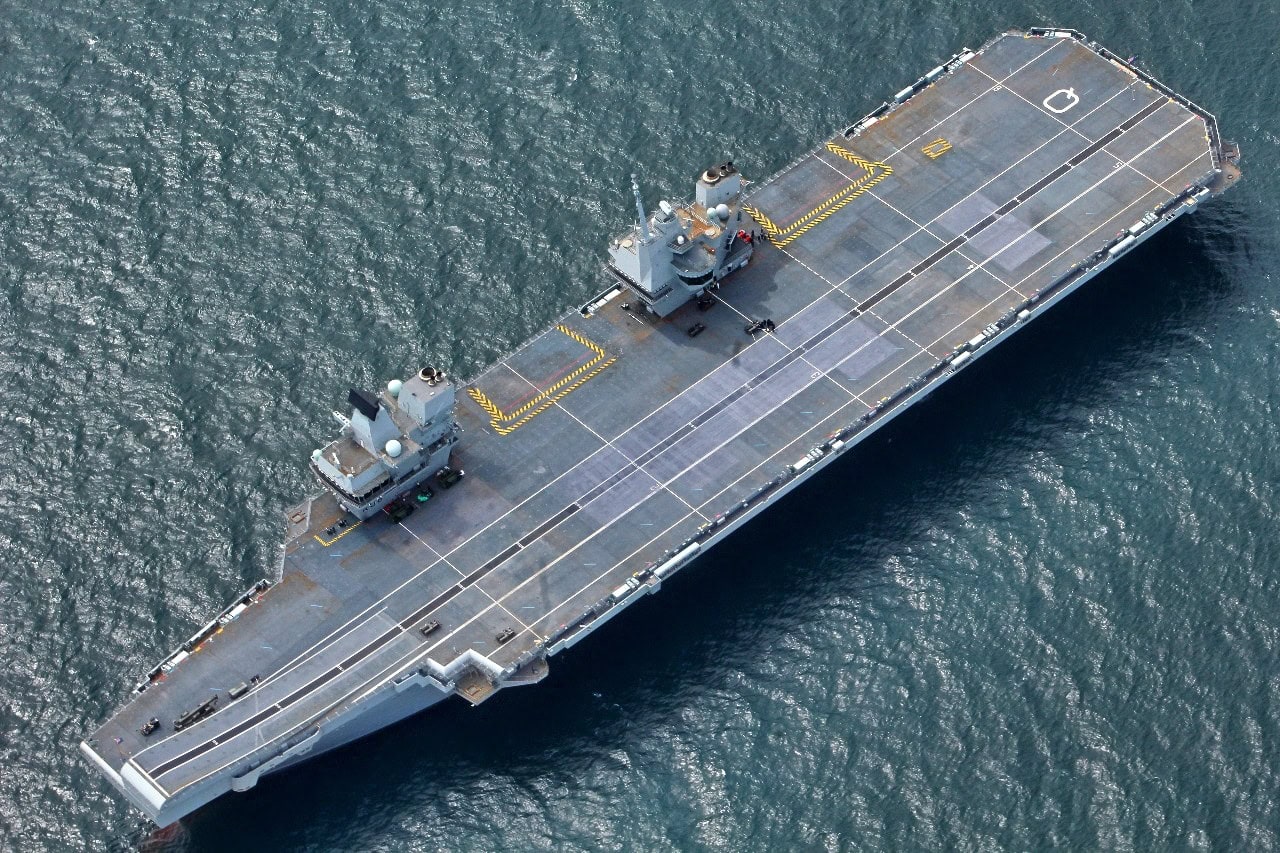
Pictured is an aerial view of HMS Queen Elizabeth as she conducts vital system tests off the coast of Scotland. HMS Queen Elizabeth left Rosyth, where she has been under construction since 2014, to conduct sea trials. Type 23 frigates Sutherland and Iron Duke joined the 65,000-tonne aircraft carrier, along with Merlin Mk2 helicopters of the Fleet Air Arm, to guard the seas as the trials get under way. The Queen Elizabeth Class Carriers are the biggest warships ever built for the Royal Navy – four acres of sovereign territory, deployable across the globe to serve the United Kingdom on operations for 50 years. HMS Queen Elizabeth and HMS Prince of Wales will be the most advanced warships in the Royal Navy fleet. They are the future flagships of the nation.
There was a problem, though. Britain couldn’t just walk away from building the second carrier; it was contractually obligated, and canceling the program would have cost more than completing it. The solution?
Britain pushed ahead with construction of a multibillion-pound warship—one that its own defense review had concluded was unnecessary—all because it would have been more expensive not to build the thing.
The incident is one of modern war planning’s most difficult procurement pickles.
Inception of the Problem: The Queen Elizabeth-Class Aircraft Carrier Saga
The carriers were approved in 2007, and the principal manufacturing contracts were signed in 2008. Rather than rely on one shipbuilder to produce the vessels, Britain created the Aircraft Carrier Alliance featuring the Ministry of Defence, BAE Systems, Babcock, and Thales.
Construction was distributed among multiple British yards; enormous blocks were built and assembled all across the country.
The arrangement served a very specific and intentional industrial purpose: it preserved British shipbuilding employment, distributed the work politically and geographically, and maintained Britain’s hyper-specialized naval engineering capacity.
But when it came time to cancel the program, the project’s wide distribution meant cancellation wasn’t as simple as telling one shipyard to put down its tools and walk away.
No, Britain had already committed money, material, labor, and industrial capacity across a sprawling supply chain.
All the contracts involved carried substantial liabilities in the event of cancellation.
In addition, if the government canceled the program, many of the shipyards would close, and thousands of jobs would be lost.
So the program had basically crossed the point where cancellation wouldn’t save a dollar. Hence the bizarre procurement decision to proceed with a ship that the country didn’t need.
The Ship Itself
And it’s not like the program called for some modest, little support ship.
The Prince of Wales, the ship in question, would become one of Britain’s largest warships ever constructed.
At 65,000 tons displaced and 920 feet long, the flight deck was roughly 13,000 square meters.
The thing was huge, with a 25-plus-knot top speed and a range of roughly 10,000 nautical miles.
The Queen Elizabeth-class was conventionally powered, unlike American supercarriers, with two Rolls-Royce MT30 gas turbines plus four diesel generator sets feeding an Integrated Full Electric Propulsion system.
The ship’s total electrical generating capacity was around 100-plus megawatts.
Notably, the ship features two separate islands—a highly unusual aesthetic in aircraft carriers.
The forward island was given responsibility for navigation and ship control, while the aft island handled flight operations.
There was an engineering reason for this: the gas turbines require large exhaust uptakes, and splitting them between two islands simplified routing while improving redundancy.
But in function, the separation of navigation and flying control made intuitive sense.
Strategic Upsides
One of the program’s central ironies is that once completed, the second carrier yielded a strategic benefit. A one-carrier fleet obviously reduces carrier availability, as every carrier must spend substantial periods undergoing maintenance, repairs, upgrades, and training.
With Queen Elizabeth unavailable, the Prince of Wales can theoretically assume the carrier-strike role and vice versa.
They can tap each other out, essentially.
Had Britain proceeded with its plans to cancel the Prince of Wales, a defect or maintenance period would have negated Britain’s entire carrier fleet (much like the single-carrier Russians have experienced over the last decade with the Admiral Kuznetsov repair saga).
The new Queen Elizabeth-class carriers also restored Britain’s ability to deploy aircraft from a non-fixed position, something that Britain had surrendered when the HMS Ark Royal and its Harrier fleet were retired in 2010.
With the Queen Elizabeth-class, Britain actually upgraded to the F-35B, offering next-generation air power.
About the Author: Harrison Kass
Harrison Kass is a writer and attorney focused on national security, technology, and political culture. His work has appeared in Tablet, City Journal, The Hill, The Spectator, and The Cipher Brief. He holds a JD from the University of Oregon and a master’s in Global & Joint Program Studies from NYU. More at harrisonkass.com.