
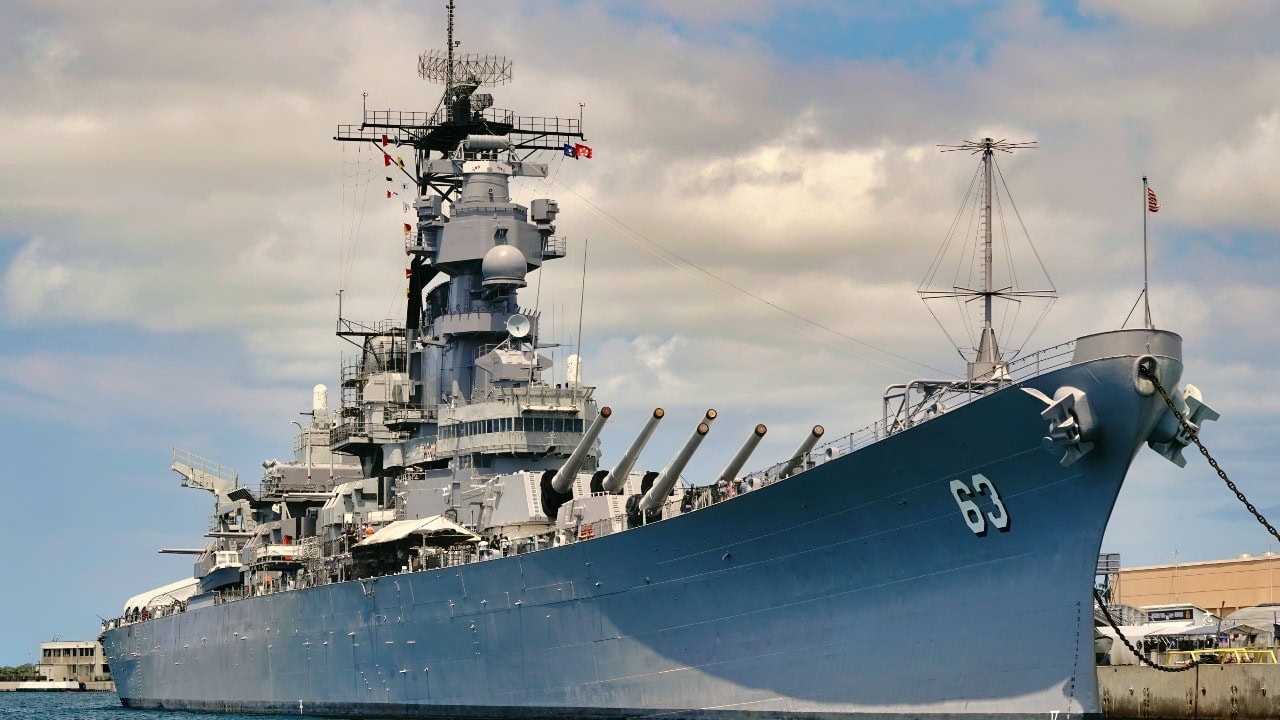
Summary and Key Points – Yamato-Class Battleship vs. US Navy Iowa-Class Battleship: For twenty-six months, the two most powerful battleship classes ever completed shared the same ocean and never met. The question of what happens when they do has outlived both navies, and it deserves a real answer built from each ship exactly as 1945 found her — Yamato in the configuration of her final spring, Iowa as she steamed with the fast carriers — fought one-on-one, open water, no escorts, no aircraft. One ship wins this fight, and the record says so with unusual clarity. With that, I decided to create a fictional battle, drawing on nearly twenty years of work on battleship and naval history, to see who would win.
Iowa vs. Yamato in 1945: The Full Battle, and Which Battleship Wins
Yamato entered 1945 having been reworked twice for the war she was actually fighting.
She displaced about 72,800 tons at full load on a hull 863 feet long, made 27 knots on roughly 150,000 shaft horsepower, and carried nine 18.1-inch guns in three triple turrets behind the thickest armor ever floated: a 16.1-inch main belt inclined at twenty degrees, decks of eight to nine inches, and turret faces of 25.6 inches.
Her 1944 refit had landed the two amidships 6.1-inch turrets to make room for twenty-four 5-inch guns, and the final winter’s yard periods added light automatic weapons until she carried around 150 barrels of 25mm, along with Type 22 surface-search and Type 13 air-search radar — sets her navy employed for search and detection, while main-battery fire direction remained optical to the end, as her one surface battle would demonstrate.
Iowa’s 1945 sheet reads as a different philosophy.
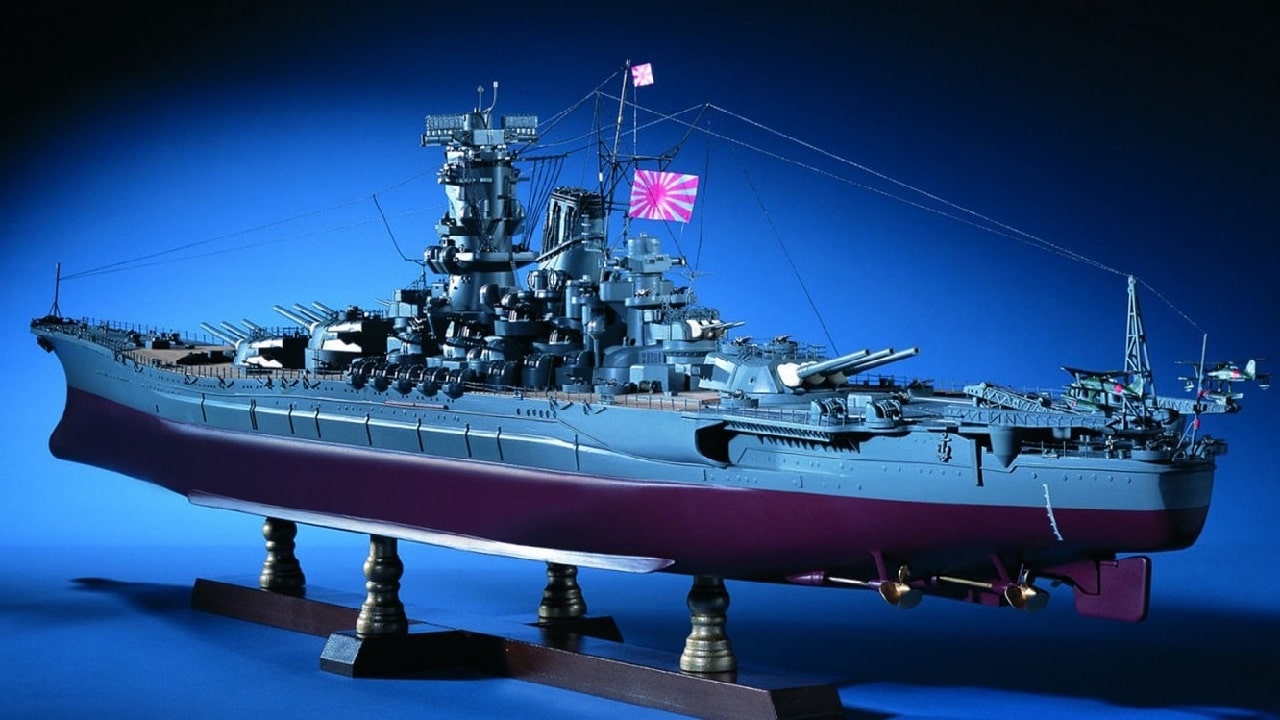
Yamato-class battleship model. Image Credit: Creative Commons.
She displaced about 57,500 tons fully loaded on an 887-foot hull, made 33 knots at 212,000 shaft horsepower, and mounted nine 16-inch/50 Mark 7 guns, twenty 5-inch/38s, roughly eighty 40mm barrels, and some fifty 20mm guns.
Her belt ran 12.1 inches on an incline, protection sized against 16-inch fire from her own generation of guns, not against the weapon Yamato carried.
What she had instead sat at the top of her superstructure: Mark 38 director systems fed by Mark 8 fire-control radar, stable elements, and the fleet’s Ford rangekeepers, a gunnery suite built to find, track, and hit a target no human eye could see.
The Guns and What They Punch Through
The main batteries frame the whole problem. Yamato’s Type 94 rifles fired a 3,219-pound armor-piercing shell out to roughly 45,900 yards at about 1.5 rounds per gun per minute, from the largest bore ever mounted on a warship, in turrets that each weighed 2,774 metric tons — the displacement of a contemporary destroyer— and rotated.
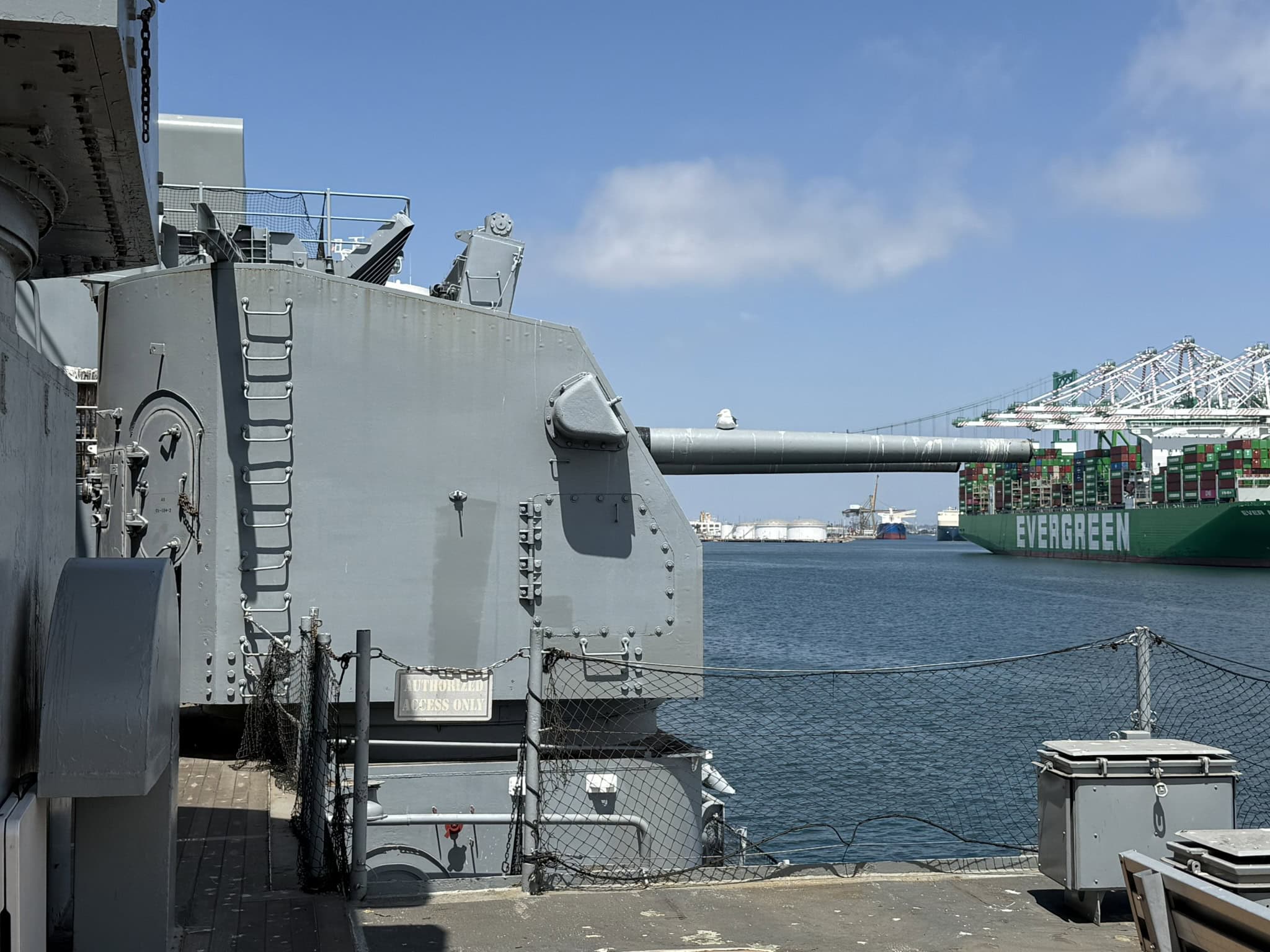
USS Iowa Visit by Harry Kazianis of 19FortyFive.com
Iowa’s Mark 7s fired the 2,700-pound Mark 8 superheavy shell to 42,345 yards at about two rounds per gun per minute, a projectile whose sectional density made it a superb deck-smasher at long range, thrown by a battery that simply shot faster.
Run the penetration tables and an uncomfortable symmetry appears. The 18.1-inch shell, according to the archival penetration tables, defeats Iowa’s belt and vitals across essentially the entire realistic fighting band; nothing about Iowa’s protection scheme was designed with this weapon in mind. The Mark 8, in turn, defeats Yamato’s 16.1-inch belt inside roughly 20,000 yards, and the postwar test at Dahlgren put a hole in the argument about her heaviest plate.
In trials the Naval Proving Ground documented in its November 1947 report, a 16-inch superheavy shell fired into the 25.6-inch turret-face armor made for Shinano passed clean through, fractured the plate, and continued out over the Potomac undamaged, with the examiners grading the steel at pre-World War I quality; the broken plate sits on display at the Washington Navy Yard today. Two caveats travel with the shot.
The plate was made for Shinano late in the war, when Japanese armor quality had fallen off, and Yamato’s own turret faces were manufactured in 1940 under different conditions; and the test was run at short range and near-normal striking angle, while a battle-range hit arrives on a plunging arc the test did not reproduce. What the trial settles is that the Mark 8 could defeat the heaviest face-hardened armor Japan ever produced.
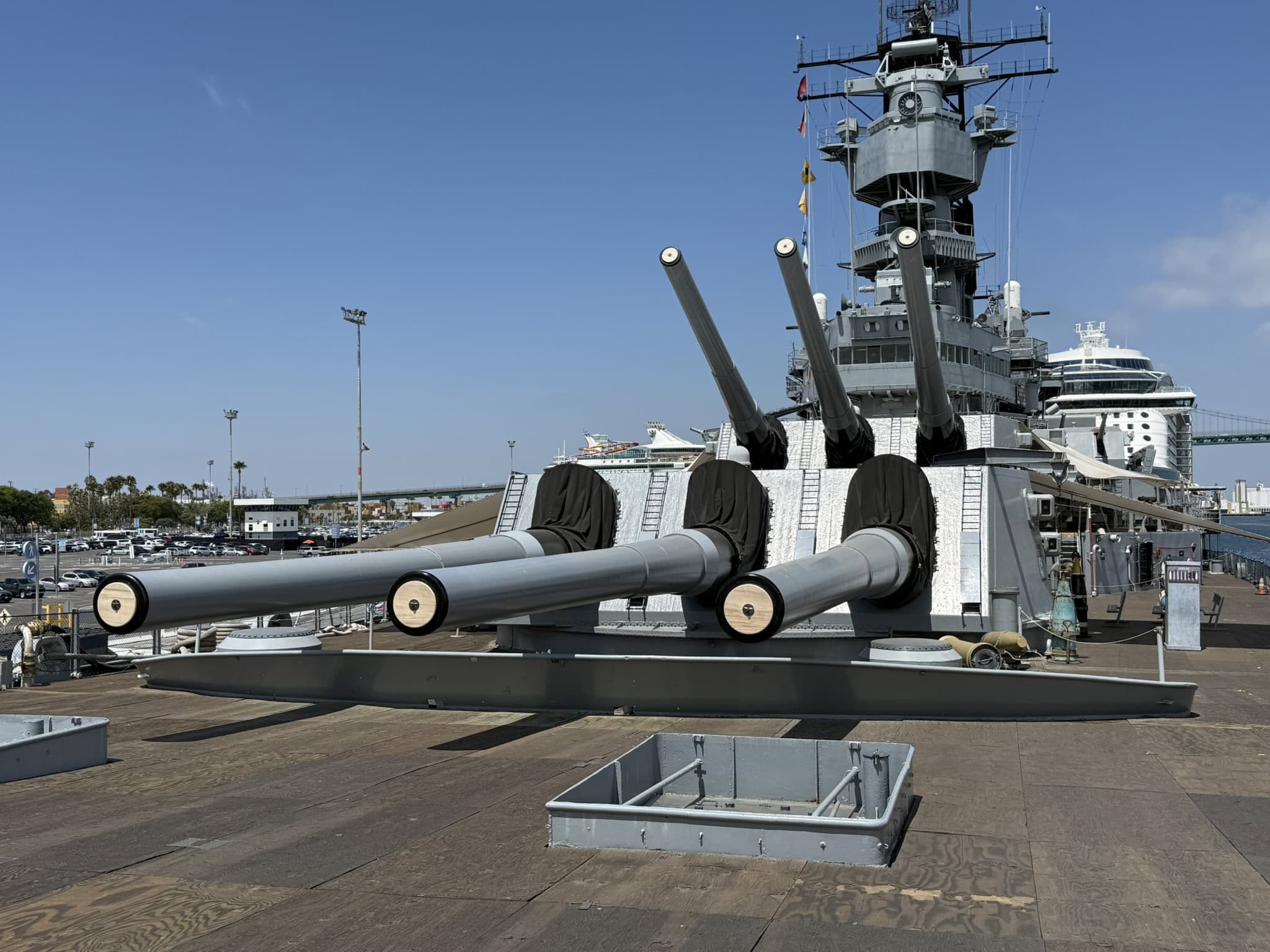
USS Iowa 16-Inch Guns. Image Credit: Harry J. Kazianis.
The 1940 plates and the long-range geometry remain open questions. Inside 20,000 yards, each ship’s guns hold the keys to the other’s magazines. The duel therefore reduces to a single question: who lands hits first, and keeps landing them.
The Machinery That Decides Who Hits First
Here the two navies stop being comparable at all, because the war ran the experiment.
Off Guadalcanal on the night of November 14-15, 1942, USS Washington used her radar to close unseen inside 9,000 yards and wrecked Kirishima in minutes, the first of only two occasions in the Pacific when battleships fought their own kind.
The Navy’s own historical summary credits Washington with at least nine 16-inch hits, possibly as many as twenty, and records that the Japanese, lacking radar, could not even locate her. Kirishima’s reply, by optics and searchlights, put a single 14-inch shell into Washington’s consort and never touched Washington. The second occasion was Surigao Strait in October 1944, where the American battle line, five of its six battleships, Pearl Harbor survivors, destroyed Nishimura’s force with radar-directed fire in the Navy’s last battle-line engagement.
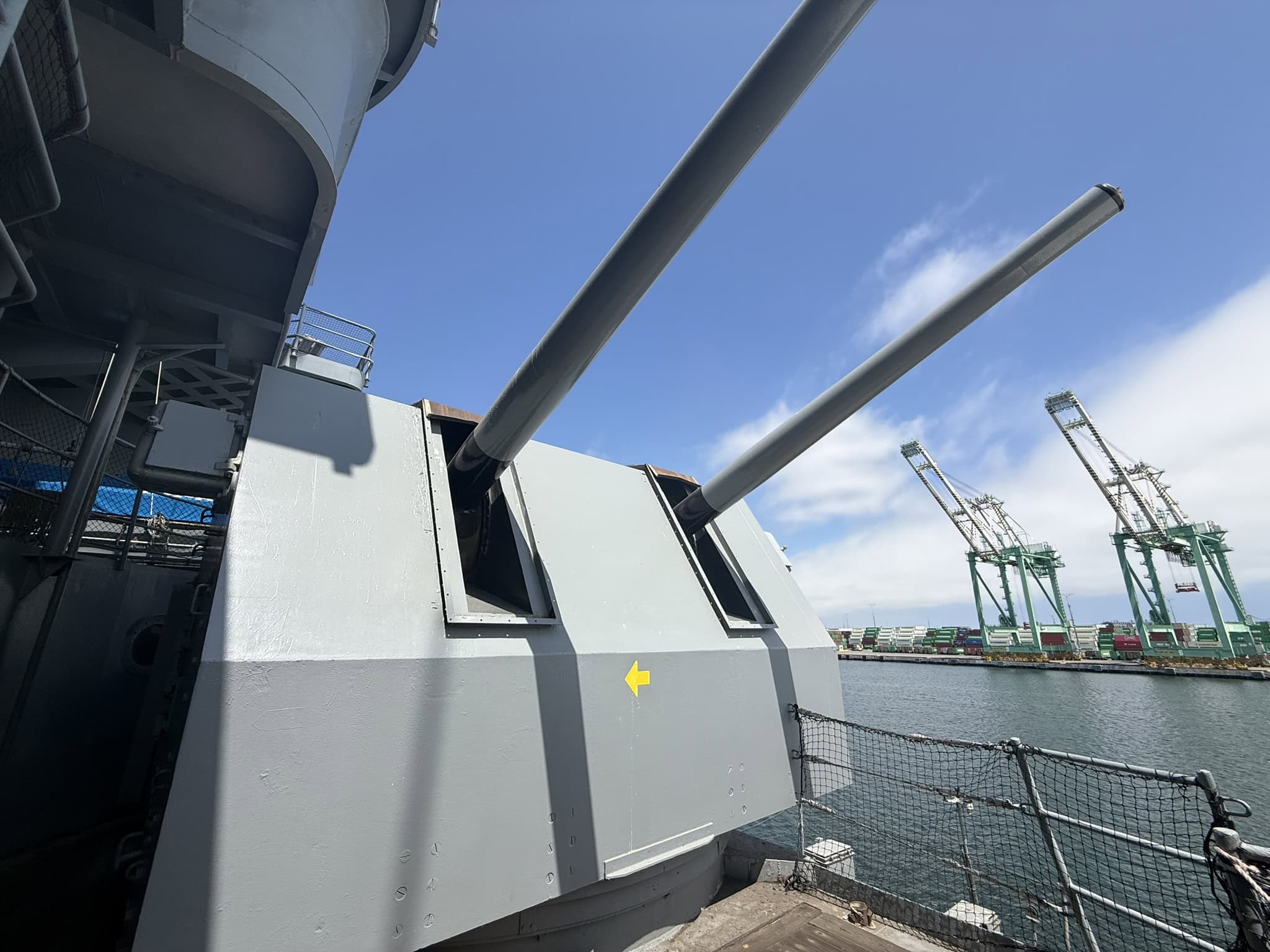
USS Iowa. 19FortyFive.com Original Image Taken in July of 2025.
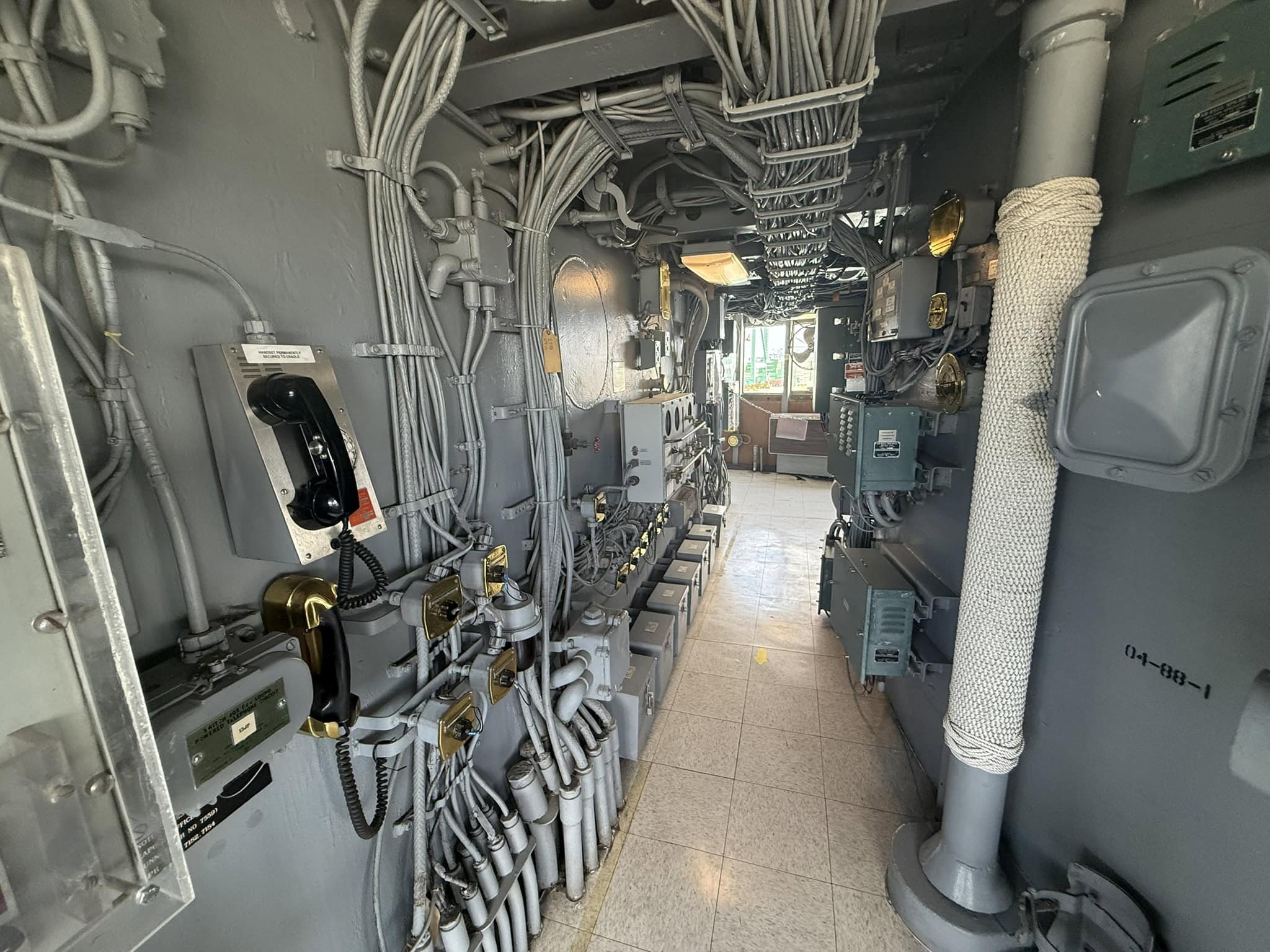
USS Iowa. 19FortyFive.com Image Taken Back in July of 2025.
Yamato’s fire-control system was the finest optical arrangement ever put to sea, built around 15-meter rangefinders and superbly trained operators, and in clear daylight at long range it was genuinely formidable.
It was also entirely dependent on seeing the target. Her navy never developed radar-directed main-battery fire as a working practice and never mastered radar spotting of shell splashes.
In any condition where visibility degrades — night, squall, smoke, funnel haze, the spray of a 30-knot sea — Yamato’s gunnery collapses into blindness, while Iowa’s remains unaffected. Battleship duels of this era were decided by fire-control kills, and every wartime data point places the first kill in American hands.
What Samar Proved
The evidence is not hypothetical, because Yamato’s main battery fired at ships exactly once.
On the morning of October 25, 1944, off Samar, her force sighted slow American escort carriers and misidentified them as fleet carriers; she opened fire at extreme range minutes later, and by the same record her opening salvos went to the escort carrier White Plains, straddling her, before smoke screens, rain squalls, and the towering splashes of her own shells made continuous optical targeting nearly impossible.

USS Iowa Seal 19FortyFive.com Original Image Taken By Harry J. Kazianis Onboard Battleship USS Iowa in 2025.
Then American destroyers attacked with torpedoes, and the world’s largest battleship turned away and ran north between the torpedo tracks until they exhausted themselves, out of her only surface battle at its crisis. She finished the morning with straddles, near-misses, a contested share in the sinking of the escort carrier Gambier Bay, and no verified main-battery kill of her own.
Against the slowest combatants in the American fleet, in degraded visibility, optical gunnery produced exactly what the Guadalcanal record predicted.
Six Knots of Initiative
Speed converts the gunnery edge into control of the whole engagement.
Iowa holds a six-knot margin, and six knots means she chooses the range, the bearing, and the duration of the fight: hold the band around 20,000 to 24,000 yards, where her shells kill; close when Yamato’s directors are wrecked; or open the range and leave if the fight sours.
Yamato can accept the battle offered or watch it steam away. She can force nothing.
The Engagement, Minute by Minute
Picture a gray morning in the Philippine Sea, visibility ragged under low cloud. Iowa’s SG search radar finds the giant beyond 40,000 yards, and her captain uses his speed to set the geometry, maneuvering to keep Yamato at about 26,000 yards.
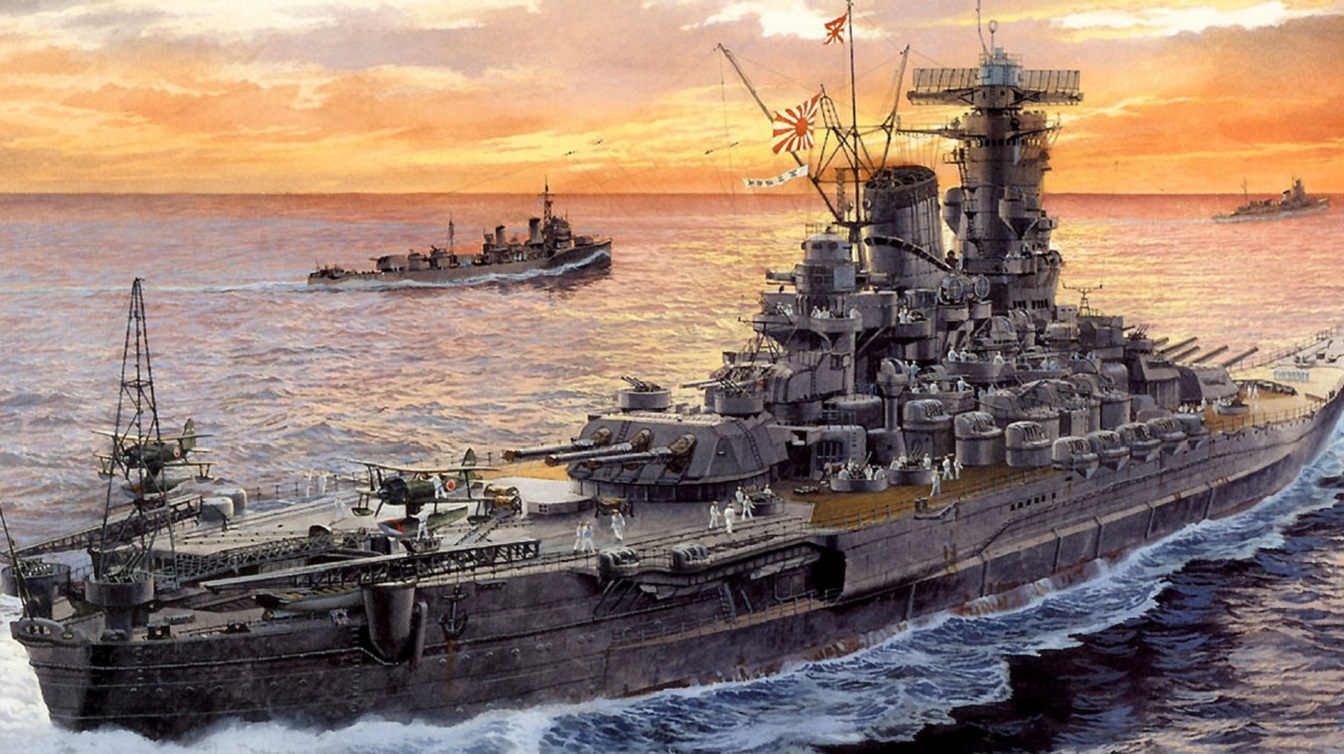
Battleship Yamato. Image Credit: Creative Commons.
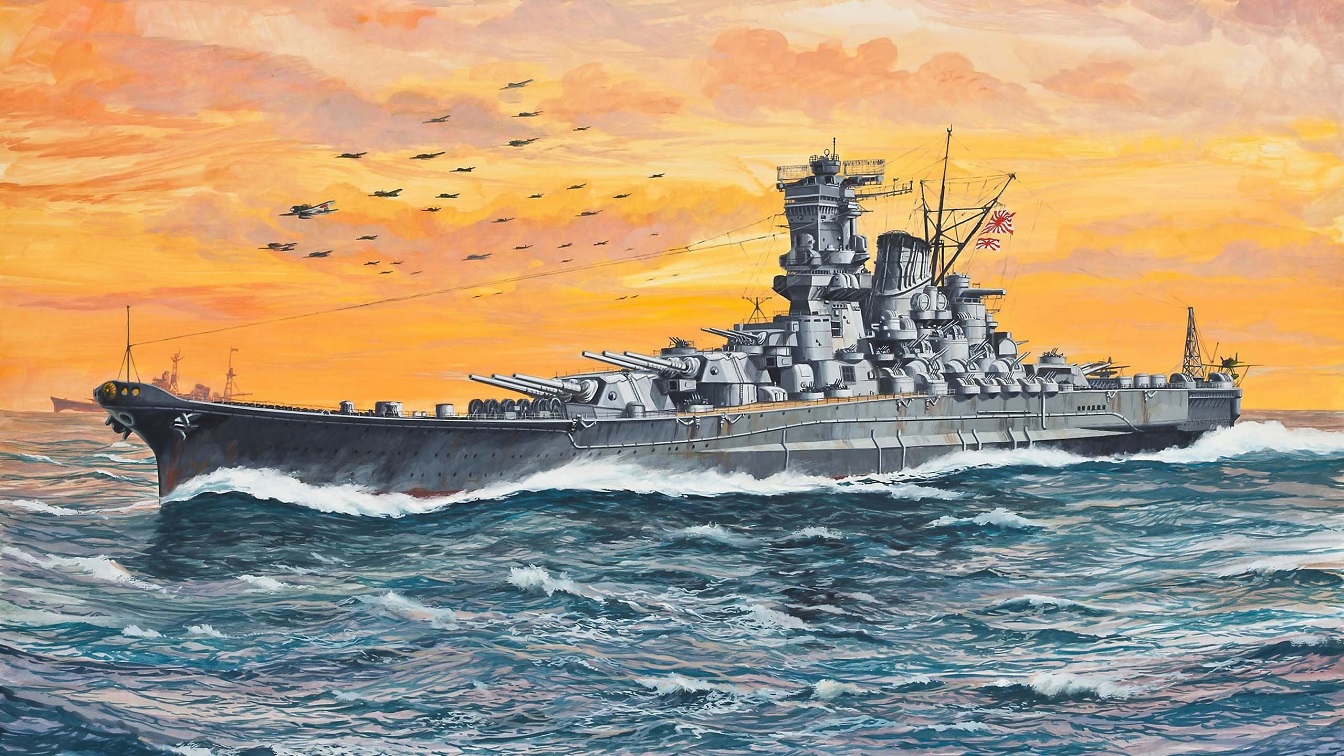
Yamato-Class Battleship/Artist Rendition. Image Credit: Creative Commons.
The Mark 8 measures the range continuously. Iowa opens deliberate fire; the radar watches her splashes, walks the third salvo across Yamato’s forecastle, and shifts to rapid fire. Yamato’s optics answer through the murk, her first straddle coming minutes behind Iowa’s, her spotters struggling against the haze her own guns thicken.
The early hits decide everything after. Mark 8 superheavies, plunging out of the murk, smash the pagoda’s rangefinders and the main director; within a quarter hour, Yamato’s turrets are ranging locally, her salvos scattering.
Iowa closes to within 21,000 yards of her penetration window and begins the methodical destruction of a ship built to refuse it.
And Yamato does refuse it, for hours. Her sister absorbed nineteen torpedoes and seventeen bombs before sinking, and no gunfire duel delivers underwater damage on that scale.
The realistic end state is a Yamato beaten silent: directors gone, turrets jammed or burning, engineering intact enough to crawl, wrecked as a fighting ship long before she is a sinking one.
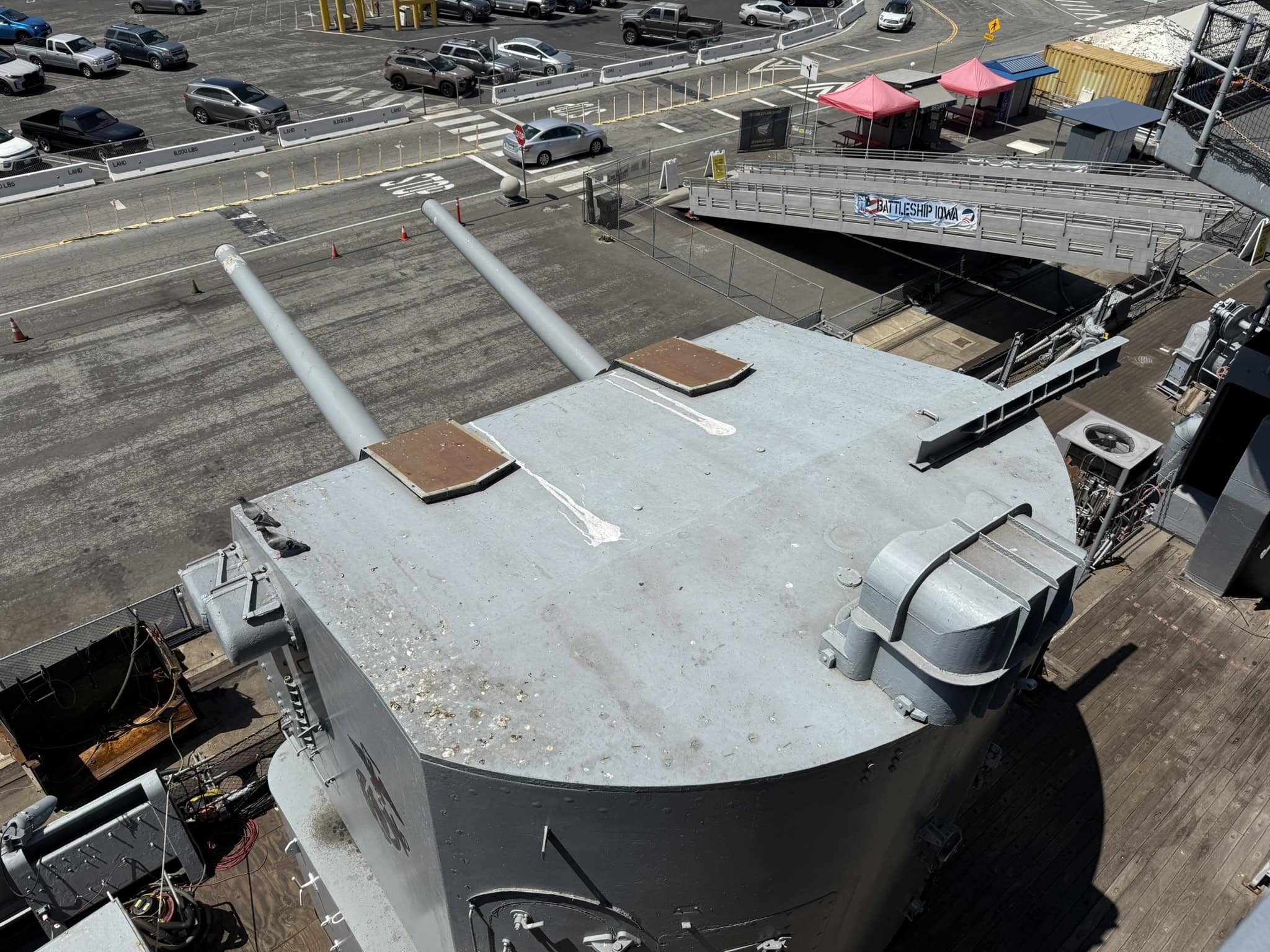
US Navy Battleship USS Iowa Tour. Photo Taken by Harry J. Kazianis for 19FortyFive.
The reverse path exists, and honesty requires it: in perfect visibility at extreme range, Yamato’s opening salvos are dangerous, and a single 3,219-pound shell finding Iowa’s plot or a magazine changes the story in one flash.
Her gun held the edge in raw reach and raw penetration, and the house analysis of the Montana matchup reached the same conclusion this one does about where the decisive advantage actually lay: in fire control, not bore diameter. The miracle-hit branch is real. It is also a bet on one salvo against a system that hits with dozens.
The Verdict
Iowa wins.
In daylight, she wins by a clear margin; at night or in bad weather, she wins by a rout, on the Surigao script.
Inside 20,000 yards both ships can kill each other, so the fight belongs to whoever hits first and most, and the hitting contest is not close: radar-corrected American gunnery demonstrated its dominance over optical fire at Guadalcanal and Surigao, and Yamato’s own morning off Samar demonstrated the other side of the same ledger. Speed lets Iowa hold the fight inside her killing band for as long as the work takes.
Yamato’s advantages — mass, shell weight, the deepest armor ever floated — make her monstrously hard to sink, and sinking was never the test; a battleship that cannot hit is defeated afloat.
The real 1945 delivered its own verdict.
When Yamato sortied for Okinawa on her final mission, an American surface force of battleships was ordered to intercept her. The aircraft of Task Force 58 arrived first: 386 planes found her on April 7, 1945, and put her under with some 3,000 of her crew.
The American battleships never fired a main-battery shell at her, and the greatest gunnery duel never fought stayed exactly where this piece found it — on paper.
About the Author: Harry J. Kazianis
Harry J. Kazianis (@Grecianformula) was the former Senior Director of National Security Affairs at the Center for the National Interest (CFTNI), a foreign policy think tank founded by Richard Nixon based in Washington, DC. Harry has over a decade of experience in think tanks and national security publishing. His ideas have been published in the NY Times, The Washington Post, The Wall Street Journal, CNN, and many other outlets worldwide. He has held positions at CSIS, the Heritage Foundation, the University of Nottingham, and several other institutions related to national security research and studies. He is the former Executive Editor of the National Interest and the Diplomat. He holds a Master’s degree focusing on international affairs from Harvard University.