Key Points and Summary – Expert Caleb Larson details a brutal stretch for Russian combat aviation that began with a freak tragedy: an accidental ejection-seat activation inside a hangar that killed both crewmen.
-Far worse followed with Ukraine’s covert Operation Spiderweb, a mass drone strike orchestrated by the SBU against four Russian bomber bases hundreds of miles from the front.
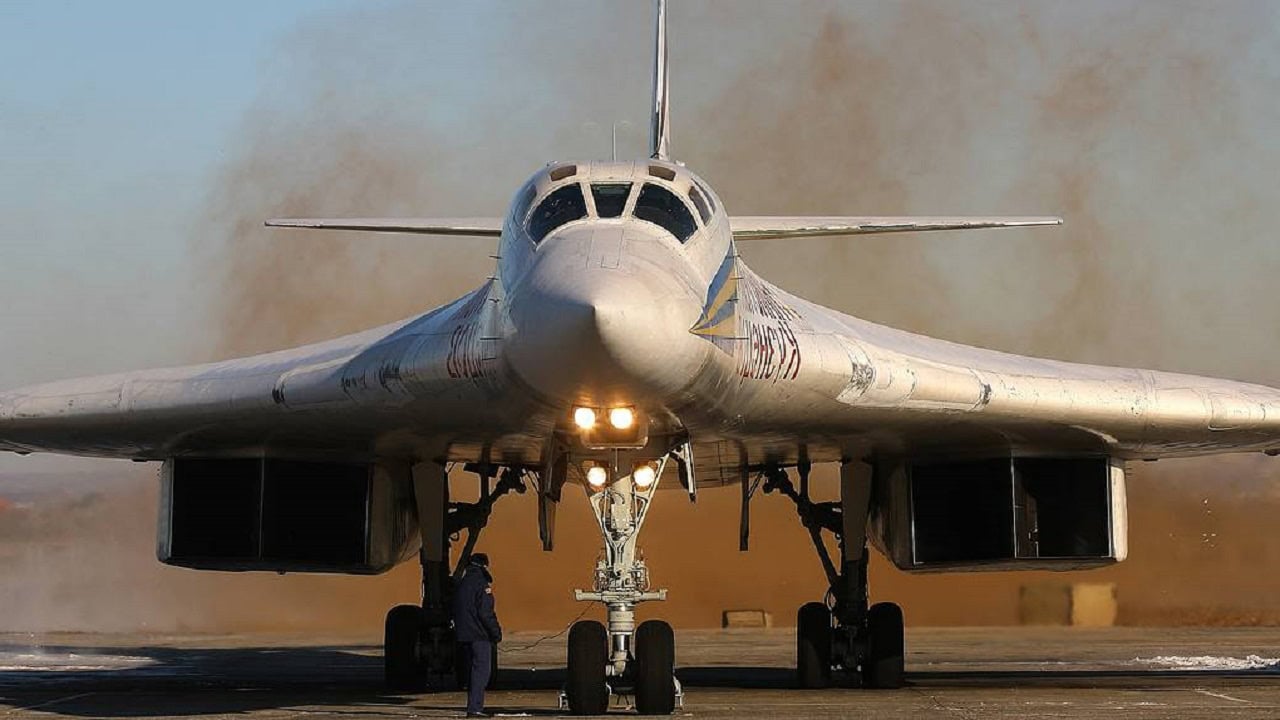
-Swarms of small UAVs reportedly destroyed or damaged Tu-22M3s, Tu-95s, Tu-160s, and even an A-50, catching many aircraft fueled and ready for long-range strikes.
-Whether the true toll is 10 aircraft or 40, Russia’s aging bomber fleet took a hit it cannot easily replace.
Russian Bombers Are Dying on the Ground – and 2025 Is Only Getting Worse
Just days ago, the Russian Air Force lost two pilots — although not during combat, not during a training exercise, and not even during flight, but while parked on the ground, seemingly safe inside an aircraft hangar. The cause of the mishap? A technical malfunction, one with deadly consequences.
Fighterbomber, a Telegram channel believed to be associated with the Russian Air Force, announced the fatalities. “Yesterday, in one of the bomber aviation regiments, the ejection system activated on an aircraft that was in a shelter,” the channel simply stated. “The pilot and navigator sustained injuries incompatible with life. A state commission is working at the scene.”
A spokesman for the Ukrainian Air Force, Yurii Ihnat, reacted to the accident on Facebook. “I really hope the explosive charges in both ejection seats, which slammed into the reinforced concrete ceiling, caused a ‘small fire onboard’” he wrote, “or at least triggered some other consequences ‘incompatible’ with further aircraft operation.”
Needless to say, it has been a tough year for Russian combat aviation. One of the year’s major Ukrainian victories was Operation Spiderweb, a daring, incredibly complex surprise attack on Russian strategic bombers based in Russia.
Operation Spiderweb
The clandestine attack was prepared and organized by the Security Service of Ukraine, or SBU, Ukraine’s central internal security agency. It was an asymmetrical attack against one of Russia’s significant advantages in this war: the Kremlin’s fleet of long-range bomber aircraft.
Interestingly, air power in the war in Ukraine has taken a back seat to the grinding land warfare that has defined that conflict, despite the Ukrainian Air Force’s disadvantage in the air.
The front line in Ukraine stretches for hundreds of miles, cutting a slash through the country’s eastern Donbas region.
And despite the front’s enormous length, it is one of the most intensely contested aerial environments in the world.
Consequently, Russia’s use of combat aviation has undergone radical adaptation. Instead of providing close air support to Russian forces on the ground or engaging Ukrainian aircraft directly, Russian aircraft are instead used as mobile launch platforms for long-range, stand-off munitions.
Complemented by Russian ballistic and cruise missiles, as well as Geran drones, Russian aircraft fire off their weaponry from well behind the front, intensely wary of losses at Ukrainian hands.
Both Russian and Ukrainian forces have driven radical experimentation with drones and anti-drone warfare. Some notable innovations include above-ground fishing-net-draped passages that protect vehicles and personnel beneath from explosive-laden drones.
So intense are both sides’ electronic warfare assets that some drones have shifted from radio frequency control to spooling out miles of untamable fiber optic cables in lieu of radio transmissions.
They’re small, cheap, hard to detect — and in some cases, exceedingly difficult to counter. It was for these reasons that the SBU’s Operation Spiderweb was so successful.
During that operation, three Russian air bases were attacked by over one hundred drones. A fourth Russian air base was to be attacked as well, although that attack attempt was unsuccessful. Overall, the operation caught Russia completely by surprise.
On June 1st, hundreds of the bomb-toting drones emerged from hidden compartments inside fake shipping containers driven by unsuspecting Russian accomplices. Most of them found their mark. Many hundreds — sometimes thousands — of miles away from Ukraine, air bases around Russia had made only rudimentary precautions against attack, believing falsely that they were safe from attack. But within that single day, Russia most probably lost more aircraft than it had since the Second World War.
The SBU claims that its drone pilots damaged or destroyed 41 Russian aircraft. Other estimates of the damage Russia sustained are more conservative, with American sources claiming that about 10 aircraft were destroyed out of 20 jets hit.
Many of the bombers were seemingly fully-fueled, giving credence to Ukraine’s claim that the jet bombers were poised to lob long-range weapons at Ukraine again. Though it is difficult to ascertain definitively, that some of the jets were indeed fueled is not disputed, and more than a few erupted into balls of flame after the Ukrainian drone strikes.
It is believed that four different kinds of aircraft were hit: Russia’s Tu-22M3, a supersonic long-range bomber, Tu-95, a strategic bomber roughly analogous to the United States’ B-52 bomber, the Tu-160, another supersonic strategic bomber, and an A-50 early warning aircraft.
Leaving aside for a moment the number of aircraft damaged or destroyed, Operation Spiderweb was quite a coup for the Security Service of Ukraine, which leveraged the operation’s success to brush off long-standing accusations that the organization was riddled with Russian operatives.
But Operation Spiderweb also put a significant dent in Russia’s strategic and long-range bomber fleet.
Many of those bombers were built during the Cold War, and Russia lacks the resources to replace those losses, let alone build out the bomber fleet.
But the Kremlin still has many bombers available at its disposal, as evidenced by its recent joint exercise with its Chinese counterparts. Still, 2025 would be a dangerous year to be a Russian bomber pilot.
About the Author: Caleb Larson
Caleb Larson is an American multiformat journalist based in Berlin, Germany. His work covers the intersection of conflict and society, focusing on American foreign policy and European security. He has reported from Germany, Russia, and the United States. Most recently, he covered the war in Ukraine, reporting extensively on the war’s shifting battle lines from Donbas and writing on the war’s civilian and humanitarian toll. Previously, he worked as a Defense Reporter for POLITICO Europe. You can follow his latest work on X.