
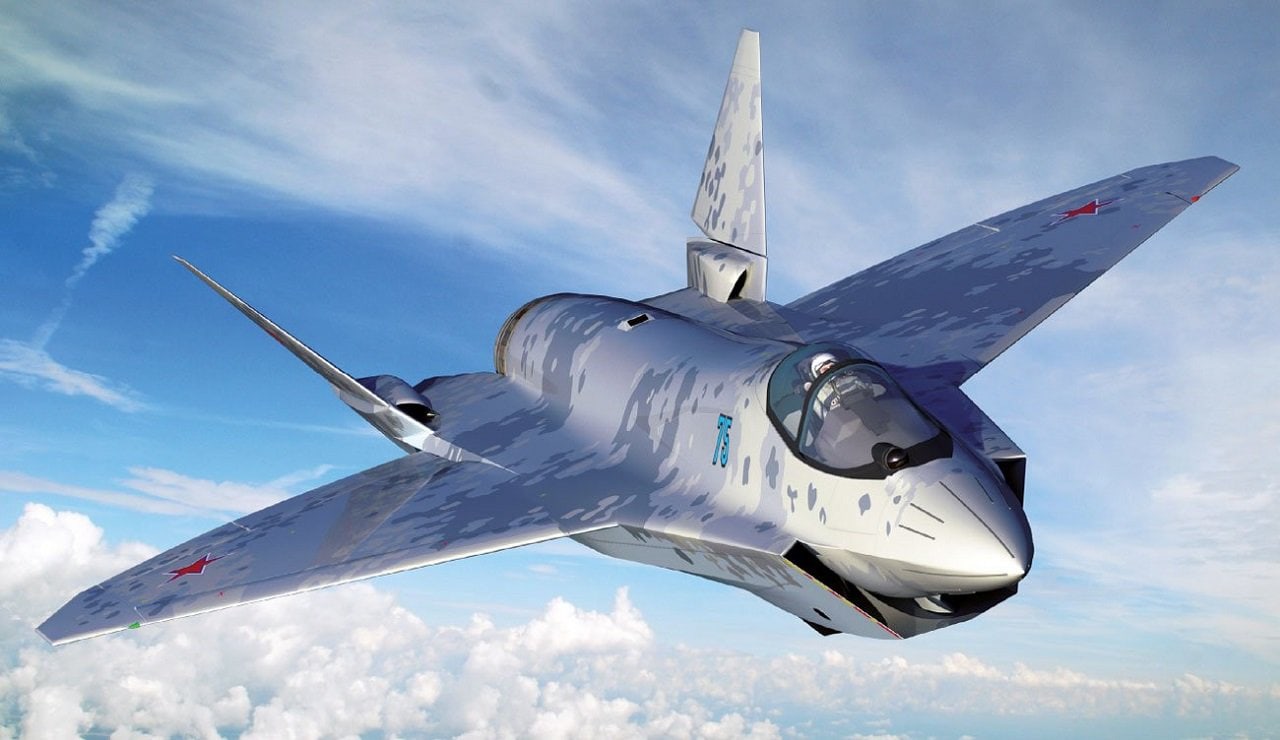
Russia’s Su-75 Checkmate has finally moved beyond years of models, patents and promotional claims, but it still has not flown. United Aircraft Corporation said in June 2026 that work had reached the construction of an experimental prototype. As of July 28, UAC had announced no rollout date, maiden flight, publicly confirmed production contract or delivery schedule.
That is far behind the plan presented at the MAKS air show on July 20, 2021. Russia displayed a full-size, nonflying demonstrator and said the single-engine fighter would take off in 2023, enter serial production in 2026 and support a business plan for 300 aircraft over 15 years.
The proposed aircraft was designed as a lighter and cheaper partner to the twin-engine Su-57. UAC still advertises a maximum speed of Mach 1.8, a 2,900-kilometer range without external tanks, a 7,400-kilogram combat load and internal carriage for as many as five air-to-air missiles. Those are manufacturer specifications, not performance demonstrated through flight testing.
The original concept made commercial sense on paper. Sukhoi would reuse engine technology, avionics, weapons and design work from the Su-57, place them in a smaller airframe and offer countries unable or unwilling to buy the F-35 a lower-cost fighter with reduced radar visibility. The business case depended upon export orders arriving before competitors captured those customers.
The 2021 Checkmate Reveal Was Built Around an Export Market
Russia took the demonstrator to the Dubai Airshow in November 2021 and promoted low operating costs, open architecture and versions tailored to different buyers. The jet was presented less as a settled Russian military requirement than as an export-dependent development program seeking a launch customer.
The distinction mattered. A government order creates funding, deadlines, test requirements and a minimum production run. Expressions of interest do not. Russian officials named no buyer behind the 300-aircraft forecast, and no publicly announced domestic or export order followed from the markets signaled in the launch campaign. The absence of a firm customer fed early doubts about whether the ambitious schedule had financial support.
By August 2022, UAC had moved the planned flight-test start to 2024 and said it intended to build four prototypes, with preparations underway for the first two. The company said feedback from potential customers led to technical and cost changes. Rostec separately shifted serial production to 2027.
Redesigns Moved the Su-75’s First Flight Further Away
Russian patent filings revealed a revised aircraft in 2023. Aviation Week identified changes to the rear fuselage, wing edges, flaperons and leading-edge extensions, along with single-seat, two-seat and uncrewed configurations. Redesigning before flight testing is less costly than correcting a flawed airframe later, but it also resets structural analysis, tooling and systems integration.
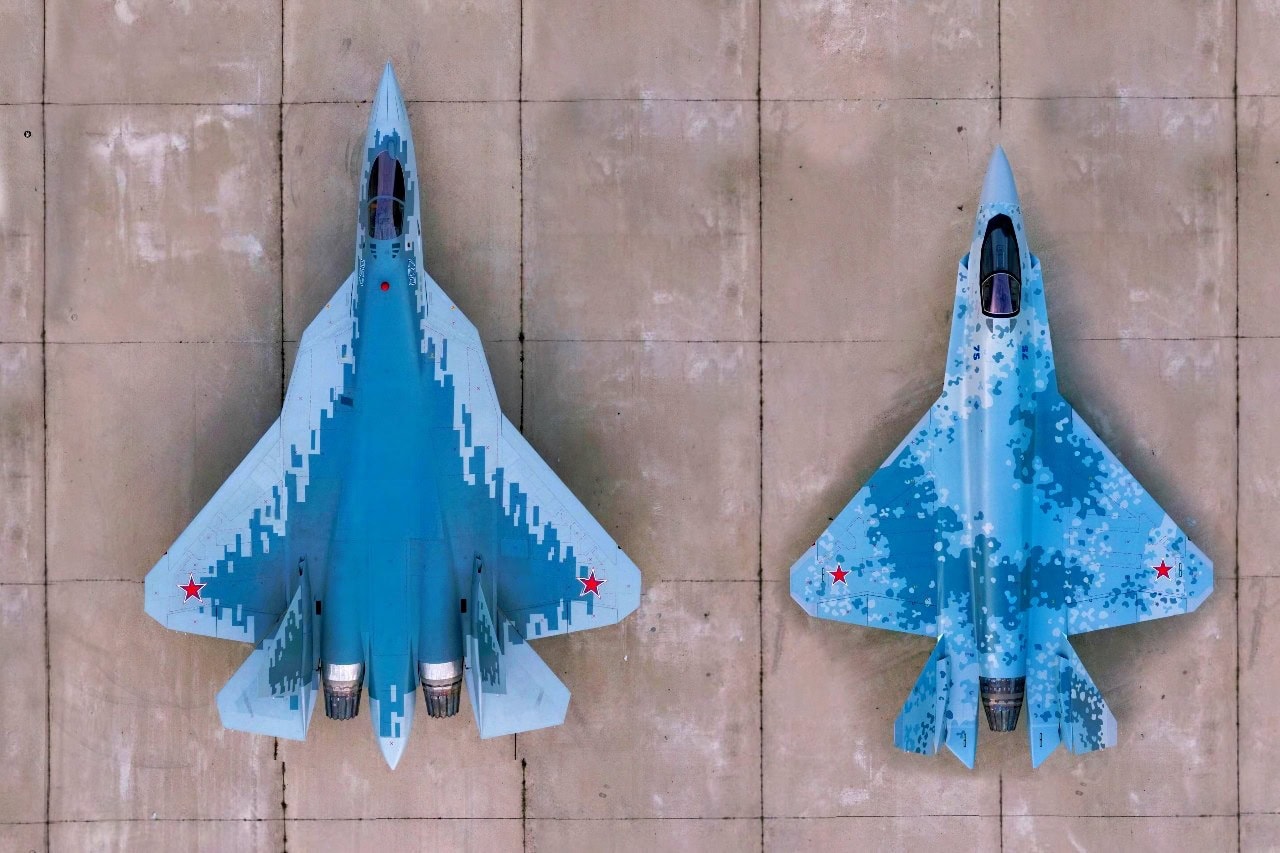
Su-57 Felon and Su-75 Fighters From Russia. Image Credit: Creative Commons.
Deputy Prime Minister Denis Manturov then said customer feedback had altered the layout, controls and armament, with the first prototype expected by the end of 2025.
An October 2025 image that appeared to show a Checkmate beside an Su-57 prompted speculation that a flight article existed. Rostec soon described the aircraft as a full-scale mock-up.
At the Dubai Airshow in November 2025, Rostec chief Sergey Chemezov said bench testing would begin soon and described the program as close to the flight stage. Sukhoi test pilot Sergei Bogdan later pointed to early 2026 for the maiden flight.
That date passed without a publicly announced taxi test or takeoff.
Russia’s War Economy Competes for the Same Aerospace Capacity
The invasion of Ukraine changed the program’s financial and industrial setting. Western sanctions narrowed access to technology, capital and export markets.
A 2025 Royal United Services Institute study found continuing Sukhoi supply-chain exposure to foreign components, materials and machine tools.
Public evidence does not establish how much each constraint delayed Checkmate, but none makes a new stealth aircraft easier to complete.
Russia is also using its aerospace workforce to deliver aircraft needed now. Rostec said in April 2026 that its plants were operating at full capacity while producing Su-35S fighters, and UAC delivered new Su-30SM2 and Su-34 batches in July.
Komsomolsk-on-Amur must support the Su-57 and Su-35 while preparing Checkmate, leaving the delayed single-engine program competing for engineers, facilities and suppliers. The same pressure explains why existing production commitments receive priority.
The project has not been formally abandoned. UAC chief Vadim Badekha said in June that the aircraft is intended for both the Russian Defense Ministry and foreign customers, with lower purchase and operating costs remaining its main advantage.
He also said delivery timing depends on customer interest and objectives, language that leaves the schedule tied to orders UAC has not publicly identified.
Prototype Construction Is Progress, Not a Production Program
A flightworthy prototype would give Sukhoi its first real opportunity to validate the engine installation, flight controls, aerodynamics and systems integration. It would not establish the advertised range, payload, radar signature, reliability or unit price.
Those require a test campaign, production-representative aircraft and a customer willing to fund the path into service.
UAC has not published a rollout date, taxi-test schedule or revised maiden-flight target.
The early-2026 date announced by Sukhoi’s test pilot passed without a flight, and the experimental Su-75 remained under construction as of publication.
MORE – China’s J-20 Stealth Fighter Was Built for a Fight with the US Air Force
About the Author: Harry J. Kazianis
Harry J. Kazianis (@Grecianformula) was the former Senior Director of National Security Affairs at the Center for the National Interest (CFTNI), a foreign policy think tank founded by Richard Nixon based in Washington, DC. Harry has over a decade of experience in think tanks and national security publishing. His ideas have been published in the NY Times, The Washington Post, The Wall Street Journal, CNN, and many other outlets worldwide. He has held positions at CSIS, the Heritage Foundation, the University of Nottingham, and several other institutions related to national security research and studies. He is the former Executive Editor of the National Interest and the Diplomat. He holds a Master’s degree focusing on international affairs from Harvard University.

