
USS Mississippi by the Numbers: 36,157 Tons, Twelve 14-Inch Guns and Eight Battle Stars: The cleanest surviving construction figure for USS Mississippi is a $7.115 million bid submitted by Newport News Shipbuilding in 1914. The shipyard went on to build the battleship at Newport News, Virginia. That figure represented the reported shipbuilding bid rather than a modern all-in acquisition total covering every weapon, armor plate, and government expense.
Workers laid the keel on April 5, 1915, launched the hull on January 25, 1917, and delivered the ship for commissioning on December 18, 1917. Keel laying to active service took two years, eight months, and 13 days. Mississippi was the second of three completed New Mexico-class battleships, following New Mexico and preceding Idaho.
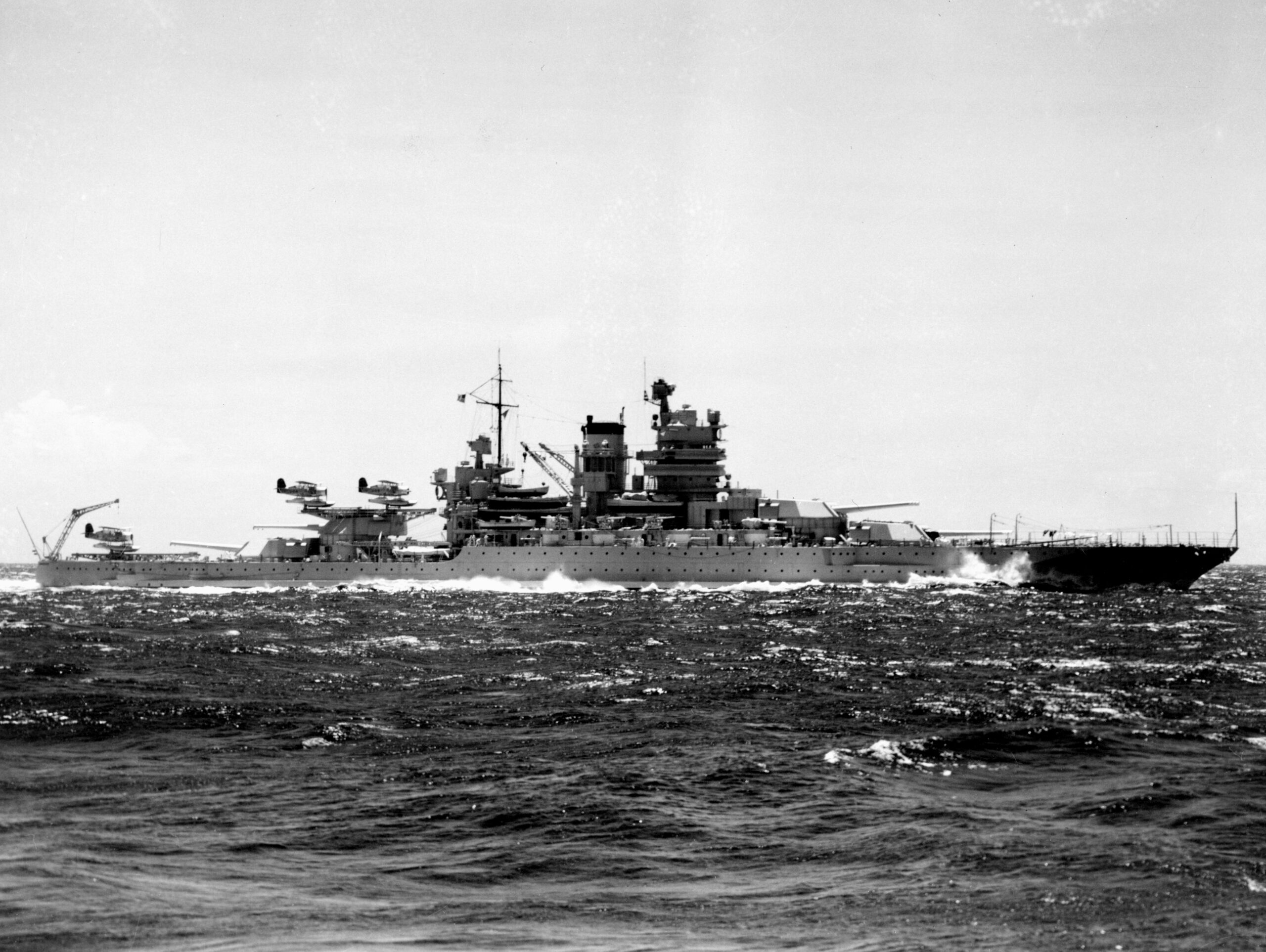
The U.S. Navy battleship USS Mississippi (BB-41) operating at sea during the later 1930s. She has three Curtiss SOC Seagull aircraft on her catapults.
As built, the ship measured 624 feet long and 97 feet 5 inches across the beam. Nine oil-fired boilers supplied four Curtis steam turbines turning four shafts, producing 32,000 shaft horsepower, a top speed of 21 knots, and an 8,000-nautical-mile range at 10 knots. A 1931–1932 reconstruction raised power to 40,000 shaft horsepower and pushed full-load displacement to 36,157 long tons.
Mississippi did not fight during World War I, but she earned eight battle stars in World War II, survived two kamikaze strikes, and fired one full broadside during history’s last battleship-against-battleship engagement. Her career continued for nearly 39 years because the Navy turned the dreadnought into a gunnery and guided-missile test ship after 1945.
The $7.115 Million Bid Produced One of Three New Mexico-Class Battleships
The New Mexico class belonged to the Navy’s standard-type battle line. Similar speed, turning characteristics, and protection allowed several battleship classes to maneuver together. Mississippi carried a main belt reaching 13.5 inches, 18-inch turret faces, and a conning tower protected by 16 inches of steel.
Her original design displacement was 32,000 long tons, rising to approximately 33,000 tons fully loaded. The Norfolk reconstruction added deck armor, improved underwater protection, new boilers, and Westinghouse geared turbines. Workers removed the cage masts and installed a tower bridge and pole mast.
Protective bulges widened the beam from 97 feet 5 inches to 106 feet 3 inches. The main-gun mounts were modified to allow a maximum elevation of 30 degrees, up from 15 degrees, greatly extending their range. Crew requirements rose from about 1,084 people when completed to 1,443 after reconstruction.
Mississippi had fired on another battleship before World War II, although not in combat. During Fleet Problem I in 1923, she sank Coast Battleship No. 4, the former USS Iowa, which had been converted into a radio-controlled target. Spotting aircraft helped direct the gunfire during the experiment.
Twelve 14-Inch Guns Produced an 18,000-Pound Broadside
Four triple turrets held Mississippi’s twelve 14-inch/50-caliber guns. Each barrel is elevated independently, allowing a damaged or malfunctioning gun to stop without disabling the other two weapons in the turret. During the 1930s refit, the class received rebuilt Mark 11 guns with improved bore treatment and tighter shot patterns.
Each gun weighed nearly 180,000 pounds with its breech and stretched 59.5 feet overall. The World War II armor-piercing projectile weighed 1,500 pounds, giving the ship an 18,000-pound full broadside. A 420-pound propellant charge drove the shell from the muzzle at 2,700 feet per second.
After reconstruction, the maximum range reached about 36,800 yards, or almost 21 miles. The guns were rated at roughly 1.75 rounds per minute, and the magazines held approximately 100 projectiles for each barrel.
The main battery’s power came with a terrible human cost in Turret No. 2. A flareback during gunnery practice off California on June 12, 1924, killed 44 men inside the turret. Four rescuers died after powder remaining in one gun ignited when Mississippi turned toward port.
Nineteen years later, the same turret exploded while Mississippi bombarded Makin on November 20, 1943. Forty-three sailors died and 19 suffered injuries. The two disasters killed 91 men, yet the battleship continued supporting the Makin operation and returned to the Pacific campaign after repairs.
Eight Battle Stars Took Mississippi From Kiska to Okinawa
Mississippi spent World War I training in American and Caribbean waters. She was operating from Iceland when Japan attacked Pearl Harbor and departed for the Pacific on December 9, 1941. Her sister USS Idaho followed a similar route from Atlantic duty into the Pacific War.
Mississippi spent much of 1942 training and escorting convoys. Her first major offensive operation came in July 1943, when the main battery bombarded Kiska during the Aleutian campaign. She later shelled Makin, Kwajalein, Taroa, Wotje and Kavieng before supporting the assault on Peleliu.
At Leyte, she joined Rear Admiral Jesse Oldendorf’s force protecting the invasion beaches from a Japanese surface attack. Later missions included Lingayen Gulf and Okinawa. Weapons designed to break battleship armor spent most of the war destroying bunkers, artillery positions and troop concentrations ashore.
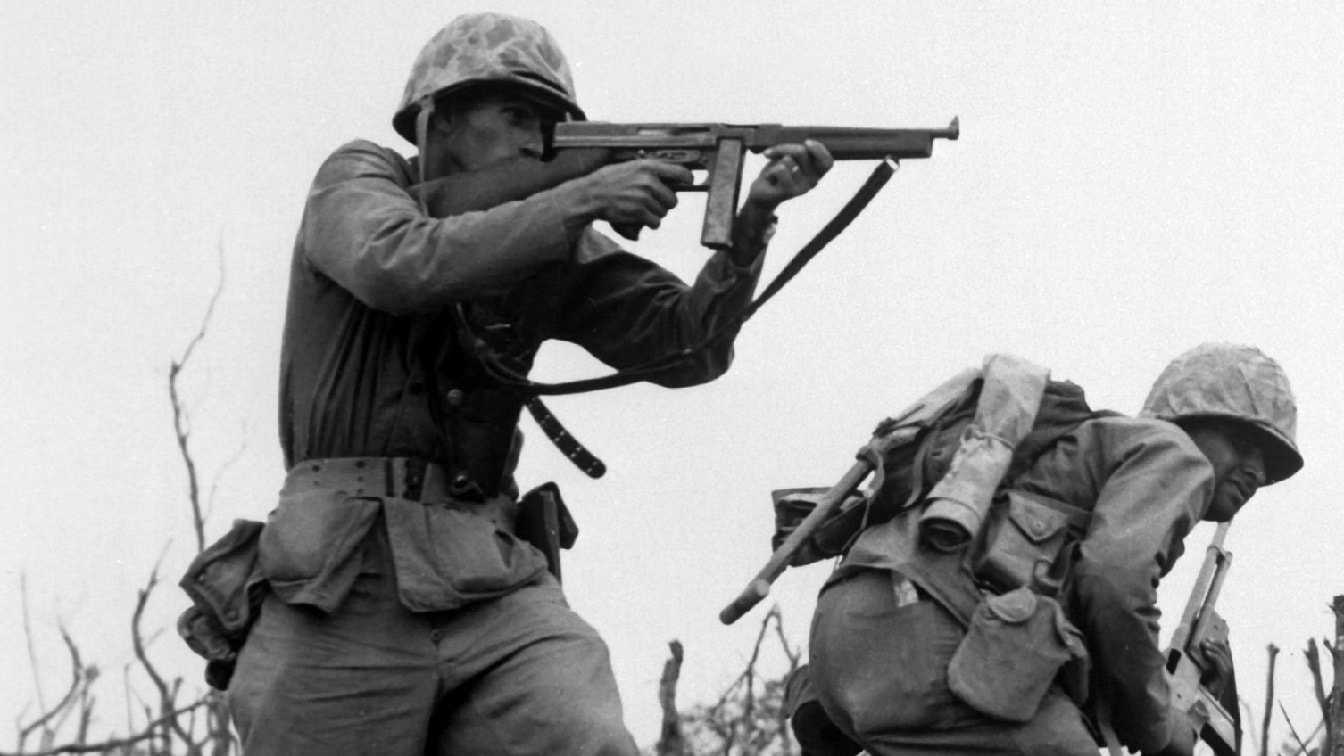
A Marine of the 1st Marine Division draws a bead on a Japanese sniper with his tommy-gun as his companion ducks for cover. The division is working to take Wana Ridge before the town of Shuri. Okinawa, 1945. S.Sgt. Walter F. Kleine. (Marine Corps)
That mission change reflected the larger shift from battleships to carrier air power. The Navy canceled the larger Montana-class battleships while older ships such as the Mississippi became floating artillery for amphibious invasions.
One 12-Gun Salvo Put Mississippi in History’s Last Battleship Duel
Mississippi did fight an enemy battleship. During the Battle of Surigao Strait on October 25, 1944, six American battleships formed across the northern exit while destroyers and torpedo boats attacked Vice Admiral Shōji Nishimura’s approaching Southern Force.
Five of the American battleships had been sunk or damaged at Pearl Harbor. Mississippi was the exception because she had been on Atlantic duty in December 1941. The formation crossed the Japanese line’s path, allowing the American ships to bring full broadsides against an enemy advancing through the narrow strait.
West Virginia, Tennessee, and California carried newer fire-control radar and opened fire first. Mississippi’s older Mark 3 system delayed target identification. At approximately 4:08 a.m., she acquired the Japanese battleship Yamashiro at a reported range of 19,790 yards and fired all twelve 14-inch guns.
Oldendorf had issued a cease-fire order, but it had not yet reached the ship. No reliable evidence assigns a specific hit to Mississippi’s broadside. Its place in history is secure for another reason: it was the last major-caliber salvo of the battle and is generally recorded as the final occasion on which one battleship fired its main guns at another.
Yamashiro sank after absorbing torpedoes and gunfire from the larger American force. Mississippi’s single salvo placed her among the relatively small group of American battleships that fought enemy capital ships.
Two Kamikazes Damaged Mississippi Without Driving Her From the Fight
A kamikaze struck Mississippi near the waterline during the bombardment of Luzon in January 1945. The impact tore into the ship and inflicted heavy casualties, but the battleship remained on station until February 10 before withdrawing to Pearl Harbor for repairs.
Mississippi returned for Okinawa and used her main battery against Shuri Castle and other fortified positions. A second kamikaze struck on June 5. She again stayed in action, continuing operations off Okinawa until June 16 before entering a floating dry dock for repairs.
The ship entered Tokyo Bay for Japan’s formal surrender on September 2, 1945. She left Japanese waters four days later and reached Norfolk on November 27.
The Navy Replaced the 14-Inch Guns With Terrier Missiles
The Navy redesignated the ship AG-128 on February 15, 1946, and rebuilt her as a gunnery training and operational-development platform. Three 14-inch turrets came out. A twin 6-inch mount, several types of 5-inch guns, 3-inch weapons, and anti-aircraft mounts allowed crews to test equipment used across the fleet.
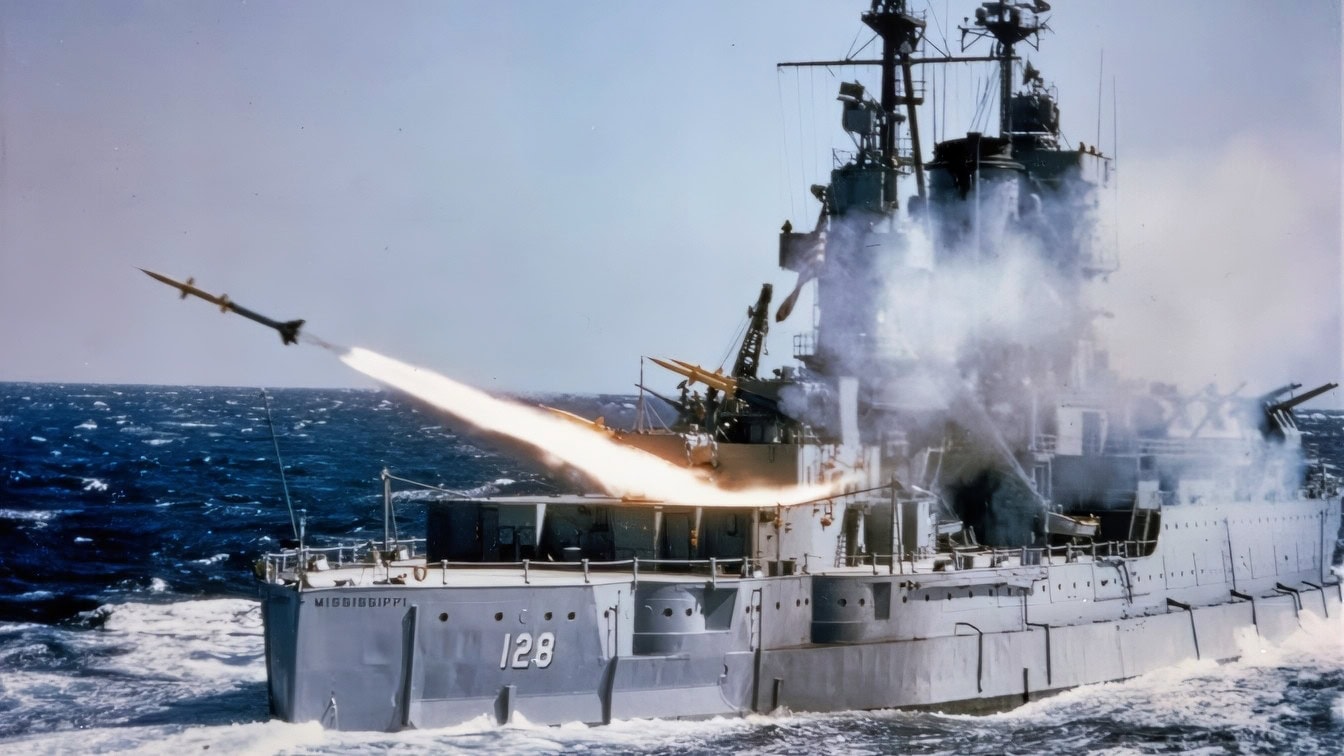
Workers removed the final 14-inch turret in 1952 and installed two twin Terrier surface-to-air missile launchers. On January 28 and 29, 1953, Mississippi conducted the first test firings of a shipborne Terrier off Cape Cod. She later supported evaluation of the Petrel radar-homing weapon in February 1956.
The Navy decommissioned Mississippi at Norfolk on September 17, 1956. Bethlehem Steel bought her for scrap on November 28. Tugboats towed the hull to Baltimore in December 1956, and workers dismantled it there during 1957.
One of Mississippi’s 14-inch guns survives in Bethlehem, Pennsylvania. The ship’s bell stands in the garden at Rosalie Mansion in Natchez, Mississippi, where visitors are allowed to pull the attached rope and ring it.
About the Author: Harry J. Kazianis
Harry J. Kazianis (@Grecianformula) was the former Senior Director of National Security Affairs at the Center for the National Interest (CFTNI), a foreign policy think tank founded by Richard Nixon based in Washington, DC. Harry has over a decade of experience in think tanks and national security publishing. His ideas have been published in the NY Times, The Washington Post, The Wall Street Journal, CNN, and many other outlets worldwide. He has held positions at CSIS, the Heritage Foundation, the University of Nottingham, and several other institutions related to national security research and studies. He is the former Executive Editor of the National Interest and the Diplomat. He holds a Master’s degree focusing on international affairs from Harvard University.

