
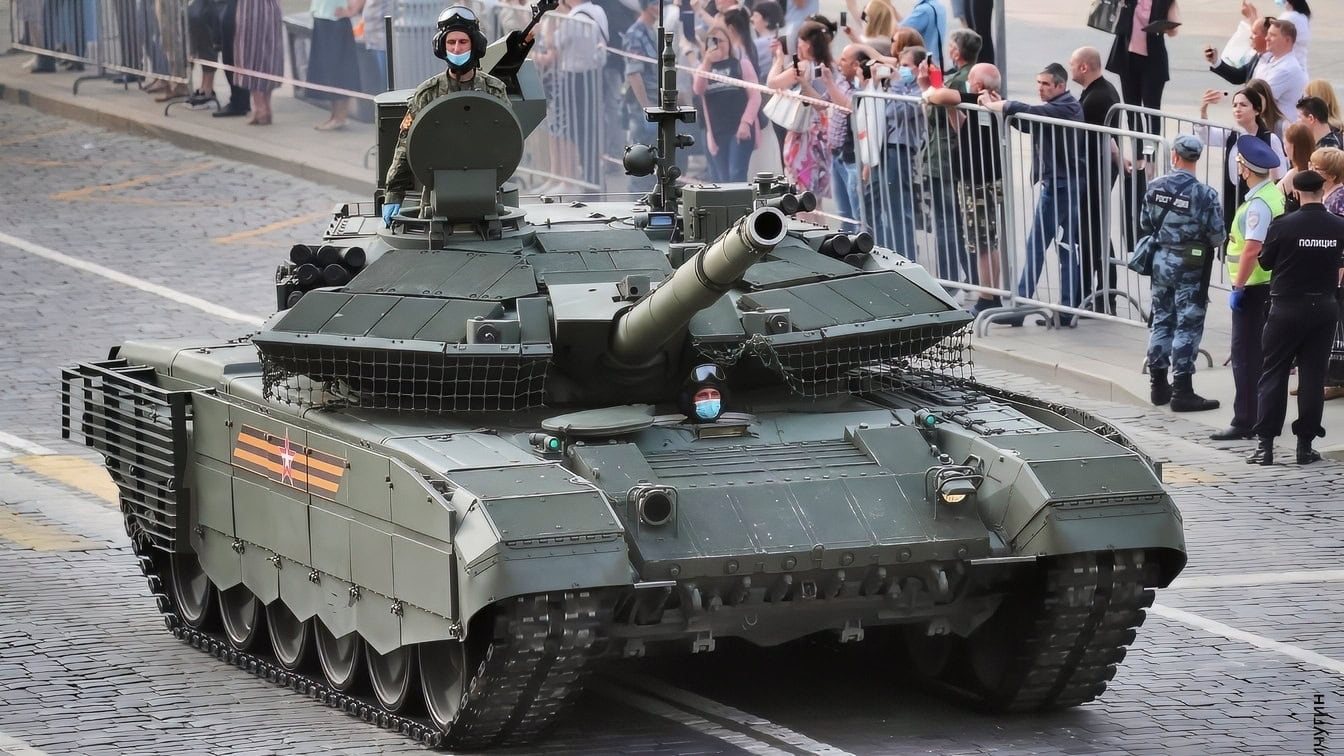
Iran Wanted Russia’s T-90. The Deal Died Before a Contract Was Signed – Despite what you might have heard, Iran never signed a T-90MS contract, as often described in various accounts. In December 2015, Iranian Army Ground Force commander Brig. Gen. Ahmad Reza Pourdastan announced plans to buy Russian T-90 tanks. He said Russian officials would visit Iran, while Iranian specialists would travel to Russia to negotiate contracts and learn how to operate the vehicle.
One week later, Pourdastan said the proposal had been sent to Iran’s General Staff. He described the T-72 as the backbone of Iran’s armored force but said the T-90 offered better combat characteristics and met Iran’s requirements for modern armor.
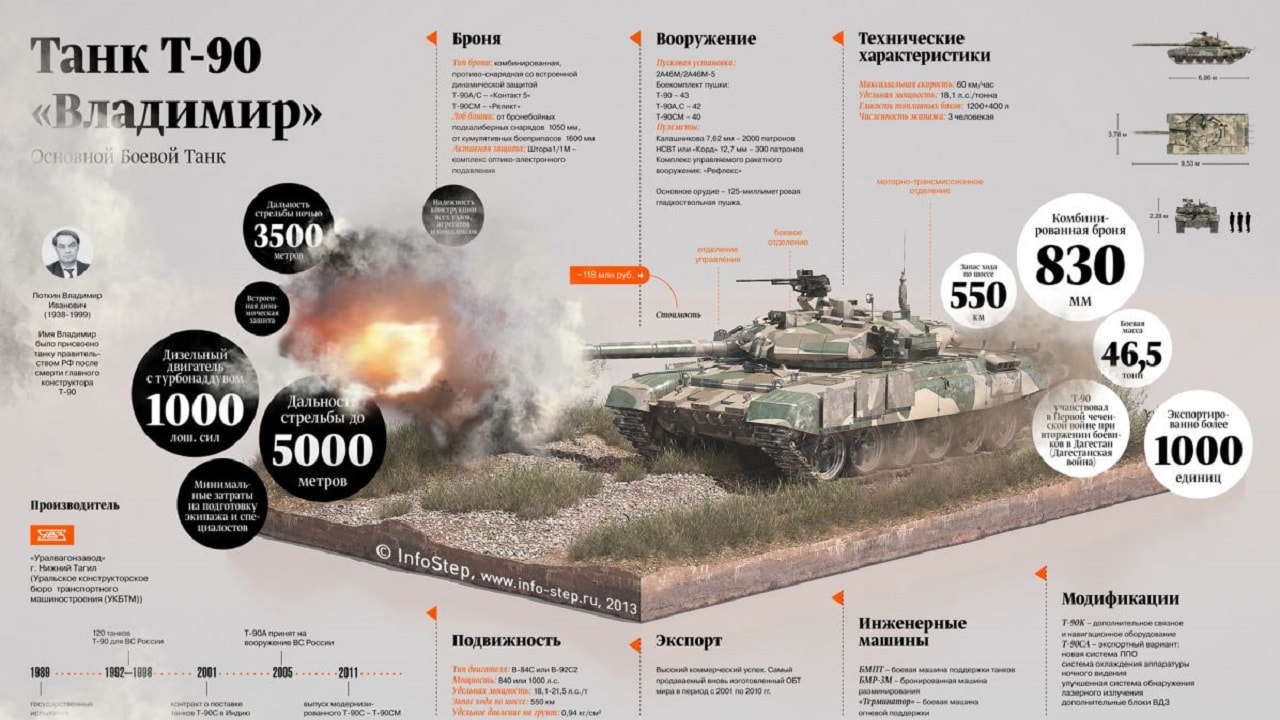
T-90 tank diagram. Image Credit: Creative Commons.
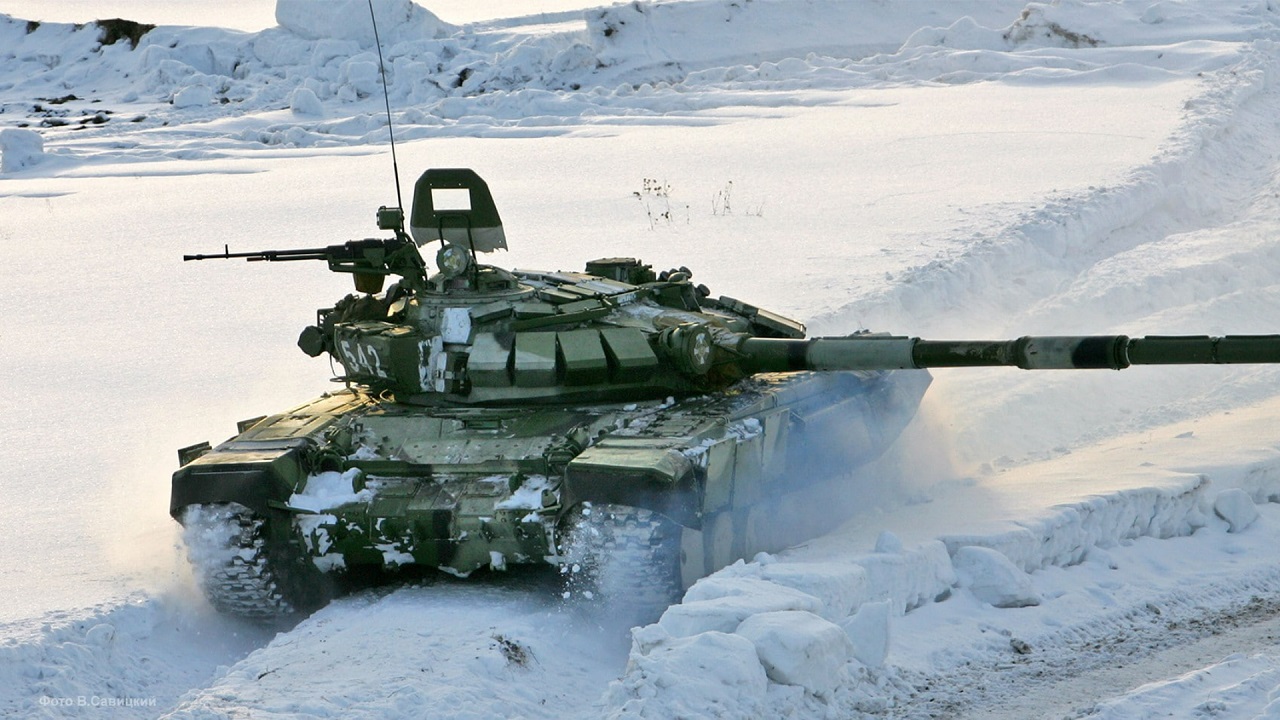
T-90 tank in the snow. Image Credit: Creative Commons.
The exact model was never settled publicly. Iranian officials usually said T-90. Russia’s clearest industrial offer involved licensed production of the T-90S, the established export model. The T-90MS was the more advanced export evolution, with a 125mm gun, a three-person crew, a 1,130-horsepower engine, modern fire control, thermal sights, improved reactive armor, and a remote weapon station.
No quantity was announced, and there was no public tank-specific price. Iranian reporting described the planned order as an unknown number of vehicles. A later $10 billion figure covered a possible Russian package involving tanks, aircraft, helicopters, and artillery rather than a defined T-90 contract.
The T-90 Offered a Logical Upgrade From Iran’s T-72 Fleet and Old US M60 Tanks
The Russian tank made practical sense for Iran.
Tehran had acquired hundreds of T-72S tanks after the Iran-Iraq War and had experience assembling, repairing, and upgrading the design. The T-90 grew from the same broad mechanical lineage, reducing some of the disruption associated with moving to an entirely different tank family.
The new vehicle promised better sights, fire control, and protection than most Iranian T-72s. A more capable night-fighting system was especially valuable. Iran’s mixed fleet included American M60S, British Chieftains, Soviet-designed T-72s, and locally developed Zulfiqar tanks, each with separate parts, ammunition, and training demands.
Tehran also wanted to rebuild armored units weakened by eight years of war and decades of sanctions. The T-90 was a vehicle already in production, used by several foreign armies, and capable of firing guided missiles from its 125mm main gun.
Iran Wanted a Factory and Technology Transfer
The central Iranian demand appeared in February 2016. Lt. Gen. Kiomars Heidari said the army had been ordered not to purchase military equipment without technology transfer.
Iran did not want to become dependent on Russian deliveries for complete tanks, replacement components, and future modernization.
The position produced contradictory announcements. Pourdastan said early that month that the direct purchase was off because Iran could manufacture a comparable tank. Heidari then said the plan had not been abandoned if Russia transferred the required technology.
Russia did not publicly issue a flat refusal.
On February 3, Uralvagonzavod said it was prepared to organize licensed T-90S production in Iran once restrictions on military-technical cooperation were lifted. That was an expression of readiness, not a contract.
Neither government disclosed how much technology Russia would release, which parts Iran would build or how intellectual property and quality control would be handled.
$10,000,000,000 Deal?
The timing worked against the proposal. The 2015 nuclear agreement had ended some sanctions, but UN Security Council Resolution 2231 still required advance, case-by-case approval for transfers of battle tanks to Iran. The restriction also covered technical training and assistance related to the manufacturing or maintenance of the weapons.
Those rules remained in effect until October 18, 2020, unless the International Atomic Energy Agency reached an earlier broader conclusion about Iran’s nuclear program. Uralvagonzavod explicitly conditioned its offer on the lifting of the restrictions.
Russia and Iran continued to discuss a larger arms relationship. In November 2016, Reuters reported talks over a possible $10 billion package that included T-90 tanks, artillery, aircraft, and helicopters. The report did not identify a tank quantity, delivery schedule, or price. No completed T-90 agreement followed.
Karrar Gave Tehran a Domestic Alternative
Iran used the same period to promote the Karrar, a domestically assembled tank developed from its T-72 industrial base. Iranian Defense Minister Hossein Dehghan claimed the vehicle was as capable as, or better than, the T-90. That comparison was never established through independent testing.
In March 2017, Iran displayed Karrar and announced a production line. Officials credited it with an electro-optical fire-control system, laser rangefinder, guided-missile capability and the ability to engage stationary or moving targets during the day or at night.
Karrar’s turret shape, armor layout and remote weapon station invited comparisons with the T-90MS. A closer look at Iran’s Karrar program shows why Tehran presented it as a domestic answer to the failed Russian negotiations. Public evidence still does not establish that Iranian optics, armor, ammunition or manufacturing quality matched the Russian tank.
The later combat record also complicates Iranian claims that buying or copying the T-90 would have solved every armored problem. The T-90 remains an extensively modernized T-72 derivative, and Russian vehicles have suffered heavy losses from mines, anti-tank missiles, artillery and drones. Moscow’s effort to fit Arena-M active protection to newer T-90Ms reflects how quickly the threat to tanks has changed since Iran opened negotiations in 2015.
The Deal Failed Before It Became a Deal
The T-90 proposal did not collapse over one documented Russian rejection. It faded because Iran demanded local production and technology; UN rules blocked a quick transfer; the two governments never settled on the variant or price; and Tehran promoted Karrar as a politically preferable domestic solution.
About the Author: Harry J. Kazianis
Harry J. Kazianis (@Grecianformula) was the former Senior Director of National Security Affairs at the Center for the National Interest (CFTNI), a foreign policy think tank founded by Richard Nixon based in Washington, DC. Harry has over a decade of experience in think tanks and national security publishing. His ideas have been published in the NY Times, The Washington Post, The Wall Street Journal, CNN, and many other outlets worldwide. He has held positions at CSIS, the Heritage Foundation, the University of Nottingham, and several other institutions related to national security research and studies. He is the former Executive Editor of the National Interest and the Diplomat. He holds a Master’s degree focusing on international affairs from Harvard University.

