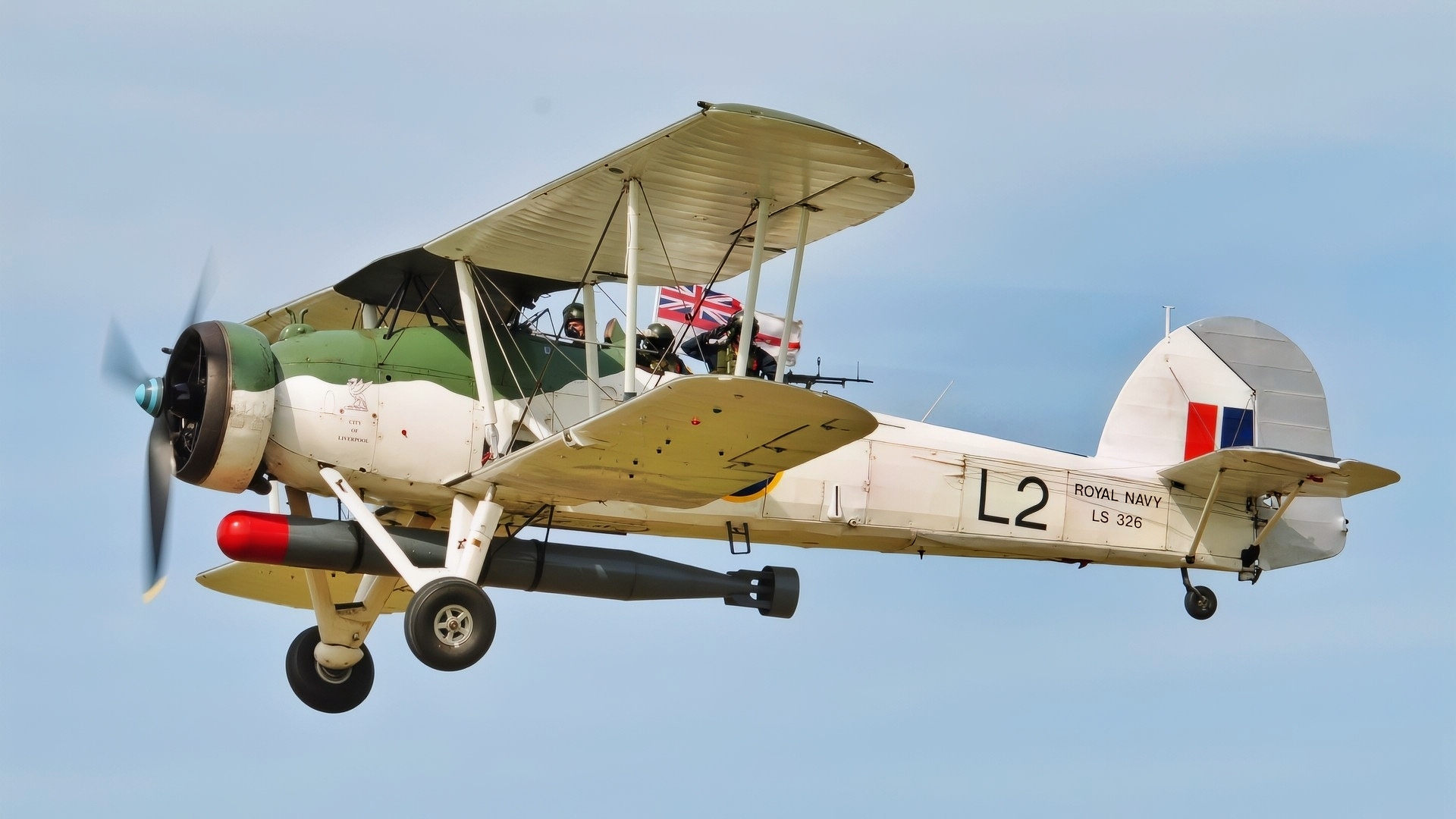
Summary and Key Points – Germany’s battleship Bismarck was a monster: more than 50,000 tons fully loaded, eight 15-inch guns, a top speed of 30 knots, and the range to hunt the convoys from the United States and Canada that fed the war in Europe. After sinking the battlecruiser HMS Hood in the Denmark Strait in May 1941, she ran for occupied France and the cover of the Luftwaffe. Britain stopped her with one of its least impressive weapons, a fabric-covered biplane called the Fairey Swordfish. A single torpedo left Bismarck unable to steer, and she never reached France.
Fairey Swordfish: The Battleship Slayer of WWII
In the early phases of the Battle of the Atlantic in the Second World War, the strategic need to cripple Germany’s small but powerful surface warfare fleet was extreme.
Specifically, the British Royal Navy desired to sink the mighty German battleship, Bismarck.
If the British could destroy that vessel, they could deal a serious blow to the German navy — and mitigate many of the risks to the essential supply convoys coming from the United States.
An Impressive German Ship
Bismarck possessed a significant set of capabilities.
It had serious anti-aircraft defenses, including 105mm, 37mm, and 20mm weapons.
This ship was a monster, too.
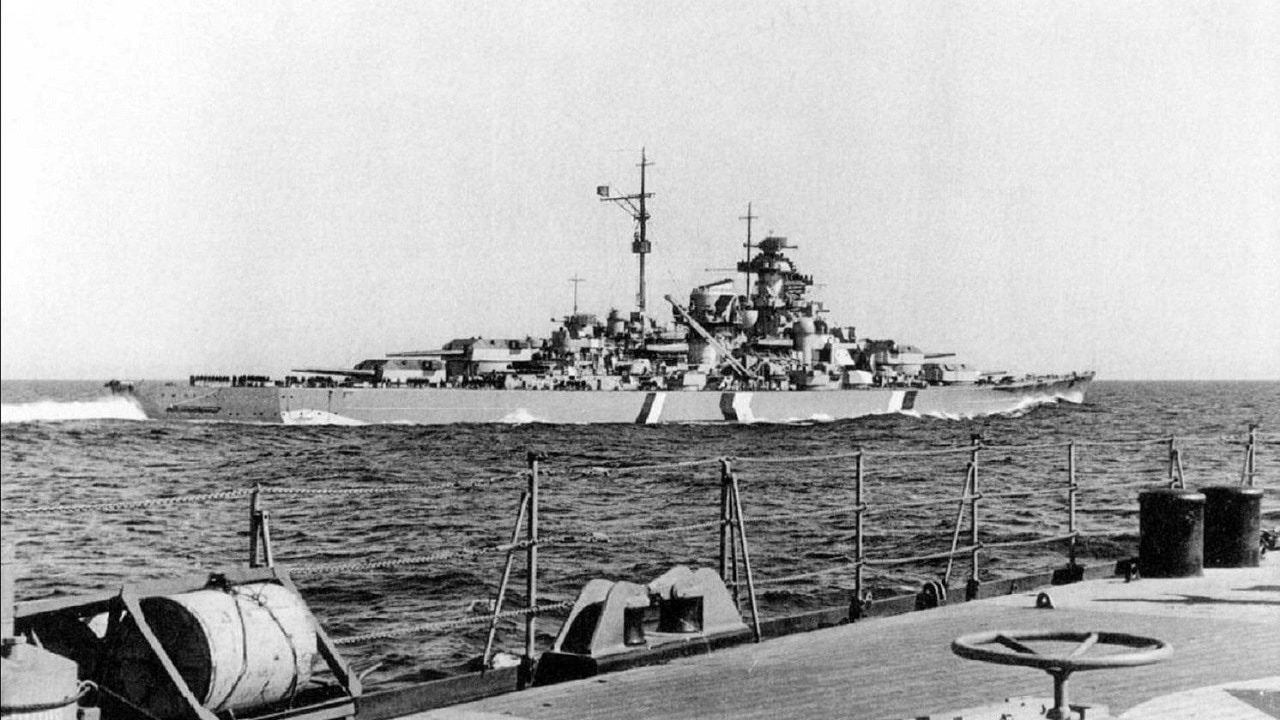
Battleship Bismarck. Image Credit: Creative Commons.
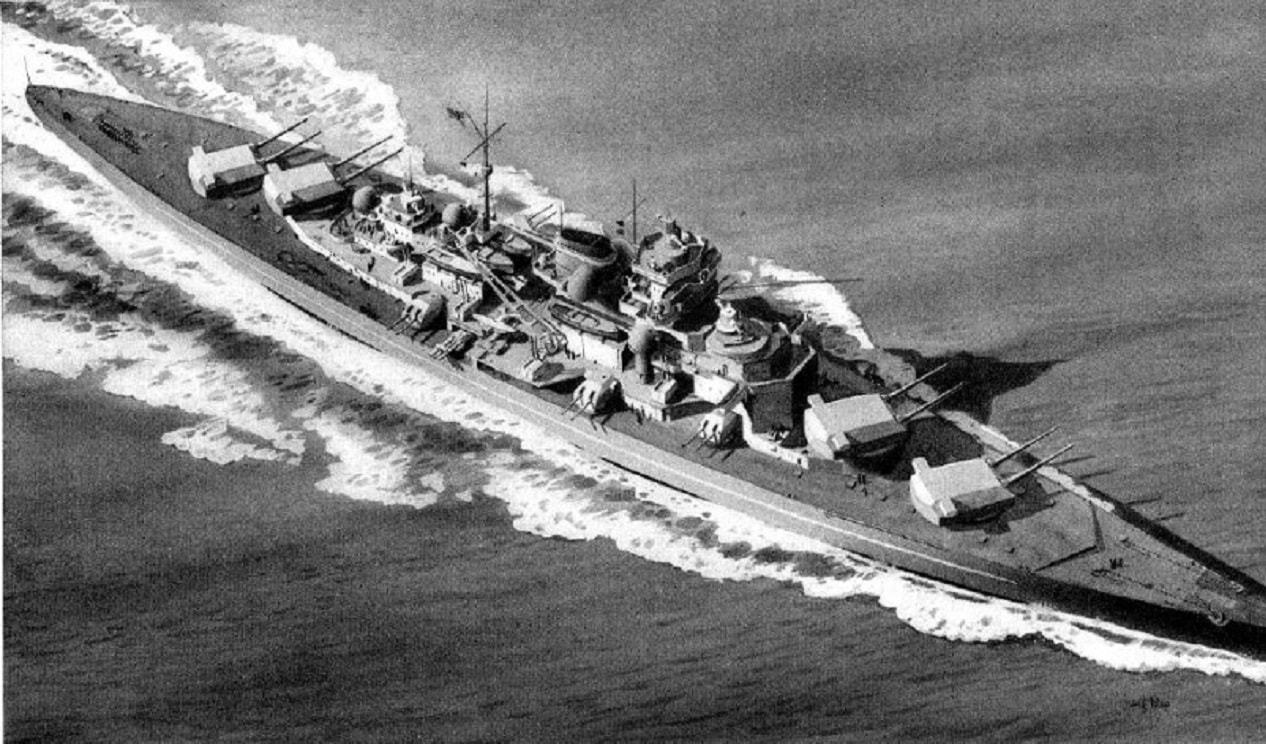
A recognition drawing of Tirpitz prepared by the US Navy.
It could displace more than 50,000 tons when fully loaded. She was powered by 12 Wagner superheated boilers and three Blohm & Voss geared steam turbines.
Bismarck could reach a top speed of 30 knots and had a range of 8,870 nautical miles (at 19 knots).
That impressive range made the Bismarck an exceptional raider against critical supply convoys from the United States and Canada that fed the European war.
In terms of armaments, besides her anti-aircraft guns, she carried eight 15-inch SK C/34 guns in four twin turrets and a secondary battery of twelve 5.9-inch guns.
What’s more, the battleship could deploy four to six Arado AR 196 Floatplanes launched from a catapult.
From an engineering perspective, it was impressive, and it caused quite a stir in the British Royal Navy.
Despite this impressive setup, the German battleship would ultimately be destroyed by what amounts to an antique.
Britain threw everything it could at the battleship. Mainly because, on May 26, 1941, the Bismarck was moving toward occupied France.
If the German battleship reached Luftwaffe air cover and the naval facilities at Brest, the British would likely not have another opportunity to destroy this potent warship for some time.
And the British fleet ultimately stopped the mighty Bismarck with one of the least impressive weapons imaginable: the Fairey Swordfish.
Even the name sounds unimpressive.
The Swordfish
A fabric-covered biplane with an open cockpit, fixed landing gear, and a maximum speed of less than 140 miles per hour (and even slower when carrying a torpedo), this plane fired the shot that crippled the Bismarck.
While even slower than its top speed of less than 140 mph, the Fairey Swordfish that took down the Bismarck was carrying a torpedo.
The torpedo was launched from the air at the battleship; it hit the Bismarck near the stern, crippled the mighty warship’s steering, and ensured its destruction.
Let’s consider the Fairey Swordfish for a moment.
It was first flown in 1934 and entered Fleet Air Arm service in 1936.
It was powered by a Bristol Pegasus radial engine that produced around 690 horsepower.
The aircraft could carry a crew of up to three.
It served in an anti-ship role, carrying a single 18-inch torpedo weighing around 1,670 pounds.
But by 1941, the Swordfish looked like an antique.
There were faster single-engine planes.
What kept the Swordfish relevant was its relative ruggedness.
The plane was maneuverable at low speeds and was easy to work.
What’s more, it could take off from short carrier decks in inclement weather.
This plane could carry torpedoes, bombs, mines, depth charges, and even rockets, and it could carry radar into battle. Those who manned the Fairey Swordfish during the war dubbed them “Stringbag.”
Yet, it was a serious threat to the capital ships of the day.
A year earlier, in November 1940, the Swordfish had launched from HMS Illustrious and attacked the Italian fleet at Taranto, damaging three Italian battleships.
Six months later, the British faced the Bismarck and again demonstrated the Swordfish’s utility against massive surface targets.
The Battle
In May 1941, the Bismarck, with its heavy cruiser escort Prinz Eugen, engaged the British battlecruiser HMS Hood and the HMS Prince of Wales in the Denmark Strait.
Hood exploded and sank within minutes of the engagement beginning.
Only three of her crew survived.
Bismarck was hit in the fighting, too. So, the battleship left that engagement and sought repairs in France.
Seeing their golden opportunity to sink the Bismarck (and avenge the Royal Navy’s wounded pride after the sinking of the Hood), the British mobilized their fleet to hunt and sink it.
Swordfish from HMS Victorious attacked the Bismarck during the night of May 24-25 and scored a torpedo hit, although it inflicted little significant damage.
But on May 26, a Catalina flying boat found Bismarck again after it had broken off contact with the British attacking force.
Fifteen Swordfish were launched from the HMS Ark Royal, enduring horrific weather conditions in the process.
After strong winds, rain, low clouds, and rough seas, German anti-aircraft defenses attacked the biplanes. Interestingly, the Swordfish biplanes’ antiquated handling was so slow and low that it may have complicated the Bismarck’s advanced anti-aircraft defenses.
In fact, no Swordfish was shot down during the attack. At least two torpedoes hit the Bismarck. The first caused minor damage.
But the other clipped the Bismarck’s stern and stopped the battleship from maneuvering. Her rudders became jammed at around 12 degrees to port.
As the battle raged, the Bismarck’s crew desperately tried to repair the steering.
In fact, the crew contemplated using explosives to free the rudders.
Everything they tried failed.
An Inauspicious End
Another day passed as the German ship limped through the sea. Finally, the Royal Navy caught up with the stricken German battleship.
The HMS Rodney and HMS King George V weakened the German ship’s superstructure through repeated hits, while the cruiser HMS Dorsetshire launched torpedoes into the stricken ship.
More than 2,000 German sailors perished.
So, the Swordfish didn’t sink the Bismarck. But it did deliver the blow that allowed the great warship to be destroyed.
About the Author: Brandon J. Weichert
Brandon J. Weichert is the Senior National Security Editor at 19FortyFive.com. He also manages The Weichert Brief on Substack. Weichert also hosts “National Security Talk” on Rumble. He is the author of four bestselling national security books, most recently A Disaster of Our Own Making: How the West Lost Ukraine (Encounter Books). Follow him via Twitter/X @WeTheBrandon.