
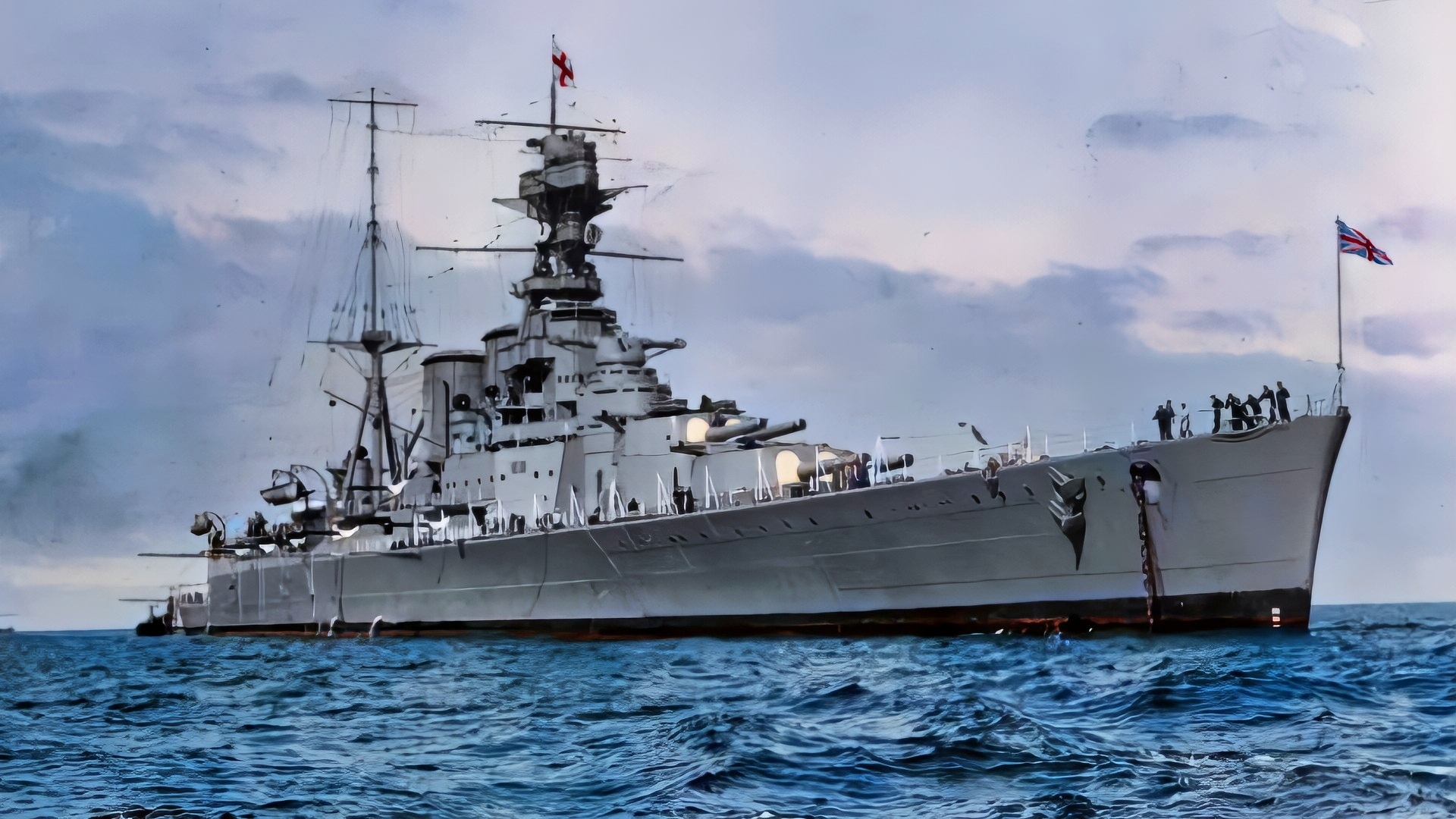
For two decades between the World Wars, HMS Hood was the most powerful warship in commission anywhere. She displaced about 42,000 tons, ran at 32 knots on trials, mounted eight 15-inch guns, and cost the British taxpayer £6,025,000, a sum the Royal Navy’s own historians record as close to twice the price of any warship it had bought before her.
She was also a battlecruiser with thin armor in one key section. To buy speed, her designers accepted horizontal protection sized for the gunnery ranges of the First World War. By 1941 those ranges had grown, and the deck armor that shielded her magazines from plunging shellfire had stayed where it was.
On the morning of May 24, 1941, in the Denmark Strait between Greenland and Iceland, a 15-inch salvo from the German battleship Bismarck reached one of Hood’s after magazines. The explosion broke the ship in half. She went down in roughly three minutes with 1,415 men aboard.
Three survived. The loss remains the worst single-ship disaster in the history of the Royal Navy, and two Boards of Enquiry and decades of forensic study have examined why she died so fast.
Britain Ordered HMS Hood to Beat a German Battlecruiser That Was Never Finished
Hood was conceived in wartime urgency.
Britain learned that Germany was building the Mackensen-class battlecruisers, and the Royal Navy wanted a faster, more powerful answer under its Emergency War Programme. John Brown & Company laid her keel at Clydebank on September 1, 1916, as yard number 460, a work that would eventually employ thousands of shipyard laborers.
She was the lead ship of a planned class of four Admiral-class battlecruisers. The other three, named Anson, Howe, and Rodney, were suspended in 1917 once it became clear the German ships would not be completed, and all three were canceled and broken up on the slip in October 1918.
Hood alone was finished.
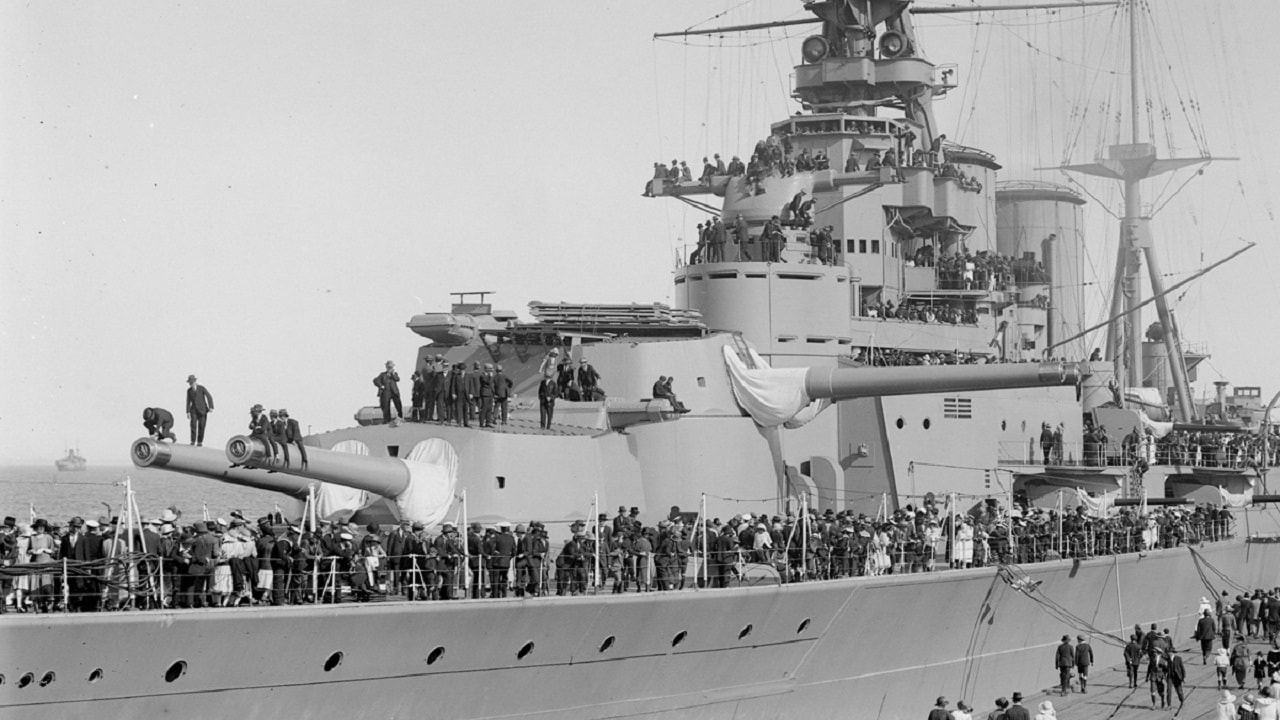
HMS Hood. Image Credit: Royal Navy.
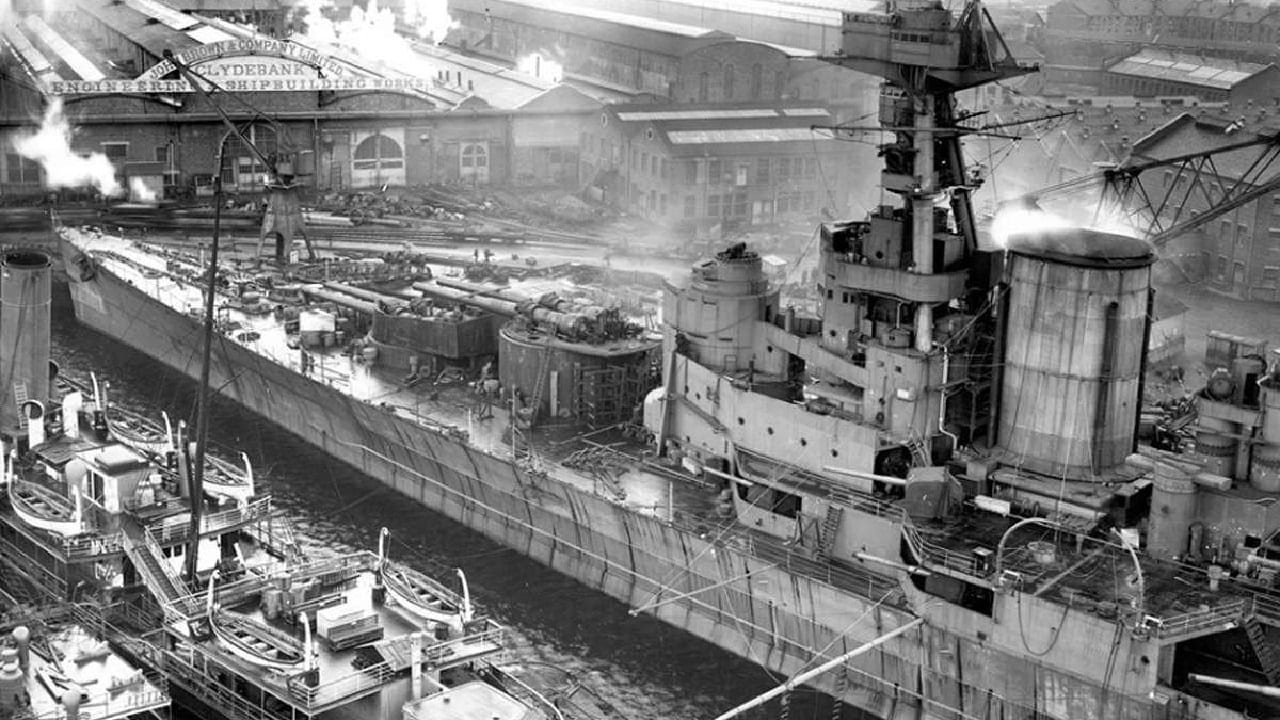
HMS Hood. Image Credit: Creative Commons.
The Battle of Jutland in May 1916 changed the ship while she was still on paper.
British battlecruisers had blown up under German fire at Jutland, and the shock prompted the Admiralty to add roughly 5,000 tons of armor to Hood’s design. To save time, the yard thickened the protection already drawn rather than redrawing the ship, leaving Hood with the deck protection that failed her in 1941.
She was launched on August 22, 1918, by Lady Hood, widow of Rear Admiral Sir Horace Hood, who had died at Jutland commanding the 3rd Battlecruiser Squadron aboard HMS Invincible, one of three British battlecruisers that exploded in that battle.
The name honored his ancestor, the 18th-century Admiral Samuel Hood.
£6,025,000 Bought the Largest Warship Afloat, and About £3 Billion Buys Its Modern Successor
£6,025,000 is the figure recorded by the HMS Hood Association, of which the builder reportedly kept about £214,000. An Admiralty estimate given to Parliament in November 1919 put the finished cost, excluding guns, ammunition, and stores, at £5,025,000, so the roughly £1 million difference covers her armament and outfit.
Putting that price in current money depends on the index and the year of the sum. Published conversions range from about £222 million to £335 million at consumer prices, with the official consumer-price basis landing near the top of that range.
Every version of the figure describes a bargain by modern standards.
Hood was the longest warship the Royal Navy had ever operated, a distinction she held for 97 years, until HMS Queen Elizabeth entered service in 2017.
The Ministry of Defence has put the acquisition cost of the two Queen Elizabeth-class carriers at about £6 billion, roughly £3 billion for each hull before aircraft and weapons. Later accounting has pushed the total for the pair to about £7.6 billion. American practice runs to the same scale, with the Gerald R. Ford-class carrier program absorbing roughly $120 billion across the class.
A modern capital ship of comparable national stature now costs close to ten times what inflation alone would predict for Hood.
Eight 15-Inch Guns on a 42,000-Ton Hull That Ran at 32 Knots
Hood measured about 860 feet in length and displaced roughly 42,000 tons at standard load, with a draft of about 47,000 tons.
She carried eight 42-calibre BL 15-inch Mk I guns in four twin turrets, the same proven weapon that armed the battleships built to fight the kind of long-range gun duel Hood herself was designed for, each barrel firing a shell of just over 1,900 pounds.
Her power came from 24 Yarrow boilers feeding Brown-Curtis geared turbines on four shafts, rated at 144,000 shaft horsepower. On trials in 1920 she made 32.07 knots, above her 31-knot design speed, and she carried close to 3,900 tons of fuel oil for a theoretical range of 7,500 nautical miles at 14 knots.
Her armor accounted for about a third of her displacement, a high proportion by British practice, with a main belt reaching 12 inches, angled outward to increase its effective thickness against flat-trajectory fire. That sloped belt worked as intended against shells arriving on a low trajectory.
The weakness lay overhead, in the horizontal armor spread across several decks.
She was commissioned on May 15, 1920, under Captain Wilfred Tomkinson. The Washington Naval Treaty of February 1922 capped new capital ships at 35,000 tons and canceled the rest of her class, but Britain was allowed to keep Hood because she had been completed so recently.
She remained the largest warship afloat for the next 20 years.
The Mighty Hood Showed the Flag From Oslo to Honolulu, Then Opened Fire on the French at Mers-el-Kébir
For most of her career Hood served as a symbol.
The press and the public called her the “Mighty Hood,” and she spent the interwar years projecting British power in distant ports, dominating anchorages from Oslo to Honolulu and Zanzibar to Rio de Janeiro. In 1923 and 1924 she circled the globe with the Special Service Squadron on the Empire Cruise. Those goodwill miles, together with tight defense budgets, kept pushing her badly needed modernization down the list.
During the Spanish Civil War, she patrolled the western Mediterranean to protect neutral shipping, and in April 1937 she trained her guns on two Spanish Nationalist cruisers that were trying to stop merchant ships bound for Bilbao. The cruisers withdrew.
Her most controversial action came after France fell. On July 3, 1940, Hood led Force H as the flagship of Vice Admiral James Somerville in Operation Catapult, the British effort to prevent the French fleet from falling under German control.
When the French commander at Mers-el-Kébir refused Britain’s ultimatum, Hood, Valiant, and Resolution opened fire at about 1754 from roughly 17,500 yards. The three ships sent 144 15-inch rounds into the harbor in about ten minutes. A hit on the old battleship Bretagne set off a magazine explosion, and about 1,300 French sailors died in an attack on ships that had recently served alongside them.
Hood’s Deck Armor Was Built for 1918 Gunnery Ranges, and the 1939 Refit Never Came
Hood’s defining weakness was in her horizontal protection. Her deck armor had been adequate at the close of the First World War, when battles were fought at moderate ranges and shells arrived on comparatively flat trajectories. As fire control improved through the 1920s and 1930s, engagement ranges lengthened, and shells began falling more steeply. A steeply descending shell strikes the deck instead of the belt, and Hood’s deck protection became her fatal flaw.
The Admiralty understood this. The Renown-class battlecruisers were reconstructed between the wars with heavier deck armor, and the Queen Elizabeth-class battleships received similar treatment.
A major reconstruction for Hood was drawn up for 1939, one that would have stripped out her 600-ton conning tower and improved her deck armor.
The reconstruction was shelved when the Second World War began in September 1939. The five King George V-class battleships were not yet in service, and Britain could not afford to remove a fast capital ship from the fleet.
Hood returned to frontline duty in the condition her critics had warned about, still carrying the decks of a 1918 design. Her officers were aware of the risk, which is why her admiral would handle her the way he did in her final battle.
A Bismarck Salvo Reached an After Magazine, and Hood Sank in About Three Minutes
In May 1941 the new German battleship Bismarck and the heavy cruiser Prinz Eugen broke out to raid Atlantic convoys.
Hood, flying the flag of Vice Admiral Lancelot Holland and commanded by Captain Ralph Kerr, sailed with the newly commissioned battleship Prince of Wales to intercept them. British cruisers shadowed the Germans into the Denmark Strait, and the two forces sighted each other shortly after dawn on May 24.
Holland drove his ships toward the enemy at speed. The tactic was deliberate, since closing the range quickly reduced the time Hood’s vulnerable decks spent exposed to plunging fire. Early in the action, a shell from Prinz Eugen started a fire among ready ammunition on Hood’s boat deck.
At about 0600 a salvo from Bismarck straddled Hood, and a 15-inch shell reached one of her after magazines. Sailors on Prince of Wales watched a pillar of flame soar above the ship, followed by an explosion that hurled chunks of turret and superstructure across the sea. The blast broke Hood’s back. Her bow rose nearly vertical before it slid under, and the last of the ship was gone within a few minutes.
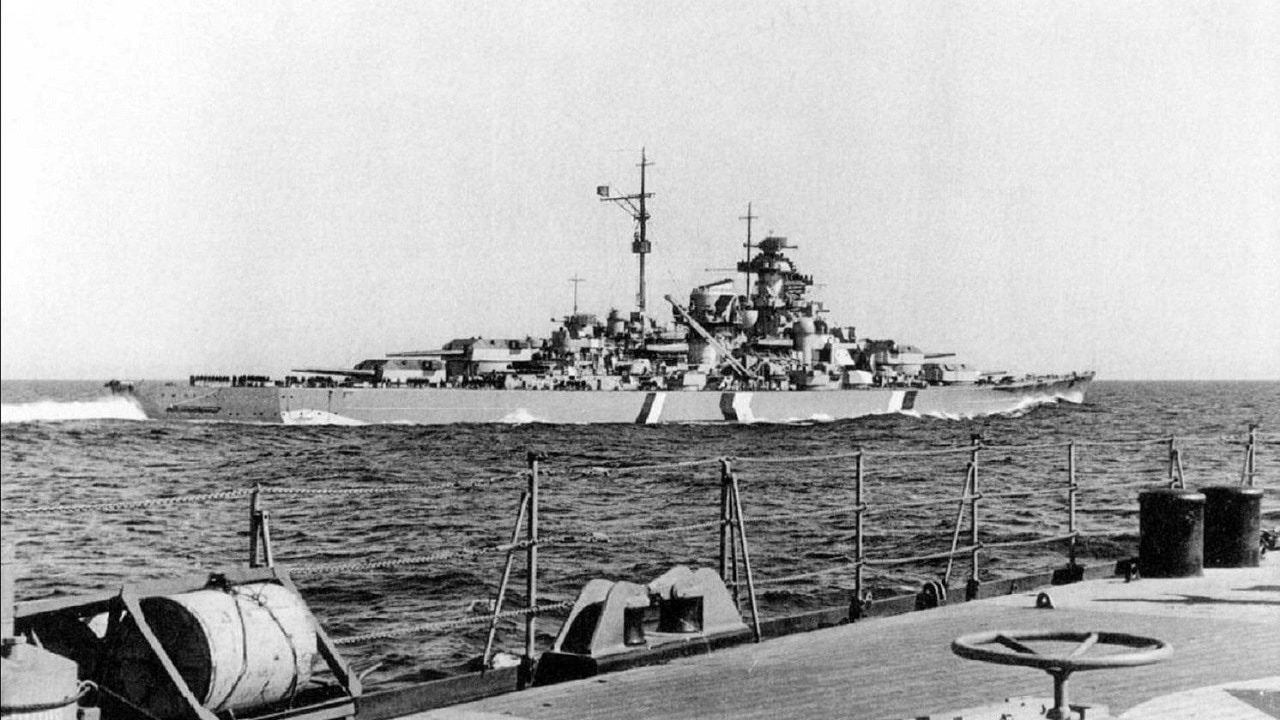
Battleship Bismarck. Image Credit: Creative Commons.
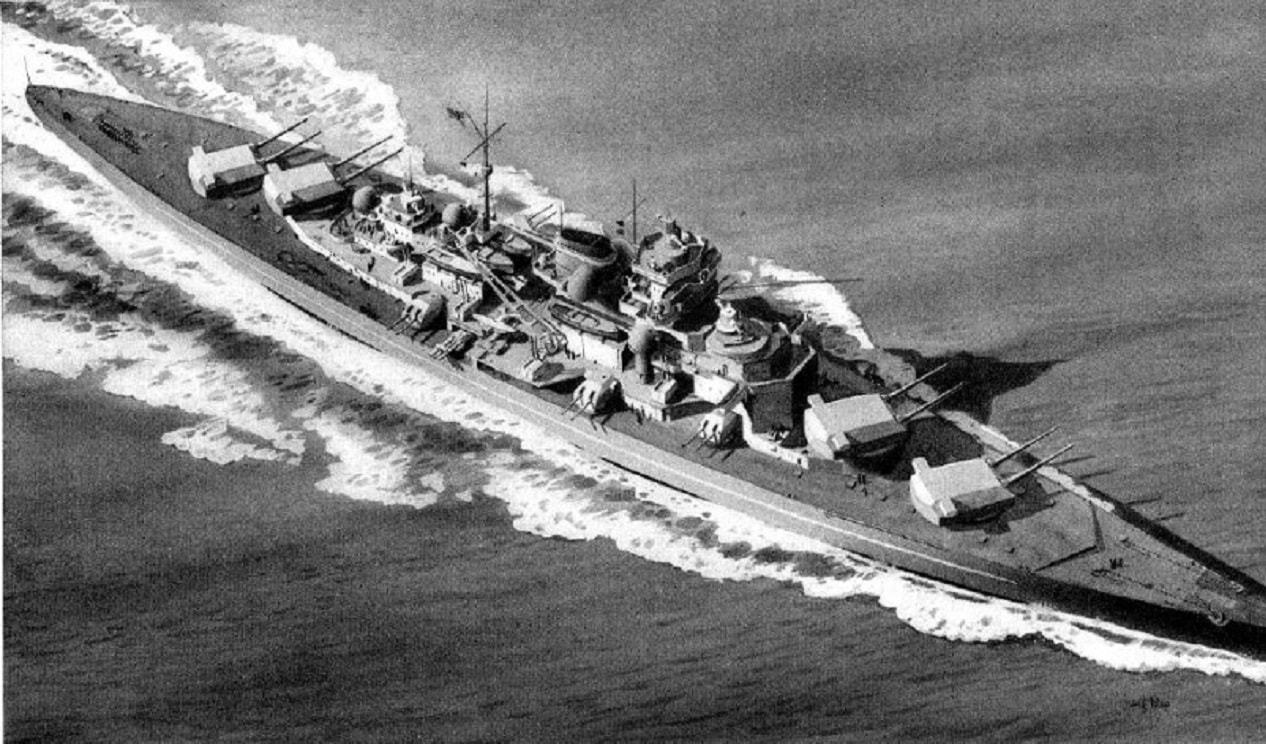
A recognition drawing of Tirpitz prepared by the US Navy.
Two Boards of Enquiry examined the loss, the second calling more than 100 witnesses and two of the survivors. Both concluded that a Bismarck shell had detonated an after magazine.
The exact path the shell took through Hood’s protection was never established with certainty, and marine forensic studies of the wreck have continued to debate it.
The outcome was not in doubt. Of Hood’s company, 1,415 men were lost, including Admiral Holland and Captain Kerr.
About the Author: Harry J. Kazianis
Harry J. Kazianis (@Grecianformula) was the former Senior Director of National Security Affairs at the Center for the National Interest (CFTNI), a foreign policy think tank founded by Richard Nixon based in Washington, DC. Harry has over a decade of experience in think tanks and national security publishing. His ideas have been published in the NY Times, The Washington Post, The Wall Street Journal, CNN, and many other outlets worldwide. He has held positions at CSIS, the Heritage Foundation, the University of Nottingham, and several other institutions related to national security research and studies. He is the former Executive Editor of the National Interest and the Diplomat. He holds a Master’s degree focusing on international affairs from Harvard University.

