
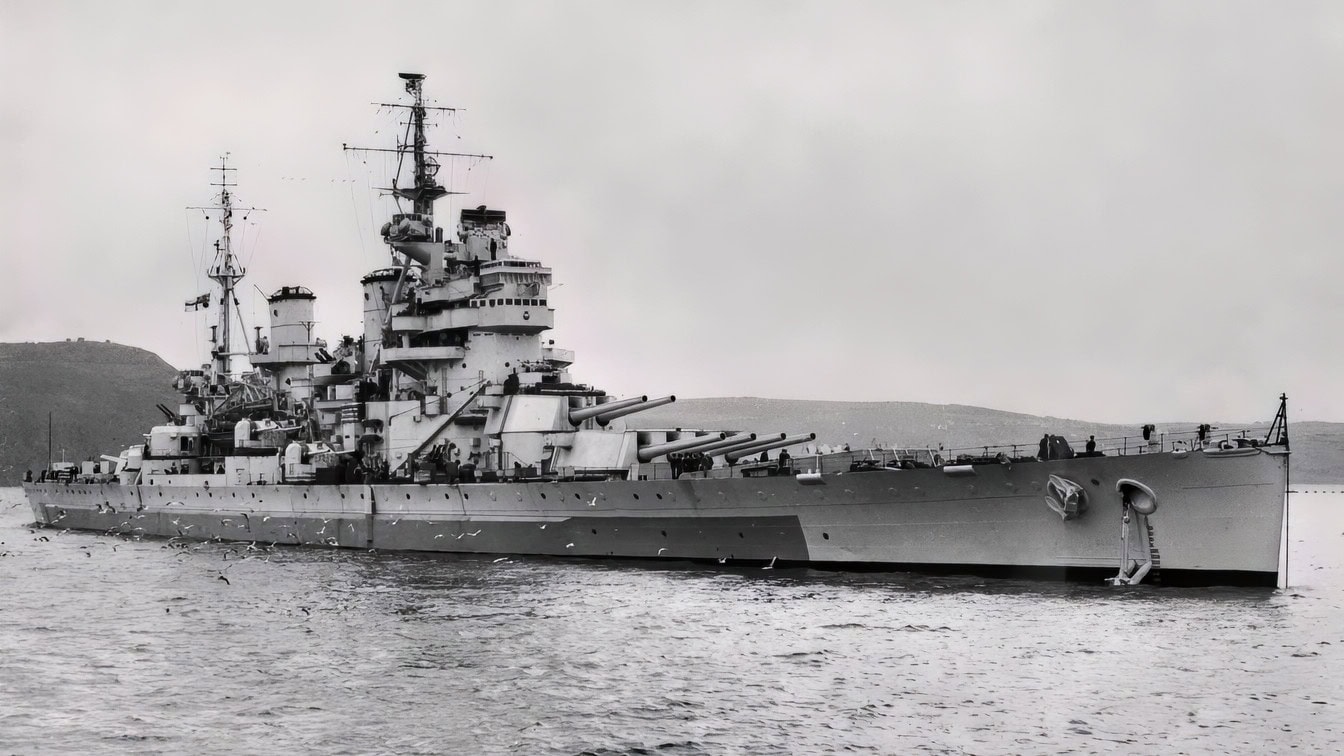
Lion Class by the Numbers: 46,400 Tons, Nine 16-Inch Guns and Zero Completed Ships: Britain laid down two Lion-class battleships in 1939 and launched neither. Temeraire began at Cammell Laird in Birkenhead on June 1, while Lion followed at Vickers-Armstrongs’ Walker yard on the Tyne on July 4. Both were expected to enter service in 1942, but work stopped after World War II began.
The approved 1938 design displaced 40,550 long tons under standard conditions and 46,400 long tons at deep load. Lion would have measured 785 feet overall, with a 105-foot beam and a 33-foot maximum draft. Eight boilers and four Parsons geared turbines were intended to produce 130,000 shaft horsepower through four propellers, giving the ship a 30-knot top speed.
The planned main battery consisted of nine 16-inch/45-caliber Mark II guns in three triple turrets. Each fired a 2,375-pound armor-piercing shell, producing a 21,375-pound broadside. Sixteen 5.25-inch dual-purpose guns and 48 two-pounder “pom-pom” antiaircraft guns completed the principal armament.
The Admiralty projected as many as six ships, although Lion and Temeraire were the only hulls laid down. No exact completed-ship price exists. During a March 1939 parliamentary debate, one member placed Britain’s seven new battleships between £60 million and £70 million combined. That was a program estimate, not a final Lion contract price.
The Treaty System Gave Britain a 16-Inch Battleship
The King George V-class had been shaped by the Second London Naval Treaty’s 35,000-ton limit and 14-inch gun ceiling. Japan’s refusal to accept the restrictions triggered an escalator process that raised the permitted maximum to 45,000 tons and 16-inch guns. Britain stopped near 40,000 tons standard because larger ships strained dock dimensions, budgets and shipyard capacity.
Lion therefore became a larger development of King George V rather than a clean-sheet design. The main belt reached 14.7 inches, and a transom stern improved efficiency at high speed. The estimated crew reached about 1,680 officers and ratings. On paper, the class belonged among the strongest battleship designs of its generation.
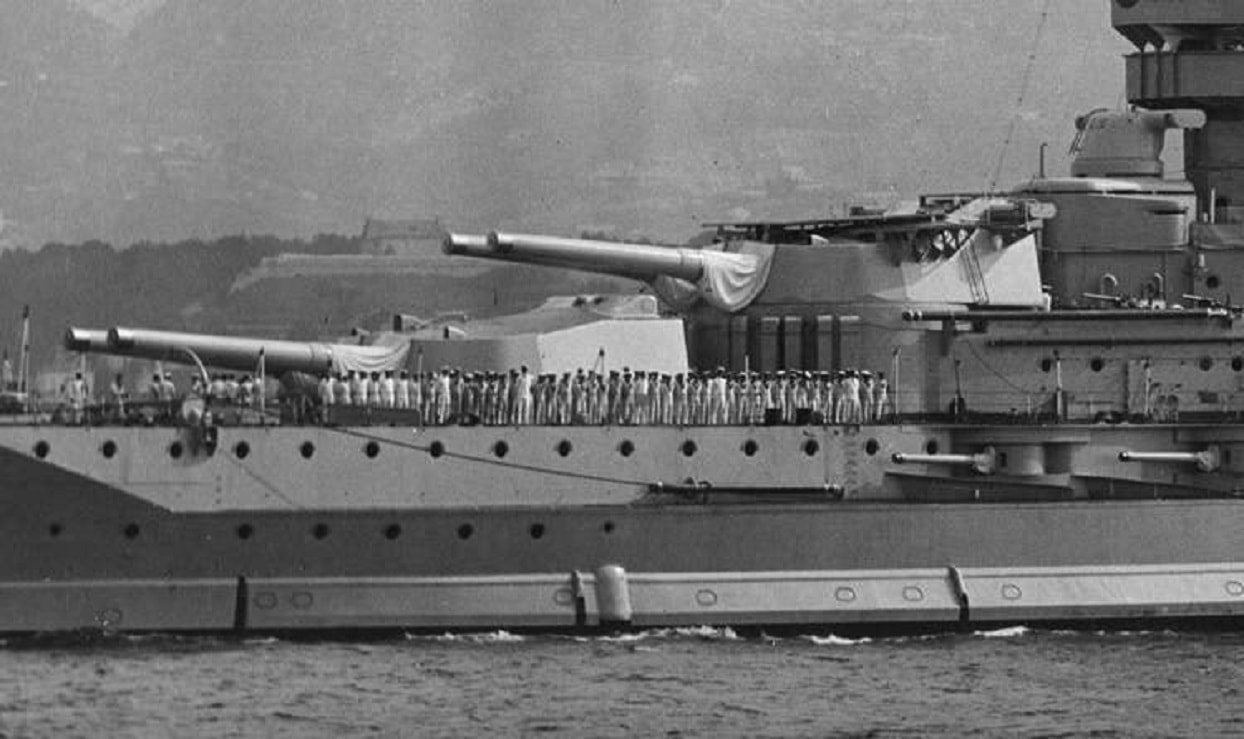
Queen Elizabeth Battleships. Image: Creative Commons.
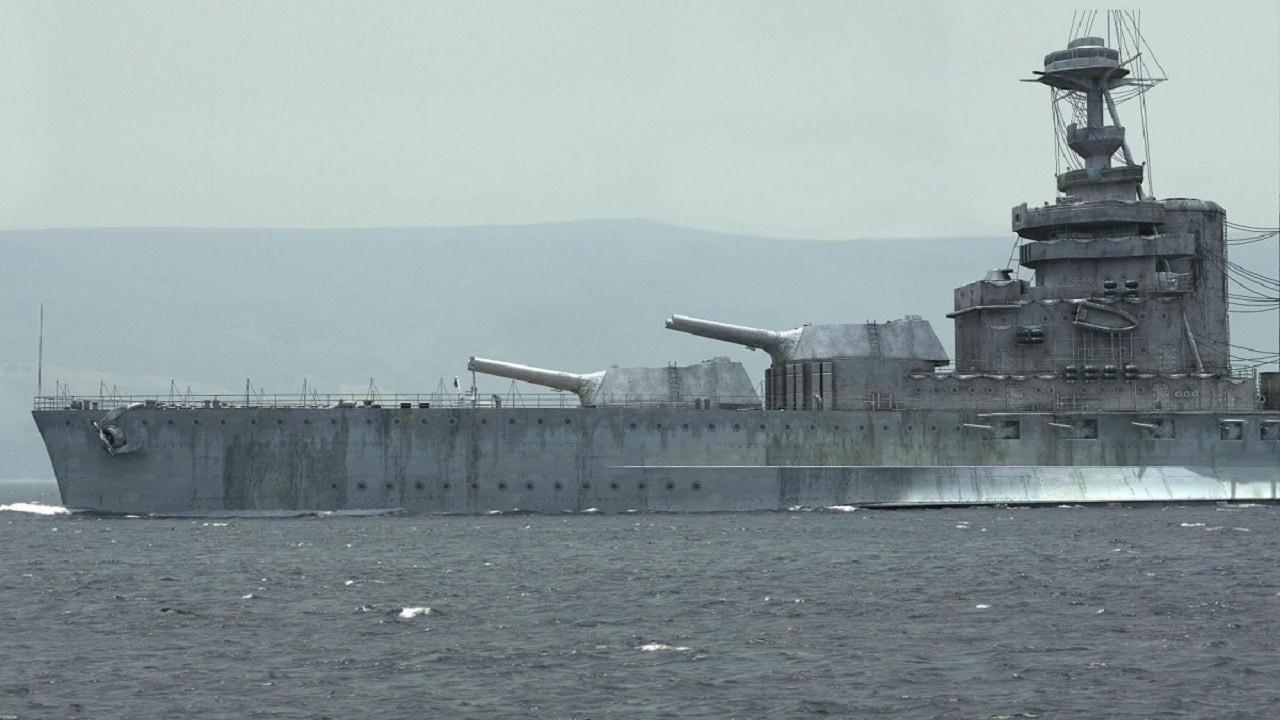
Queen Elizabeth–class Battleship Artist Rendering. Creative Commons Image.
Nine 16-Inch Guns Defined the Lion Class
The new Mark II gun weighed about 133 tons and was rated for two rounds per minute. Each ship was designed to carry 100 rounds per barrel, or 900 main-battery projectiles. A full salvo outweighed the broadside of the 14-inch King George V class and Germany’s eight-gun Bismarck.
The class would have been broadly comparable to contemporary American 16-inch battleships, though smaller and less heavily armed than Japan’s Yamato class. Its 5.25-inch battery was intended to engage aircraft and smaller surface ships, while the pom-poms provided close antiaircraft defense.
Two Lion-Class Hulls Reached the Slipway
Lion and Temeraire were suspended on October 3, 1939, briefly retained as projects, then stopped again as labor and materials moved to ships able to affect the war sooner. British construction tables record a final stop on March 27, 1941, and cancellation on January 31, 1944.
Conqueror and Thunderer were intended to follow but never reached their slipways. Heavy-gun production created another delay because Britain had limited capacity to manufacture triple 16-inch mountings. A detailed history of the program’s slow collapse places assembled material at only about 218 tons for Lion and 121 tons for Temeraire.
Escorts and Aircraft Carriers Took Priority
The Royal Navy needed destroyers, corvettes and other escorts to protect Atlantic supply routes from German submarines. Shipyards also had to repair damaged vessels and complete aircraft carriers whose strike range extended far beyond battleship gunfire. Wartime records show other warship projects being delayed to give escort construction priority.
Combat reinforced the shift. Carrier aircraft helped disable Bismarck, Japanese aircraft sank Prince of Wales and Repulse, and Midway demonstrated how carrier air groups could destroy capital ships without a gun duel. Existing battleships remained useful for convoy cover, carrier escort and shore bombardment, as HMS Warspite’s wartime record demonstrated. A Lion arriving late did not solve the immediate shortage of escorts and flight decks.
HMS Vanguard received priority partly because Britain already possessed four twin 15-inch turrets built for earlier battlecruisers. Reusing those weapons avoided waiting for six new triple 16-inch mountings. Vanguard still entered service in 1946.
The 1942 Redesign Became Heavier and Slower
The Admiralty continued revising Lion after construction stopped. A 1942 version grew to 42,550 long tons standard and about 47,650 tons at deep load. Length increased to 793 feet and beam to 108 feet. The unchanged 130,000-horsepower plant now produces an estimated 28.25 knots.
The revision increased endurance to about 16,500 nautical miles at 10 knots, deepened the torpedo-protection system and removed the aircraft facilities. Light anti-aircraft armament rose to 76 pom-pom barrels. Each attempt to absorb wartime lessons increased size, cost and construction time. Later studies became heavier before the Admiralty rejected further Lion-class work in 1945.
Lion Would Have Been Britain’s Most Powerful Battleship
A completed Lion would have given the Royal Navy its most powerful battleship main battery.
Its speed suited Home Fleet operations against Tirpitz and Scharnhorst, Arctic convoy cover, Mediterranean service and carrier escort.
In the Pacific, the 16-inch guns would have provided heavy shore bombardment and another armored escort for British carriers.
The class would have added firepower and redundancy rather than changed the direction of the naval war.
Britain already used King George V-class ships, older battleships and carriers for most of those missions.
Aircraft, submarines, radar, escorts and logistics increasingly decided whether a fleet reached its target.
Royal Museums Greenwich preserves the Admiralty’s Lion-class design drawing dated December 15, 1938. Lion and Temeraire together never advanced beyond about 339 tons of assembled steel.
About the Author: Harry J. Kazianis
Harry J. Kazianis (@Grecianformula) was the former Senior Director of National Security Affairs at the Center for the National Interest (CFTNI), a foreign policy think tank founded by Richard Nixon based in Washington, DC. Harry has over a decade of experience in think tanks and national security publishing. His ideas have been published in the NY Times, The Washington Post, The Wall Street Journal, CNN, and many other outlets worldwide. He has held positions at CSIS, the Heritage Foundation, the University of Nottingham, and several other institutions related to national security research and studies. He is the former Executive Editor of the National Interest and the Diplomat. He holds a Master’s degree focusing on international affairs from Harvard University.

