
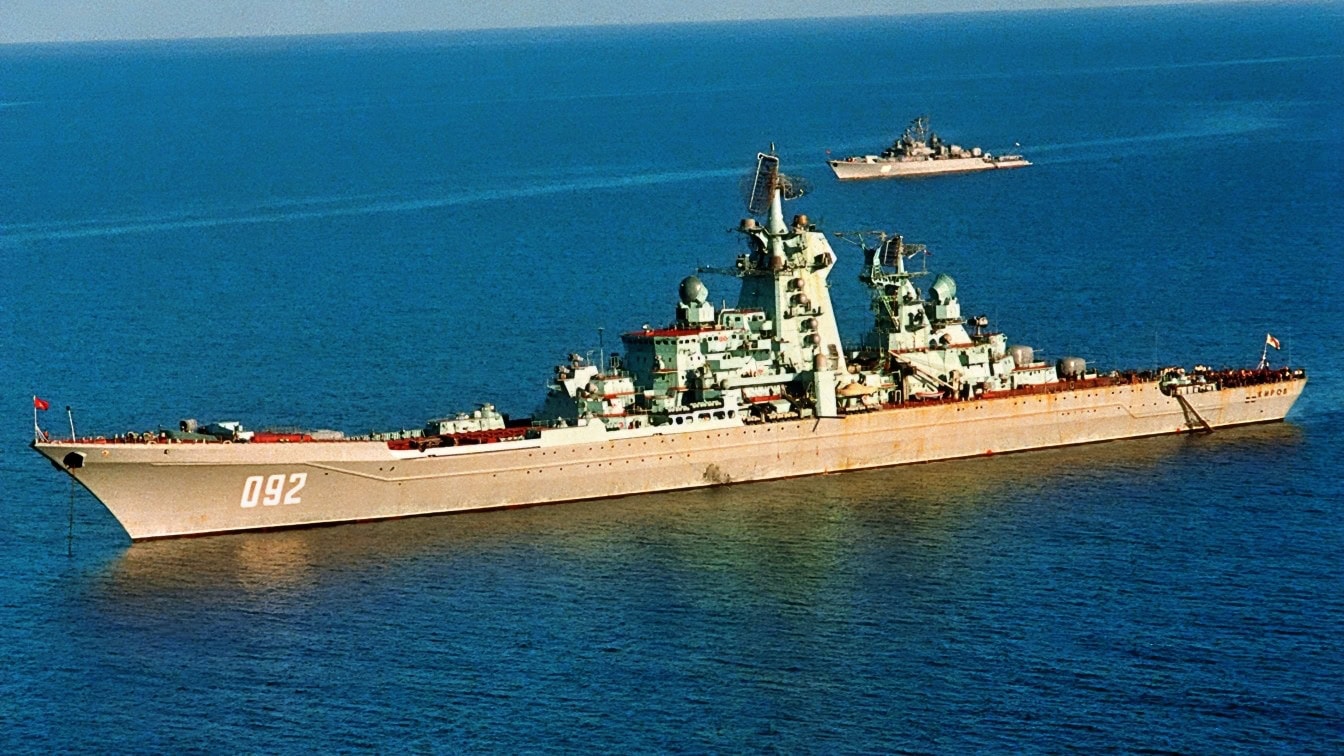
Russia’s Admiral Nakhimov Has More Missile Cells Than the Proposed Trump-Class on Paper: Russia expects the nuclear-powered battlecruiser Admiral Nakhimov to enter service before the end of 2026, nearly three decades after the Kirov-class ship disappeared into repair. Russian Navy commander Adm. Alexander Moiseyev said on July 26 that the cruiser was completing trials and would join the fleet this year.
The 28,000-ton warship returned to Severomorsk in late June for the first time in 27 years, according to satellite imagery and local photographs. Its arrival places the rebuilt cruiser at the Northern Fleet’s main base near the Barents Sea.
Open-source estimates give Admiral Nakhimov roughly 176 major missile cells: 80 universal strike cells and 96 long-range air-defense cells. The first number is well supported. Janes confirmed ten eight-cell UKSK modules, while reporting remains divided over whether the defensive battery uses a naval S-300 derivative, an S-400 variant or another configuration.
That estimated total exceeds the current Trump-class concept. U.S. Navy presentations describe 128 Mk 41 vertical-launch cells plus 12 dedicated Conventional Prompt Strike positions, or 140 major launch positions. The comparison is not exact, but it matters: Russia is preparing to operate a ship with a deeper missile magazine than the American battleship announced in December 2025, while the U.S. design remains under development.
Admiral Nakhimov Replaced 20 Granits With 80 Flexible Strike Cells
The original cruiser carried 20 enormous P-700 Granit anti-ship missiles built to attack American carrier groups. The modernization replaced them with 80 cells able to carry Kalibr land-attack and anti-ship missiles, P-800 Oniks anti-ship weapons, Zircon hypersonic missiles and Otvet anti-submarine weapons. The broader target set explains why the 176-cell estimate attracts so much attention.
Those cells let commanders alter the load for a specific deployment. A Northern Fleet patrol might emphasize anti-ship weapons and air defense. A distant strike mission might carry more Kalibr missiles. The cruiser’s value comes from magazine depth and flexibility, not from filling every position with Zircons. The rebuilt Kirov-class arsenal places several missile batteries on one hull.
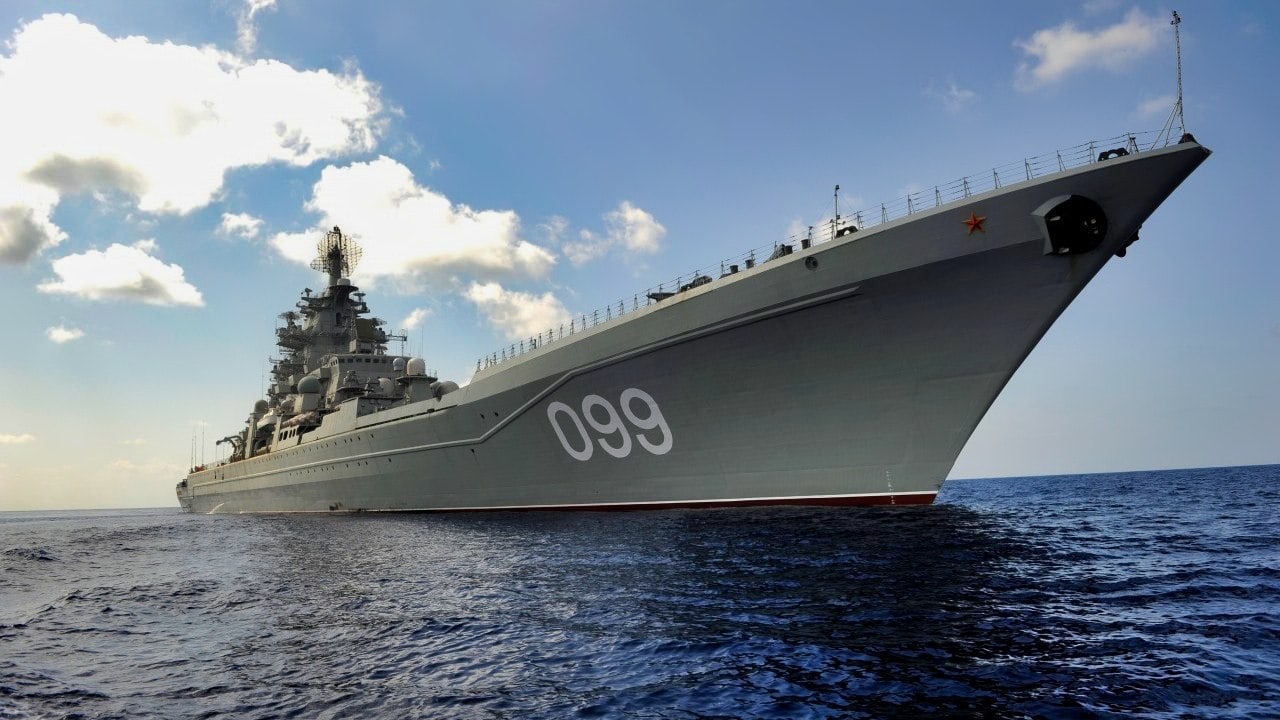
Kirov-Class Battlecruiser Russian Navy
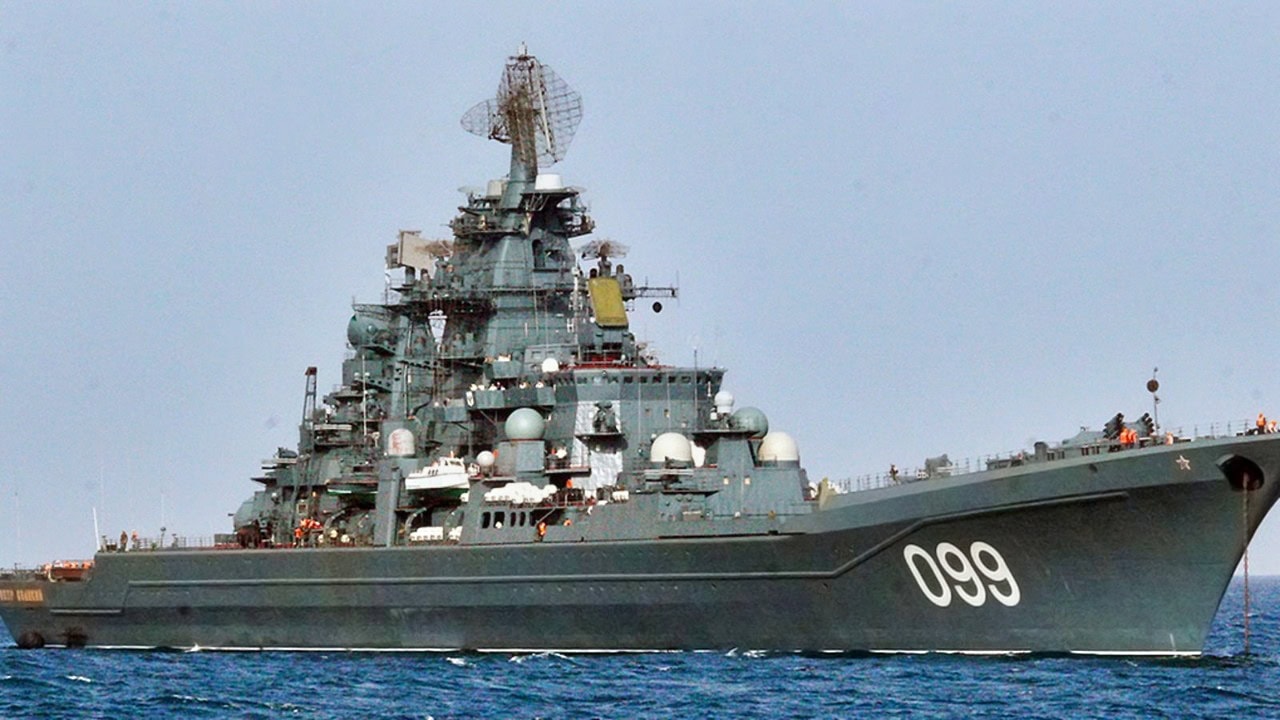
Kirov-Class Battlecruiser Russian Navy. Image Credit: Creative Commons.
The Air-Defense Magazine Gives Russia an Arctic Fleet Hub
The estimated 96 defensive cells matter because Admiral Nakhimov is expected to operate near Russia’s most important naval nuclear forces. A deep air-defense magazine gives the Northern Fleet a command ship able to protect nearby vessels, defend approaches to submarine patrol areas and remain on station without frequent fuel stops. Both KN-3 reactors were restarted by February 2025, according to reporting on the propulsion overhaul.
The ship would complicate NATO planning in the Norwegian and Barents seas. Long-range interceptors, Zircon and Oniks missiles, anti-submarine weapons and helicopters give one platform several ways to contest the same operating area. It gives Russia a heavily armed node around which frigates, submarines, aircraft and shore-based sensors can operate. The cruiser’s strongest mission is likely to be close to Russia’s northern support network, not alone in distant waters.
The Trump-Class Comparison Shows Why Magazine Depth Is Back
The proposed Trump-class follows similar logic on a larger American hull. Current planning calls for a nuclear-powered ship designed to deliver high-volume long-range fires and serve as a forward command platform. The Navy now wants 15 ships, with the lead vessel estimated at roughly $17.5 billion, according to the May 2026 shipbuilding plan.
Its 128 Mk 41 cells would carry a mix of Tomahawks and Standard Missile interceptors, while 12 larger positions would support Conventional Prompt Strike weapons. That is fewer major launch positions than Admiral Nakhimov’s estimated 176, although Mk 41 cells can carry different weapons and some can hold multiple smaller interceptors. The Trump-class missile-arsenal concept also includes sensors, command facilities and future weapons that a cell count misses.
The common problem is rearmament. Once a vertical-launch cell is fired, replacing its missile at sea remains difficult. The U.S. Navy demonstrated an underway Mk 41 reload in 2024, but the capability is not routine across the fleet. A deeper magazine keeps a ship in combat longer before it must withdraw. That is one reason both navies are again studying giant missile carriers.
Admiral Nakhimov Concentrates Enormous Value on One Hull
Cell count alone does not determine combat power. Admiral Nakhimov still needs reliable radars, external targeting data, escorts, trained crews and working combat systems. Its immense radar signature makes concealment difficult, while mechanical failure or battle damage threatens the entire magazine. Russia spent decades and billions of dollars restoring a capability that exists in only one modernized hull.
The same warning applies to the Trump-class. A large arsenal ship offers endurance, electrical power, command space and missile capacity, but every dollar and launcher placed aboard it becomes unavailable elsewhere. A distributed force is harder to disable with one successful attack and can cover more ocean. A giant combatant offers concentration; a larger fleet offers redundancy.
Russia now has to prove the rebuilt ship can deliver this capability at sea. Moiseyev says the cruiser will enter service this year, but Moscow has not publicly disclosed its final missile load or announced completion of the combat-system trials.
About the Author: Harry J. Kazianis
Harry J. Kazianis (@Grecianformula) was the former Senior Director of National Security Affairs at the Center for the National Interest (CFTNI), a foreign policy think tank founded by Richard Nixon based in Washington, DC. Harry has over a decade of experience in think tanks and national security publishing. His ideas have been published in the NY Times, The Washington Post, The Wall Street Journal, CNN, and many other outlets worldwide. He has held positions at CSIS, the Heritage Foundation, the University of Nottingham, and several other institutions related to national security research and studies. He is the former Executive Editor of the National Interest and the Diplomat. He holds a Master’s degree focusing on international affairs from Harvard University.