
What Iran Tells Us About the Trump-Class Battleship Idea
When the United States and Israel launched large-scale strikes against Iran in late February, the opening phase of the conflict followed a common pattern, starting with stealth aircraft penetrating the airspace and clearing the way for other assets.
Cruise missiles struck fixed targets, and naval forces also projected power from a standoff range. But what has followed since poses a challenge that U.S. planners must now confront, because sustaining that level of firepower is difficult.
In the first four weeks alone, U.S. forces fired more than 850 Tomahawk cruise missiles at Iranian targets, according to reports citing U.S. defense officials. That expenditure rate has triggered concerns inside the Pentagon about stockpiles and production capacity. And for good reason.
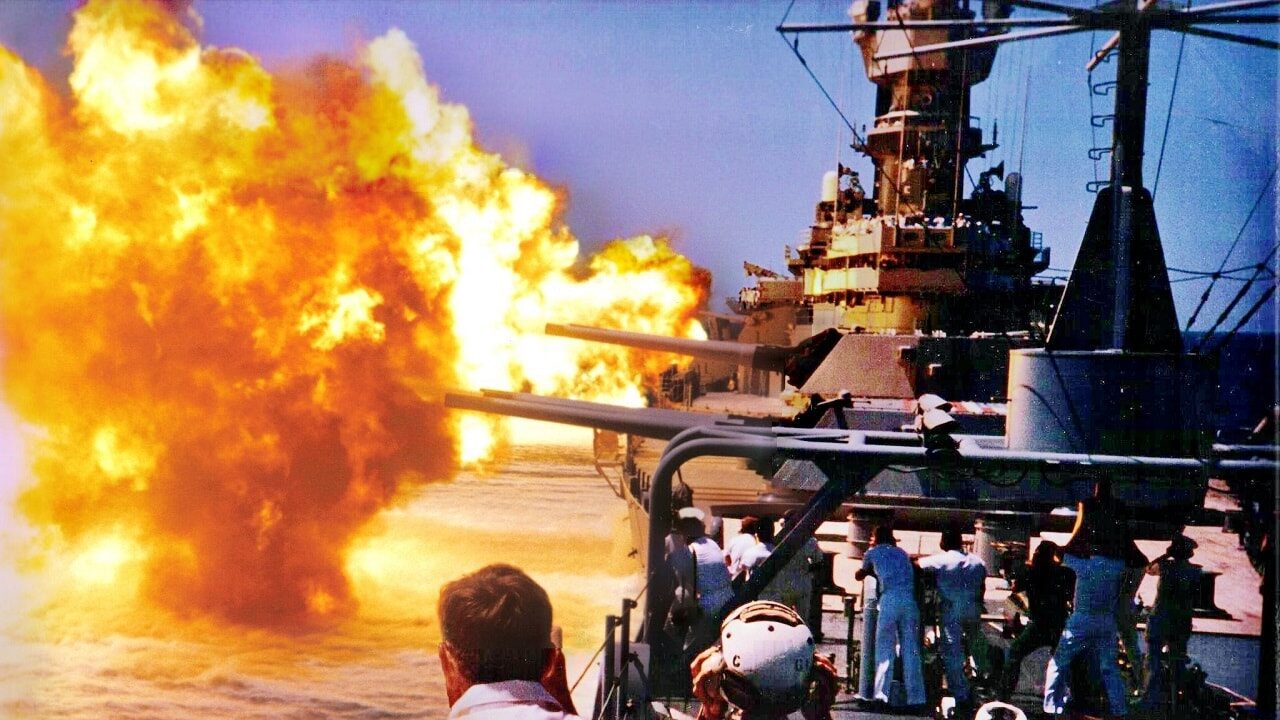
Battleship USS Iowa. Image Credit: Creative Commons.
But before the Iran conflict escalated to this level, the Trump administration proposed a new class of warship designed to carry large numbers of missiles and hypersonic weapons.
Known as the “Trump-class,” the ships have proven somewhat controversial, with analysts and observers debating whether they represent a sensible use of resources or whether they might even survive the many layers of bureaucracy and negotiations that precede production. But could the conflict in Iran have just exposed a genuine gap that such a ship could fill? Or has it reinforced the risks of concentrating too much capability in a single platform?
What the Trump-Class Battleship Is Meant To Be
The Trump-class is not designed to be a return to the heavily armored, gun-centric battleships of the 20th century. Visit any old Iowa-class battleship and you will understand that real fast, like we did last summer.
Battleship USS Iowa Logo 19FortyFive Image.
The concept, formally referred to as BBG(X), is closer to a large surface combatant or “arsenal ship” than a battleship of old, built around missile capacity and command functions.
The ship, announced in December 2025, is expected to displace roughly 30,000 to 40,000 tons. That’s more than double the size of the Arleigh Burke-class destroyer and significantly larger than the 15,000-ton Zumwalt-class. It will also be heavily armed, with plans calling for around 128 vertical launch system (VLS) cells capable of firing Tomahawk cruise missiles, SM-series interceptors, and other munitions, alongside a dedicated launcher for hypersonic Conventional Prompt Strike weapons.
The ship could also carry a nuclear-capable sea-launched cruise missile, restoring a capability that has been debated within U.S. nuclear policy circles for years. But beyond missiles, the concept includes systems that are at varying stages of development, including electromagnetic railguns and high-energy laser weapons, as well as advanced sensors built around the AN/SPY-6 radar architecture.
Just as important as its weapons is its intended role. U.S. defense officials have stressed the urgent need for a new class of ships with advanced capabilities spanning both sensors and weapons, noting that it could serve as a potential command-and-control node to replace capabilities lost as Ticonderoga-class cruisers retire.
Rear Admiral Derek Trinque made the case for a new ship, insisting that the proposed Trump-class is more than a revival of old designs.
“Battleships are obsolete. This is not us blowing the dust off the design of the Montana-class, which was to be a successor to the Iowa-class at the end of World War II, and then we won World War 2, we didn’t need the Montana-class. It’s true we don’t need that class. This is a ship we do need,” Trinque said.
Critics might allege that the idea for huge new battleships is a nostalgic vanity project, but in reality it is an attempt to concentrate modern naval warfare capabilities and requirements into a single, high-capacity hull.
What the Iran War Reveals About U.S. Naval Firepower Limits
The Iran war helps explain why the idea of concentrating firepower into one hull has resurfaced in recent years. The most immediate issue to consider is how rapidly missile stocks can be depleted in a high-tempo conflict.
Hundreds of Tomahawk missiles were used within only a matter of weeks – and that was a conflict against a much less capable military power. It proves just how quickly precision munitions are expended in sustained operations.
That problem is also compounded by the structure of the fleet. A typical Arleigh Burke-class destroyer carries around 90 to 96 VLS cells, while the Ticonderoga-class cruisers – long the Navy’s most heavily armed surface combatants – carry 122.
As those cruisers retire, total available missile capacity at sea is already declining. Importantly, those cells cannot be easily replenished in combat.
There is currently no widely fielded capability to reload VLS systems at sea under operational conditions, meaning that once a ship expends its missiles, it must withdraw to a secure port or logistics hub to rearm. Submarines also face similar constraints. While Ohio-class guided missile submarines can carry large numbers of Tomahawks, they are being retired, and Virginia-class boats carry significantly smaller payloads unless equipped with additional modules.
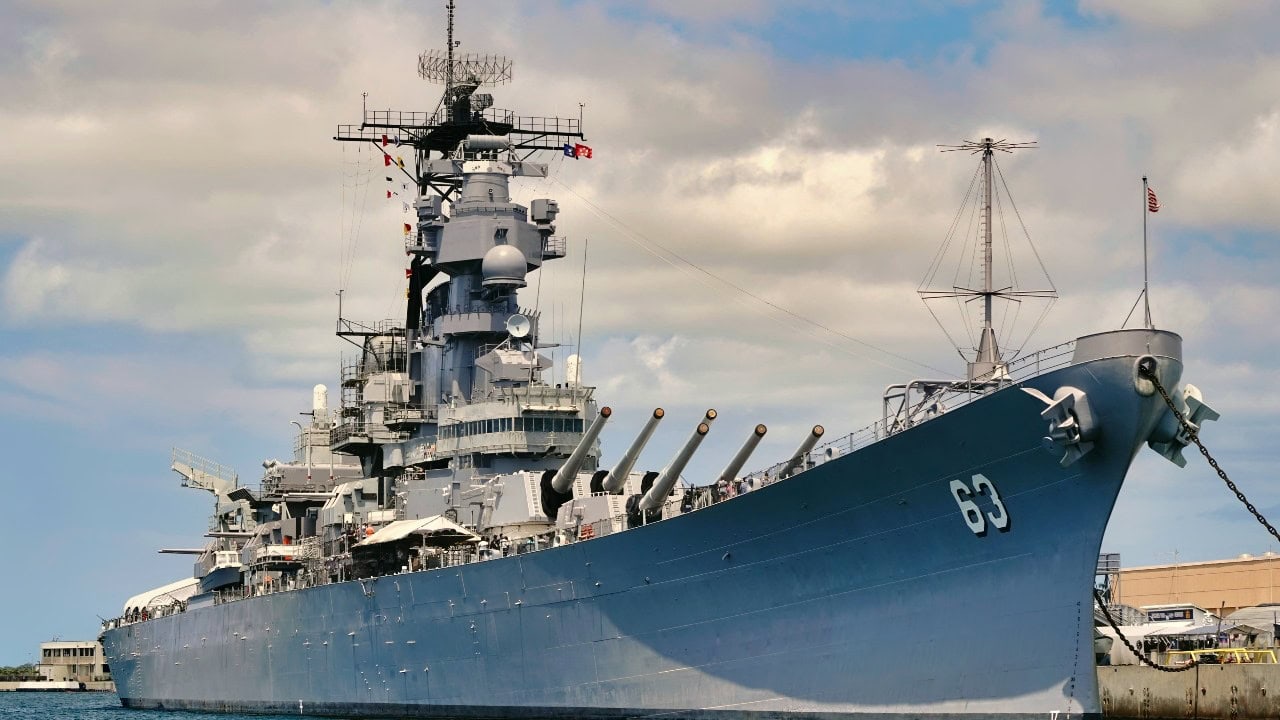
Iowa-Class Battleship at Port. Image Credit: Creative Commons.
Carrier air wings provide another form of strike capacity, of course, but they are also constrained – just in different ways. Sortie generation rates depend on deck cycles and maintenance, as well as the distance between carrier and target, and carriers operating within range of Iranian ballistic and cruise missiles must manage their exposure carefully. Even if they have layered defense systems to protect them.
Much of the operating area around Iran, including the Persian Gulf and surrounding waters, falls within the range of Iranian missile systems. U.S. bases in the region are also exposed to strikes.
It’s clear, then, that the United States can generate enormous strike power at the outset of a conflict. It can even do it at short notice. But sustaining that output over time is significantly more difficult – not just in terms of manufacturing sufficient numbers of missiles, but in fielding vessels and assets capable of firing them over long periods.
The Case for a More Heavily Armed Surface Combatant
This is where the proposed Trump-class comes in. A ship with 128 or more VLS cells, supplemented by hypersonic launchers and potentially other, more advanced systems, represents a sizeable increase in strike capacity per hull.
In a campaign like Operation Epic Fury, U.S. forces are managing. But in an operation against a stronger adversary, a larger surface combatant could remain on station longer, continue delivering strikes without quickly needing to be resupplied, and reduce the operational tempo – the rate at which ships are forced to cycle in and out of the fight – across the rest of the fleet.
The Trump-class would also offer a degree of flexibility, with a single platform being capable of conducting land-attack missions as well as contributing to air and missile defense and even coordinating operations across multiple units.
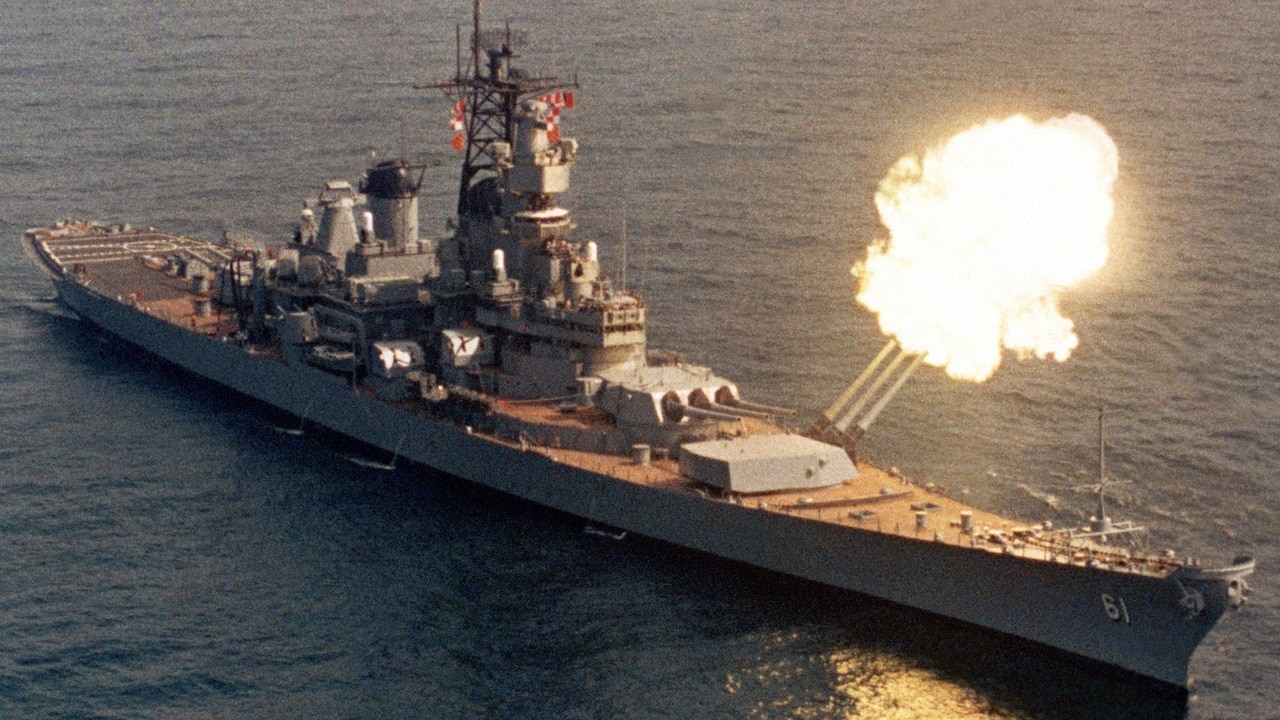
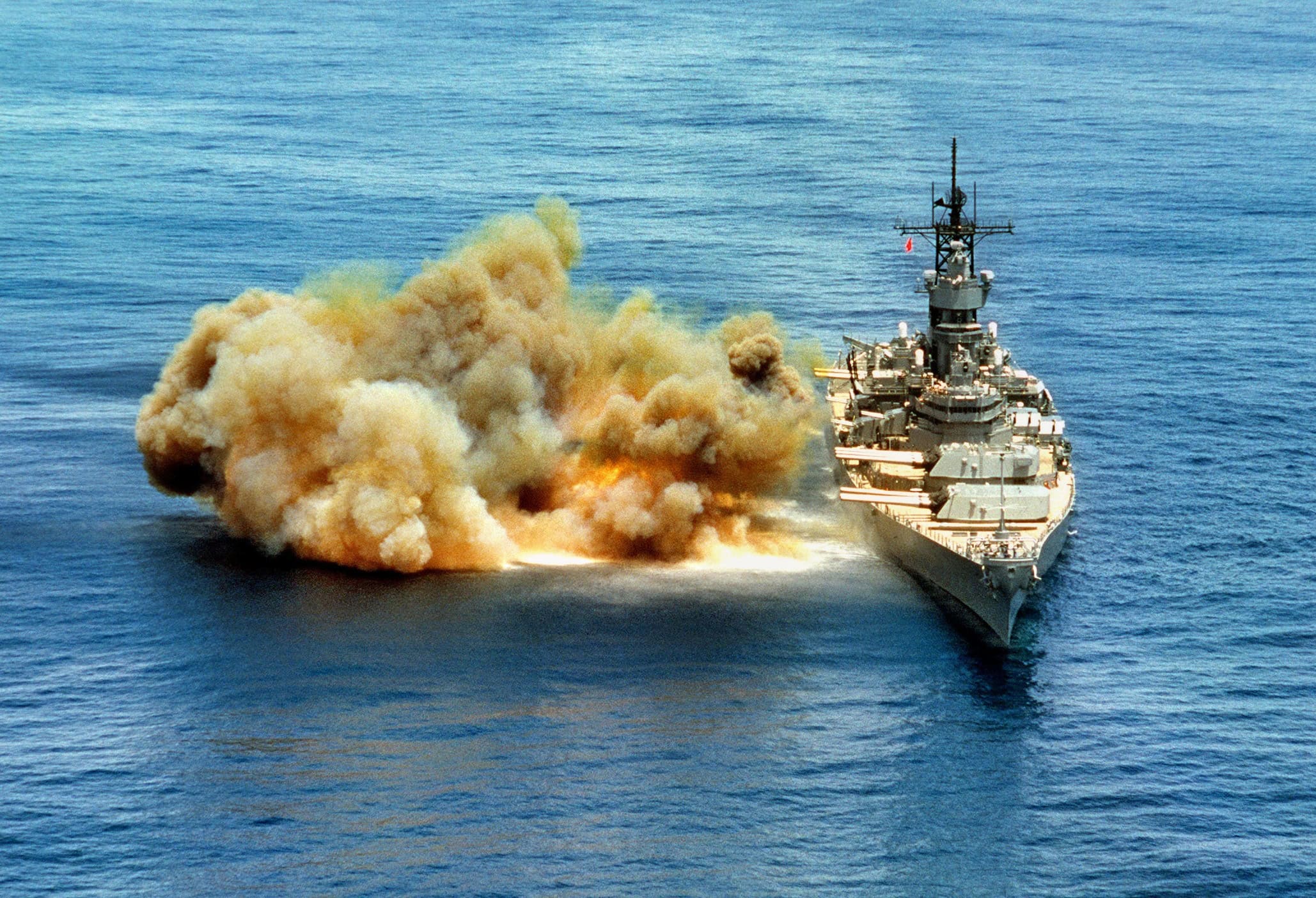
An aerial starboard bow view of the battleship USS IOWA (BB 61) firing a 2,700-pound projectile from the barrel of a forward 16-inch gun during sea trials off the coast of Mississippi. The IOWA is scheduled to be recommissioned into the fleet on April 28, 1984, after completion of modernization/reactivation construction at Ingalls Shipbuilding, Pascagoula, Mississippi.
And then there’s the industrial dimension. The proposal is tied to plans to expand U.S. shipbuilding capacity at a time when China’s output is surpassing that of the United States. From that perspective, the Trump-class is not just an opportunity to increase firepower and make sustained operations possible, but to shore up American industrial capacity and end the persistent pattern of delays.
The Trump-class is not yet a guarantee and is still in its earliest phase. After the December 2025 announcement, the U.S. Navy moved to define an initial design schedule in early 2026, with industry teams now working to shape requirements over the next several years.
Current planning timelines suggest the design phase will run into the early 2030s, with construction of the lead ship, USS Defiant, unlikely to begin until then and commissioning not expected until the late 2030s at the earliest.
MORE – The Iran War Isn’t a Rehearsal for a Taiwan War with China — It’s a Stress Test
About the Author: Jack Buckby
Jack Buckby is a British researcher and analyst specializing in defense and national security, based in New York. His work focuses on military capability, procurement, and strategic competition, producing and editing analysis for policy and defense audiences. He brings extensive editorial experience, with a career output spanning over 1,000 articles at 19FortyFive and National Security Journal, and has previously authored books and papers on extremism and deradicalization.