
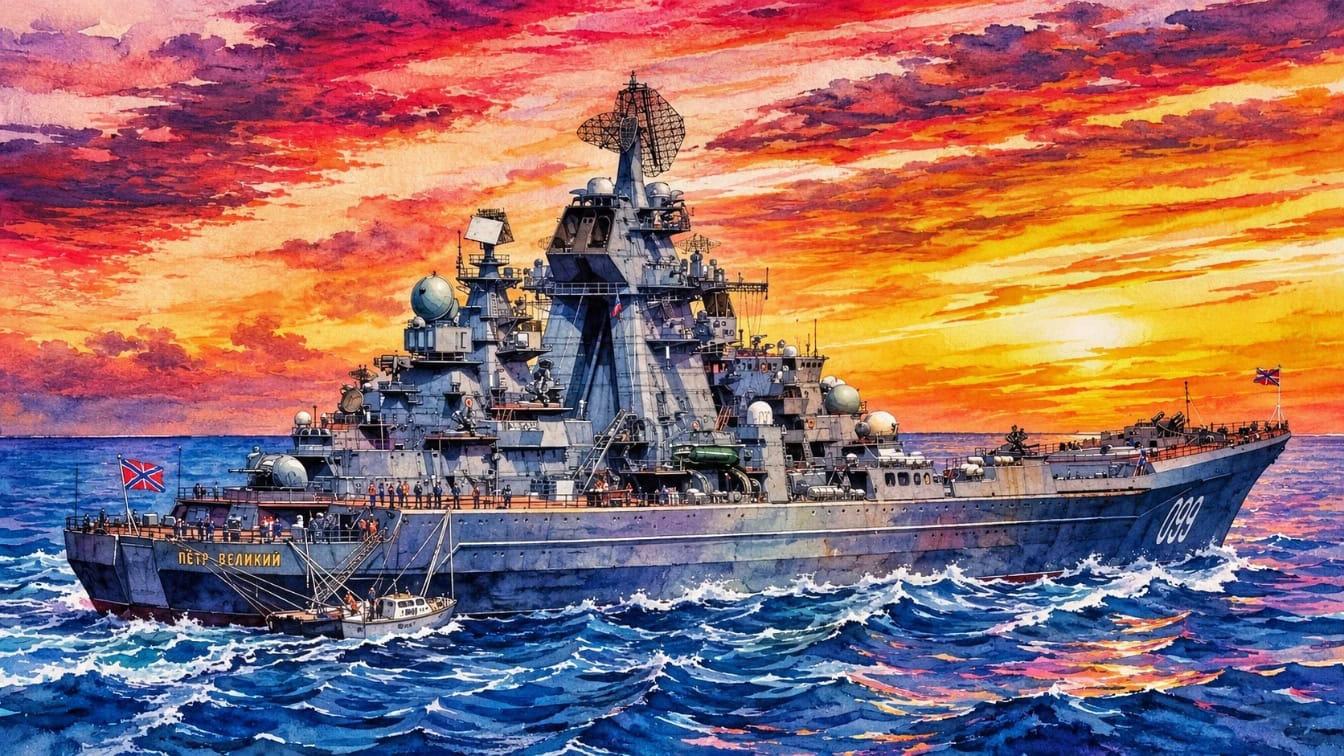
The Russian Navy’s Kirov-class nuclear-powered missile cruiser Admiral Nakhimov was confirmed on June 26 to have returned to its home port of Severomorsk after 29 years out of service for refurbishment, with the vessel reported to be finishing its sea trials.
The Nakhimov was re-floated on July 25, 2025, before setting sail under its own power for the first time in 28 years in August 2025, and beginning the final phase of its sea trials on June 1.
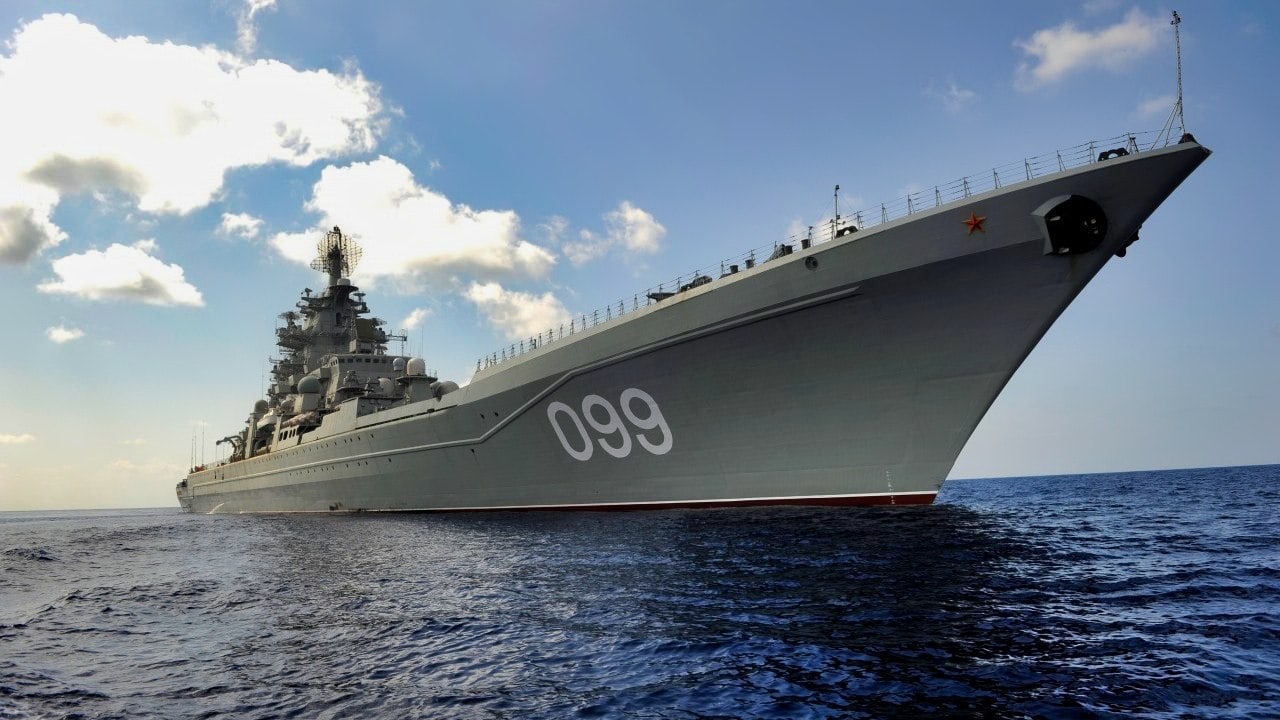
Kirov-Class Battlecruiser Russian Navy
The cruiser’s return to Severomorsk marks one of the most significant milestones in Russian naval modernization and follows what is widely considered the most complex warship refit in the country’s history.
A Brand New Warship With 176 Missiles
Many naval analysts believe that, due to all the major modifications made to the ship during its nearly 30-year absence, it is, in essence, a brand-new warship.
The Russian Navy’s Kirov-class nuclear-powered battlecruiser will rejoin the fleet for the first time since 1999.
The Admiral Nakhimov was designed long ago to hunt and destroy American aircraft carrier strike groups at the height of the Cold War.
It was commissioned in 1988 and served 11 years before being sent to dry dock for upgrades that lasted until 2025.
The Kirov battlecruisers use the CONAS (Combined Nuclear and Steam) propulsion system. Two conventional boilers serve as a backup to the nuclear reactor in the event of reactor failure.
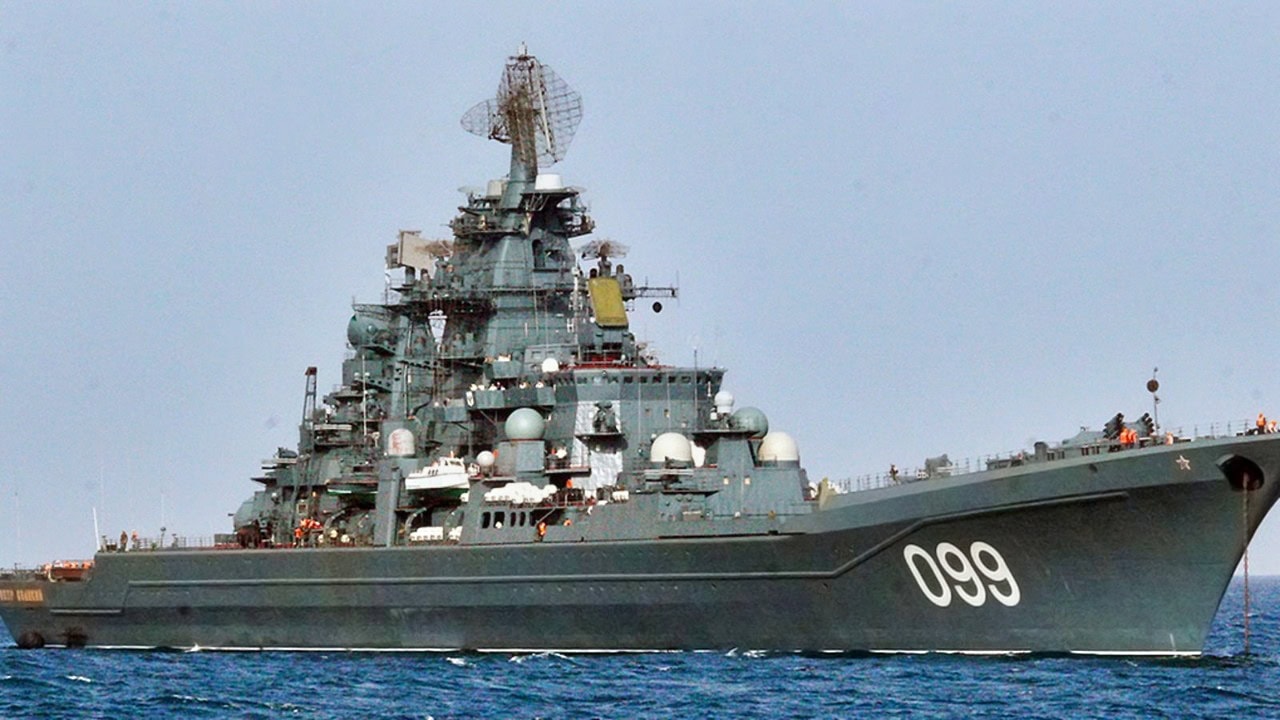
Kirov-Class Battlecruiser Russian Navy. Image Credit: Creative Commons.
Both components can drive two geared steam turbines, generating 120,000 hp (89 MW) at two prop shafts. The ship was capable of 31 knots.
Its missile systems were taken out and replaced completely, giving it the largest arsenal of long-range surface-to-air and cruise missiles of any warship in the world, with 176 vertical launch cells.
Anti-Submarine Warfare Improvements
The Admiral Nakhimov’s anti-submarine capabilities were also largely upgraded, as the battlecruiser is now armed with the new Paket-NK anti-torpedo and anti-submarine system and the Otvet anti-submarine missile.
The warship can carry up to three Ka-27 helicopters, giving it the capability to hunt submarines at considerable range, which is significantly important in the Northern Fleet’s patrol areas, where NATO submarine activity is very high.
However, Russia’s radars and data links are definitely a big step behind those of US and Chinese units in terms of sophistication. And its radar cross-section is enormous, making it a much bigger target and easy to track at longer ranges.
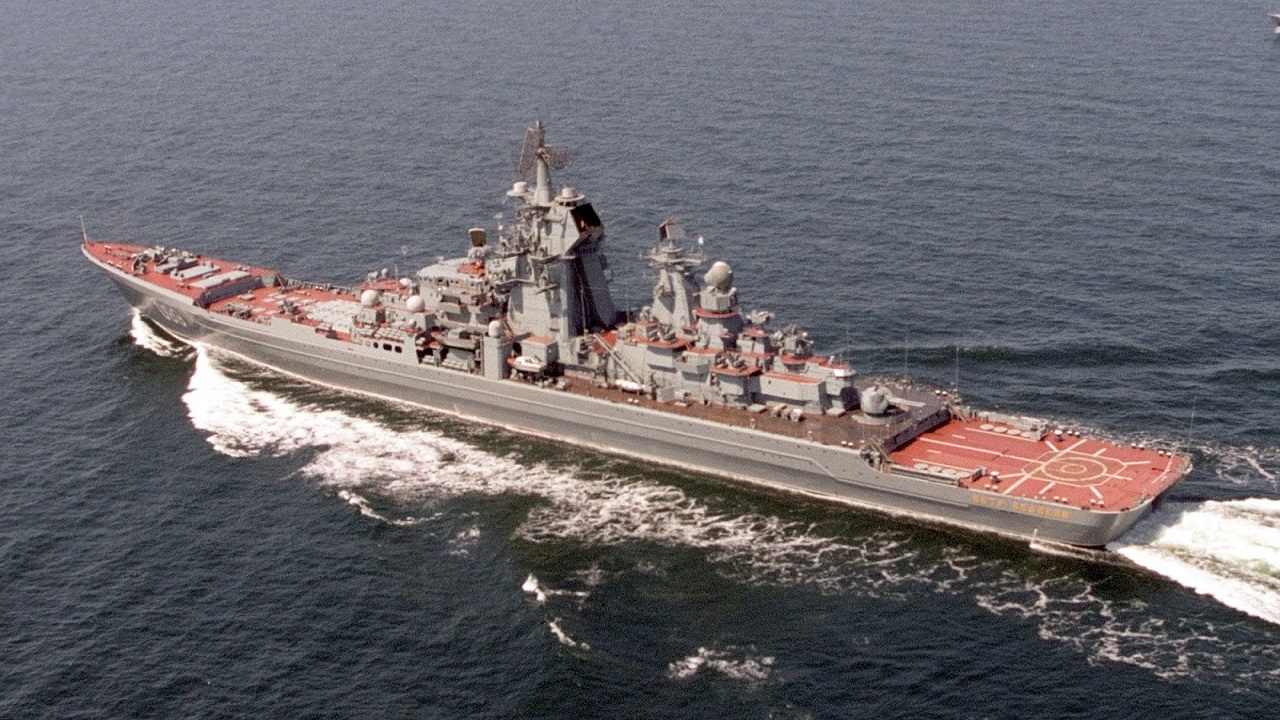
Kirov-Class battlecruiser. Image Credit: Creative Commons.
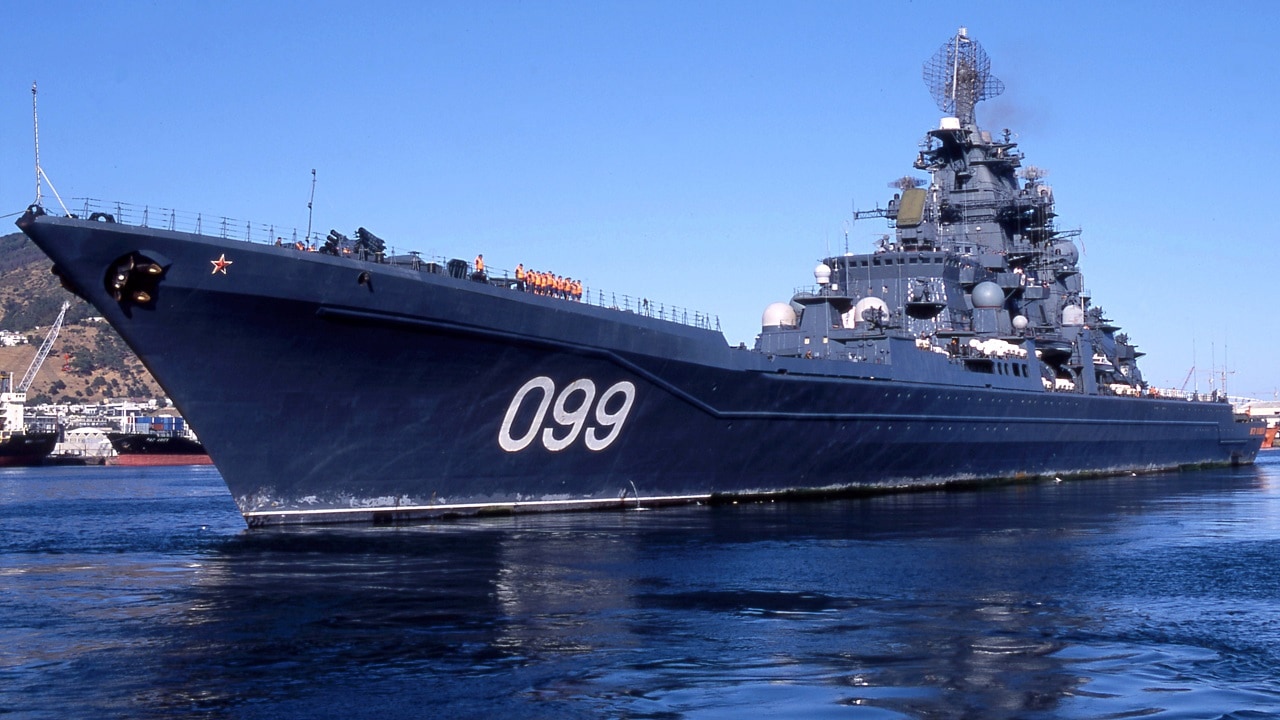
Kirov-Class Battlecruiser. Image Credit: Russian Navy.
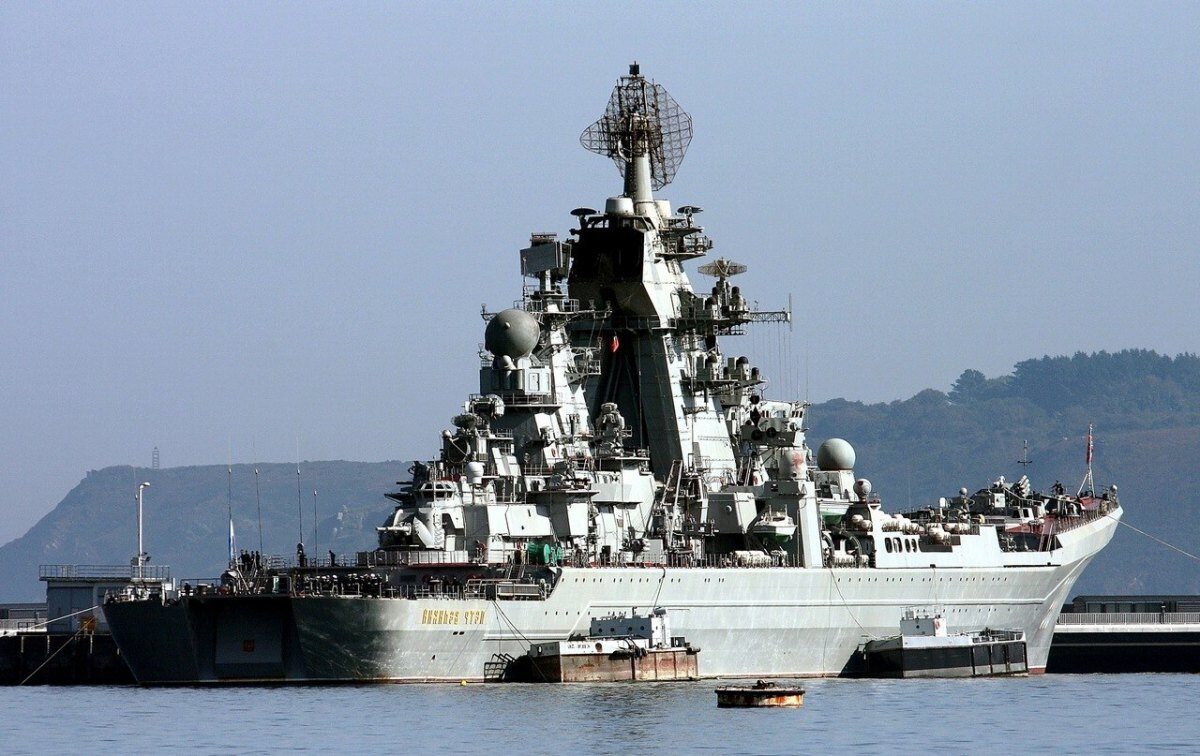
Kirov-Class. Image Credit: Creative Commons.
The Huge Battlecruiser Admiral Nakhimov
The 827-foot-long Admiral Nakhimov is the third nuclear-powered guided-missile cruiser in the Russian Navy’s four-strong Kirov-class, only three of which remain following the scrapping of sister ship Admiral Lazarev in 2021.
The Admiral Nakhimov was laid down in Leningrad in 1983 and launched in 1986 under its original name, Kalinin.
The warship is part of the Project 1144.2 Orlan class, known in Russia as the Kirov class and codenamed by NATO. In its current modernized form, the battlecruiser has the revised designation Project 1144.2M.
In 2006, the Russian Government decided to modernize the cruiser by upgrading its weaponry and other equipment and returning it to operational status. However, the actual works commenced only in 2014 and have been continuously delayed.
The delays have been constant, with proclamations by the Navy, yet the timelines have not been met. In December 2024, TASS reported that the ship had begun factory sea trials. According to reports, the reactors are back online.
The US Navy didn’t have anything as big as the Kirov-class ships. There was a gap in large surface warfare ships.
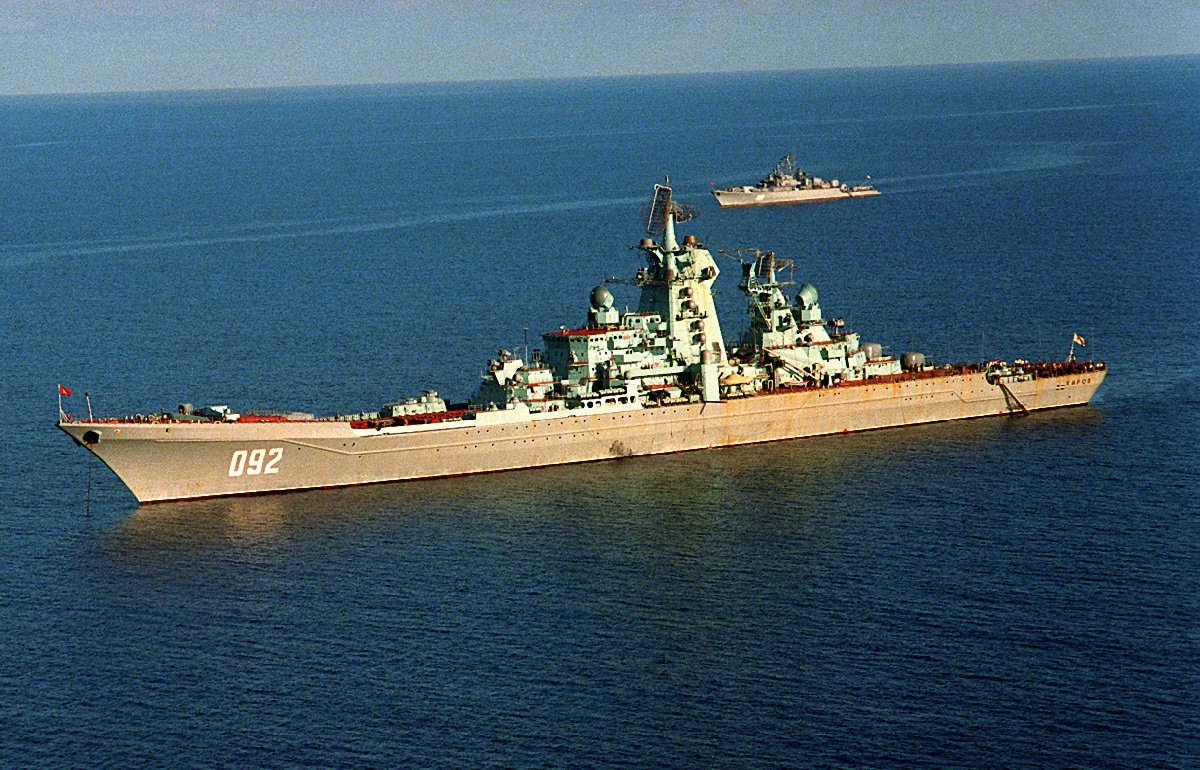
A port view of the Soviet nuclear-powered guided missile cruiser KIROV at anchor. In the background is a Soviet Krivak I-class guided missile frigate.
The Missile Arsenal Is Large And Varied
The Admiral Nakhimov is heavily armed with a mix of Kalibr, Oniks, and Zircon missiles and features a new firing system.
The 3M22 Zircon (Tsirkon) is a Russian hypersonic cruise missile, primarily anti-ship, known for its extreme speed (up to Mach 9) and maneuverability, which drastically reduce target reaction times. It is launched from naval vessels or submarines, and recent tests have also shown ground-launch capability.
It uses a scramjet engine for sustained hypersonic flight and is designed to challenge advanced air defenses, such as the Aegis system, with claimed ranges up to 1,000 km and recent use in Ukraine for combat trials.
Only Aircraft Carriers Are Larger Than Kirov-Class Battlecruisers
The ships are enormous – only aircraft carriers are bigger than these cruisers – and the well-known S-300 air defense system makes them distinctive.
The S-300F maritime variant is a ship-based version of the S-300P land-fired system, and its integration into a battlecruiser gives the Russian Navy an air- and ballistic-missile defense capability it otherwise lacks.
However, while the S-300 is considered highly capable, Russia sold these to Iran to protect the nuclear facilities at Isfahan. And the Israelis and the United States destroyed them without loss.
At the heart of Admiral Nakhimov’s modernization was the plan to install 176 vertical launch tubes, which would provide it with more than any other surface combatant or submarine in the world.
This number far outclasses anything in comparison. China’s Type 55 ‘super destroyer’ has 112 vertical launch system cells. A Flight III Arleigh Burke-class destroyer has 96 cells, while a Ticonderoga-class cruiser has 122 cells. The U.S. Navy’s Zumwalt-class stealth destroyers currently have 80 cells.
Solitary Battlecruiser Means…What?
According to the Barents Observer, the big battlecruiser is expected to operate primarily in the Barents Sea, the Norwegian Sea, and the Arctic, where one of the Northern Fleet’s core missions is to protect the “bastion” for Russia’s ballistic missile submarines.
Admiral Nakhimov is expected to replace her sister ship, the Pyotr Velikiy, as the flagship of Russia’s Northern Fleet.
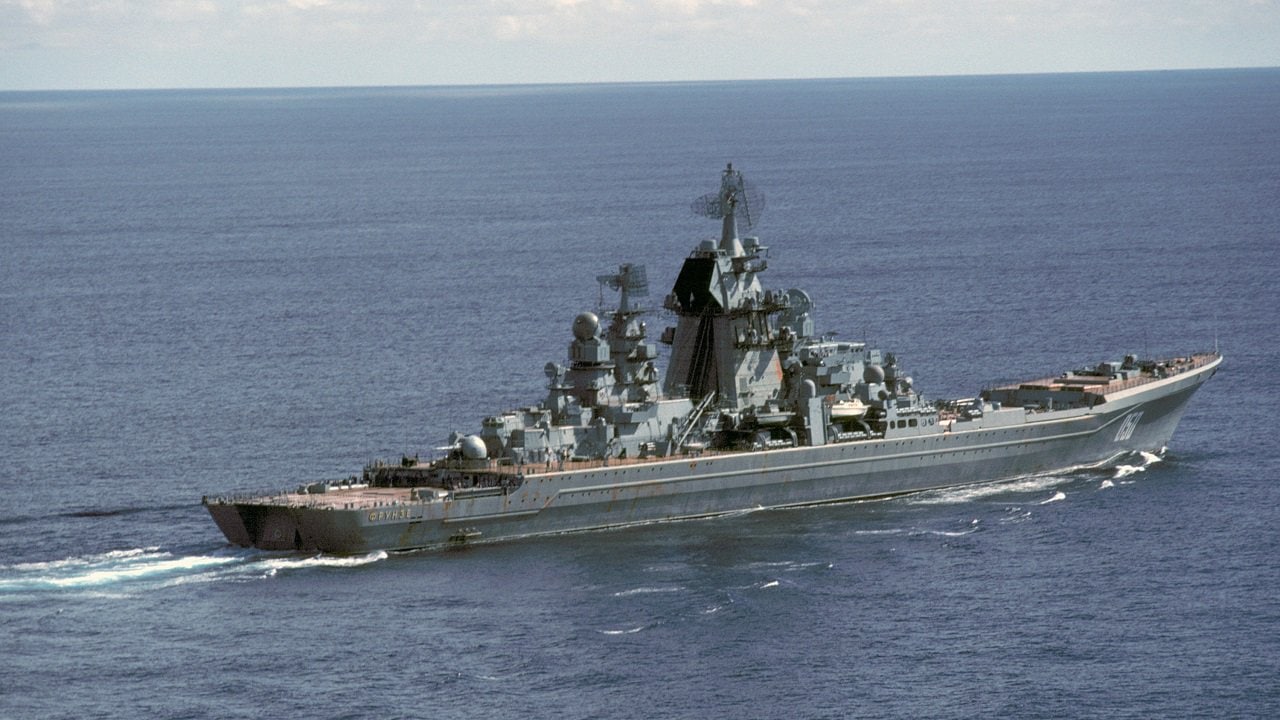
Aerial starboard quarter view of the Soviet Kirov-class guided missile destroyer FRUNZE underway back in 1985.
Pyotr Velikiy has been in port at a pier in Severomorsk since the fall of 2022 and is expected to be decommissioned and scrapped.
The Admiral Nakhimov is certainly a heavily armed and powerful ship.
But it is also a big target as well.
And a solitary battlecruiser can’t stay at sea constantly. And Russian maintenance facilities are in worse shape than American ones are.
It remains to be seen how effective the ship will be. Despite its impressive armament, it is still a Cold War relic.
Due to the threat of long-range drones and the high-profile loss of other large Russian surface combatants, risking this singular, multi-billion-dollar ship in highly contested zones remains a major strategic dilemma given its huge size and questionable radar.
About the Author: Steve Balestrieri
Steve Balestrieri is a National Security Columnist. He served as a US Army Special Forces NCO and Warrant Officer. In addition to writing on defense, he covers the NFL for PatsFans.com and is a member of the Pro Football Writers of America (PFWA). His work was regularly featured in many military publications.