
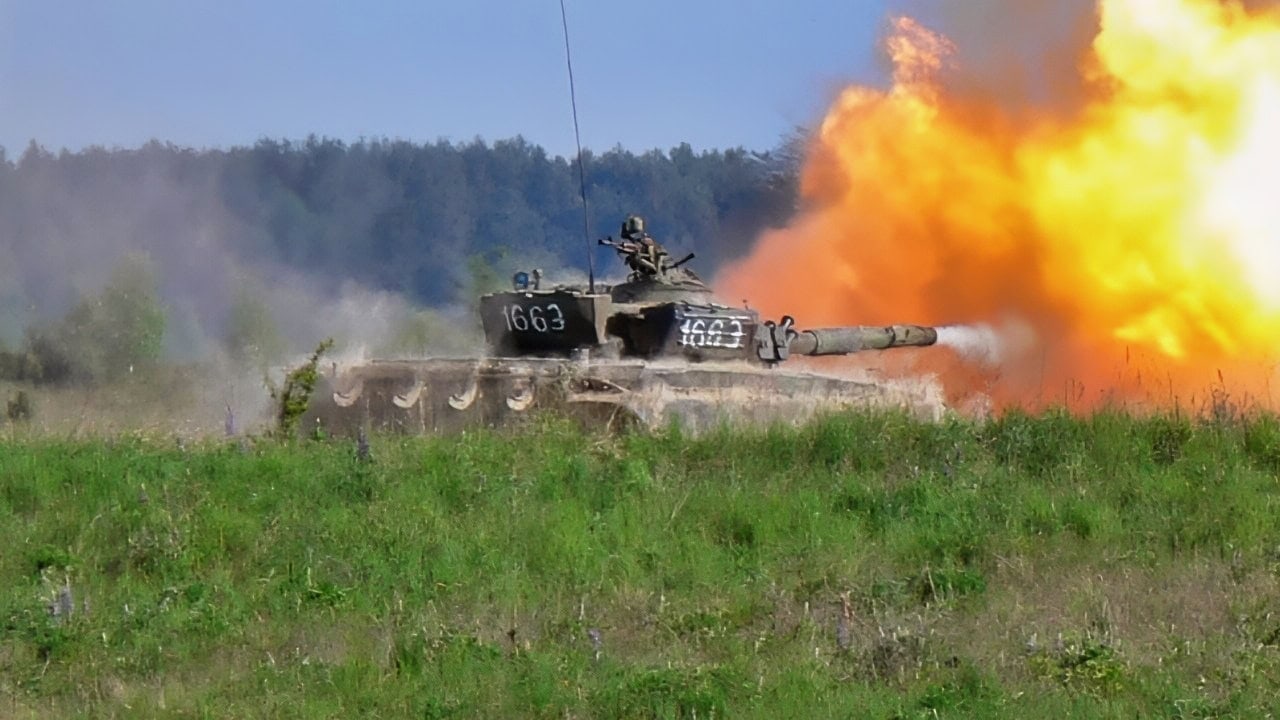
The Islamic Republic of Iran’s 47-year-long enmity with the United States of America notwithstanding, the Islamist regime’s current cozy relations with Russia are comparatively new.
Indeed, even after Shah Mohammad Reza Pahlavi—a staunch U.S. ally—was overthrown by the 1979 Iranian Revolution, Iranian forces under the Ayatollah Ruhollah Khomeini and his now equally deceased successor, Supreme Leader Ali Khamenei, continued to use American-made military equipment, from fighter jets such as the F-4 Phantom II and F-14 Tomcat to main battle tanks (MBTs) such as the M60 “Patton.”
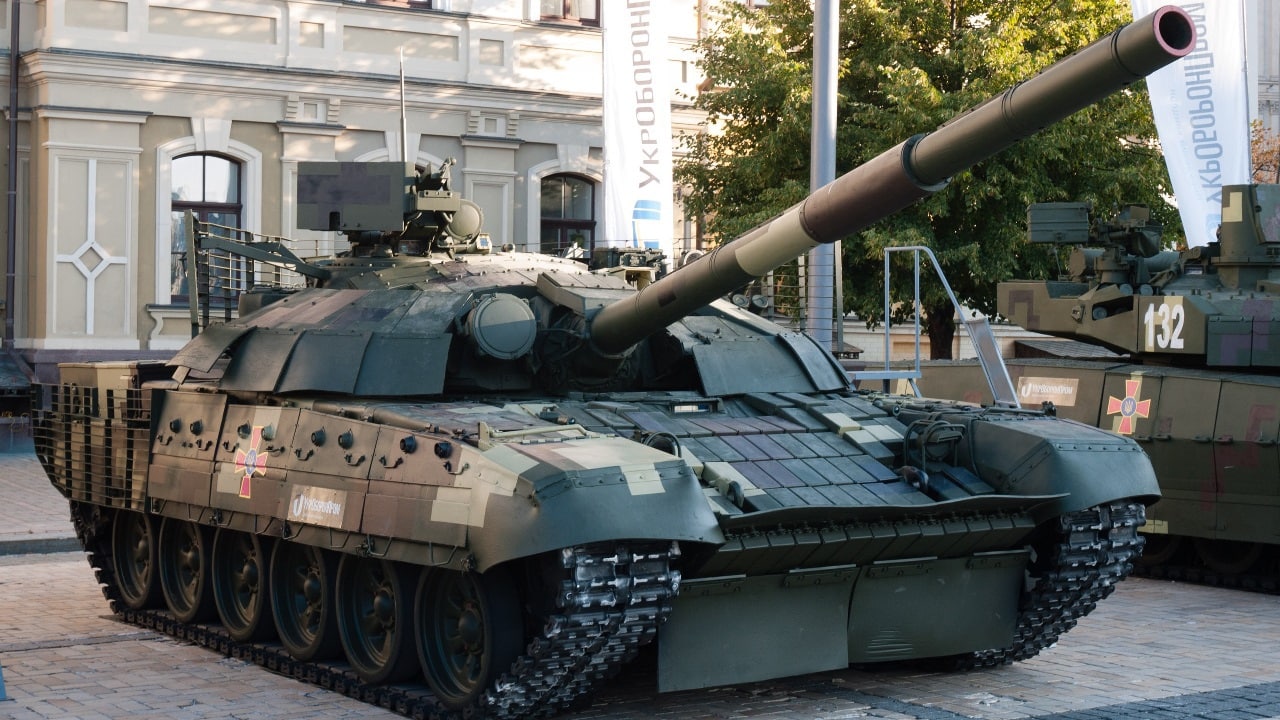
Ukraine T-72ATM main battle tank. Image Credit: Creative Commons.
But Iran eventually did get around to purchasing Russian-made military equipment, especially as those U.S.-made war machines grew older and harder to maintain. Chief among these has been Russia’s famed MBT, the T-72.
Backstory/Initial History: Iran on the Wrong End of the T-72 Barrel
In one of those ironic twists of history, the Islamic Republic of Iran Ground Forces’ first experience with the T-72 was an unpleasant one, as they were on the receiving end of the Soviet-made tanks’ punishment during the 1980-1988 Iran–Iraq War.
More specifically, the T-72s were employed by then-Iraqi strongman Saddam Hussein’s elite Republican Guard troops, and they totally dominated Iranian tankers, whether the latter were using M60s or leftover British-made Chieftain tanks.
Part of this was due to the T-72’s superior armament and armor, while another contributing factor was the Iranians’ inferior tactics, wherein they tended to use their tanks piecemeal rather than en masse.
The two sides didn’t agree on much, but they did concur that the T-72 was the most feared tank of the Iran–Iraq War.
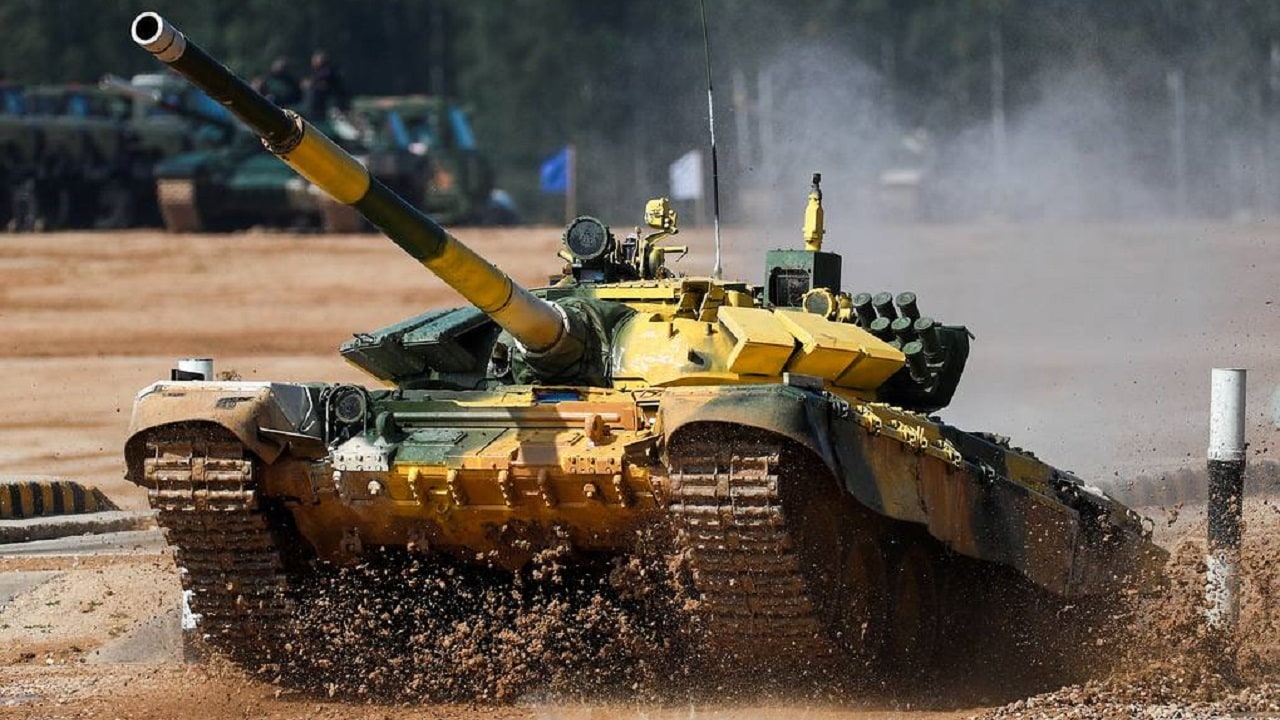
Russian T-72 tank. Image Credit: Creative Commons.
The T-72 Purchase
Or if you prefer Elvis Presley—himself a former U.S. Army M48 Patton tanker—to Bob Dylan, “Ain’t it funny how time slips away…”
Three years after the Iran-Iraq War ended, the same Iraqi Republican Guard T-72s that dominated Iranian armor got clobbered by American M1 Abrams MBTs during the Persian Gulf War, aka Operation Desert Storm, and that piece of history repeated itself in the 2003 Iraq War, aka Operation Iraqi Freedom.
Now, Saddam Hussein is long gone, and the post-Saddam Iraqi Ground Forces have an estimated 487 M1A1s supplementing their roughly 478 remaining T-72s. As the one saying goes, “If you can’t beat ‘em, join ‘em,” or if you prefer, “What goes around, comes around.”
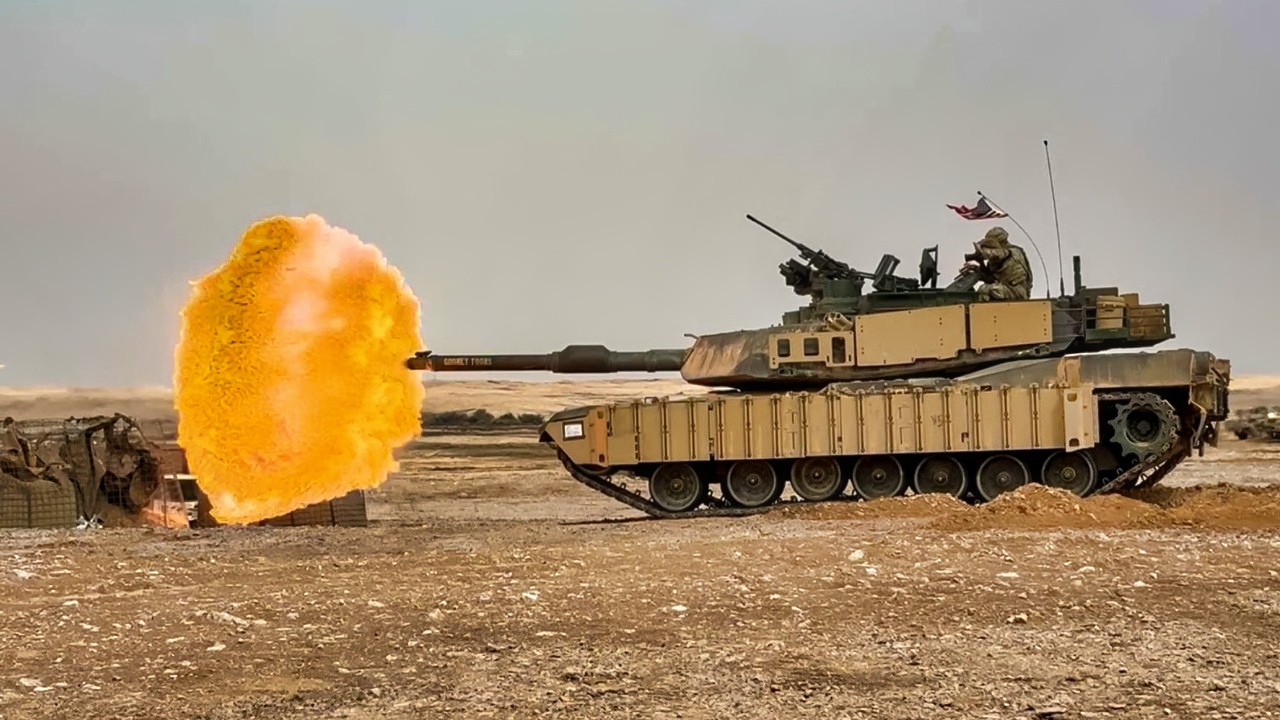
U.S. Army Soldiers assigned to Troop G, 2nd Squadron, 278th Armored Cavalry Regiment, Task Force Reaper fire a M1A2 Abrams tank within the U.S. Central Command’s area of responsibility during the Friendship 25 exercise, Feb. 12, 2025. Exercises like Friendship 25 develop U.S. and Royal Saudi Land Forces service members and enable increased military capacity to address threats to regional security. (U.S. Army Photo by U.S. Army Photo by Maj. Matthew Madden)
In the spirit of those same two proverbs, in the wake of their war with Iraq, the Artesh decided to jump on the same T-72 bandwagon that inflicted so much death and misery upon them.
Accordingly, on 13 November 1991—a mere 8.5 months after the conclusion of major combat operations in Desert Storm and 1.5 months before the collapse of the Soviet Union—Tehran entered into an agreement with Moscow for licensed production of 1,000 T-72S MBTs, along with 1,500 BMP-2 infantry fighting vehicles (IFVs), ammunition, factory equipment and technical assistance. The initial deal was worth $2.2 billion USD.
However, less than half of the T-72 portion of that package deal was fulfilled; expenditures netted the Iranians 422 T-72S’s and 413 BMP-2s between 1993 and 2000.
This was due to the Gore-Chernomyrdin arms agreement of June 1995—named for then-U.S. Vice President Al Gore and then-Russian Prime Minister Viktor Chernomyrdin—which placed restrictions on Russian arms transfers to Iran.
Russia’s relations with Iran and the U.S. have obviously taken a sharp 180-degree turn in the subsequent 31 years, but it remains to be seen if Vladimir Putin and Ayatollah Mojtaba Khamenei will attempt to resurrect the deal.
Current total T-72S inventory—which doesn’t specify the number in actual fighting trim—in Iranian Army hands is estimated at 480 specimens, according to the International Institute for Strategic Studies. Being a license-built export variant, the T-72S is based on the T-72 A/B chassis, thereby retaining the 125mm 2A46 smoothbore gun, autoloader, and basic composite armor, but lacking advanced fire control, digital sights, or upgraded engines.
The Iranian T-72S’s also reportedly come with the Rakhsh modernization package, which includes features such as a variant of Kontakt-5 explosive reactive armor (ERA) based on the Chinese FY-II series.
Current Status
So then, have Iran’s T-72s actually been used in combat? As far as this writer can ascertain, no, but if any of you dear readers know otherwise, please let us know in the Comments section.
Lack of confirmed combat action notwithstanding, Iran certainly shows signs of prepping its prized T-72s for battle, albeit in a more defensive role than an offensive one.
Earlier this month, it was reported that three of the tanks belonging to the Artesh’s 92nd Armored Division, a Khuzestan-based formation responsible for defending Iran’s strategically sensitive southwest, were sent south toward Abadan, positioning armor near the Iraqi and Kuwaiti borders.
Army Recognition states that maneuver “is more consistent with reinforcement, dispersal, readiness activity, or the repositioning of equipment away from potentially vulnerable garrisons.”
About the Author: Christian D. Orr
Christian D. Orr is a Senior Defense Editor. He is a former Air Force Security Forces officer, Federal law enforcement officer, and private military contractor (with assignments worked in Iraq, the United Arab Emirates, Kosovo, Japan, Germany, and the Pentagon). Chris holds a B.A. in International Relations from the University of Southern California (USC) and an M.A. in Intelligence Studies (with a concentration in Terrorism Studies) from American Military University (AMU). He is also the author of the book “Five Decades of a Fabulous Firearm: Celebrating the 50th Anniversary of the Beretta 92 Pistol Series,” the second edition of which was recently published.